97-Pound Yemeni Hunger Striker Appears Before Periodic Review Board As Saudi is Approved for Release from Guantánamo
 I wrote the following article for the “Close Guantánamo” website, which I established in January 2012 with US attorney Tom Wilner. Please join us — just an email address is required to be counted amongst those opposed to the ongoing existence of Guantánamo, and to receive updates of our activities by email.
After months of inaction on Guantánamo, there has, in recent weeks, been a flurry of activity, with two prisoners released (one to Morocco and one to Saudi Arabia), and with the approval of two prisoners for release by Periodic Review Boards (Omar Mohammed Khalifh, a Libyan, and Fayiz al-Kandari, the last Kuwaiti in the prison, who was recommended for ongoing imprisonment by a PRB last year, but was given a second opportunity in July to persuade the board that he is no threat to the United States, which was successful).
On Friday, it was also revealed that Shaker Aamer, the last British resident in Guantánamo (who I have written about extensively for Close Guantánamo, and for whom I co-founded a high-profile campaign in the UK, We Stand With Shaker), will be freed within the next month, and it is expected that a Mauritanian, Ahmed Ould Abdel Aziz, long approved for release like Shaker, will also be freed soon, along with two the prisoners whose cases are with defense secretary Ashton Carter, but who have not been publicly identified.
Adding to all this news, last week — largely unnoticed in the media — another prisoner was approved for release by a Periodic Review Board, the review process established two years ago to review the cases of all the men who were not previously approved for release by the high-level, inter-agency Guantánamo Review Task Force that President Obama established shortly after taking office, and who are not facing trials. Read the rest of this entry »
“The More We Get Close to What We Want, The Farther It Goes”: Shaker Aamer’s Endlessly Thwarted Hope of Being Released from Guantánamo
 On Saturday, Jeremy Corbyn, a prominent supporter in Parliament of Shaker Aamer, the last British resident in Guantánamo, was elected, by a landslide, as the leader of the Labour Party, something that was unimaginable just three months ago. Jeremy is a member of the Shaker Aamer Parliamentary Group, and in May he visited Washington D.C. with three of his Parliamentary colleagues, to meet with Senators and representatives of the Obama administration, to try and secure Shaker’s release.
The Shaker Aamer Parliamentary Group was established last November by John McDonnell MP, Jeremy’s close friend and colleague on the left of the Party, who, yesterday, was appointed by Jeremy as Shadow Chancellor of the Exchequer.
Shaker now has two prominent supporters in previously unexpected high-profile positions, and I hope this fact is not lost on the Obama administration, which continues to hold Shaker needlessly. Cleared for release in 2007 (under George W. Bush) and again in 2009 under President Obama, he could be released in a month’s time if the will existed to free him, 30 days being the amount of time that lawmakers in Congress have required the defense secretary to give them before freeing any prisoner.
Other supporters of Shaker in the shadow cabinet are Diane Abbott, the shadow secretary of state for international development, and Ian Murray, the shadow secretary of state for Scotland, and while we wait to see how the Labour Party under Jeremy Corbyn will raise Shaker’s case (which I’m sure will happen soon), I’m cross-posting below an article about Shaker that was published in the Mail on Sunday, written by Ramzi Kassem, a professor at the City University of New York School of Law, who I have known for many years — and have also spoken with on occasion. Read the rest of this entry »
Shrapnel-Damaged Libyan Amputee Seeks Release from Guantánamo via Periodic Review Board
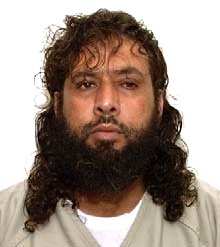 On June 24, Omar Mohammed Khalifh (ISN 695, identified by the US authorities as Omar Khalif Mohammed Abu Baker or Omar Khalifa Mohammed Abu Bakr), a Libyan prisoner at Guantánamo who is 42 or 43 years old, took part in a Periodic Review Board, a process that involved him talking by video-link, accompanied by his civilian lawyer and two US military personal designated as “personal representatives,” who also spoke on his behalf, to representatives of the Departments of State, Defense, Justice and Homeland Security, as well as the office of the Director of National Intelligence and the Office of the Joint Chiefs of Staff, in a secure facility near Washington D.C.
Khalifh is one of 39 prisoners still held who were designated for ongoing imprisonment without charge or trial in January 2010 by the high-level, inter-agency Guantánamo Review Task Force that President Obama established shortly after taking office in 2009 to review the cases of all the prisoners held at that time and to recommend whether they should be freed or prosecuted, or whether they should continue to be held without charge or trial, because they were regarded as too dangerous to release, but it was acknowledged that insufficient evidence existed to put them on trial.
In a world that respects the rule of law, this third option is a disgrace, as it gives weight to information that is too flimsy to be regarded as evidence and should therefore be discredited — often because it was derived through the use of torture or other abuse. Read the rest of this entry »
Video: Andy Worthington Speaks About Guantánamo and We Stand With Shaker in New York, Plus Lawyers Ramzi Kassem and Omar Farah
 I’m still catching up with some of the media from my recent US tour, and delighted that, just a few days ago, a film-maker called Edward Briody posted videos from the event I took part in in New York on January 8. Entitled, “Close the US Torture Camp at Guantánamo NOW: Stand with Shaker Aamer, Fahd Ghazy & all the Prisoners Unjustly Held,” the event was introduced by Debra Sweet, the national director of the campaigning group World Can’t Wait (who organized my tour), and, as well as me, featured two lawyers for Guantánamo prisoners — Ramzi Kassem, a law professor at City University of New York, where where he directs the Immigrant & Non-Citizen Rights Clinic, and Omar Farah of the Center for Constitutional Rights.
It was a great event, at Rutgers Presbyterian Church on West 73rd Street. Around 80 people braved the extremely inclement weather to come and listen to us talk — me speaking about We Stand With Shaker, the campaign I launched with activist Joanne MacInnes in November, to call for the release from Guantánamo of Shaker Aamer, the last British resident in the prison, and in particular to put pressure on David Cameron to secure Shaker’s return as swiftly as possible.
I also spoke about Guantánamo in general, just three days before the 13th anniversary of the opening of the prison, making particular reference to the dubious information, masquerading as evidence, that, in 2009, President Obama’s high-level, inter-agency Guantánamo Review Task Force used to recommend that 48 of the remaining prisoners should continue to be held without charge or trial because they were “too dangerous to release,” even though the task force conceded that there was insufficient evidence to put them on trial. Read the rest of this entry »
Radio, TV and Live Events: Andy Worthington Discusses Guantánamo and the Need to Close the Prison During His US Tour
 I’m back from my US tour, recovering from jet lag and fatigue as a result of a punishing (if rewarding) Stateside schedule, in which, over an 11-day period, I visited New York, Washington D.C., Boston and other locations in Massachusetts, and Chicago as part of series of events to mark the 13th anniversary of the opening of the prison at Guantánamo, organized by Debra Sweet of World Can’t Wait, who accompanied me for the majority of the visit. I’ve already posted videos of me speaking outside the White House on the anniversary, and a video of an event at New America on January 12 at which I spoke along with the attorney Tom Wilner and Col. Morris Davis, the former chief prosecutor of the military commissions at Guantánamo, who is now an implacable critic of the “war on terror.”
Below, I’m posting links to three radio shows I did on January 14, when I was in Massachusetts (one of which was with a show in Chicago, and was broadcast the day after), and a TV interview I did that same day for a local news show, WWLP-22News. On that particularly busy day, I also spoke at two events, for which videos will shortly be available.
For my first interview, at 9am, I spoke to Bill Newman, a civil rights and criminal defense attorney and the director of the western Massachusetts office of the ACLU, who hosts a weekday radio talk show on WHMP in Northampton, Massachusetts. Bill also worked as co-counsel on behalf of a Guantánamo prisoner several years ago. Read the rest of this entry »
Shaker Aamer’s Universal Declaration of No Human Rights, Part of Vice’s Compelling New Feature on Guantánamo
 Congratulations to Vice, which describes itself as “an ever-expanding galaxy of immersive, investigative, uncomfortable, and occasionally uncouth journalism,” who have shown up the mainstream media by publishing a major feature on November 10, “Behind the Bars: Guantánamo Bay,” consisting of 18 articles published simultaneously, all of which are about Guantánamo — some by Guantánamo prisoners themselves, as made available by their lawyers (particularly at Reprieve, the legal action charity), others by former personnel at the prison, and others by journalists. “Behind the Bars” is a new series, with future features focusing on prisoners in the UK, Russia and beyond.
Following an introduction by Vice’s Global Editor, Alex Miller, there are five articles by three prisoners, as follows:
- “The Declaration of No Human Rights” (cross-posted below) and “Colonel John Bogdan Has No Nose” by Shaker Aamer, the last British resident in Guantánamo, long cleared for release but still held. In the second of these articles, Shaker focuses on Guantánamo’s recently retired warden, who oversaw a period of particular turmoil at the prison; in particular, the prison-wide hunger strike last year that finally awakened widespread outrage domestically and internationally about the plight of the prisoners.
- “What Happens When I Try to Give My Guantánamo Guards Presents” and “An Obituary for My Friend, Adnan Abdul Latif” by Emad Hassan, a Yemeni, cleared for release in 2009 by President Obama’s high-level, inter-agency Guantánamo Review Task Force, but still held, who as been on a hunger strike since 2007. Adnan Abdul Latif, a Yemeni who had serious mental health issues, was the last prisoner to die at Guantánamo, in September 2012, even though he too had long been cleared for release, so this tribute by Emad Hassan is particularly poignant.
- “My Road to Guantánamo” by Younous Chekkouri (aka Younus Chekhouri), a Moroccan prisoner, also cleared for release in 2009, who tells the story of his capture and explains why he cannot return to Morocco and is seeking a third country to offer him a new home. In February this year, Reprieve made available a love letter by Younus to his wife Abla.
Guantánamo Lawyers Urge Obama Administration to Approve Release of Six Men to Uruguay
 Lawyers for six prisoners at Guantánamo — four Syrians, a Palestinian and a Tunisian, who have long been cleared for release from the prison, but are unable to return home — sent a letter to the Obama administration on Thursday calling for urgent action regarding their clients. I’m posting the full text of the letter below.
It’s now over three months since President José Mujica of Uruguay announced that he had been approached by the Obama administration regarding the resettlement of five men — later expanded to six — and was willing to offer new homes to them. I wrote about the story here, where I also noted that one of the men is Abu Wa’el Dhiab, a Syrian man, consigned to a wheelchair as a result of his suffering at Guantánamo. Dhiab is on a hunger strike and being force-fed, and has, in recent months, mounted a prominent legal challenge to his treatment, securing access for his lawyers to videotapes showing his force-feeding and violent cell extractions. The other Syrians are Abdelhadi Faraj (aka Abdulhadi Faraj), Ali Hussein al-Shaaban and Ahmed Adnan Ahjam, the Palestinian is Mohammed Taha Mattan (aka Mohammed Tahamuttan), and the Tunisian, whose identity is revealed for the first time, is Adel El-Ouerghi (aka Abdul Ourgy (ISN 502)).
All six men were cleared for release from the prison in January 2010 by the high-level, inter-agency Guantánamo Review Task Force that President Obama appointed shortly after taking office in 2009, and in their letter the lawyers provided detailed explanations of how the deal has progressed since first being mooted late last year and how it appeared to be confirmed months ago, before it had first been mentioned publicly. “In February,” they wrote, “some or us were informed that, while it was not possible to ascertain precisely when transfer would occur, it was ‘a matter of weeks, not months.'” Read the rest of this entry »
“It Is All Theater, It Is All A Game,” Yemeni “Forever Prisoner” Says from Guantánamo
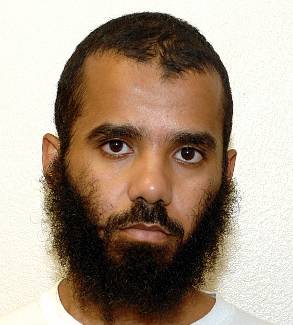 It is, I believe, impossible to argue with the logic of Muaz al-Alawi, a Yemeni prisoner in Guantánamo, who recently told his lawyer, Ramzi Kassem, that, when attempting to make sense of Guantánamo, only one analysis is necessary: “It is all political,” al-Alawi told him. “It is all theater, it is all a game.”
The US has such disdain for the prisoners at Guantánamo that, 12 and a half years on from the prison’s opening, they are still identified by the names given to them at the time of their capture, by personnel unfamiliar with the languages of their home countries — Arabic, for example. As a result, al-Alawi is identified as Moath al-Alwi.
His comments, made to Kassem, an associate professor of law at the City University of New York who directs the Immigrant and Non-Citizen Rights Clinic, which represents prisoners at Guantánamo and elsewhere, were in the context of the manufactured hysteria regarding the release of five Taliban prisoners in exchange for Sgt. Bowe Bergdahl, the sole US prisoner of war in Afghanistan, which I have written about here, here and here (and also see my Democracy Now! appearance). Read the rest of this entry »
Gravely Ill, Shaker Aamer Asks US Judge to Order His Release from Guantánamo
 I wrote the following article for the “Close Guantánamo” website, which I established in January 2012 with US attorney Tom Wilner. Please join us — just an email address is required to be counted amongst those opposed to the ongoing existence of Guantánamo, and to receive updates of our activities by email. Please also sign and share the international petition calling for Shaker Aamer’s release.
Last Monday, lawyers for Shaker Aamer, 45, the last British resident in the US prison at Guantánamo Bay, Cuba, asked a federal judge to order his release because he is chronically ill. A detailed analysis of Mr. Aamer’s mental and physical ailments was prepared by an independent psychiatrist, Dr. Emily A. Keram, following a request in October, by Mr. Aamer’s lawyers, for him to receive an independent medical evaluation.
The very fact that the authorities allowed an independent expert to visit Guantánamo to assess Mr. Aamer confirms that he is severely ill, as prisoners are not generally allowed to be seen by external health experts unless they are facing trials. Mr. Aamer, in contrast, is one of 75 of the remaining 154 prisoners who were cleared for release from Guantánamo over four years ago by a high-level, inter-agency task force established by President Obama shortly after he took office in 2009.
As a result, the authorities’ decision to allow an independent expert to assess Mr. Aamer can be seen clearly for what it is — an acute sensitivity on their part to the prospect of prisoners dying, even though, for many of the men, being held for year after year without justice is a fate more cruel than death, as last year’s prison-wide hunger strike showed. Read the rest of this entry »
Radio: Andy Worthington Discusses “The State of Guantánamo Today” with Rose Aguilar, Ramzi Kassem and Sharon Adams in San Francisco
 I’m currently in southern California — on the campus of Cal Poly (aka California Polytechnic State University) in San Luis Obispo, about 40 miles north of Los Angeles. As I wait for the last public event of my 12-day “Close Guantánamo Now” tour, with the support of the World Can’t Wait, I have some time, while hiding from the sun — which alarmingly, is currently hotter than the hottest day in summer in the UK — to catch up on some of the events in which I’ve taken part.
I recently posted videos from my first event — a panel discussion in New York — and a video of the creative protests in Washington D.C. last Saturday, January 11, on the 12th anniversary of the opening of Guantánamo.
The morning after, I flew out to San Francisco, where I stayed for three days, and after a gathering of like-minded individuals at the house of friends in Oakland on the Sunday evening, Monday began with a visit to KALW Public Radio, high up on San Francisco’s hills, for an interview with Rose Aguilar, as part of her “Your Call” show from 10-11am.
The 53-minute show, entitled, “What’s the state of Guantánamo today?” is available here, and I do hope you have time to listen to it, and to share it if you find it useful. I’ve spoken to Rose on my visits before, and it’s always good to spend some time with her, and with her indefatigable producer, Malihe Razazan. Read the rest of this entry »












 Who's still at Guantánamo?
