Betrayal: Senegal Prepares to Send Two Former Guantánamo Prisoners Back to Libya, Where They Face Imprisonment, Torture and Even Execution
 Please support my work as a reader-funded journalist! I’m currently trying to raise $2500 (£2000) to support my writing and campaigning on Guantánamo and related issues over the next three months of the Trump administration.
Dreadful news from Senegal, where two former Guantánamo prisoners, both from Libya, have been told that their resettlement in the country in April 2016, which they had been led to believe was permanent, is to be brought to a sudden end tomorrow, with their unwilling — and potentially fatal — repatriation to Libya.
For the Intercept, Murtaza Hussain and Glenn Greenwald reported the story on Saturday night, focusing on the story of one of the men, Omar Khalifa Mohammed Abu Bakr (aka Omar Mohammed Khalifh), whose release in Senegal was “the by-product of a deal negotiated by his attorneys with the U.S. government.” His lawyer, Ramzi Kassem, a professor at CUNY School of Law in New York, told the Intercept that the agreement “expressly guaranteed that the Libyan would have the right to permanently settle in Senegal and rebuild his life there, rather than be returned to war-torn Libya.”
As the Intercept explained, “In addition to the deteriorating security situation in his home country, Khalifa’s status as a former Guantánamo detainee as well as his tribal background meant that being sent back to his country of origin would mean an almost certain death sentence.” Read the rest of this entry »
Ahmed Al-Darbi: Still Held, the Guantánamo Prisoner Who Was Supposed to Have Been Sent Home Two Weeks Ago
 Please support my work as a reader-funded journalist! I’m currently trying to raise $2500 (£2000) to support my writing and campaigning on Guantánamo and related issues over the next three months of the Trump administration.
On Friday, Ahmed al-Darbi, a Saudi prisoner at Guantánamo, publicly criticized his government for failing to secure his release from the prison on February 20. The release date had been agreed last October as part of a plea deal he had initially agreed to in February 2014.
In what the New York Times described as “an unusual statement” conveyed through his lawyer, he said, “It’s shameful. Unlike other countries, the Saudi government never even provided me with an attorney all these years.” He added, “And now my own government is an obstacle to my repatriation. What kind of country abandons its citizens in the custody of another government for 16 years? My country won’t take a step that was agreed on four years ago so that I can finally go home. It’s been my daily dream for four years to see my wife and children.”
Under the terms of his plea deal, al-Darbi admitted that he played a part in a 2002 attack by Al-Qaeda on a French oil tanker, the Limburg, off the Yemeni coast, in exchange for a promise that he would be repatriated, after cooperating further with the US, to serve out the rest of his sentence in Saudi Arabia. As I explained in October, when he was given a 13-year sentence, his sentencing didn’t take place before “because it was dependent upon him providing testimony for the trials of other prisoners, testimony that he undertook [last] summer, providing videotaped testimony against Abd al-Rahim al-Nashiri, who is on trial for his alleged involvement in the bombing off the USS Cole in 2000, and a deposition in the case of Abd al-Hadi al-Iraqi, another prisoner facing a trial by military commission.” Read the rest of this entry »
Curator of Guantánamo Art Show Responds to Authorities’ Threats to Burn Prisoners’ Work: “Art Censorship and Destruction Are Tactics of Terrorist Regimes, Not US Military”
 Please support my work as a reader-funded journalist! I’m currently trying to raise $2500 (£2000) to support my writing and campaigning on Guantánamo and related issues over the next three months of the Trump administration.
Stung by criticism of its paranoid and heavy-handed approach to Guantánamo prisoners’ art, the Pentagon now seems to be involved in a rearguard damage limitation exercise, but it may be too late.
Last week, as I explained here, the Miami Herald reported that “Ode to the Sea: Art from Guantánamo Bay,” a show of prisoners’ art in New York, featuring 36 works by eight prisoners, four of whom are still held, had led the US military to say that it would be stopping prisoners from keeping any artwork they have made, and to threaten to burn it, prompting widespread criticism.
In a powerful op-ed in the New York Times, which I’m cross-posting below, Erin Thompson, a professor of art crime and one of the curators of the show at John Jay College of Criminal Justice, stated, “Art censorship and destruction are tactics fit for terrorist regimes, not for the US military. The art poses no security threat: It is screened by experts who study the material for secret messages before it leaves the camp, and no art by current prisoners can be sold. Guantánamo detainees deserve basic human rights as they await trial. Taking away ownership of their art is both incredibly petty and utterly cruel.” Read the rest of this entry »
Persistent Dehumanization at Guantánamo: US Claims It Owns Prisoners’ Art, Just As It Claims to Own Their Memories of Torture
 Please support my work as a reader-funded journalist! I’m currently trying to raise $2500 (£2000) to support my writing and campaigning on Guantánamo and related issues over the next three months of the Trump administration.
I wrote the following article (as “The Persistent Abuse of Guantánamo Prisoners: Pentagon Claims It Owns Their Art and May Destroy It, But U.S. Has Long Claimed It Even Owns Their Memories of Torture“) for the “Close Guantánamo” website, which I established in January 2012, on the 10th anniversary of the opening of Guantánamo, with the US attorney Tom Wilner. Please join us — just an email address is required to be counted amongst those opposed to the ongoing existence of Guantánamo, and to receive updates of our activities by email.
After years of letting Guantánamo prisoners keep the artwork they have made at the prison, subject to security screening, the Pentagon has suddenly secured widespread condemnation for banning its release, and, it is alleged by one of prisoners’ attorneys, for planning to burn it.
The story was first reported on November 16 by Carol Rosenberg of the Miami Herald, and updated on November 20. Rosenberg explained how, for years, prisoners’ art had been released “after inspection by prison workers schooled in studying material for secret messages under the rubric of Operational Security.”
However, as Rosenberg explained, “Ode to the Sea: Art from Guantánamo Bay,” an exhibition in the President’s Gallery of New York’s John Jay College of Criminal Justice until January 16, 2018, which features “paintings and other works by current and former captives” — and “which garnered international press coverage” — “apparently caught the attention of the Department of Defense,” because of an email address provided for people “interested in purchasing art from these artists.” Read the rest of this entry »
Ahmed Al-Darbi, Admitted Terrorist at Guantánamo, Receives 13-Year Sentence Following 2014 Plea Deal
Please support my work as a reader-funded journalist! I’m currently trying to raise $2500 (£2000) to support my writing and campaigning on Guantánamo and related issues over the next three months of the Trump administration.
Last Friday, the US authorities secured a rare success at Guantánamo, when a panel of US military officers gave a 13-year sentence to Ahmed al-Darbi, a Saudi prisoner, for what the New York Times described as “his admitted role in a 2002 attack by Al Qaeda on a French oil tanker off the Yemeni coast.”
Al-Darbi had pleaded guilty in his military commission trial in February 2014, but his sentencing had not taken place until now because it was dependent upon him providing testimony for the trials of other prisoners, testimony that he undertook this summer, providing videotaped testimony against Abd al-Rahim al-Nashiri, who is on trial for his alleged involvement in the bombing off the USS Cole in 2000, and a deposition in the case of Abd al-Hadi al-Iraqi, another prisoner facing a trial by military commission.
Under the terms of the plea deal, as Charlie Savage described it in the New York Times, “the commission could have imposed a sentence of 13 to 15 years.” However, the prosecutors joined with al-Darbi’s defense team to ask for “the minimum available term in light of his extensive assistance to the government.” As Savage put it, al-Darbi “has renounced Islamist ideology and lived apart from the general detainee population for years.” Read the rest of this entry »
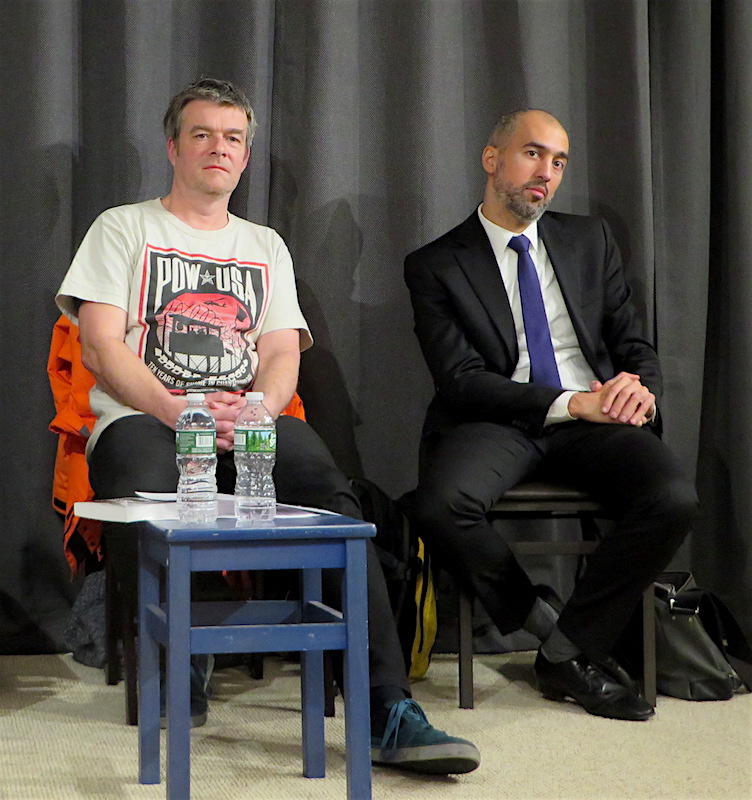
Video: Andy Worthington and Ramzi Kassem Discuss Trump, Obama, Guantánamo and Torture at Revolution Books in Harlem
 Please support my work! I’m currently trying to raise $2500 (£2000) to support my writing and campaigning on Guantánamo and related issues over the first two months of the Trump administration.
On Sunday I got back from my US tour to coincide with the 15th anniversary of the opening of Guantánamo, which was on January 11, and I’m posting the video below of a powerful event I took part in during my visit — a panel discussion, on “Trump, Torture and Guantánamo” (and Barack Obama’s legacy) at Revolution Books in Harlem.
I was delighted to take part in the event with another speaker I had invited, Ramzi Kassem, a law professor at City University of New York (CUNY), with whom I have appeared at events many times before (see here, for example), and who, back in 2012, provided me exclusively with unclassified notes of meetings with Shaker Aamer, the last British resident in Guantánamo, which I published on my website and on the website of the Close Guantánamo campaign that I co-founded with the attorney Tom Wilner in January 2012, marking the 10th anniversary of the prison’s opening.
Because of the uncertainties surrounding the transition from Barack Obama’s presidency to that of Donald Trump’s, I was involved in fewer events than usual on this visit — my seventh in a row to coincide with the anniversary of Guantánamo’s opening, all of which have been arranged by Debra Sweet of the World Can’t Wait — although everything I took part in was extremely worthwhile. I have previously posted the video of my speech outside the Supreme Court on Jan. 11, and the video of the panel discussion I initiated on Jan. 11 at New America, which also featured Tom Wilner, former Congressman Jim Moran, and Rosa Brooks and Peter Bergen of New America, and I’m pleased to be posting the video below, via Vimeo: Read the rest of this entry »
For Review Board, Revelations That Tortured Guantánamo Prisoner Mohammed Al-Qahtani Was Profoundly Mentally Ill Before Capture
 I wrote the following article — as “Tortured Guantánamo Prisoner Mohammed Al-Qahtani Was Profoundly Mentally Ill Before His Capture” — for the “Close Guantánamo” website, which I established in January 2012, on the 10th anniversary of the opening of Guantánamo, with the US attorney Tom Wilner. Please join us — just an email address is required to be counted amongst those opposed to the ongoing existence of Guantánamo, and to receive updates of our activities by email.
Last week, a Periodic Review Board at Guantánamo raised a number of uncomfortable questions for the US authorities: what do you do with a prisoner allegedly involved with Al-Qaeda, but who you have tortured? And what do you do if it then transpires that, before you captured and tortured this man, he already had a history of severe mental health problems?
The prisoner in question is Mohammed al-Qahtani, the 47th prisoner to face a PRB, since they were set up in 2013 to review the cases of all the prisoners not already approved for release or facing trials. Tortured for 50 days straight at the end of 2002, he was “subjected to constant interrogations marked by extreme sleep deprivation, low temperatures, stress positions and forced nudity as well as being threatened with a military dog,” and “had to be hospitalized twice with a dangerously low heart rate,” as the Washington Post described it last week.
It was also in the Washington Post, in January 2009, that, for the first, and, to date, only time, a senior Pentagon official, Susan Crawford, the convenor of Guantánamo’s military commissions, admitted that a prisoner in US custody had been tortured. “We tortured Qahtani. His treatment met the legal definition of torture,” Crawford said, adding that that was why she didn’t refer his case for prosecution, even though he had been charged in February 2008 with five other men who are still facing prosecution for the 9/11 attacks. Read the rest of this entry »
Who Are the Two Libyans Freed from Guantánamo and Given New Homes in Senegal?
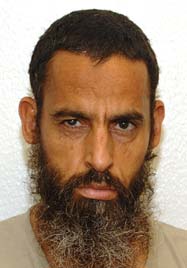 On April 3, two Libyans — former opponents of Colonel Gaddafi, who was overthrown in 2011 — were freed from Guantánamo and resettled in Senegal, whose Ministry of Foreign Relations issued a statement pointing out that the two men were granted “asylum … in accordance with the relevant conventions of international humanitarian law, also in the tradition of Senegalese hospitality and Islamic solidarity with two African brothers who have expressed interest in resettlement in Senegal after their release.”
The two men — Omar Mohamed Khalifh, 44 (ISN 695), and Salem Gherebi, 55 (ISN 189) — are the first former prisoners to be resettled in the west African country, and with their release 89 men remain in Guantánamo, of whom 35 have been approved for release — 23 by the high-level, inter-agency Guantánamo Review Task Force that President Obama established shortly after taking office in 2009, and 12 other approved for release since January 2014 by another high-level review process, the Periodic Review Boards.
Khalifh, also identified as Omar Khalif, went before a Periodic Review Board in June 2015 and was approved for release in September, bringing freedom within sight for an amputee with numerous other health problems who, as the Libyan-born British resident Omar Deghayes (released from Guantánamo in December 2007) told me in 2010, was not who the Americans thought he was: Read the rest of this entry »
Guantánamo Lawyers Complain About Slow Progress of Periodic Review Boards
 Yesterday I published an article about the most recent Periodic Review Board to take place at Guantánamo, and I was reminded of how I’ve overlooked a couple of interesting articles about the PRBs published in the Guardian over the last six weeks.
When it comes to President Obama’s intention to close Guantánamo before he leaves office next January, the most crucial focus for his administration needs to be the Periodic Review Boards, featuring representatives of the Departments of State, Defense, Justice and Homeland Security, and the offices of the Director of National Intelligence and Joint Chiefs of Staff, as I have been highlighting through the recently launched Countdown to Close Guantánamo. Of the 91 men still held, 34 have been approved for release, and ten are undergoing trials (or have already been through the trial process), leaving 47 others in a disturbing limbo.
Half these men were, alarmingly, described as “too dangerous to release” by the high-level, inter-agency Guantánamo Review Task Force that President Obama established shortly after taking office in 2009, even though the task force acknowledged that insufficient evidence existed to put them on trial. Read the rest of this entry »
Shaker Aamer’s Latest Words from Guantánamo; On a Hunger Strike, Fearful That He Won’t See His Family Again
 Yesterday, just ten days after the announcement that Shaker Aamer is finally to be freed from Guantánamo and returned to his family, was quite a disturbing day for those of us who care about Shaker and his health, as the Mail on Sunday ran a seven-page feature on Shaker that centered on his lawyer Clive Stafford Smith’s report of his latest words from Guantánamo, via a recent phone call.
Shaker stated, as the Mail on Sunday put it, that “he is on a hunger strike in protest at an assault by guards, who, he says, forced him to give blood samples,” and that he is “still being subjected to brutal physical abuse” by the authorities, and he also expressed his fears that he will not make it out of Guantánamo alive. As he said in his own words: “I know there are people who do not want me ever to see the sun again. It means nothing that they have signed papers, as anything can happen before I get out. So if I die, it will be the full responsibility of the Americans.”
This is rather bleak, and it made those of us who worry about Shaker’s health very unsettled. In my conversations with people yesterday, we also reflected on how the news must have been very disturbing for Shaker’s family. However, it is not all darkness. In another key passage, not picked up by the headline writers, Shaker said, powerfully, in words that illuminate his passion for justice and the tenacity that so many of us have admired over the years, “I do not want to be a hero. I am less than a lot of people who suffered in this place. But all this time I stood for certain principles: for human rights, freedom of speech, and democracy. I cannot give up.” Read the rest of this entry »












 Who's still at Guantánamo?
