Fighting Guantánamo in the Courts Under President Biden

Please support my work as a reader-funded journalist! I’m currently trying to raise $2500 (£2000) to support my writing and campaigning on Guantánamo and related issues over the next three months. If you can help, please click on the button below to donate via PayPal.
I wrote the following article (as “The Ongoing Legal Struggles to Secure Justice for the Guantánamo Prisoners Under President Biden”) for the “Close Guantánamo” website, which I established in January 2012, on the 10th anniversary of the opening of Guantánamo, with the US attorney Tom Wilner. Please join us — just an email address is required to be counted amongst those opposed to the ongoing existence of Guantánamo, and to receive updates of our activities by email.
In the nineteen unforgivably long years since the “war on terror” prison at Guantánamo Bay was first established, lawyers have worked tirelessly to challenge and overturn the Bush administration’s outrageous contention that everyone who ended up at Guantánamo was an “enemy combatant” with no rights whatsoever, who could be held indefinitely without charge or trial.
There have been victories along the way, but the sad truth is that Guantánamo’s fundamental lawlessness remains intact to this day. Since 2010, only one prisoner has been freed because of the actions of lawyers and the US courts (a Sudanese man whose mental health issues persuaded the Justice Department, in this one instance only, not to challenge his habeas corpus petition), and, as the four years of Donald Trump’s presidency showed, if the president doesn’t want anyone released from Guantánamo, no legal avenue exists to compel him to do otherwise.
The lawyers’ great legal victories for the Guantánamo prisoners came in the Supreme Court in what now seems to be the distant, long-lost past. In June 2004, in Rasul v. Bush, the Supreme Court ruled that the prisoners had habeas corpus rights; in other words, the right to have the evidence against them objectively assessed by a judge. That ruling allowed lawyers into the prison to begin to represent the men held, breaking the veil of secrecy that had allowed abusive conditions to thrive, but Congress then intervened to block the habeas legislation, and it was not until June 2008 that the Supreme Court, revisiting Guantánamo, ruled in Boumediene v. Bush that Congress had acted unconstitutionally, and affirmed that the prisoners had constitutionally guaranteed habeas rights.
Great News from Guantánamo As Three “Forever Prisoners,” Including 73-Year Old Saifullah Paracha, Are Approved for Release

Please support my work as a reader-funded journalist! I’m currently trying to raise $2500 (£2000) to support my writing and campaigning on Guantánamo and related issues over the next three months. If you can help, please click on the button below to donate via PayPal.
In extremely encouraging news from Guantánamo, three men have been approved for release from the prison by Periodic Review Boards, the high-level government review process established under President Obama.
The three men are: 73-year old Pakistani citizen Saifullah Paracha, Guantánamo’s oldest prisoner; Abdul Rahim Ghulam Rabbani, another Pakistani citizen who is 54 years old; and Uthman Abd al-Rahim Uthman, a 41-year old Yemeni. All have been held without charge or trial at Guantánamo for between 17 and 19 years.
Between November 2013 and January 2017, when President Obama left office, the Periodic Review Boards — consisting of representatives of the Departments of State, Defense, Justice and Homeland Security, as well as the office of the Director of National Intelligence and the Office of the Joint Chiefs of Staff — reviewed the cases of 64 prisoners, to ascertain whether or not they should still be regarded as a threat to the US, and, in 38 cases, recommended the prisoners for release. All but two of these men were released before the end of Obama’s presidency.
Afghan Government Calls for Release of Guantánamo “Forever Prisoner” Asadullah Haroon Gul

Please support my work as a reader-funded journalist! I’m currently trying to raise $2500 (£2000) to support my writing and campaigning on Guantánamo and related issues over the next three months. If you can help, please click on the button below to donate via PayPal.
As we await further information from the Biden administration about its planned review of Guantánamo, it’s reassuring to see that the Afghan government has submitted an amicus brief in a US court as part of efforts to secure the release and repatriation of Asadullah Haroon Gul, one of the last two Afghans in Guantánamo, after 14 years of imprisonment at Guantánamo without charge or trial, in which, for the first nine years, he didn’t even have representation by a lawyer.
I have followed Gul’s story since he arrived at Guantánamo from Afghanistan in June 2007, as one of the last prisoners to be sent to the prison. He had allegedly been involved with Hezb-e-Islami Gulbuddin (HIA, also identified as HIG), a group led by the Afghan warlord Gulbuddin Hekmatyar, who had briefly been aligned with al-Qaeda after the US-led invasion in October 2001, but the US authorities had never regarded him as significant, because he is the only Guantánamo prisoner not to have been assigned a Guantánamo Internment Serial Number (ISN). Instead, his prisoner serial number (3148) is from Bagram. This is significant because a Guantánamo number is required to be eligible for an administrative review at Guantánamo (a Combatant Status Review Tribunal), which is required if a prisoner is to be charged.
Even more significant is the fact that, even if Gul was involved with HIA, Hekmatyar no longer has any connection to al-Qaeda, and HIA “ceased all hostilities with the United States” in 2016, following a peace agreement in 2016 between HIA and the Afghan government, as the Afghan Ministry of Foreign Affairs explains in the brief, adding that “[d]etainees who are not a member of Al Qaida or the Taliban must be released if their organization is no longer engaged in hostilities with the United States.” In August, Hekmatyar’s return to Afghan political life was confirmed when he was appointed to the Afghan government’s High Council for National Reconciliation.
As the Ministry also points out, “Members of the United States Government have recognized this end to hostilities by negotiating with members of HIA. Thus, Haroon, a member of HIA, should be released.”
Seven Authors, All Former Guantánamo Prisoners, Urge President Biden to Close the Prison Before its 20th Anniversary

Please support my work as a reader-funded journalist! I’m currently trying to raise $2500 (£2000) to support my writing and campaigning on Guantánamo and related issues over the next three months. If you can help, please click on the button below to donate via PayPal.
As the Biden administration settles in, and we await news of its plans for Guantánamo — after defense secretary Gen. Lloyd Austin told the Senate during his confirmation hearing, “I believe it is time for the detention facility at Guantánamo to close its doors” — it’s good to see the need for Guantánamo to be closed being discussed in the New York Review of Books by seven former prisoners who have all written books about their experiences.
The seven authors are Mansoor Adayfi, whose memoir Don’t Forget Us Here: Lost and Found at Guantanamo is being published this August, Moazzam Begg (Enemy Combatant, 2006), Lakhdar Boumediene (Witnesses of the Unseen: Seven Years in Guantanamo, 2017), Sami Al Hajj (Prisoner 345: My Six Years in Guantánamo, 2018), Ahmed Errachidi (The General: The Ordinary Man Who Challenged Guantánamo, 2013), Mohamedou Ould Slahi (Guantánamo Diary, 2015) and Moussa Zemmouri (Onschuldig in Guantánamo, 2010).
I’ve read all of the above — with the exceptions of Moussa Zemmouri’s book, which hasn’t been translated into English, and Mansoor Adayfi’s, which hasn’t been published yet — and what I know from all of them is how eloquent the authors are, and how keenly they experienced and articulated the injustices of Guantánamo.
Close Guantánamo: Lawyers Decry Broken Military Commission System and Status of “Forever Prisoners” in Washington Post Op-Ed

Please support my work as a reader-funded journalist! I’m currently trying to raise $2500 (£2000) to support my writing and campaigning on Guantánamo and related issues over the next three months. If you can help, please click on the button below to donate via PayPal.
As the 19th anniversary of the the opening of the prison at Guantánamo Bay recedes, and the inauguration of Joe Biden hoves into view, it remains crucial that all of us who oppose the continued existence of Guantánamo continue to discuss the 40 men still held there, the inadequacy of the status of all of them (six approved for release but still held, nine charged or tried in a broken trial system, and 25 consigned to oblivion as “forever prisoners”), and to demand its closure.
On the anniversary, along with the various online events and interviews, Newsweek distinguished itself by being the only mainstream US media outlet to focus on the anniversary, publishing a powerful op-ed by former prisoner, torture victim and best-selling author Mohamedou Ould Salahi, which I posted the day after on the Close Guantánamo website.
The only other mainstream media coverage I’ve found came the day after the anniversary in the Washington Post, where two attorneys with the Military Commissions Defense Organization, civilian defense counsel Brian Bouffard, and Aaron Shepard, a lieutenant commander in the US Navy JAG Corps, wrote what really ought to be an epitaph for Guantánamo’s broken military commission trial system, and for the rotten policy of indefinite detention without charge or trial that is the main hallmark of Guantánamo’s unforgivable exceptionalism, as the prison begins its 20th year of operations. The op-ed is cross-posted below.
In Trump’s Dying Days, Guantánamo Review Board Approves Yemeni Prisoner for Release

Please support my work as a reader-funded journalist! I’m currently trying to raise $2500 (£2000) to support my writing and campaigning on Guantánamo and related issues over the next three months. If you can help, please click on the button below to donate via PayPal.
I wrote the following article for the “Close Guantánamo” website, which I established in January 2012, on the 10th anniversary of the opening of Guantánamo, with the US attorney Tom Wilner. Please join us — just an email address is required to be counted amongst those opposed to the ongoing existence of Guantánamo, and to receive updates of our activities by email.
In the three years and eleven months since Donald Trump’s inauguration, there has been — until now — no good news from Guantánamo. That first piece of good news, reported by NPR on December 11, is that Said Salih Said Nashir, a 46-year old Yemeni held at Guantánamo without charge or trial for 18 years, has been unanimously approved for release from the prison by a Periodic Review Board.
Consisting of a panel of military and intelligence officials, the Periodic Review Boards were established by President Obama, to review the cases of men held at Guantánamo who had not been recommended for release by Obama’s first high-level review process, the Guantánamo Review Task Force.
The task force’s report — recommending 156 prisoners for release, 36 for prosecution, and 48 for ongoing imprisonment without charge or trial — was issued in January 2010, but by the time the PRBs took place, beginning in November 2013, just 41 of the 48 men recommended for ongoing imprisonment without charge or trial remained: two had died, and five others — high-ranking Taliban officials — were freed in a prisoner swap.
“A Big Black Stain That Provides No Benefit Whatsoever”: Lawyers Urge Joe Biden to Close Guantánamo

Please support my work as a reader-funded journalist! I’m currently trying to raise $2500 (£2000) to support my writing and campaigning on Guantánamo and related issues over the next three months. If you can help, please click on the button below to donate via PayPal.
One month since the Presidential Election, and with less than seven weeks until Joe Biden is inaugurated as the 46th President of the United States, it’s reassuring that the need for the prison at Guantánamo Bay to be closed is being discussed in the US media. 40 men are still held at Guantánamo — five approved for release by high-level government review process under President Obama; nine facing or having faced trials in the military commissions; and 26 others officially held indefinitely without charge or trial.
For the Associated Press — in a story entitled, “Biden’s win means some Guantánamo prisoners may be released,” which was widely picked up on and reported across the US and around the world — longtime Guantánamo watcher Ben Fox began by speaking to attorney Shelby Sullivan-Bennis, who was at Guantánamo for her client Saifullah Paracha’s latest Periodic Review Board hearing.
Guantánamo’s oldest prisoner, Paracha, 73, whose case I have covered extensively, has diabetes and a heart condition, and is one of the 26 “forever prisoners,” held on an ongoing basis without charge or trial because the US authorities allege that they pose some kind of “threat” to national security. However, as Ben Fox explained, he “went to his latest review board hearing with a degree of hope, something that has been scarce during his 16 years locked up without charges at the US base in Cuba,” because, as he added, he “had two things going for him that he didn’t have at previous hearings: a favorable legal development and the election of Joe Biden.”
A Guantánamo Insider’s Detailed Proposal for How Joe Biden Can Finally Close the Prison

Please support my work as a reader-funded journalist! I’m currently trying to raise $2500 (£2000) to support my writing and campaigning on Guantánamo and related issues over the next three months. If you can help, please click on the button below to donate via PayPal.
I wrote the following article for the “Close Guantánamo” website, which I established in January 2012, on the 10th anniversary of the opening of Guantánamo, with the US attorney Tom Wilner. Please join us — just an email address is required to be counted amongst those opposed to the ongoing existence of Guantánamo, and to receive updates of our activities by email.
With Joe Biden’s victory in the Presidential Election, it’s reassuring that Guantánamo is back on the radar, after four long years under Donald Trump in which time may as well have stood still.
The Just Security website has just published a powerful article, “A Path for Renewing Guantánamo Closure,” which we’re cross-posting below. It was written by Benjamin R. Farley, who served as Senior Adviser to the Special Envoy for Guantánamo Closure at the U.S. Department of State from 2013-17, and is currently a Trial Attorney and Law-of-War Counsel at the U.S. Department of Defense, Military Commissions Defense Organization, assigned to the team representing Ammar al-Baluchi, one of the five co-defendants in the 9/11 trial.
Farley explains how, of the 40 men still held, 30 can be released “simply by restoring, with slight modification, the successful GTMO closure policy process developed during the Obama administration,” although he concedes that, “[t]o finish the remaining 25 percent of the project, [he] will likely need the historically elusive support of Congress.”
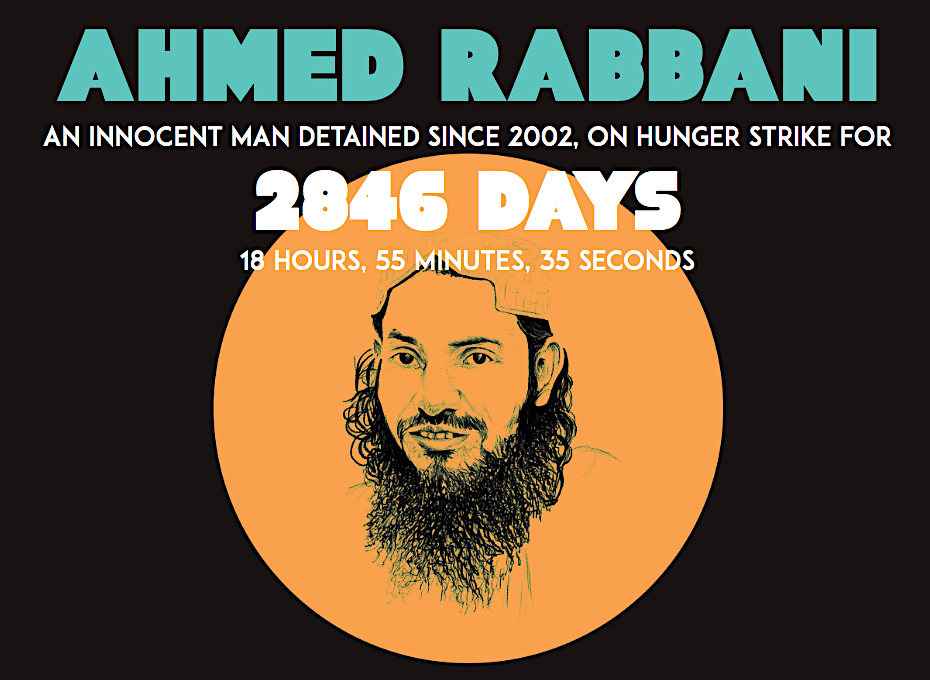
As You Read This, Guantánamo Prisoner Ahmed Rabbani Has Been On A Hunger Strike for 2,846 Days
Please support my work as a reader-funded journalist! I’m currently trying to raise $2500 (£2000) to support my writing and campaigning on Guantánamo and related issues over the next three months. If you can help, please click on the button below to donate via PayPal.
With the media spotlight hopefully being shone anew on the prison at Guantánamo Bay, now that Joe Biden has been elected as the US president, it is to be hoped that, as I explained in my recent article, President Elect Biden, It’s Time to Close Guantánamo, arrangements will be made to release the five men still held who were unanimously approved for release by high-level government review processes under President Obama, and that there will be an acceptance within the Biden administration that holding 26 other men indefinitely without charge or trial is unacceptable.
These 26 men — accurately described as “forever prisoners” by the media — were recommended either or for prosecution, or for ongoing imprisonment without charge or trial, on the basis that they were “too dangerous to release,” even though it was acknowledged that insufficient evidence — or insufficient untainted evidence — existed for them to be charged, by the first of Obama’s two review processes, the Guantánamo Review Task Force, in 2009.
Four years later, the 26 — along with 38 others — were deemed eligible for a second review process, the Periodic Review Boards. Unlike the first process, which involved officials assessing whether prisoners should be freed, charged or held on an ongoing basis without charge or trial, the PRBs were a parole-type process, in which the men were encouraged to express contrition for the activities in which they were alleged to have been involved (whether those allegations were accurate or not), and to present credible proposals for a peaceful and constructive life if released.
President Elect Biden, It’s Time to Close Guantánamo

Please support my work as a reader-funded journalist! I’m currently trying to raise $2500 (£2000) to support my writing and campaigning on Guantánamo and related issues over the next three months. If you can help, please click on the button below to donate via PayPal.
I wrote the following article for the “Close Guantánamo” website, which I established in January 2012, on the 10th anniversary of the opening of Guantánamo, with the US attorney Tom Wilner. Please join us — just an email address is required to be counted amongst those opposed to the ongoing existence of Guantánamo, and to receive updates of our activities by email.
Congratulations to President Elect Joe Biden and Vice President Elect Kamala Harris for persuading enough people to vote Democrat to end the dangerous presidency of Donald Trump.
Trump was a nightmare on so many fronts, and had been particularly dangerous on race, with his vile Muslim travel ban at the start of his presidency, nearly four long years ago, his prisons for children on the Mexican border, and, this last year, in his efforts to inflame a race war, after the murder of George Floyd by a policeman sparked huge protests across the country.
At Guantánamo, Trump’s racism manifested itself via indifference to the fate of the 40 Muslim men, mostly imprisoned without charge or trial and held for up to 15 years when he took office. To him they were terrorists, and he had no interest in knowing that very few of the men held at Guantánamo have ever been accused of involvement with terrorism, and that, of the 40 men still held, only nine of them have been charged with crimes, and five of them were unanimously approved for release by high-level government review processes under President Obama.












 Who's still at Guantánamo?
