Photos and Report: The Global Vigils for the Closure of Guantánamo on International Women’s Day, and Victoria Brittain’s Speech in London

Please support my work as a reader-funded journalist! I’m currently trying to raise $2500 (£2000) to support my writing and campaigning on Guantánamo and related issues over the next three months. If you can help, please click on the button below to donate via PayPal.
Thanks to the many campaigners who turned up on Wednesday (March 8) in London, Washington, D.C., New York and Mexico City for four coordinated global vigils calling for the closure of the prison at Guantánamo Bay.
It was a day of extremes. Those in London for the UK Guantánamo Network’s vigil had to endure an extraordinarily cold, wet day, while in Washington, D.C. it was warm, and in Mexico City, apparently, it was almost unbearably hot.

Free the Guantánamo 18: New Campaign Posters for Coordinated Global Vigils for Prison’s Closure on March 8, International Women’s Day

Please support my work as a reader-funded journalist! I’m currently trying to raise $2500 (£2000) to support my writing and campaigning on Guantánamo and related issues over the next three months. If you can help, please click on the button below to donate via PayPal.
With the release from Guantánamo last week of the Rabbani brothers, Ahmed and Abdul Rahim, the last two Pakistanis in the prison, Guantánamo now holds just 32 men, at an annual cost of at least $17 million a prisoner.
18 of these men — like the Rabbanis — have been approved for release, and yet they are still held because the Biden administration is not legally compelled to free them — unlike Majid Khan, who completed a military commission sentence last year and was resettled in Belize a month ago.
This is because the high-level government review processes that determined, unanimously, that the US no longer wanted to hold these men were purely administrative, meaning that the men, unlike Khan, cannot ask a judge to order their release, even though none of them have never even been charged with a crime.
Photos and Report: Coordinated Protests for the Release of “The Guantánamo 20”, and the Closure of the Prison, in London and Washington, D.C.

Please support my work as a reader-funded journalist! I’m currently trying to raise $2500 (£2000) to support my writing and campaigning on Guantánamo and related issues over the next three months. If you can help, please click on the button below to donate via PayPal.
On Wednesday, February 15, campaigners in London and Washington, D.C. held their first coordinated monthly protest calling for the closure of the prison at Guantánamo Bay, and, specifically, for the release of 20 men (out of the 34 men still held), who have long been approved for release, but who are still held because of a lack of urgency on the part of the US government when it comes to securing their freedom.
I wrote about the plight of the 20 men here, when Majid Khan was released from Guantánamo and resettled in Belize, eleven months after his military commission sentence came to an end, when I noted that, while it was, of course, just and appropriate that Khan had been freed and resettled, because the US government was legally required to freedom at the end of his sentence, it was unforgivable that the Biden administration is dragging its heels when it comes to releasing the 20 other men still held who have been approved for release, because the decisions to release them were taken by administrative review processes that carry no legal weight.
As I stated at the time, “Until they are freed, the message the US government is sending to these 20 men, and to the world, is that it is easier to resettle from Guantánamo someone convicted of terrorism but demonstrably remorseful than it is to resettle someone never charged with a crime at all.”
Quarterly Fundraiser: Seeking £1,000 For ‘The State of London’, My Unique Reader-Funded Photo-Journalism Project

Please click on the ‘Donate’ button below to make a donation to support my photo-journalism project ‘The State of London’.
Dear friends and supporters of ’The State of London’,
Every three months I ask you, if you can, to make a donation to support my unique, reader-funded photo-journalism project ‘The State of London’, which over 6,000 of you follow on Facebook — and nearly 1,500 on Twitter.
Long ago, in the mists of time, when David Cameron’s Tories had only been in power for two years, Brexit hadn’t even been conceived, and London was gearing up for the jingoistic orgy of nationalism that was the 2012 Olympics, I set out on my bike, with a little point-and-shoot Canon camera, to record the changing face of London.
That was in May 2012, and five years later I began posting a photo a day from my archive, and from the photos I was still taking on a daily basis, on ‘The State of London’ Facebook page, along with accompanying essays — about cynical council estate demolitions, the proliferation of new high-rise office blocks in the City and Canary Wharf, as well as photos taken on the sometimes long distance journeys that I undertook through London’s 120 geographical postcodes.
Videos: Andy Worthington and Sara Birch at the London Rally for the Closure of Guantánamo, Jan. 14, 2023

Please support my work as a reader-funded journalist! I’m currently trying to raise $2500 (£2000) to support my writing and campaigning on Guantánamo and related issues over the next three months. If you can help, please click on the button below to donate via PayPal.
On Jan.14, as I explained in a recent article, Photos and Report: The Inspiring Close Guantánamo March and Rally in London, Jan. 14, 2023, the UK Guantánamo Network, which includes members of various Amnesty International groups, the Close Guantánamo campaign and the Guantánamo Justice Campaign, held a march and rally for the closure of the prison at Guantánamo Bay, marking the 21st anniversary of its opening three days earlier.
The rally in Trafalgar Square, which featured a number of speakers, followed a march from the Houses of Parliament, up Whitehall and past 10 Downing Street to Trafalgar Square, in which dozens of campaigners marched in silence, in single file, wearing orange jumpsuits and hoods, and holding placards showing the 35 men still held.
Speakers at the rally included myself and Sara Birch, the convenor of the UK Guantánamo Network, who read out a statement by former prisoner Omar Deghayes, and I’m delighted to post videos of both these speeches, on my YouTube channel (which you’re welcome to subscribe to!), as recorded by Sinai Noor.
Photos and Report: The Inspiring Close Guantánamo March and Rally in London, Jan. 14, 2023
Please support my work as a reader-funded journalist! I’m currently trying to raise $2500 (£2000) to support my writing and campaigning on Guantánamo and related issues over the next three months. If you can help, please click on the button below to donate via PayPal.
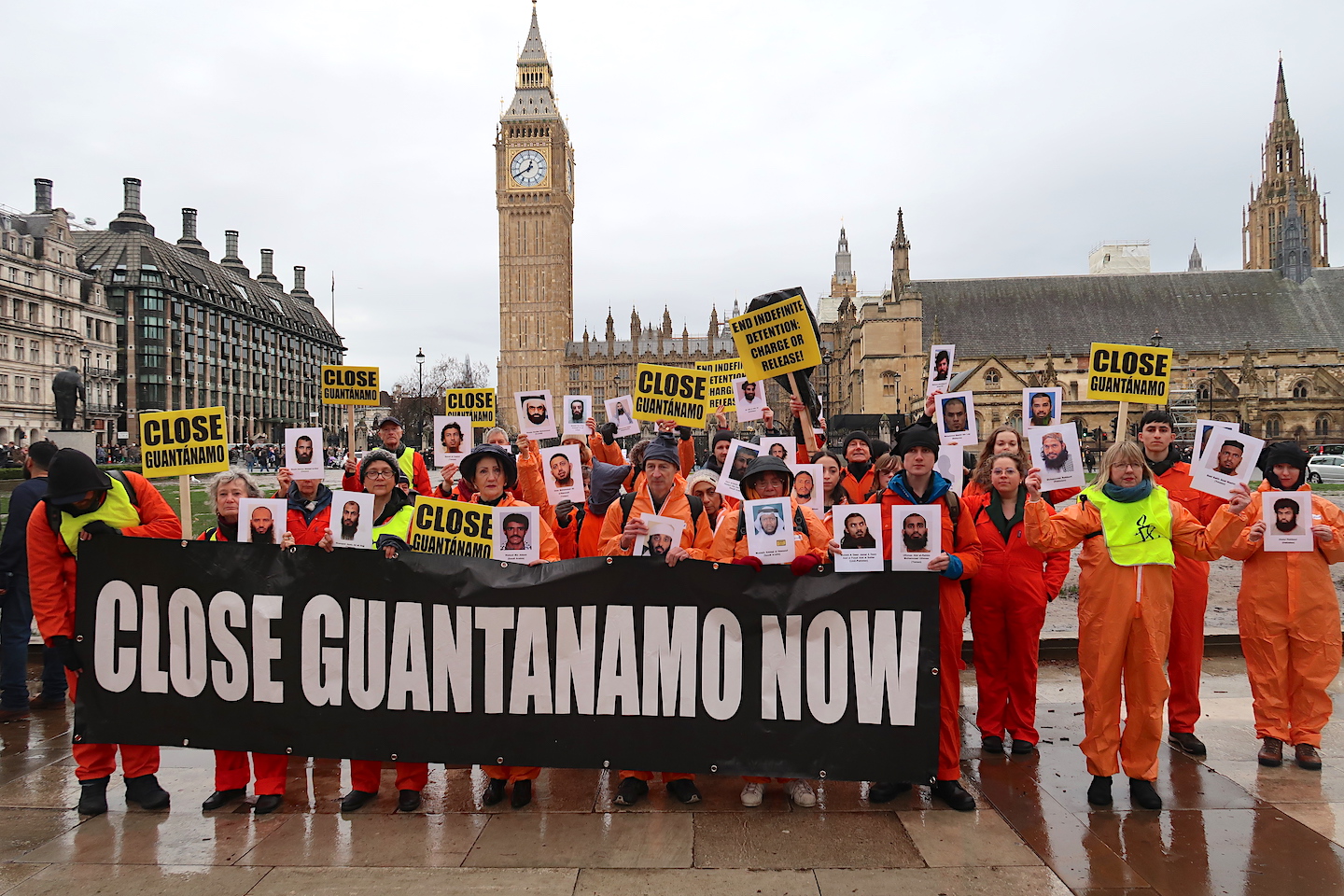
On Saturday (January 14), the UK Guantánamo Network held a powerful and inspiring march and vigil for the closure of Guantánamo in central London.
The UK Guantánamo Network, formed in 2021, comprises representatives of various Amnesty International groups, Close Guantánamo, the Guantánamo Justice Campaign, the London Guantánamo Campaign and Freedom From Torture, and under the inspiring leadership of Convenor Sara Birch (of Lewes Amnesty Group), representatives of at least seven Amnesty groups (Lewes, the Kent Network, Reading, Blackheath and Greenwich, Ealing, Brighton and Hillington) turned up, as well as myself, representing Close Guantánamo, members of the Guantánamo Justice Campaign, and supporters of Julian Assange, whose extradition case is intimately tied in with Guantánamo, as it involves charges relating to the classified military files from the prison that were released by WikiLeaks in 2011, and on which I worked as a media partner.
We gathered in Old Palace Yard opposite the Houses of Parliament at 11.30am, dressing up in orange jumpsuits and hoods, and then, holding placards calling for the closure of the prison and photos of the 35 men still held, we marched in single file, and in silence, up Whitehall, via Parliament Square and 10 Downing Street, to Trafalgar Square, with various photo opportunities along the way.
Quarterly Fundraiser: Seeking £1,000 to Support ‘The State of London’, My Unique Photo-Journalism Project
Please click on the ‘Donate’ button below to make a donation to support my photo-journalism project ‘The State of London’.
Dear friends and supporters,
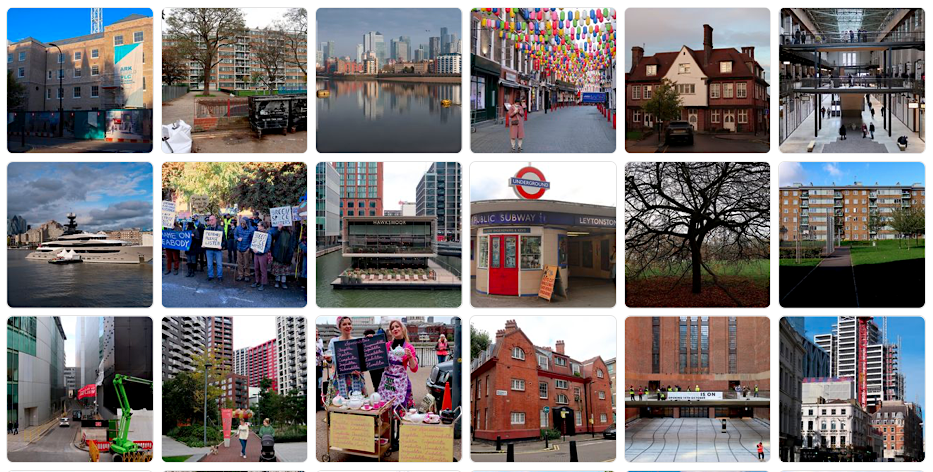
Ten and a half years ago, at the comparatively youthful age of 48, I set out on my bike, armed with a small point-and-shoot Canon camera, on an ambitious mission to photograph the whole of London — or, more specifically, the 120 geographic postcodes that make up the 241 square miles of the London postal district.
3,839 days later, I’m now close to my 60th birthday, I’ve cycled tens of thousands of miles and taken tens of thousands of photos, as well as getting through two bikes and four cameras — with the most recent of these, a Canon PowerShot G7 X Mk. II, having transformed my photography since I first bought it nearly four years ago.
For the last five and a half years, my ambitious mission to record the changing face of the capital has manifested itself as ‘The State of London’, a unique photo-journalism project on Facebook (and Twitter), which involves me posting a photo from these journeys every two days, along with a detailed accompanying essay (I used to post a photo and essay every day until July this year, when I finally realised that the daily schedule had become too arduous).
Celebrating 2,000 Days of ‘The State of London’, My Unique Photo-Journalism Project

Please click on the ‘Donate’ button below to make a donation to support my reader-funded photo-journalism project ‘The State of London’, as it reaches its 2,000th day.
I’m delighted to report that today marks 2,000 days since I first began posting a photo a day taken on bike rides through the 241 square miles the capital’s 120 geographical postcodes — plus an accompanying essay — on my Facebook page ‘The State of London.’ I launched the Facebook page on the 5th anniversary of when I first set out consciously on my bike to capture my perceptions of London with a small point-and-shoot camera, on May 11, 2012 — and for anyone interested in that longer timescale, today actually marks 3,826 days since the project began, which has involved me getting through two bikes and four cameras (ending up with the wonderful Canon PowerShot G7 X Mk. II, which I’ve had for nearly the last four years, and going from looking at my 50th birthday approaching to reflecting on my imminent 60th.
I’m grateful to my 5,800 followers — and 1,350 followers on Twitter — plus the many more people who take an interest in the project without officially ‘following’ it.
There are, of course, many pages and websites out there that feature photos of London, but to the best of my knowledge there’s nothing like ‘The State of London’, which is very specifically a photo-journalism project. I endeavour to make the photos memorable in their own right, but they are rarely the kind of images you’d find wooing tourists, or emblazoned on a canvas print in a populist art shop — and, moreover, the photos are always accompanied by detailed essays providing a wealth of context, historical background and commentary.
Photos and Report: The Phenomenal Success of the Human Chain for WikiLeaks’ Julian Assange Around the UK Parliament

Please support my work as a reader-funded investigative journalist, commentator and activist. If you can help, please click on the button below to donate via PayPal.
Yesterday was a great day for activism, as at least 5,000 people turned up to form a Human Chain around Parliament for WikiLeaks’ founder Julian Assange, who has been held in HMP Belmarsh for three and a half years, challenging his proposed extradition to the US to face espionage charges relating to his work publishing classified US government files leaked to WikiLeaks by Chelsea Manning.
As I arrived, just before the start time of 1pm, it was wonderful to see people lined up all along the front of the House of Parliament, and, as time passed and more people arrived, the line stretched south through Victoria Tower Gardens towards Lambeth Bridge, and across Westminster Bridge to the north, eventually completing the encirclement as people lined up by the Covid memorial wall on the south bank of the River Thames.
Although many organizations were involved — including numerous pro-Assange groups, and Amnesty International, who have an ongoing petition calling for the US government to drop the charges against Julian — this was primarily a protest by concerned individuals, not just from the UK, but also from across Europe, and from as far afield as Australia and New Zealand — who had all chosen to take part because of the huge threat to press freedom that Julian’s proposed extradition represents.
Quarterly Fundraiser: Seeking £1000 to Support my Photo-Journalism Project ‘The State of London’

Please click on the ‘Donate’ button below to make a donation to support my photo-journalism project ‘The State of London’.
Dear friends and supporters,
Every three months, I ask you, if you can, to make a donation to support my ongoing photo-journalism project ‘The State of London’, an entirely reader-funded endeavour, in which, for the last five years and three months, I’ve been posting a photo a day, plus an accompanying essay, drawn from the photos I’ve been taking on daily bike rides throughout the capital for the last ten years.
If you can help out at all, please click on the “Donate” button above to make a payment via PayPal. Any amount will be gratefully received — whether it’s £5, £10, £20 or more!
You can also make a recurring payment on a monthly basis by ticking the box marked, “Make this a monthly donation,” and filling in the amount you wish to donate every month. If you are able to do so, a regular, monthly donation would be very much appreciated.
The donation page is set to dollars, because my PayPal page also covers donations to support my ongoing work to secure the closure of US prison at Guantánamo Bay, and many of those supporters are based in the US, but PayPal will convert any amount you wish to pay from any other currency — and you don’t have to have a PayPal account to make a donation.










 Who's still at Guantánamo?
