Photos and Report: The Global Vigils for the Closure of Guantánamo on the 22nd Anniversary of the Prison’s Opening

Please support my work as a reader-funded journalist! I’m currently trying to raise $2500 (£2000) to support my writing and campaigning on Guantánamo and related issues over the next three months. If you can help, please click on the button below to donate via PayPal.


8,000 Days of Guantánamo: Vigils Take Place Around the World and 170 Former Prisoners, Lawyers, Politicians and Campaigners Join Photo Campaign

Please support my work as a reader-funded journalist! I’m currently trying to raise $2500 (£2000) to support my writing and campaigning on Guantánamo and related issues over the next three months. If you can help, please click on the button below to donate via PayPal.
Wednesday December 6 was a big day for Guantánamo activism, as it marked 8,000 days since the prison opened, and also coincided with the date for the latest global vigils, calling for the closure of Guantánamo, which I initiated in February, and which have been taking place across the US, in London, Mexico City, and elsewhere, every month since.
To mark 8,000 wretched and unforgivably long days of the prison’s existence, I encouraged anti-Guantánamo campaigners around the world to take a photo with the 8,000 days poster, hosted on the Gitmo Clock website, an initiative of the Close Guantánamo campaign, which I established nearly 12 years ago, on the 10th anniversary of the opening of Guantánamo.
The Gitmo Clock has been counting, in real time, how long Guantánamo has been open for nearly six years, since the 16th anniversary of the prison’s opening, on January 11, 2018, when the lamentable Donald Trump was president, and when the prison had been open for 5,845 days.
Celebrating 2,400 Days of ‘The State of London’: Please Donate to Support This Unique Photo-Journalism Project

Please click on the ‘Donate’ button below to make a donation to support my photo-journalism project ‘The State of London’.
Dear friends and supporters,
Today marks 2,400 days — or a little over six and a half years — since I first set up ‘The State of London’ Facebook page, and began posting a photo a day, with an accompanying essay, drawn from the photos I had been taking since I first began cycling around London and taking photos throughout the capital’s 120 geographic postcodes five years before — on May 11, 2012, to be precise. I also post the photos on X (formerly Twitter).
From the beginning, this has been something of a deranged hobby. I have no financial backing for the project and, as a result, am reliant on you, my readers and followers, to provide me with any kind of monetary recompense for the ridiculous amount of time that I’ve spent cycling around London with a camera over the last eleven and a half years — and, in particular, the many hours I spend researching and writing about the photos that I post to entertain and inform you about London’s history, its social housing, its takeover, in recent decades, by predatory capitalism, the changing seasons, forgotten corners, rivers, hills and canals, parks and graveyards, seats of power, poverty and protests.
In the last six months, for example, I’ve celebrated pubs and cafes, inter-war council estates, Art Deco and Brutalist triumphs, delved through the archive for coverage of lost or soon to be lost reminders of London’s history — Coal Drops Yard in King’s Cross, prior to redevelopment, slipper baths in South Bermondsey, council flats in Homerton, a lodge in Archway and a prefab in Stepney Green, and have also posted about horrible new developments in Pimlico, Canary Wharf, the City, Vauxhall and Lewisham, as well as covering the massive and frequent protests against Israel’s genocidal war on Gaza.
Photos and Report: The Coordinated Global Vigils for the Closure of Guantánamo on November 1, 2023

Please support my work as a reader-funded journalist! I’m currently trying to raise $2500 (£2000) to support my writing and campaigning on Guantánamo and related issues over the next three months. If you can help, please click on the button below to donate via PayPal.


Grenfell Six Years On: Still Crying Out for Justice

Please support my work as a reader-funded investigative journalist, commentator and activist. If you can help, please click on the button below to donate via PayPal.
Six years ago today, on June 14, 2017, I watched in horror on the news as an inferno engulfed Grenfell Tower, a 24-storey block of council flats in North Kensington, in west London.
London — and the UK as a whole — would never be the same again.
Compelled to visit, as a photo-journalist covering London for my project ‘The State of London’, I cycled from my home in south east London on what was, objectively, a radiant sunny day, through a city that was going about its everyday business as though nothing had happened. It was only as I got closer and the charred, still smouldering skeleton of the tower finally rose up, make me feel slightly queasy and, disturbingly, rather ghoulish, that the enormity of what had occurred struck home.
On the ground, the local community had gone into overdrive to help the survivors, donating vast amounts of food and clothing, and seeking to do all they could to help, but, throughout this heartfelt humanitarian effort, it was clear that they were alone; no one in a position of authority was anywhere to be seen.
Join Us on Wednesday June 7 for the Next Monthly Coordinated Global Vigils for the Closure of Guantánamo

Please support my work as a reader-funded journalist! I’m currently trying to raise $2500 (£2000) to support my writing and campaigning on Guantánamo and related issues over the next three months. If you can help, please click on the button below to donate via PayPal.
Since February, on the first Wednesday of every month, campaigners around the world have been holding coordinated vigils calling for the closure of the prison at Guantánamo Bay, which, as of today, has been open for 7,810 days. The next vigils take place next Wednesday, June 7, and we hope you’ll join us, either by joining an existing vigil, or by setting up your own! And please, if you are taking part in a vigil, take photos and send them to me, as the cumulative visual effect of many vigils taking place on the same day is really quite powerful.
Campaigners in London, who had held weekly vigils outside Parliament for many years to call for the release of Shaker Aamer, the last British resident in Guantánamo, who was finally freed in October 2015, resumed vigils (on a monthly basis) last September, largely due to the tenacity of Sara Birch of the Lewes Amnesty Group, who is also the Convenor of the UK Guantánamo Network, comprising members of various Amnesty groups, Close Guantánamo and other organizations.
After global protests for the closure of Guantánamo on and around the 21st anniversary of its opening, on January 11 this year, I thought it would make sense to try to get campaigners in the US and elsewhere to join with us in holding coordinated vigils on the first Wednesday of every month, and so a movement was born.
Marking 11 Years of ‘The State of London’, An Appeal for £1000 to Support My Unique Photo-Journalism Project For the Next Three Months

Please click on the ‘Donate’ button below to make a donation to support my photo-journalism project ‘The State of London’.
Dear friends and supporters of ’The State of London’,
Every three months I ask you, if you can, to make a donation to support my unique, reader-funded photo-journalism project ‘The State of London’, which has just reached 6,200 followers on Facebook, and has over 1,550 followers on Twitter. As I have no institutional backing whatsoever, I’m entirely dependent on your generosity to enable me to continue this project, which takes up a considerable amount of otherwise entirely unpaid time.
If you can help out at all, please click on the “Donate” button above to make a payment via PayPal. Any amount will be gratefully received — whether it’s £10, £20, £50 or more!
You can also make a recurring payment on a monthly basis by ticking the box marked, “Make this a monthly donation,” and filling in the amount you wish to donate every month. If you are able to do so, a regular, monthly donation would be very much appreciated.
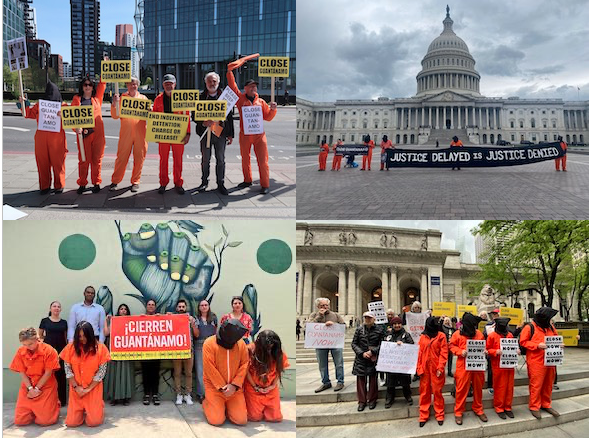
Photos and Report: The Coordinated Global Vigils for the Closure of Guantánamo in London, Washington, D.C., New York, Mexico City, Copenhagen, Brussels and Detroit on May 3, 2023
Please support my work as a reader-funded journalist! I’m currently trying to raise $2500 (£2000) to support my writing and campaigning on Guantánamo and related issues over the next three months. If you can help, please click on the button below to donate via PayPal.
On Wednesday (May 3), the latest coordinated global vigils for the closure of the prison at Guantánamo Bay took place in eight cities across the world — London, Washington, D.C. New York, Mexico City, Copenhagen, Brussels, Detroit and Los Angeles — and with former prisoner Mansoor Adayfi joining us in Belgrade.
The idea for coordinated vigils arose from the monthly vigils that the UK Guantánamo Network (a coalition of various Amnesty groups, Close Guantánamo and other groups) started last September, and I was inspired to try coordinating vigils worldwide after reflecting on the various actions marking the 21st anniversary of the opening of Guantánamo in January.
Fortunately, friends in Washington, D.C. agreed to join in in February, with New York and Mexico City joining in March, and Brussels, Los Angeles, Raleigh, NC and Cobleskill, NY joining last month, and this month we were delighted to also welcome campaigners in Copenhagen and Detroit.
Photos and Report: The Coordinated Global Vigils for the Closure of Guantánamo in the UK, the US, Mexico and Belgium on April 5, 2023

Please support my work as a reader-funded journalist! I’m currently trying to raise $2500 (£2000) to support my writing and campaigning on Guantánamo and related issues over the next three months. If you can help, please click on the button below to donate via PayPal.
Yesterday, Wednesday April 5, eight coordinated global vigils took place calling for the closure of the prison at Guantánamo Bay — and the release of the 17 men (out of the 31 still held) who have been approved for release.
Campaigners in the UK — with the UK Guantánamo Network, which includes various Amnesty International groups, Close Guantánamo, the Guantánamo Justice Campaign and the London Guantánamo campaign — began holding monthly vigils outside Parliament last September, and two months ago, following global actions to mark the 21st anniversary of the opening of Guantánamo, I asked fellow campaigners in Washington, D.C. to join us, which they did. Last month, campaigners in New York and Mexico City also joined us, and yesterday campaigners in Brussels, Los Angeles, Raleigh, NC and Cobleskill, NY also joined in.
Those taking part included the UK Guantánamo Network, Amnesty International, Close Guantánamo, Witness Against Torture, World Can’t Wait, CAIR (the Council on American-Islamic Relations), ICUJP (Interfaith Communities United for Justice and Peace), NC Stop Torture Now, Schoharie Peacemakers and the Comité Free.Assange.Belgium, while supporting organizations include NRCAT (the National Religious Campaign Against Torture), September Eleventh Families for Peaceful Tomorrows and NYC Veterans For Peace.
Wednesday April 5: The Next Global Coordinated Protests for the Closure of Guantánamo

Please support my work as a reader-funded journalist! I’m currently trying to raise $2500 (£2000) to support my writing and campaigning on Guantánamo and related issues over the next three months. If you can help, please click on the button below to donate via PayPal.
I wrote the following article for the “Close Guantánamo” website, which I established in January 2012, on the 10th anniversary of the opening of Guantánamo, with the US attorney Tom Wilner. Please join us — just an email address is required to be counted amongst those opposed to the ongoing existence of Guantánamo, and to receive updates of our activities by email.
With the release from Guantánamo three weeks ago of the Saudi citizen Ghassan al-Sharbi, the prison now holds just 31 men, out of the 779 held by the US military since it first opened over 21 years ago.
17 of these 31 men have been approved for release, and yet there is no way of knowing when, if ever, they will be released, because they did not have their release ordered by a court, but recommended by administrative review processes, and, as a result, they cannot appeal to a judge to order their release if, as is the case, the government shows no sense of urgency when it comes to freeing them.
Complicating matters, however, we acknowledge that, in the cases of 13 of these men, the US government must find third countries prepared to offer them new homes, because provisions inserted by Republicans into the annual National Defense Authorization Act since the early years of the Obama presidency prevent any repatriations from Guantánamo to countries including Yemen, Libya and Somalia, and eleven of these men are Yemeni, one is a Libyan, and another is a Somali. An additional complication is that none of these men can be resettled in the US, because another provision in the NDAA prevents any Guantánamo prisoner from being brought to the US mainland for any reason.










 Who's still at Guantánamo?
