Judge Blocks Punitive US Sanctions on UN Rapporteur Francesca Albanese
Please click on either of the ‘Donate’ or ‘Buy’ buttons below (via PayPal or Stripe) to make a donation towards the $2,500 (£2,000) I’m trying to raise to support my work as a reader-funded investigative journalist, commentator and activist over the next three months. To get links to all my work in your inbox, please also consider taking out a free or paid subscription to my new Substack newsletter.
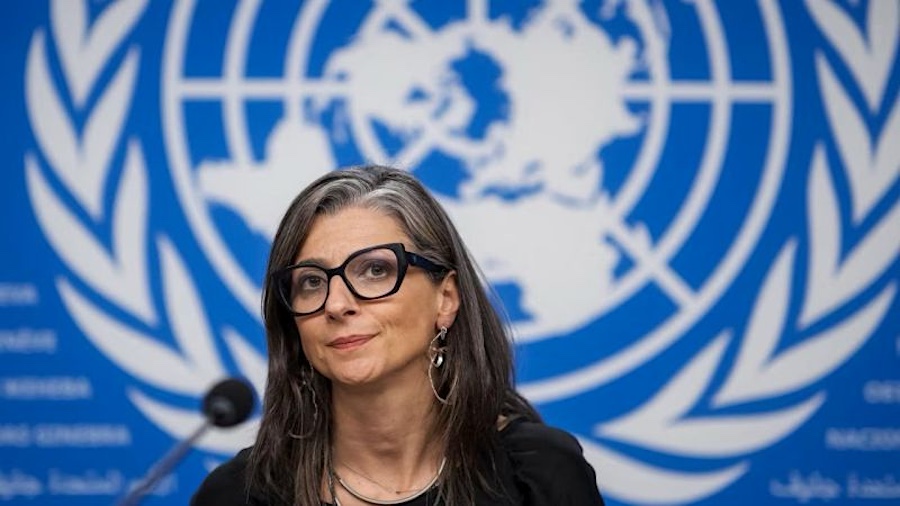
In wonderful news from the District Court in Washington, D.C., Judge Richard Leon has blocked the imposition of US sanctions on Francesca Albanese, the tenacious UN Special Rapporteur on the Occupied Palestinian Territories, who, since Israel’s exterminatory assault on Gaza began, 31 months ago, has been fearless and indefatigable in her support of the Palestinians, and her condemnation of Israel’s almost innumerable crimes — including war crimes, crimes against humanity and genocide — and has also condemned the countries and companies that have been complicit. See her reports here: “Genocide as colonial erasure”, “From economy of occupation to economy of genocide”, “Gaza Genocide: a collective crime” and “Torture and genocide.”
The 26-page ruling, a preliminary injunction, will be particularly irritating for the Trump administration, because Judge Leon cannot be dismissed as a “left-wing activist judge.” An appointee of George W. Bush, he first came on my radar in 2008-09, when, as a judge dealing with the habeas corpus petitions of prisoners at Guantánamo, he became notorious for his frequent rulings against the prisoners, including one particular case which I condemned as How Cooking For The Taliban Gets You Life In Guantánamo.
The latest case before Judge Leon was brought in February by Albanese’s husband, who, like her, is an Italian citizen, and by their daughter, who is a US citizen, seeking a preliminary injunction against the decision, last July, by US Secretary of State Marco Rubio, to designate Albanese as a foreign national who has “directly engaged with the International Criminal Court (ICC) in efforts to investigate, arrest, detain, or prosecute nationals of the United States or Israel, without the consent of those two countries.”
In his press statement, Rubio added, “The United States has repeatedly condemned and objected to the biased and malicious activities of Albanese that have long made her unfit for service as a Special Rapporteur”, claiming, hysterically, that she ”has spewed unabashed antisemitism, expressed support for terrorism, and open contempt for the United States, Israel, and the West.”
The Man They Never Knew: Said Bakush Is Repatriated from Guantánamo to Algeria; 30 Men Now Remain, 16 Also Approved for Release

Please support my work as a reader-funded journalist! I’m currently trying to raise $2500 (£2000) to support my writing and campaigning on Guantánamo and related issues over the next three months. If you can help, please click on the button below to donate via PayPal.
On April 20, the last Algerian in Guantánamo, Said Bakush (also known as Saeed Bakhouche), was repatriated after being held for nearly 21 years without charge or trial.
Bakush, a Berber, who is now 52 years old, was freed just over a year after his approval for release, when a Periodic Review Board (a parole-type process established under President Obama) “determined that continued law of war detention [was] no longer necessary to protect against a continuing significant threat to the national security of the United States,” and it is to be hoped that he will somehow be able to pick up the pieces of his broken life, even though he was not married, and has no children, and no one seems to know whether he has any relatives who are in a position to provide him with the support that will be needed after he lost over a third of his life in Guantánamo.
30 men now remain at Guantánamo, and 16 of them, like Bakush, have been approved for release. His release is to be commended, but it is imperative that these other men are also freed as swiftly as possible, although the release of the majority of them is complicated by the fact that they cannot be repatriated, because of provisions preventing their return to their home countries that have been included by Republicans in the annual National Defense Authorization Act for over a decade, and third countries must be found that are prepared to offer them new homes.
US Supreme Court Supports Lifelong Imprisonment Without Charge or Trial at Guantánamo; Only Justice Breyer Dissents

Please support my work as a reader-funded journalist! I’m currently trying to raise $2500 (£2000) to support my writing and campaigning on Guantánamo and related issues over the next three months of the Trump administration. If you can help, please click on the button below to donate via PayPal.
I wrote the following article for the “Close Guantánamo” website, which I established in January 2012, on the 10th anniversary of the opening of Guantánamo, with the US attorney Tom Wilner. Please join us — just an email address is required to be counted amongst those opposed to the ongoing existence of Guantánamo, and to receive updates of our activities by email.
Remember when the US courts used to guarantee the rights of any individual not to be imprisoned indefinitely without charge or trial, in defiance of all accepted domestic and international laws and treaties?
Yes, so do we, but unfortunately all that changed nearly 15 years ago, when the Supreme Court, in a case called Hamdi v. Rumsfeld, dealing with the sole US citizen held at Guantánamo, Yasser Hamdi, born in Baton Rouge, Louisiana in 1980, but living in Saudi Arabia since he was a child, ruled that foreign prisoners held at Guantánamo could be — yes, you guessed it — imprisoned indefinitely without charge or trial.
Hamdi, seized in Afghanistan in December 2001, had been held at Guantánamo until the US authorities realized that he was a US citizen, at which point he was moved to a military brig on the mainland, where he became one of three US citizens or residents held as “enemy combatants” and subjected to torture (the others being US citizen Jose Padilla, and legal resident Ali al-Marri).
The Man They Don’t Know: Saeed Bakhouche, an Algerian, Faces a Periodic Review Board at Guantánamo
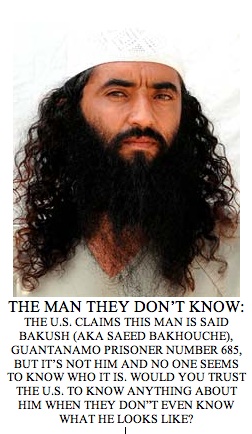 On Tuesday May 24, Saeed Bakhouche, a 45-year old Algerian who has been held in the US prison at Guantánamo Bay since June 2002, became the 40th prisoner to face a Periodic Review Board at Guantánamo.
Like many Guantánamo prisoners, Bakhouche has also been known by another name – in his case, Abdel Razak Ali, a name he gave when he was captured – but to the best of my knowledge he is the only prisoner whose classified military file, compiled in 2008 and released by WikiLeaks in 2011, has a photo that purports to be him, but is not him at all. No one seems to know who it is, but it is not Saeed Bakhouche.
Moreover, his attorney, Candace Gorman, told me that a different photo – again, not of her client – was displayed outside his cell for a year and a half, a mistake that had disturbing ramifications, because this was the same photo shown to other prisoners during interrogations, leading to a situation whereby information about someone else was added his file as though it related to him.
The fact that the US authorities have, historically, not known who Saeed Bakhouche is, does not, however, appear to have been conveyed to the members of his PRB, which involves representatives of the Departments of State, Defense, Justice and Homeland Security, as well as the office of the Director of National Intelligence and the Office of the Joint Chiefs of Staff. Set up in 2013, the boards are reviewing the cases of 41 men previously described, by the high-level, inter-agency Guantánamo Review Task Force that President Obama established shortly after taking office, as “too dangerous to release,” although that has turned out to have been outrageous hyperbole. Of the 40 men whose cases have so far been reviewed, eleven are awaiting decisions, just seven have had their ongoing imprisonment approved, while 22 have had their release recommended — and nine of those have, to date, been freed. Read the rest of this entry »
Guantánamo Review Boards (2/3): Ghaleb Al-Bihani, a Cook, Asks to Be Sent Home to Yemen or to Another Country
 Last week, I published the first of three new articles about the Periodic Review Boards at Guantánamo, looking at the hearing for a Yemeni prisoner, Ali Ahmad al-Razihi, who had the opportunity to ask for his freedom on March 20.
Ali is one of 71 prisoners — out of the 154 men still held — who were either designated for ongoing imprisonment without charge or trial in January 2010 by the high-level, inter-agency Guantánamo Review Task Force that President Obama established shortly after taking office in 2009 (46 men in total), or were recommended for prosecution (25 others).
The 46 had their ongoing imprisonment without charge or trial approved by President Obama in an executive order issued in March 2011, on the alarming basis that they were allegedly too dangerous to release, even though insufficient evidence existed to put them on trial. The president tried to sweeten this unacceptable endorsement of indefinite detention by promising that the men would receive periodic reviews of their cases, but the first of these did not take place until last October. Read the rest of this entry »












 Who's still at Guantánamo?
