The Man They Never Knew: Said Bakush Is Repatriated from Guantánamo to Algeria; 30 Men Now Remain, 16 Also Approved for Release

Please support my work as a reader-funded journalist! I’m currently trying to raise $2500 (£2000) to support my writing and campaigning on Guantánamo and related issues over the next three months. If you can help, please click on the button below to donate via PayPal.
On April 20, the last Algerian in Guantánamo, Said Bakush (also known as Saeed Bakhouche), was repatriated after being held for nearly 21 years without charge or trial.
Bakush, a Berber, who is now 52 years old, was freed just over a year after his approval for release, when a Periodic Review Board (a parole-type process established under President Obama) “determined that continued law of war detention [was] no longer necessary to protect against a continuing significant threat to the national security of the United States,” and it is to be hoped that he will somehow be able to pick up the pieces of his broken life, even though he was not married, and has no children, and no one seems to know whether he has any relatives who are in a position to provide him with the support that will be needed after he lost over a third of his life in Guantánamo.
30 men now remain at Guantánamo, and 16 of them, like Bakush, have been approved for release. His release is to be commended, but it is imperative that these other men are also freed as swiftly as possible, although the release of the majority of them is complicated by the fact that they cannot be repatriated, because of provisions preventing their return to their home countries that have been included by Republicans in the annual National Defense Authorization Act for over a decade, and third countries must be found that are prepared to offer them new homes.
A Rare Court Victory Offers Hope for Guantánamo’s “Forever Prisoners”

Please support my work as a reader-funded journalist! I’m currently trying to raise $2500 (£2000) to support my writing and campaigning on Guantánamo and related issues over the next three months of the Trump administration. If you can help, please click on the button below to donate via PayPal.
I wrote the following article for the “Close Guantánamo” website, which I established in January 2012, on the 10th anniversary of the opening of Guantánamo, with the US attorney Tom Wilner. Please join us — just an email address is required to be counted amongst those opposed to the ongoing existence of Guantánamo, and to receive updates of our activities by email.
Anyone who has been following the alleged legal basis for the ongoing imprisonment without charge or trial of prisoners at Guantánamo should be encouraged by a ruling on June 21, 2019 by a three-judge panel — consisting of Judges Patricia A. Millett, Cornelia T. L. Pillard, and Harry T. Edwards — in the D.C. Circuit Court (the Court of Appeals for the District of Columbia) in Qassim v. Trump, a case involving Khalid Qassim, a 41-year old Yemeni citizen who has been held at Guantánamo without charge or trial for over 17 years.
Close Guantánamo’s co-founder Tom Wilner argued the case before the court, and, as he explains, the court “reversed an eight-year rule that has prevented Guantánamo detainees from seeing and rebutting the evidence purportedly justifying their detentions,” as part of a ruling in which the judges granted Qassim’s request to reverse the District Court’s denial of his petition for habeas corpus.
To give some necessary perspective to the significance of the ruling, it is important to understand that, for most of Guantánamo’s history, the law has failed to offer them adequate protections against executive overreach. In a glaring demonstration of arrogant folly after the terrorist attacks of September 11, 2001, the Bush administration decided that anyone who ended up in US custody would be treated neither as a criminal (to be charged and put on trial), nor as a prisoner of war protected by the Geneva Conventions, who could be held unmolested until the end of hostilities. Instead, the prisoners were designated as “unlawful enemy combatants”; essentially, human beings without any rights whatsoever.
The Man They Don’t Know: Saeed Bakhouche, an Algerian, Faces a Periodic Review Board at Guantánamo
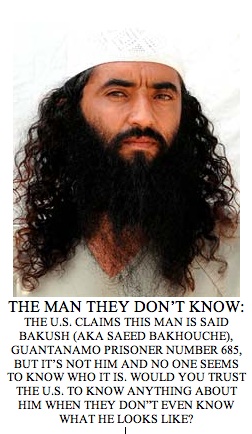 On Tuesday May 24, Saeed Bakhouche, a 45-year old Algerian who has been held in the US prison at Guantánamo Bay since June 2002, became the 40th prisoner to face a Periodic Review Board at Guantánamo.
Like many Guantánamo prisoners, Bakhouche has also been known by another name – in his case, Abdel Razak Ali, a name he gave when he was captured – but to the best of my knowledge he is the only prisoner whose classified military file, compiled in 2008 and released by WikiLeaks in 2011, has a photo that purports to be him, but is not him at all. No one seems to know who it is, but it is not Saeed Bakhouche.
Moreover, his attorney, Candace Gorman, told me that a different photo – again, not of her client – was displayed outside his cell for a year and a half, a mistake that had disturbing ramifications, because this was the same photo shown to other prisoners during interrogations, leading to a situation whereby information about someone else was added his file as though it related to him.
The fact that the US authorities have, historically, not known who Saeed Bakhouche is, does not, however, appear to have been conveyed to the members of his PRB, which involves representatives of the Departments of State, Defense, Justice and Homeland Security, as well as the office of the Director of National Intelligence and the Office of the Joint Chiefs of Staff. Set up in 2013, the boards are reviewing the cases of 41 men previously described, by the high-level, inter-agency Guantánamo Review Task Force that President Obama established shortly after taking office, as “too dangerous to release,” although that has turned out to have been outrageous hyperbole. Of the 40 men whose cases have so far been reviewed, eleven are awaiting decisions, just seven have had their ongoing imprisonment approved, while 22 have had their release recommended — and nine of those have, to date, been freed. Read the rest of this entry »
Updated: My Definitive List of the Guantánamo Habeas Corpus Results
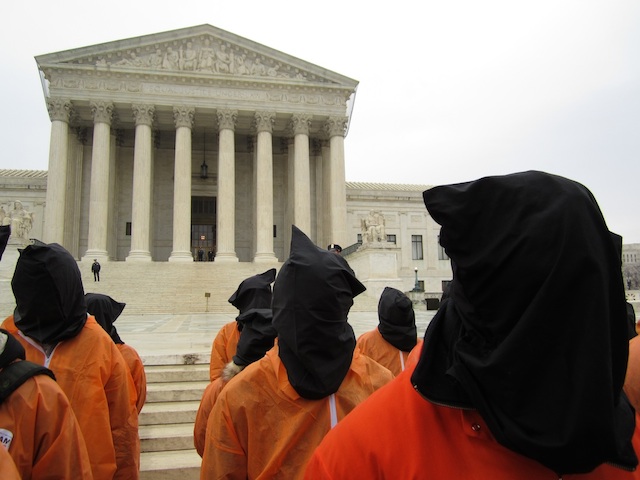
See the updated Guantánamo habeas list here.
Sometimes life takes us down unexpected routes, and yesterday, while looking for links for my last article, a transcript of a talk I gave in Los Angeles during my recent US tour calling for the closure of the prison at Guantánamo Bay on the 12th anniversary of its opening, I found myself visiting a page I first created in May 2010, entitled, “Guantánamo Habeas Results: The Definitive List.”
The page is a list of all the prisoners whose habeas corpus petitions were ruled on by judges in the District Court in Washington D.C. following the Supreme Court’s important ruling, in June 2008, in Boumediene v. Bush, granting the prisoners constitutionally guaranteed habeas corpus rights. At the time I created the list, there had been 47 rulings, and in 34 of those cases, after reviewing all the evidence, the judges concluded that the government had failed to demonstrate that they were connected in any meaningful manner with either al-Qaeda or the Taliban, an ordered their release.
This was humiliating for those who sought to defend Guantánamo, especially as the habeas hearings involved a low evidentiary hurdle — requiring the government to establish its case through a preponderance of the evidence rather than beyond any reasonable doubt. It was, moreover, a vindication for those like myself and some other journalists, as well as lawyers for the men, NGOs and others concerned by the existence of Guantánamo, like Lt. Col. Stephen Abraham, who had worked on the tribunals at Guantánamo, who had long maintained that the supposed evidence against the men was flimsy and untrustworthy, in large part because it was gathered using torture or other forms of coercion, or, in some cases at Guantánamo, because certain prisoners were bribed with better living conditions if they told lies about their fellow prisoners. Read the rest of this entry »
Judge Calls for An End to Unjust Provisions Governing Guantánamo Prisoners’ Habeas Corpus Petitions
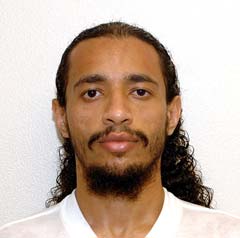 In preventing the release of prisoners from Guantánamo, all three branches of the US government are responsible. President Obama promised to close the prison within a year of taking office, but he lacked a concrete plan, and soon caved in to criticism, blocking a plan by White House counsel Greg Craig to bring some cleared prisoners who couldn’t be safely repatriated — the Uighurs, Muslims from China’s Xinjiang province — to live in the US, and imposing a ban on releasing all Yemenis after it was discovered that a failed plot to blow up a plane bound for the US on Christmas Day 2009 was hatched in Yemen.
Congress, in turn, imposed ban on bringing prisoners to the US mainland, and, in the last two versions of the National Defense Authorization Act, a ban on releasing prisoners to any country where even a single released prisoner has allegedly engaged in recidivism (returning to the battlefield), and a requirement that, if a prisoner were to be released, the Secretary of Defense would have to certify that they would not be able, in future, to engage in any terrorist activities — a requirement that appears to be impossible to fulfill.
Largely overlooked has been the responsibility of the judiciary — and specifically, the Court of Appeals in Washington D.C. (the D.C. Circuit Court), and the Supreme Court, but their role in keeping men at Guantánamo is also crucial.
Nine years ago, in June 2004, in Rasul v. Bush, the Supreme Court granted the prisoners habeas corpus rights, a momentous ruling that pierced the veil of secrecy that had allowed the Bush administration to establish a torture regime at Guantánamo, and also allowed the prisoners to be represented by lawyers, who were allowed to visit them. Read the rest of this entry »












 Who's still at Guantánamo?
