Hearing Date Set for Bradley Manning, the Alleged Whistleblower Who Exposed the Horrors of America’s Wars and of Guantánamo
 Every day, for the last seven months, I have had cause to reflect on the bravery of the whistleblower — Pfc. Bradley Manning, according to the US authorities — who, two years ago, released, to WikiLeaks, a trove of classified US documents — the “Collateral Murder” video, showing US soldiers killing civilians in Iraq in 2007, hundreds of thousands of pages of war logs from Afghanistan and Iraq, over 250,000 diplomatic cables, whose selective release, beginning almost exactly a year ago, drove the news agenda globally for many weeks (and also see my reflections on what they revealed about Guantánamo and US torture), and the military files on the Guantánamo prisoners, released last April.
It is, of course, the Guantánamo files that have encouraged me to think every day about the whistleblower responsible for providing them to WikiLeaks, as we all owe a great debt to whoever it was who leaked them. I worked with WikILeaks as a media partner for the release of these documents, liaising with nine media organisations (including McClatchy, the Washington Post, the Daily Telegraph, Der Spiegel, Le Monde and El Pais), and although their impact was overshadowed — rather conveniently, it seems — after just a week, when Osama bin Laden was killed by US forces in Pakistan, I have continued analyzing them ever since, creating a 70-part, million-word series, “The Complete Guantánamo Files,” which will be complete by spring 2012.
The documents — Detainee Assessment briefs prepared by the Pentagon’s Joint Task Force at Guantánamo — profile all but three of the 779 prisoners held at Guantánamo since the prison opened on January 11, 2002, and provide details of what was ascertained about the prisoners, and who provided that information. The documents clarify that many prisoners were completely innocent, detained because the Bush administration arrogantly disregarded the Geneva Conventions, and its tried and tested methods for screening prisoners seized in wartime to make sure that civilians had not been swept up with soldiers. Read the rest of this entry »
As Hackgate Resurfaces, John Pilger Criticizes Mainstream Media, Salutes Independent Investigative Journalists
 I was recently alerted, by my good friend Ann Alexander, to a transcript of a speech given by the legendary investigative journalist John Pilger at the “Reclaim the Media” conference, organised by NUJ activists, which took place in central London on October 26 to discuss the fallout from the phone-hacking scandal that discredited Rupert Murdoch’s media empire over the summer, and led to the demise of the News of the World.
This is timely, of course, as the phone-hacking scandal has not gone away, and, in the last few days, in advance of another appearance by James Murdoch in front of the Culture, Media and Sport Select Committee on Thursday, News International launched a voluntary compensation scheme for victims of phone-hacking, the day after the Metropolitan police stated that the number of possible victims of News International’s phone-hacking had reached 5,795, which was nearly 2,000 more than the police estimated in July.
In October, the Guardian noted that News International was facing more than 60 new compensation claims, and it seems unlikely, therefore, that the scandal will go away, especially as it has now emerged that, for eight years, a private detective was paid by News International to follow celebrities (including Prince William), and also to follow lawyers (those working for Milly Dowler’s family, who were followed last year and this year) and politicians (including cabinet ministers, and Tom Watson MP, who has made it his mission to expose News International’s wrongdoing).
However, Ann alerted me to the article because she was thinking about me, in a very kind manner, and picked up on a section of Pilger’s speech in which he spoke about a Ministry of Defence document released by WikiLeaks, which stated that there were “three main threats to the ministry’s view of the world” — namely, “Russian spies, terrorists, and by far the greatest threat — independent investigative journalists,” and she was thinking about my investigative work, primarily in connection with Guantánamo. Read the rest of this entry »
Ten Years After 9/11, America Deserves Better than Dick Cheney’s Self-Serving Autobiography
 On August 30, when In My Time, former Vice President Dick Cheney’s self-serving autobiography was published, the timing was pernicious. Cheney knows by now that every time he opens his mouth to endorse torture or to defend Guantánamo, the networks welcome him, and newspapers lavish column inches on his opinions, even though astute editors and programmers must realize that, far from being an innocuous elder statesman defending the “war on terror” as a robust response to the 9/11 attacks, Cheney has an ulterior motive: to keep at bay those who are aware that he and other Bush administration officials were responsible for authorizing the use of torture by US forces, and that torture is a crime in the United States.
As a result, Cheney knew that, on the tenth anniversary of the terrorist attacks that launched the “war on terror” that he is still so concerned to defend, his voice would be echoing in the ears of millions of his countrymen and women, helping to disguise a bitter truth: that, following the 9/11 attacks, Cheney was largely responsible for the abomination that is Guantánamo, and for the torture to which prisoners were subjected from Abu Ghraib to Bagram to Guantánamo and the “black sites” that littered the world.
Alarmingly, while Cheney has been largely successful in claiming that the use of torture was helpful, despite a lack of evidence that this was the case, what strikes me as even more alarming is that many Americans are still unaware of the extent to which the torture for which Cheney was such a cheerleader did not keep them safe from terrorist attacks, but actually provided a lie that was used to justify the invasion of Iraq in March 2003. Read the rest of this entry »
The Baha Mousa Inquiry: A Good Day for British Justice, A Bleak Day for the British Army and Their US Mentors
 Yesterday, the publication of the final report of the Baha Mousa Inquiry demonstrated that, occasionally, when something truly monstrous has occurred, the British government can do the right thing, and hold a proper inquiry.
Baha Mousa, a hotel receptionist in Basra, Iraq, was killed by British soldiers in September 2003, his brutalized body bearing 93 separate injuries, after two days of what the judge in the three-year inquiry, Sir William Gage, described as “serious, gratuitous violence” that leaves “a very great stain on the reputation of the Army.”
As the Independent explained in an editorial today, the report is “damning.” The judge found that the “savagery meted out to Mr. Mousa and fellow detainees in Basra in 2003 were not the actions of a few ‘bad apples,'” but were, instead, “the result of systemic, ‘corporate’ failures that meant neither the abusive soldiers, nor their superiors, were aware that forcing detainees to wear hoods and adopt excruciating stress positions contravened both British law and the Geneva Convention.”
The Independent noted, “That any British soldier is unclear about what constitutes torture is disgraceful enough. That there were others who saw what was happening and allowed it to continue is truly shameful.” Read the rest of this entry »
More Evidence of the Use of Water Torture at Guantánamo and in Afghanistan and Iraq
 Three weeks ago, my colleague Jeffrey Kaye, a full-time psychologist in California who also manages to find time to pursue a second career as a blogger producing important work on America’s torture program, wrote an article for Truthout about the use of water torture at Guantánamo, which pulled together information that was previously available, but scattered around a number of different sources, and which, I’m delighted to note, secured a wide audience online, also attracting interest in the mainstream media.
As a follow-up, Jeff recently wrote another article for Truthout, providing further examples of the use of water as a torture technique, not only in Guantánamo, but also in Afghanistan and Iraq, and to mark my return to work after two weeks away in Greece, I’m cross-posting his latest article as my own follow-up, because I cross-posted his earlier article just before my departure for Athens and Agistri, and I hope that making both articles available here will ensure that they reach new readers who have not yet come across Jeff’s work.
More Evidence of Water Torture “Depravity” in Rumsfeld’s Military
By Jeffrey Kaye, Truthout, August 18, 2011
There have been a number of cases of detainees held by the Department of Defense (DoD) who have been subjected to water torture, including some that come very close to waterboarding, according to an investigation by Truthout. The prisoners have been held in a number of settings, from Afghanistan and Iraq to Guantánamo Bay.
In a number of settings, DoD spokespeople in the past — most notably former secretary of defense Donald Rumsfeld — have denied the use of waterboarding by DoD personnel. But as examples of DoD water torture have multiplied, it appears government denials about “waterboarding” were overly legalistic, and that behind them, DoD personnel were hiding torture involving similar methods of choking, suffocation or near-drowning by water. Read the rest of this entry »
New Revelations About The Use of Water Torture at Guantánamo
 For Truthout, my colleague Jeffrey Kaye, who is a full-time psychologist but somehow manages also to pursue a second career as a blogger, has just written an article about the use of water torture at Guantánamo (and elsewhere in the “War on Terror”), which has been securing excellent coverage online.
I’m delighted to discover that people remain interested in the Bush administration’s use of torture, and questions of accountability that have been brushed under the carpet by President Obama, not just because terrible crimes have been committed and no one has been held accountable, but also because the topic of America’s torture program has generally slipped off the media’s radar (as has that other abiding topic of interest of mine, Guantánamo, and the 171 prisoners still held).
Jeff has done a great job in pulling together examples of prisoners who were subjected not to waterboarding, but to other forms of torture using water that the Bush administration largely managed to avoid mentioning or being asked to justify, including Murat Kurnaz, who discussed having his head held under water in his book, Five Years of My Life: An Innocent Man in Guantánamo, first published in 2007, Mohammed al-Qahtani, the most notorious torture victim at Guantánamo, and others — the Mauritanian Mohamedou Ould Slahi, who was, notoriously, “broken” by torture at Guantánamo, and who had water poured over him to “enforce control” and “keep [him] awake,” the British resident Omar Deghayes, the Algerian Djamel Ameziane (still held, despite being cleared for release many years ago), and Mustafa Ait Idr, an Algerian living in Bosnia-Herzegovina, released in 2008 after winning his habeas petition, whose torture using water I mentioned in The Guantánamo Files, and in my article, After 7 Years, Judge Orders Release of Guantánamo Kidnap Victims. Also of interest are examples from Iraq, which have also not been publicized widely. Read the rest of this entry »
In the US, on the International Day in Support of Victims of Torture, A Glimmer of Hope Amidst the Hypocrisy
 At the weekend, to mark the International Day in Support of Victims of Torture, which takes place on June 26 each year, President Obama issued an extraordinary statement, declaring support for those working to eradicate the use of torture, and explaining that “[t]orture and abusive treatment violate our most deeply held values,” that they “do not enhance our national security,” that they “serv[e] as a recruiting tool for terrorists and further endanger[] the lives of American personnel,” and that they “are ineffective at developing useful, accurate information.”
The President was absolutely correct in his assessment of the problems with torture, and was also correct to point out how “President Reagan signed, and a bipartisan Senate coalition ratified” the UN Convention Against Torture, which came to force on June 26, 1987, and whose anniversary has been marked, since 1998, as the International Day in Support of Victims of Torture.
However, when President Obama wrote of “paying tribute to all those who are courageously working to eradicate these inhuman practices from our world, and reaffirming the commitment of the United States to achieving this important goal,” and of remaining “dedicated to supporting the efforts of other nations, as well as international and nongovernmental organizations, to eradicate torture through human rights training for security forces, improving prison and detention conditions, and encouraging the development and enforcement of strong laws that outlaw this abhorrent practice,” it was difficult not to ignore the stench of hypocrisy. Read the rest of this entry »
US Supreme Court Refuses to Allow Abu Ghraib Torture Victims to Sue Military Contractors
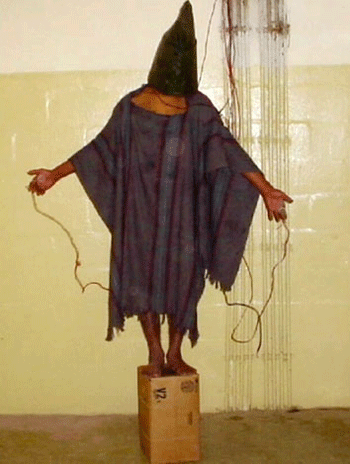 With what can only come across as cynical timing, the US Supreme Court on Monday, the day after the UN International Day in Support of the Victims of Torture, declined without comment to take up a lawsuit filed on behalf of 250 Iraqis — formerly prisoners at the notorious Abu Ghraib prison near Baghdad, home of the most significant scandal in the Bush administration’s “War on Terror,” which surfaced in April 2004 with the publication of photos showing the torture and abuse of Iraqi prisoners in US custody at the prison. The prisoners were seeking to hold Titan Corporation, which provided Arabic translation services, and CACI International, which provided interrogators, accountable for their role in the torture and abuse of prisoners at Abu Ghraib in 2003 and 2004.
Although a handful of serving US military personnel — eleven in total, referred to by President Bush as “a few bad apples” — were prosecuted for the abuse at Abu Ghraib, they were, in fact, scapegoated for implementing a policy that came from the highest levels of government, and which was designed to ensure that all aspects of the detention regime were dependant upon the whims of interrogators — as at Guantánamo, from where the system was exported by its commander, Maj. Gen. Geoffrey Miller, who was sent to “Gitmoize” Abu Ghraib with the results that the world saw to its horror in April 2004.
The case that was shunned by the Supreme Court on Monday, Saleh v. Titan Corporation, was an important attempt to extend accountability from the military to the contractors who make up such a huge part of America’s post-9/11 war machine, and who, unlike their official military counterparts, appear to be as much beyond the law as the senior administration officials — and their lawyers — who implemented, approved and oversaw every aspect of the “War on Terror” that should have shocked the conscience — involving torture, “extraordinary rendition,” secret prisons and the miseries of arbitrary detention at Guantánamo. As Human Rights First explained, “Army investigations implicated at least five private contractors in similar crimes,” although “no contractor was ever charged.” Read the rest of this entry »
Bradley Manning and WikiLeaks: New Film by the Guardian Tells His Troubling Story
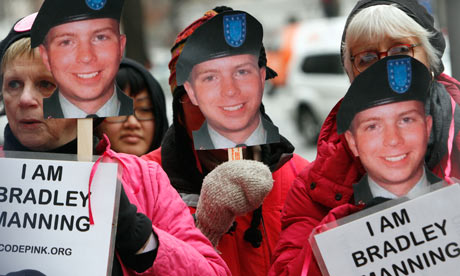 To mark the first anniversary of the arrest of Pfc. Bradley Manning, the alleged whistleblower responsible for leaking hundreds of thousands of classified US military documents and diplomatic cables to WikiLeaks, the Guardian has produced a 19-minute film, “The madness of Bradley Manning?” telling his story, and including elements that have not been reported before.
Arrested in Kuwait on May 26, 2010, after computer hacker Adrian Lamo, with whom he had apparently been communicating about his activities downloading confidential material and handing it on to WikiLeaks, reported him to the FBI, Manning was held in solitary confinement in a military brig in Quantico, Virginia, for nine months from July 2010 to April 2011, when he was moved to Fort Leavenworth in Texas, where some social interaction is allowed.
The film is available below, as are cross-posts of two Guardian stories published to accompany it, Bradley Manning: the bullied outsider who knew US military’s inner secrets and Bradley Manning: fellow soldier recalls ‘scared, bullied kid’. Read the rest of this entry »












 Who's still at Guantánamo?
