A Photographic Journey around Fitzrovia, Central London’s Former Bohemia


A Journey around Fitzrovia, Central London’s Former Bohemia, a set on Flickr.
On August 31, 2012, after I took part in a demonstration against the involvement of the multinational corporation Atos Healthcare in the government’s disgraceful disability reviews, designed to find disabled people for work when they are not, I cycled from Triton Square, where the protest had taken place — a small but highly corporate private development on the northern side of the Euston Road — through Fitzrovia — the area south of Euston Road, and north of Oxford Street, bounded by Gower Street to the east and Great Portland Street to the west — to Oxford Street, and then on to Trafalgar Square, across the river to Waterloo and back to my home in Brockley through Bermondsey.
I still have many hundreds of photos to post of trips I made in July and early August (before my family holiday in Italy) as part of my ongoing project to photograph the whole of London by bike, but in an effort to try and keep up with the trips I have made since returning from Italy, I’m making a concerted effort to post the most recent photos first, beginning with these. Read the rest of this entry »
A Place to Call Home: Photos of Brockley from Winter to Summer


A Place to Call Home: Brockley from Winter to Summer, a set on Flickr.
I have lived in London for 27 years, and for the last 12 years (13 in November) I have made my home — with my wife, and with the son who, prematurely, joined us shortly after moving here — in Brockley, on the hills above New Cross and Lewisham, and near the hill-top park of Hilly Fields, which commands fine views over to Blackheath and Greenwich, to the east, to Blythe Hill Fields to the south, and south east to Kent.
For decades, Brockley was a kind of secret village in south east London, home to artists, writers, musicians and various other bohemians, and affordable for those seeking to buy, whilst also providing generous allocations of social housing. In the 12 years since I came here, I have watched as coffee shops and delicatessens and bars and restaurants and gift shops have opened, where, in 1999, there were none — places like The Broca and Magi Gifts and The Orchard — which have brought the area to life, and although Brockley remains, at heart, the same clever, down-to- earth place it has been for decades, the upgrade of the East London Line and its incorporation into a London-wide Overground network, and regular publicity in the media’s property pages, has led to a recent influx of Yuppies. Read the rest of this entry »
Photos of London At Night: From the Olympics at Greenwich to Deptford and Surrey Quays


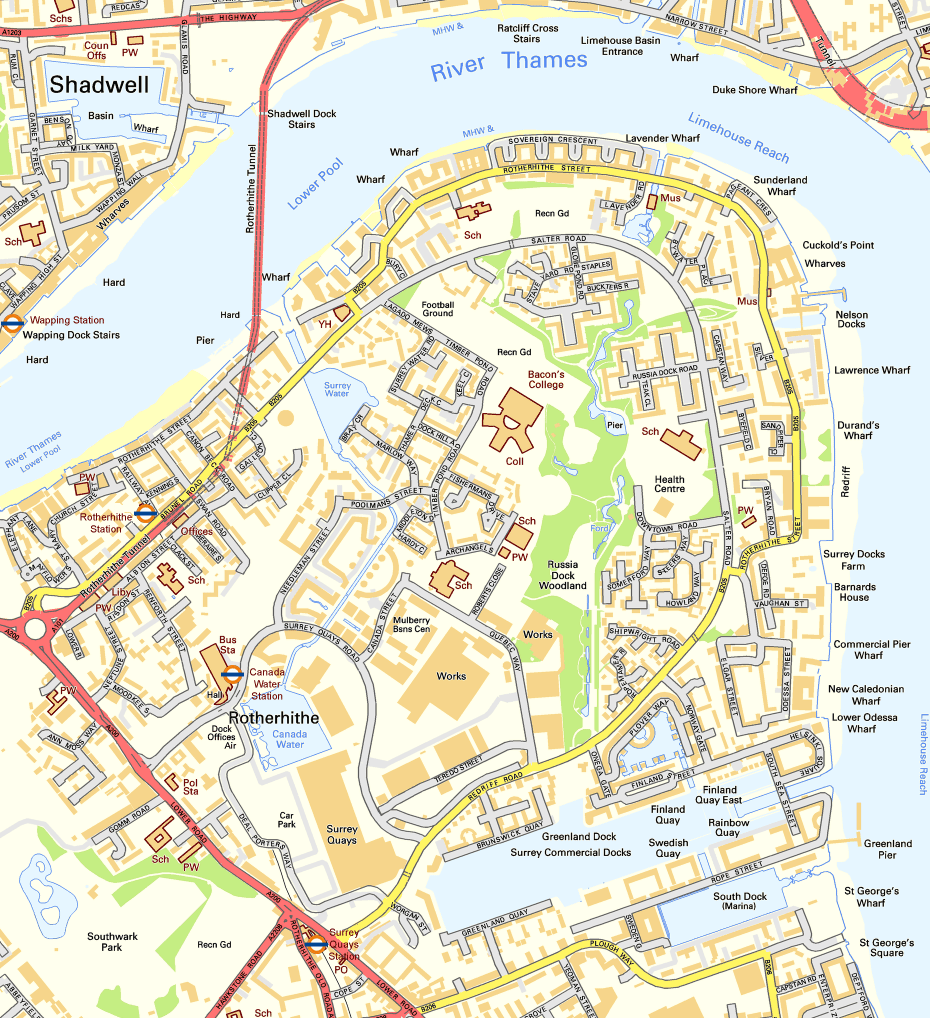
On August 8, 2012, as part of my ongoing project to photograph the whole of London by bike — and also to fully understand, both physically and mentally, the scale of the city and how its various neighbourhoods join together, I cycled down to Greenwich from my home in Brockley, and then along the River Thames through Deptford to Surrey Quays, and back, inland, to Deptford and home.
I was not alone on this journey, as I also took my son Tyler along as a bit of an adventure — for both of us — and we began by checking out the Olympic screen in the Old Royal Naval College in Greenwich, and then cycling through Deptford, partly on the Thames Path along the river, which I first recorded here, through the Pepys Estate (formerly part of Deptford’s extensive docks) to the remaining docks of Rotherhithe — the South Dock and the colossal Greenland Dock — which are the last of the docks that once covered the whole of Rotherhithe. Read the rest of this entry »
Real London: Photos of New Cross, Bermondsey and the Old Kent Road

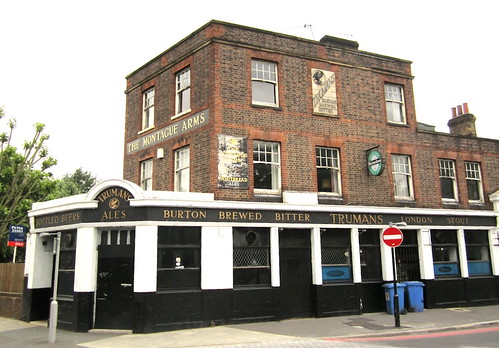


Real London: New Cross, Bermondsey and the Old Kent Road, a set on Flickr.
“Real London” is a short-hand, of course, for a London that is not the shiny one of glass and steel built and sold by property developers, and bought by those in the top few percent of earners — as well as by foreign investors. It is a world of workers, some of whom live in their own houses, having secured mortgages before the boom that began in the late 1990s, and often well before that, when it was still affordable for working people to take out mortgages and be able to repay them. Others live in social housing, built by local councils and run either by the councils or by housing associations, or, less frequently, owned or owned and managed by co-ops, and others have to cope with the increasingly greedy, unregulated private rental market . And amongst them, of course, are the unemployed — part of the current total of two and a half million unemployed people in the UK as a whole. According to the London Skills and Employment Observatory, 1.38 million people are currently either unemployed or “economically inactive” in London, and the unemployment rate is 8.9 percent.
These workers and homeowners were, perhaps, on salaries between the median and the average — currently £14,000 and £26,000, as I discussed in my article, The Housing Crisis and the Gulf Between the Rich and the Poor: Half of UK Workers Earn Less Than £14,000 A Year — but whereas in the past it would have been possible for a household on average or below average wages to buy a house, now it is completely impossible.
As I explained in a recent article, Unaffordable London: The Great Housing Rip-Off Continues, on a multiplier of three times earnings, which was how the housing market functioned before the Blair and Brown boom years, a couple buying a house in London for the average price — £388,000 — need a combined income of nearly £130,000, or something slightly less plus a whopping great deposit. Read the rest of this entry »
Unaffordable London: The Great Housing Rip-Off Continues
 On Monday, a rather unprecedented event occurred. The BBC, in its long-running but generally dumbed-down Panorama slot, broadcast a half-hour programme — Britain on the Brink: Back to the 70s? — which took off the blinkers, or the rose-coloured spectacles, that much of the mainstream media have clamped on Britain’s face since the cruel and incompetent Tories began laying waste to the British economy two years ago.
Those of us with any intelligence — and I don’t count George Osborne and David Cameron or any of the other clowns masquerading as functional ministers in this category — knew that the government’s claims that, despite all evidence to the contrary, savage austerity cuts to the state provision of almost services, accompanied by up to a million job losses, would allow the private sector to ride in on a white charger dispensing new jobs like confetti were the worst sort of fantasy. The truth, of course, is that savage austerity cuts always — always — mean an economic death spiral, and the only way out of a recession is to spend wisely to stimulate demand.
In addition, of course, those not blinded by having studied the propaganda that mostly passes for economics would also have realised that the private sector’s ability to provide answers has come to an end. In truth, the motto that private was better than public was largely a ruse of Margaret Thatcher’s to destroy Britain’s manufacturing, and then plunder the family silver for profit — the nationalised industries and some other necessary state-provided services. Read the rest of this entry »
The Housing Crisis and the Gulf Between the Rich and the Poor: Half of UK Workers Earn Less Than £14,000 A Year
 Note: For US readers, £14,000 is approximately $22,000.
In a new series, Breadline Britain, the Guardian is examining how the Tory-led government’s cuts are impacting on British families and individuals, and on the first day of the ongoing series, Amelia Hill provided an overview of the project, which has involved the Guardian commissioning a comprehensive study of the household finances of those in employment (or who are self-employed). As her introductory article explained:
Almost 7 million working-age adults are living in extreme financial stress, one small push from penury, despite being in employment and largely independent of state support … Unlike the “squeezed middle”, these 3.6m British households have little or no savings, nor equity in their homes, and struggle at the end of each month to feed themselves and their children adequately. They say they are unable to cope on their current incomes and have no assets to fall back on, leaving them vulnerable to something as simple as an unexpectedly large fuel bill.
Frank Field, the Labour MP for Birkenhead and former welfare minister, told the Guardian, “These figures are a mega-indictment on the mantra of both political parties, that work is the route out of poverty. What’s shocking about this is that these are people who want to work and are working but who, despite putting their faith in the politicians’ mantra, find themselves in another cul-de-sac. Recent welfare cuts and policy changes make it difficult to advise these people where they should turn to get out of it: it really is genuinely shocking.” Read the rest of this entry »
Rents Out of Control: How Londoners Are Being Fleeced by Greedy Landlords
 Yesterday, in my article bemoaning the baleful effect on London of hosting the Olympic Games, I touched upon a story that had emerged last week, when the BBC reported that tenants in east London were being evicted as their landlords sought to cash in on the Olympics, charging up to 20 times the normal rent. The BBC noted that one estate agent “said properties typically rented for £350 per week were being marketed for £6,000 per week,” and the housing charity Shelter said it had “seen increasing evidence of landlords giving tenants little time to leave or increasing rents hugely during the Olympics,” and worried that “the situation will get worse as the Games approach.”
This is pretty disgusting, although it should come as no surprise really, as Britain has, over my lifetime, became a country where any means of making money is regarded as laudable, and wealth is, in many ways, the only barometer of success.
However, even without this particularly excessive behaviour brought on by the Olympics, the rental market in London is out of control. A shortage of housing, an excess of demand, the eradication of empathy, and the casual greed that underpins the buy-to-let mentality has meant that families and individuals unable to get on a housing ladder that is out of reach for many people — as prices in London and the south east remain outrageously high — are being thoroughly fleeced by landlords who are not bound by any rules and regulations, and who can — and often do — treat them with disdain while milking them of half their wages or more. Read the rest of this entry »












 Who's still at Guantánamo?