While Tyrants Sleep: Photos of Canary Wharf at Night


While Tyrants Sleep: Canary Wharf at Night, a set on Flickr.
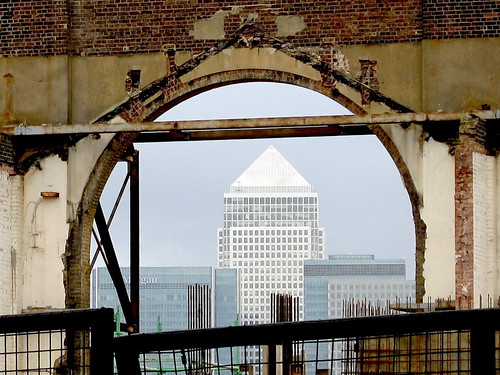
On November 14, 2012, as I explained in my previous photo set, “Curious Insomnia: A Journey through Deptford and Millwall to Canary Wharf at Night,” I decided, at 1am, to cycle from my home in Brockley, in south east London, down through Deptford and Greenwich, and through the Greenwich Foot Tunnel to the Isle of Dogs, where I cycled through Millwall, via the former docks and South Quay Plaza (and the DLR station) to Canary Wharf, the multi-towered financial centre and underground shopping complex that has been sucking the lifeblood out of the rest of London since it overcame its early wobbles under Margaret Thatcher and John Major, and became a magnet for dodgy unregulated bankers and obsessive materialists during the reign of Tony Blair.
It is, in fact, a place which, as Owen Hatherley explained in an excellent article for the Guardian last year (which I also drew on here), is responsible for “the most spectacular expression of London’s transformation into a city with levels of inequality that previous generations liked to think they’d fought a war to eliminate.” Read the rest of this entry »
Wake Up to the Injustice of Britain’s Housing Crisis
 Modern Britain is gripped by a cold-heartedness created by a sense of entitlement — not the entitlement to meagre benefits that is so shamefully touted by the Tory leaders of the coalition government as an excuse for hateful attacks on the welfare state, but the entitlement of those like David Cameron and George Osborne and those they represent, those who feel entitled to use clever accountants to avoid paying tax, both individually and in relation to the companies and corporations they support, and those who believe that it is acceptable to exploit others to live in the manner to which they believe they are entitled — which many people do through property.
These people, through their invented sense of entitlement, are presiding over the creation of the most hideously unequal society since before the time of the great Victorian reformers, who, in contrast, were inspired by a desire to help the poor rather than punish them, and were often inspired by the words and deeds of Jesus Christ. As a response to unfettered exploitation and hideous inequality, these reformers laid the foundations for the welfare state in the second half of the 19th century, foundations that were only fully realised through the establishment of the modern welfare state (including the creation of the NHS) by a Labour government after the Second World War.
However, in modern Britain, the notion of Christian charity is severely endangered by naked profiteers and those who, less obviously but no less damagingly, exploit those who cannot afford to buy their own homes to charge hideously expensive rents in a rental market that is unregulated by government, and is, moreover, one in which rampant greed has become commonplace. Read the rest of this entry »
The Death of Empathy in Cruel, Heartless Britain
 Last Wednesday, while George Osborne was delivering his Autumn Statement, taking aim at the most vulnerable members of society once more, with another savage attack on the welfare state, I was in central London, and I returned home after he had made his smug and visibly heartless performance in the House of Commons, when the Evening Standard was already announcing his new attack on the poor and disabled.
The Standard‘s headline — “George Osborne hits welfare for poor and raids pensions of rich” — was not exactly a ringing endorsement of the Chancellor’s statement, but it failed to dent the prejudices of the two women next to me, who were returning home, presumably from their office jobs. As they idly perused the paper, they complained about the amount of money the unemployed receive, followed swiftly by a complaint that they then sit around at home doing nothing. There was no mention of the fact that most of what the unemployed receive from the government goes to their landlords, or that there is still only one job for every five people who are unemployed, let alone the fact that a large proportion of benefits are actually paid to working people who aren’t otherwise paid enough money to survive on. Why let anything that might lead you to regard the unemployed as fellow human beings interfere with some knee-jerk bigotry?
Complaining that they too were suffering, they then spent the rest of their journey home — disturbingly, to Brockley, where I also live — rather undermining their case, by talking about party dresses and which gyms they attended. Read the rest of this entry »
Ex-Children’s Minister Sarah Teather Condemns Government’s Benefit Cap as Cruel and Immoral
 Hurrah for Sarah Teather, the Liberal Democrat MP for Brent Central, and the minister for children and families in the Tory-led coalition government until September, when she was sacked.
I was sorry to see Sarah under the yoke of this hideous government, because she clearly had more humanity than all the other ministers, and, although she undoubtedly was trying to do her best for those in need, it was also clear to me that she would be unable to do anything much that was worthwhile in a government so dedicated to making the poorest people in society suffer as much as possible. I knew of her humanity, and of her dedication as a constituency MP, because she had very actively campaigned for one of her constituents, Jamil El-Banna, a prisoner in Guantánamo who was released five years ago, and I had met her during that time.
On Sunday, Sarah Teather broke her silence in fine style, telling the Observer, in no uncertain terms, that the government’s welfare reforms are unacceptable, and that, in particular, the one-size-fits-all benefit cap, being introduced in April, is cruel and immoral. Read the rest of this entry »
Beautiful Dereliction: Photos of the Thames Shoreline by Convoys Wharf, Deptford


Beautiful Dereliction: The Thames Shoreline by Convoys Wharf, Deptford, a set on Flickr.
Regular readers might recall that, three weeks ago, I posted a set of photos of Deptford, the lively, historically important and frequently maligned area of south east London, between Greenwich and Rotherhithe along the River Thames, and also reaching inland up the River Ravensbourne (which is known, as it nears the Thames, as Deptford Creek). The set was entitled, “Deptford: A Life By The River Thames,” and in it I had the opportunity to discuss Convoys Wharf, a vast, derelict riverside site (40 acres, or 16 hectares) of huge historic importance, which, for the last ten years, has seen developers queuing up to turn it into some kind of inappropriate high-rise housing development for bankers and international investors, intended to include over 3,500 new homes for 9,000 people with the money required to buy into a project that is estimated to cost a billion pounds.
In that set, I also included a handful of photos from the shoreline in front of Convoys Wharf, where there is a listed pier, incorporated in the plans for the site, but only to be tarted up as though it were new , and — as has already been proposed — to serve as the location for a ferry to Canary Wharf, where many of those who would live in Convoys Wharf would, presumably, be working. Read the rest of this entry »
Sunny Sunday: Photos of the Isle of Dogs and Canary Wharf


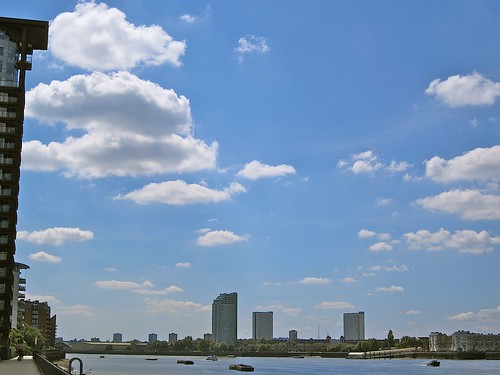
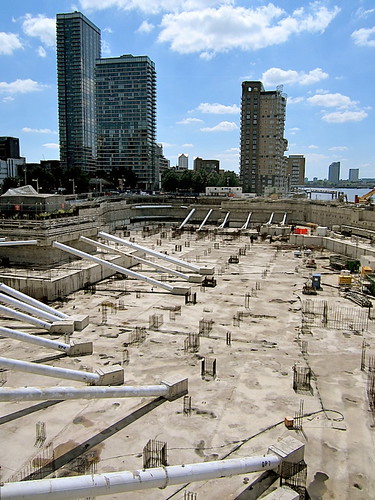

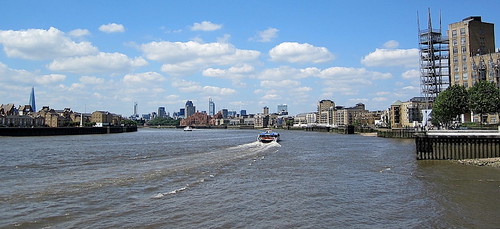


Sunny Sunday: The Isle of Dogs and Canary Wharf, a set on Flickr.
In my quest to catch up on posting some of the photos that I didn’t manage to post before my family holiday in Italy in August, this set and another to follow record a glorious Sunday in July when, with my family, I cycled from our home in Brockley, in south east London, down to Greenwich, through the Greenwich Foot Tunnel and along the western shore of the Isle of Dogs to Limehouse, and then on to Wapping, where our objective was to visit the Wapping Project, an art gallery and restaurant housed in Wapping Hydraulic Power Station, which was built in 1890 and closed in 1977.
This is the 43rd set of photos in my ongoing project to photograph the whole of London by bike, which is progressing extremely well, despite my inability to post the results to keep up with my photographic journeys, as I have 160 sets still to post, with more on the way on an almost daily basis. Come rain or shine, I am out on my bike, having discovered, after my illness last year, when I gave up smoking after 29 years, that being healthy, and relentlessly exploring this fascinating and sometimes infuriating city I live in, by bike, is the perfect antidote to years of imperilling my health by smoking like a madman and working obsessively on Guantánamo. Not that I’ve given up on Guantánamo, of course, as I still write regularly about the ongoing horrors of indefinite detention for the men still held there, and, just this week, published an exclusive article based on notes from a lawyer’s meeting with Shaker Aamer, the last British resident in the prison, which Shaker wanted to be made available to me. Read the rest of this entry »
Development Frenzy: Photos of the Regent’s Canal from St. Pancras Basin to King’s Cross


This set of photos is the 40th in my ongoing project to photograph the whole of London by bike, which I began in May, and it follows on from three previous sets recording a particular journey I made on September 3, 2012, when I cycled from Tottenham Court Road, up Hampstead Road to Mornington Crescent, and then along Camden High Street, through busy Camden with its many lively markets to the Regent’s Canal.
From there I cycled along the tow path of this wonderful artery that avoids the traffic-choked chaos of London’s roads to St. Pancras Basin and King’s Cross — or, to be specific, the King’s Cross development project that is currently underway, which, it seems to me, is rather dangerously at odds with the spirit of the canal, as a place of calm, and an antidote to the clamour of money that is so incessant elsewhere. Read the rest of this entry »
The First Squatter Is Jailed Since Being Homeless Was Criminalised by the Tories
 This afternoon, on my way back from a disturbing bike ride around Mayfair, where money is almost literally oozing out of every orifice of those who find it easier than ever to enrich themselves at the expense of society as a whole, I arrived back at Charing Cross, to catch the train back to south east London, where I was confronted by the front page of the Evening Standard announcing, “London Squatter First to Be Jailed,” which threw me into an angry depression.
The squatter in question — actually a 21-year old from Portsmouth, Alex Haigh, who only arrived in London in July — is indeed the first person to be jailed for squatting since the law on squatting was changed on September 1, transforming it from a civil to a criminal offence, punishable by a six-month prison sentence and a £5,000 fine.
Haigh was given a 12-week sentence after pleading guilty to squatting a property in Pimlico owned by the housing association L&Q (London & Quadrant), which, ironically, is supposed to be in the business of providing homes to those in need, like all providers of social housing. He is now in Wormwood Scrubs, where his accommodation for the next three months will be provided by the British taxpayer. Depriving people of their liberty costs, on average, between £27,000 and £29,000 a year, and £2.2 billion is spent in total on the 80,000-plus prisoners in England and Wales. Read the rest of this entry »
Photos of Deptford: A Life By The River Thames


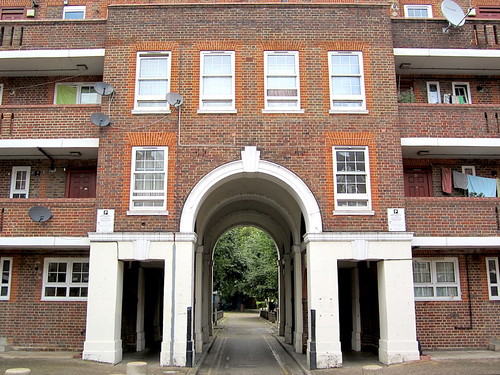




Deptford: A Life By The River Thames, a set on Flickr.
In May, when I first conceived of the notion of travelling the whole of London by bike, taking photos to compile a portrait of the city at this troubling time in its history (caught between the Olympics and its role as a harbour for the global rich on the one hand, and on the other subjected to the Tories’ ruinous and ideologically malignant “age of austerity”), the first places I visited were Greenwich and Deptford (or see here), down the hill from my home in Brockley, in south east London.
Greenwich, of course, is internationally renowned, and deservedly so, as it is the home of the Royal Observatory (and the location of the prime meridian), and is also the home of the recently renovated Cutty Sark tea clipper, and the splendid Royal Naval College.
Deptford, in contrast, Greenwich’s westerly neighbour and the site of the former Royal Dockyard, is unknown to many Londoners, and has few obvious attractions beyond its two historically significant churches — the Church of St. Nicholas on Deptford Green, where the playwright Christopher Marlowe is buried, and the Church of St. Paul, located off Deptford High Street. Read the rest of this entry »
A Future for Occupy? Why We Need A Campaign for Genuinely Affordable Housing
 A year ago, when Occupy Wall Street began, people occupying public spaces in large numbers and refusing to go home was innovative and radical, but then those spaces were reclaimed by the establishment — with violence, or through legal machinations — essentially bringing the first phase in this new era of protest and activism to an end.
Anyone thinking that the Occupy movement has gone away, however, is missing the point. Just as the movement introduced a powerful new concept — the 99 percent versus the 1 percent — into political discourse, so the complaints that motivated people to occupy public spaces in the first place have not gone away.
Essentially, we live in a broken system, broken by criminals who have not been held responsible for their actions, criminals on Wall Street and in the City of London and Canary Wharf, motivated by greed on a colossal scale, who, aided and abetted by venal and/or stupid politicians, crashed the global economy in 2008 but then got away with it.
Saved by government bailouts, the criminals continue to live lives of almost unprecedented wealth and greed, while the rest of the people — the 99 percent — are being made to pay for the crimes of these thieves through savage austerity programs that are driven by malignant ideologies and are also, it should be noted, economically suicidal. Read the rest of this entry »












 Who's still at Guantánamo?
