The Evil Empire Isn’t Russia; It’s Fossil Fuel-Based Capitalism, Waging Apocalyptic War on the Planet and the Whole of Humanity

Please support my work as a reader-funded investigative journalist, commentator and activist. If you can help, please click on the button below to donate via PayPal.
Since Russia invaded Ukraine 15 months ago, the West has been subjected to a pro-war propaganda campaign, on Ukraine’s behalf, on a scale not seen since the run-up to the illegal invasion of Iraq in 2003.
I don’t mean to suggest in any way that we shouldn’t feel sympathy for the people of Ukraine, but the relentless reporting of their suffering, which dominated the news, to the exclusion of almost everything else, for several months after the war began, was so all-pervasive that it was difficult to recognize — or to remember — that, as is powerfully explained in ‘Why Are We in Ukraine?’, a major new article for Harper’s Magazine by Benjamin Schwarz and Christopher Layne, the war didn’t happen because Vladimir Putin is a figure of pure evil, but because of over 30 years of provocation by the US.
Since the fragmentation of the Soviet Union, between 1989 and 1991, the US has sought to erase the reality that its relationship with Russia is, necessarily, one of two vast and different political entities, each bristling with nuclear weapons, and has, instead, increasingly regarded itself as the world’s sole superpower, entitled to use NATO to encroach further and further on Russian territory, despite Secretary of State James Baker, in February 1990, convincing Mikhail Gorbachev to give up East Germany by telling him that, if he did so, NATO would “not shift one inch eastward from its present position.”
Life After Guantánamo: Attorney Tells the Story of a Father and Son Freed, But Separated By 1,850 Miles
 Back in 2006, when I began working full-time on Guantánamo, researching the stories of the men held there for my book The Guantánamo Files, which was published in September 2007, the main research I undertook involved a detailed analysis of 8,000 pages of documents relating to the prisoners that had been released in 2006 as a result of freedom of information submissions and federal lawsuits submitted by the Associated Press.
The documents consisted primarily of unclassified allegations against the prisoners and transcripts of various review processes — the Combatant Status Review Tribunals (CSRTs) and Administrative Review Boards (ARBs) — that had been conducted from 2004 onwards, purportedly to establish the status of the prisoners, although these processes were so one-sided and what passed for evidence was generally so poor that, as the AP put it, all the transcripts generally revealed about the prisoners was “the often vague reasons the United States used for locking them up.”
Also included in the releases by the Pentagon were the first ever lists of the prisoners that had been made public, and, although all the files released required significant cross-referencing to create a coherent account of all the prisoners held at Guantánamo, past and present, I was able, over a period of 14 months, to do just that, producing the first — and still the only — comprehensive account of all the prisoners who, in such a cavalier and unsubstantiated manner, had been described by the Bush administration as “the worst of the worst.”
The overwhelming majority of the men held — I would say as many as 97 percent of the 779 men held throughout Guantánamo’s history (of whom 116 remain) — had no involvement with terrorism, and were either humble foot soldiers for the Taliban or civilians unlucky enough to be in the wrong time and the wrong place while the US was handing out substantial bounty payments to its Afghan and Pakistani allies for anyone who could be packaged up as being involved with al-Qaeda and/or the Taliban. Read the rest of this entry »
New Evidence Casts Doubt on US Claims that Three Guantánamo Deaths in 2006 Were Suicides
 Eight years ago, on June 10, 2006, the world awoke to the news that three men — Yasser Al-Zahrani, Ali Al-Salami and Mani Al-Utaybi — had died at the Bush administration’s “war on terror” prison at Guantánamo Bay, Cuba. The authorities claimed that the three men had committed suicide, and, notoriously, as I explained in an article last year, “The Season of Death at Guantánamo,” the prison’s commander, Rear Adm. Harry B. Harris Jr., “attracted widespread criticism by declaring that the deaths were an act of war. Speaking of the prisoners, he said, ‘They are smart, they are creative, they are committed. They have no regard for life, neither ours nor their own. I believe this was not an act of desperation, but an act of asymmetrical warfare waged against us.'”
Doubts were immediately expressed about whether it was possible, in a facility well-known for the persistent monitoring of the prisoners, for three men to manage to kill themselves without any guards noticing, and questions were also asked about how, even if the men had evaded surveillance, they had actually managed to kill themselves when they were allowed almost no possessions in their cells.
It took until August 2008 for the official report on the deaths, conducted by the Naval Criminal Investigative Service (NCIS), to be made available, but as I explained in an article at the time, the investigators “unreservedly backed up the suicide story” by reporting that “Autopsies were performed by physicians from the Armed Forces Institute of Pathology at Naval Hospital Guantánamo on June 10 and 11. The manner of death for all detainees was determined to be suicide and the cause of death was determined to be by hanging, the medical term being ‘mechanical asphyxia.'” Read the rest of this entry »




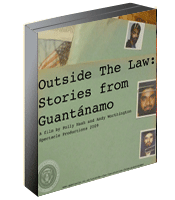







 Who's still at Guantánamo?
