Seriously Ill Egyptian and a Yemeni Freed from Guantánamo in Bosnia and Montenegro; Another Refuses to Leave
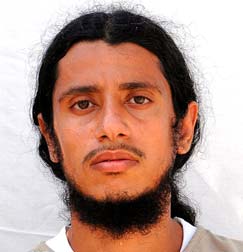 On Wednesday, with exactly one year left until the end of Barack Obama’s presidency, two more prisoners were released from Guantánamo, leaving 91 men still held. A third man was supposed to have been freed, but he refused at the last minute.
One of the two men freed, Tariq al-Sawah (ISN 535), also identified as Tariq El-Sawah, who is 58 years old, had gained some notoriety in the past — first as a disillusioned former training camp instructor who had become a welcome informant in Guantánamo, and then as he became seriously overweight, endangering his health. At one point, he weighted 420 pounds, double his weight on arrival at the prison in 2002.
In 2013, as his lawyers sought his release because of his ill-health and his cooperation, I explained how he “had high-level support for his release,” having “received letters of recommendation from three former Guantánamo commanders,” as the Associated Press described it. I stated, “One, Rear Adm. David Thomas, recommended his release in his classified military file (his Detainee Assessment Brief) in September 2008, which was released by WikiLeaks in 2011 … In that file, al-Sawah’s health issues were also prominent. It was noted that he was ‘closely watched for significant and chronic problems’ that included high cholesterol, diabetes and liver disease.” Read the rest of this entry »
The “Countdown to Close Guantánamo” Launches: Send in Your Photos Asking President Obama to Fulfill His Promise to Close the Prison
 I wrote the following article for the “Close Guantánamo” website, which I established in January 2012 with US attorney Tom Wilner. Please join us — just an email address is required to be counted amongst those opposed to the ongoing existence of Guantánamo, and to receive updates of our activities by email. In the photo here, former Guantánamo prisoner Shaker Aamer supports the new “Countdown to Close Guantánamo” initiative. See more on the Celebrity Photos page and also the Public Photos page, and please send in your own photos — see below for details!
January 20, 2016 marked the beginning of the last year of the Obama presidency, and tomorrow (January 22) marks the seventh anniversary of President Obama’s promise to close the lawless prison at Guantánamo Bay within a year, which he made on his second day in office in January 2009. To highlight the president’s last chance to fulfill his promise to close the prison, the “Close Guantánamo” campaign has launched a new initiative, the “Countdown to Close Guantánamo.”
The “Countdown to Close Guantánamo” encourages celebrities, lawmakers and concerned members of the public, from the US and around the world, to take photos of themselves holding signs counting down to the end of the Obama presidency, urging President Obama to close the prison before the inauguration of the next president on January 20, 2017.
Our first poster, reading, “President Obama, you have one year left to close Guantánamo,” was made available when the campaign launched, on Jan, 20. It is being followed, throughout the year, by posters counting down every 50 days — so “350 days” is on February 4, “300 days” will be on March 25, and so on.
Please print off the 350 days poster, take a photo of yourself holding it, and send it to: info@closeguantanamo.org.
Fayiz Al-Kandari is Free! The Last Kuwaiti in Guantánamo Is Released, Plus a Saudi: Now 103 Men Remain
 For Fayiz al-Kandari, the last Kuwaiti held at Guantánamo, who turned 40 at the prison in 2015, there is finally justice, as he was released on Friday January 10 and sent back home, over 14 years after he was first seized in Afghanistan, where, he always maintained, he had traveled to engage in humanitarian aid work.
Fayiz’s release, and that of another prisoner, a Saudi, appears to provide a demonstration of President Obama’s renewed commitment to close Guantánamo in his last year in office, as four men have now been freed in the last few days, and 13 more releases are expected soon. Without a doubt, it also provides further vindication that the Periodic Review Board process at Guantánamo — established in 2013 to review the cases of all the prisoners not already approved for release or facing trials — is working. in the cases of both men, they were recommended for continued imprisonment after PRBs, but were then reviewed again, when they both worked harder to convince the boards that they pose no threat and want only to rebuild their lives in peace — as, it should be noted, do most of the 103 men still held.
Of the 18 cases so far decided in PRBs, 15 have ended with recommendation for the release of the prisoners — a great result when all were previously regarded as “too dangerous to release” — although the process is moving far too slowly. Those 18 cases took over two years, and 42 other men are awaiting reviews, which will not be completed until 2020 at the current pace. If President Obama is serious about closing Guantánamo, he needs to find a way to speed up the process considerably in his last 12 months in office. Read the rest of this entry »
President Obama on Closing Guantánamo
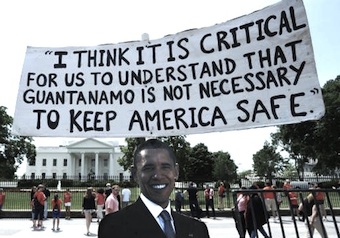 I wrote the following article for the “Close Guantánamo” website, which I established in January 2012 with US attorney Tom Wilner. Please join us — just an email address is required to be counted amongst those opposed to the ongoing existence of Guantánamo, and to receive updates of our activities by email.
A week before Christmas, at a press conference, President Obama spoke about Guantánamo, and we wanted to make sure that our supporters know exactly what he said, as it is significant for the coming year — Obama’s last in office — to know what he has planned, and what he thinks of the opposition to his plans in Congress, where Republicans have been imposing restrictions on his ability to release prisoners and to close the prison for most of his presidency, including a ban on bringing prisoners to the US mainland for any reason.
Below are President Obama’s comments, interspersed with our commentary. We hope you find it useful. The president’s comments came in response to a question by the journalist David Jackson.
David Jackson: Thank you, Mr. President. A Gitmo question. Congress has made it pretty clear that they’re just not going to let you transfer prisoners to the United States for trial. But some people think you already have the executive authority to transfer those prisoners and close Gitmo itself next year. My question is, do you believe you have that authority and are you willing to exercise it to close that place? Read the rest of this entry »
Playing Politics with the Closure of Guantánamo
 I wrote the following article for the “Close Guantánamo” website, which I established in January 2012 with US attorney Tom Wilner. Please join us — just an email address is required to be counted amongst those opposed to the ongoing existence of Guantánamo, and to receive updates of our activities by email.
Supporters of the “Close Guantánamo” campaign have long been aware that the very existence of the “war on terror” prison at the US naval base in Guantánamo Bay, Cuba is an affront to all notions that the United States respects justice and the rule of law, and we remember that as the closure of the prison becomes, yet again, an undignified game of political football, with Congress continuing to erect obstacles to the release of prisoners and the transfer of anyone to the US mainland for any reason, and the Obama administration trying to come up with a workable plan for the prison’s closure.
Although Congress, the week after the 9/11 attacks, passed a law — the Authorization for Use of Military Force — that purports to justify the detention of prisoners without charge or trial at Guantánamo, and the Supreme Court ruled in June 2004 that the government can hold them until the end of hostilities, this thin legal veneer has persistently failed to disguise the fact that everything about Guantánamo is wrong.
The Bush administration established the prison to be beyond the reach of the US courts, and for nearly two and a half years the men — and boys — held there had no rights whatsoever. In a second decision delivered in June 2004, the Supreme Court ruled that they had habeas corpus rights, a decision that allowed lawyers into the prison, breaking the veil of secrecy that had shrouded the prison for all that time, enabling torture and other forms of abuse to take place. Even so, it was not until June 2006 that the Supreme Court, in another ruling, reminded the administration that no one can be held without rights, and that Common Article 3 of the Geneva Conventions, which prohibits torture and “humiliating and degrading treatment,” applied to everyone in US custody. Read the rest of this entry »
Five Yemenis Freed from Guantánamo, Given New Homes in the United Arab Emirates
 There’s good news from Guantánamo, as five Yemenis, approved for release from the prison in 2005, 2007 and 2014, have finally been freed, and given new homes in the United Arab Emirates.
As the New York Times reported, the resettlement “was the first of its kind to the United Arab Emirates, which had previously taken in just one former Guantánamo detainee, in 2008 — its own citizen,” Abdullah al-Hamiri, whose story I discussed here.
The Times also explained that, “In May, President Obama met at Camp David with leaders or representatives of the six Middle Eastern countries that make up the Gulf Cooperation Council, including a representative from the United Arab Emirates. The main topic of discussion was the nuclear agreement with Iran, but officials familiar with the deliberations said Mr. Obama had also pressed them to consider resettling groups of detainees. The deal announced on Sunday appears to be the first fruits of those talks.” Read the rest of this entry »
Periodic Review Board Approves Release of Fayiz Al-Kandari, the Last Kuwaiti in Guantánamo
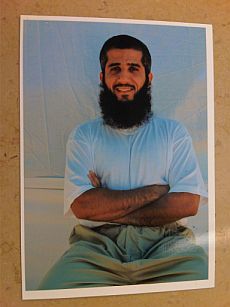 I wrote the following article for the “Close Guantánamo” website, which I established in January 2012 with US attorney Tom Wilner. Please join us — just an email address is required to be counted amongst those opposed to the ongoing existence of Guantánamo, and to receive updates of our activities by email.
On Thursday, the same day that it was announced that a Moroccan prisoner, Younous Chekkouri, had been repatriated from Guantánamo, it was also announced that Fayiz al-Kandari, the last Kuwaiti in the prison, had been approved for release by a Periodic Review Board.
The PRBs are made up of representatives of the Departments of State, Defense, Justice and Homeland Security, as well as the office of the Director of National Intelligence and the Office of the Joint Chiefs of Staff, and they are slowly making their way through the cases of 46 men designated for ongoing imprisonment without charge or trial by the high-level, inter-agency Guantánamo Review Task Force that President Obama established in 2009, and 25 others initially recommended for prosecution until the legitimacy of Guantánamo’s military commissions was shredded by US judges in 2012 and 2013.
And in case you’re wondering — yes, it is unacceptable that a task force appointed by President Obama recommended 46 men for ongoing imprisonment without charge or trial — on the basis that they are “too dangerous to release,” but that insufficient evidence exists to put them on trial — because that means it is not evidence, but dubious information that would not stand up to objective scrutiny — the fruits of torture or other abuse, or of the bribery or exhaustion of prisoners, who were relentlessly encouraged to rat on their fellow prisoners or to incriminate themselves. Read the rest of this entry »
Disgraceful US Justice Department Secretly Blocks Release from Guantánamo of Gravely Ill Hunger Striker Tariq Ba Odah
 “Wonderful.” This is the only word that Guantánamo prisoner Tariq Ba Odah said, over and over, as he “looked through photos of vigils and protests, tweets and Facebook posts, and dozens of articles about efforts to free him” from Guantánamo, at a meeting last week with his lawyer, Omar Farah, of the New York-based Center for Constitutional Rights.
Tariq, as regular readers will know, is a Yemeni, and a long-term hunger striker, who has been refusing food since 2007, and is force-fed on a daily basis. He now weighs just 74.5 pounds, and is at risk of death, but the Obama administration refuses to help him. Three weeks ago, I wrote about his lawyers’ efforts to have a US judge order his release because of the very real risk he faces of imminent death.
Tariq’s plight sparked media interest — and gasps of horror from anyone still sensitized enough, after nearly 14 years of the “war on terror” declared by the Bush administration after the terrorist attacks of September 11, 2001, to realize that a man weighing just 74.5 pounds would look like a survivor of — or a corpse at — the concentration camps run by the Nazis. Read the rest of this entry »
Ignoring President Obama, the Pentagon Blocks Shaker Aamer’s Release from Guantánamo
 I’m just back from a fortnight’s family holiday in Turkey (in Bodrum and Dalyan, for those interested in this wonderful country, with its great hospitality, history and sights), and catching up on what I missed, with relation to Guantánamo, while I was away. My apologies if any of you were confused by my sudden disappearance. I was working so hard up until my departure that I didn’t have time to put up an “on holiday” sign here before heading off.
Those of you who are my friends on Facebook or who follow me there will know that I managed to leave a brief message there, announcing my intention to be offline for most of the two-week period — and encouraging you all to take time off from the internet and your mobile devices for the sake of your health!). While away, my Facebook friends will also know that I touched on one of the most significant Guantánamo stories to take place during my absence — the disgraceful revelation that, despite having been approved for release in 2010 by a thorough, multi-agency US government review process (the Guantánamo Review Task Force, established by President Obama shortly after taking office in January 2009), Shaker Aamer, the last British resident in the prison, is still being held because of obstruction by the Pentagon, and, moreover, that the Pentagon has specifically been blocking his release since October 2013.
The story appeared in the Guardian on August 13, following a Washington Post article three days earlier, in which, during a discussion about the Obama administration’s quest for a prison on the US mainland that could be used to hold Guantánamo prisoners, it was noted that, in a meeting last month with President Obama’s top national security officials, defense secretary Ashton Carter “indicated he was inclined to transfer Shaker Aamer.” By law, the defense secretary must certify that steps have been taken to mitigate any possible risk posed by released prisoners, and provide Congress with 30 days’ notice of any planned releases. Read the rest of this entry »
Write to the Guantánamo Prisoners, Don’t Let Them Be Forgotten
 Every six months, I ask people to write to the prisoners in Guantánamo, to let them — and the US authorities — know that they have not been forgotten.
The letter-writing campaign was started five years ago by two Facebook friends, Shahrina J. Ahmed and Mahfuja Bint Ammu, and it has been repeated every six months (see here, here, here, here, here, here, here and here for my articles encouraging opponents of Guantánamo to write to the prisoners). Their latest campaign coincided with the start of Ramadan, on June 12, and I’m following up in the hope that, as Ramadan continues, you too can send a letter to some or all of the men to let them know they’ve not been forgotten.
Since the start of February, when — slightly belatedly — I last encouraged opponents of Guantánamo to write to the prisoners, just six men have been released. 116 men are now held — 44 cleared for release in January 2010 by the high-level, inter-agency Guantánamo Review Task Force established by President Obama when he took office in 2009, and eight others cleared for release in the last year and a half by a new review process, the Periodic Review Boards, which started in 2013.
In the list below, I have divided the remaining 116 prisoners into those cleared for release (52), those listed as being eligible for Periodic Review Boards (54) and those charged or tried in the military commissions system (10). Please note that I have largely kept the spelling used by the US authorities in the “Final Dispositions” of the Guantánamo Review Task Force, which was released through FOIA legislation in June 2013. Even though these names are often inaccurate, they are the names by which the men are officially known in Guantánamo — even though, in their everyday dealings with the US authorities, they are all still referred to, not as human beings with names, but as numbers. Read the rest of this entry »












 Who's still at Guantánamo?
