Photos: Grenfell 1st Anniversary – The Silent Walk and the Solidarity March
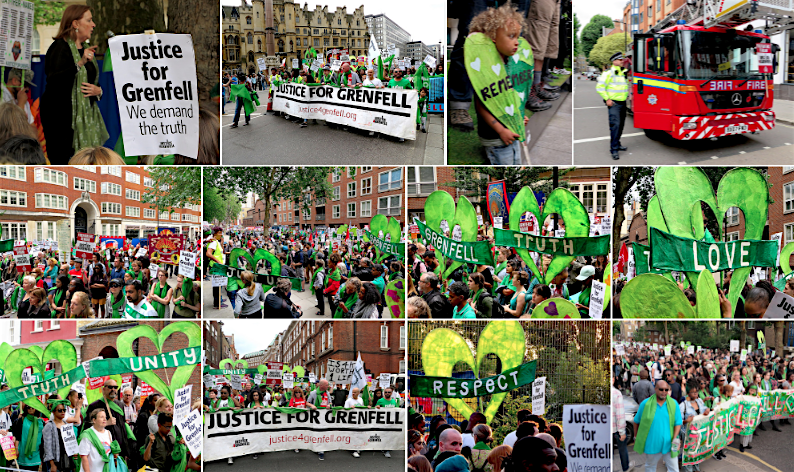 Please check out my photo sets on Flickr – of the Silent Walk in Kensington on June 14, 2018 and of the Solidarity March in central London on June 16, 2018.
Please also feel free to support my work as a reader-funded investigative journalist, commentator and activist.
It’s just over a year since the defining event in the UK last year — the Grenfell Tower fire, an entirely preventable disaster in west London, in which 72 people died when an inferno engulfed a 24-storey tower block in North Kensington in west London, and I’m pleased to be posting photos from two recent Grenfell-related events as my contribution to trying to make sure that there is no let-up in the pressure for justice and accountability following the first anniversary of the disaster last June.
The first photo set is of the Silent Walk for Grenfell on the actual anniversary. Silent Walks have taken place on the 14th of every month since the fire, in the vicinity of the tower, and on the anniversary, on Thursday June 14, thousands of people turned up, from across London as well as from other places in the UK, to show solidarity with the survivors and the local community. The Silent Walks are extremely moving experiences, and the 1st anniversary walk was, of course, no exception.
The second photo set is from the Grenfell Solidarity March in central London, starting and ending outside 10 Downing Street, and including a visit to the Ministry of Housing, Communities and Local Government on Marsham Street, organised by the survivors’ group Justice4Grenfell and the Fire Brigades Union. Read the rest of this entry »
Grenfell One Year On: How Can We Feel Safe in a Country That Regards Everyone in Social Housing as Inferior?
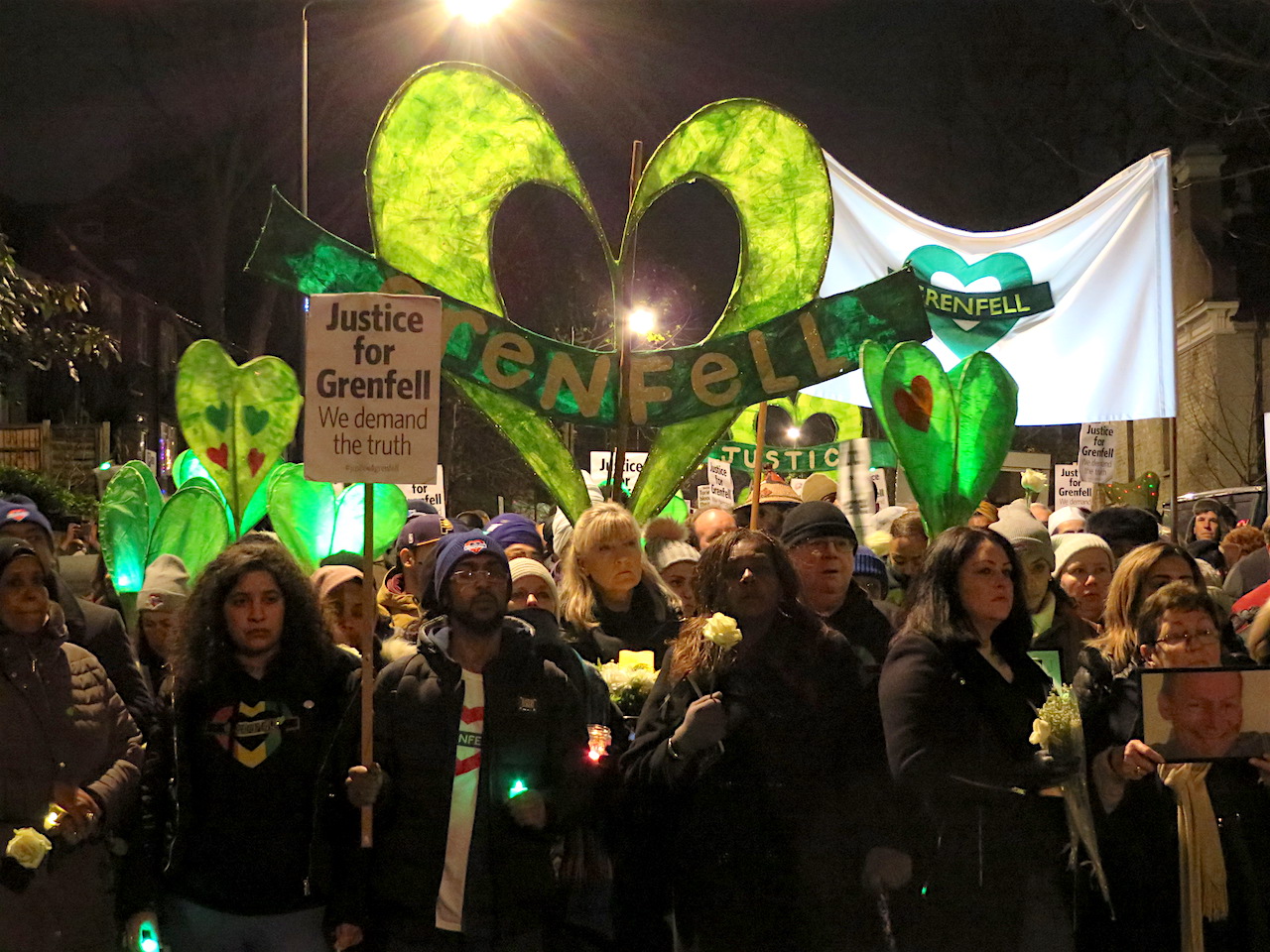 Exactly one year, ago, an inferno engulfed Grenfell Tower, a 24-storey tower block in north Kensington, in west London, with such speed and ferocity that 71 people died, and a 72nd person died this January as a result of injuries sustained that night.
It was a disaster that should never have happened, and the fact that it did cuts to the heart of how Britain operates in the 21st century.
The tower block was built of essentially incombustible concrete, and the process known as compartmentalisation was meant to ensure that any fire that broke out would be contained within the flat in which it broke out, with every other flat supposed to be able to resist the spread of fire for an hour, giving the fire services time to arrive on the scene.
In fact, fire leapt up the tower like nothing anyone had seen before, clearly indicating that every safety measure that was supposed to prevent an inferno had drastically failed. At the heart of the disaster were measures taken that had fatally corrupted the structural integrity of the tower. In order to make the tower appear more attractive, new cladding had been applied to it, but the cladding was flammable, and had created the inferno that took so many lives. Read the rest of this entry »
Photos: The Powerful Grenfell Protest Outside Parliament, May 14, 2018, and Updates About Safety Concerns
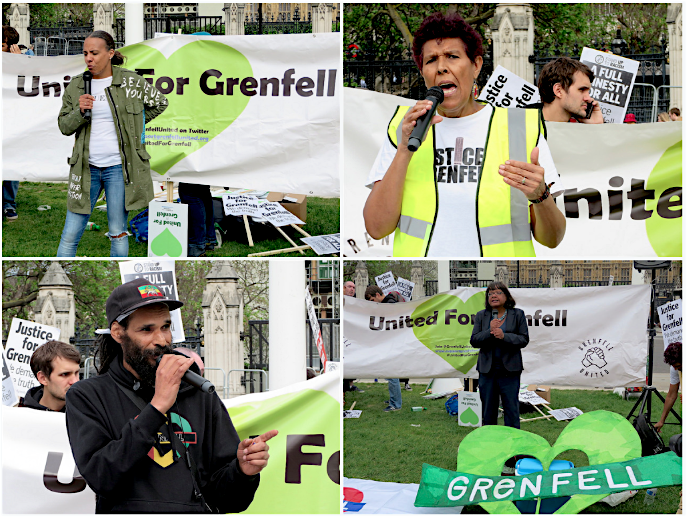 See my photos on Flickr here! And please support my work as a reader-funded investigative journalist, commentator and activist.
Please also check out ‘Grenfell’ by my band The Four Fathers, and please mark the following date in your diary: Saturday June 16, ‘One year on: Justice for Grenfell Solidarity March’, organised by Justice4Grenfell, starting outside 10 Downing St at noon.
Monday May 14, 2018 marked eleven months since the fire that engulfed Grenfell Tower, in north Kensington, killing over 70 people in an inferno that should never have occurred, and, to mark the occasion, survivors, members of the local community and supporters from across London converged on Parliament as MPs were preparing to debate the government’s response to the disaster, as I discussed in my previous article, Grenfell Campaigners Mark Eleven Months Since the Disaster That Killed 71, As MPs Debate the Government’s Response, written after I had attended the rally in Parliament Square
I also took photos, featuring representatives of survivors’ groups and the local community (including Justice4Grenfell and Grenfell United), which I have just posted to Flickr, so the purpose of this article is to provide a link to the photos, but also to provide some important updates on the Grenfell story that have emerged over the last few days.
The Parliamentary debate was taking place because, after the fire, Theresa May had announced the launch of an official inquiry, but campaigners wanted representatives from the local community to be involved, and launched a petition demanding this from the government, which secured the 100,000 signatures that made it eligible for a Parliamentary debate after grime star Stormzy promoted it to his many followers in February. Read the rest of this entry »
Celebrating One Year of My Photo Project ‘The State of London’; Now For An Exhibition and a Book!
 Please support my work as a reader-funded investigative journalist, photographer, commentator and activist.
Exactly one year ago, I began posting a photo a day on a Facebook page I had just established — ‘The State of London’ — from my archive of tens of thousands of photos taken of London, in all 120 of the capital’s postcodes, as well as some of the outlying boroughs, that I had built up over the previous five years.
I haven’t advertised ‘The State of London’ via Facebook, which some people suggest is a good way of getting supporters, but I’ve steadily built up a following over the last year of people who like my photo-journalistic take on the capital — photos, often accompanied by short essays, of the good, the bad and the ugly of London in the second decade of this tumultuous century. Someone more objective than me can probably analyse my taste, but I know that I’m bewitched by the light and the changing seasons, that I love catching photos on those outings when I get caught in storms or showers or torrential rain, that I love the river and its tributaries, and London’s canals, that I love the capital’s hills, its park, its trees, and that I also see almost everything with a political eye.
On my endless, restless journeys, I see everything that is happening with the built environment, but when I started in 2012, in the year of the Olympic hype, in which big money was savagely reshaping the Lea valley, I was appalled by the jingoism and empty patriotism, but I didn’t fully comprehend how, in the years that followed, the broken capitalist model that had almost killed itself through 2008’s self-inflicted global economic crash would end up working out that the only way left to guarantee huge and unjustifiable profits for the lazy rich was for the UK establishment, and those who aspire to it, to cannibalistically feed off its own people, through housing. Read the rest of this entry »










 Who's still at Guantánamo?
