How the Law Failed at Guantánamo

Please support my work as a reader-funded journalist! I’m currently trying to raise $2500 (£2000) to support my writing and campaigning on Guantánamo and related issues over the next three months. If you can help, please click on the button below to donate via PayPal.
Just five days ago, on July 11, the prison at Guantánamo Bay marked another sad and unjustifiable milestone in its long history — nineteen and a half years since it first opened on January 11, 2002.
From the beginning, Guantánamo was a project of executive overreach — of the US government, under George W. Bush, deciding, after the 9/11 attacks, that the normal rules governing the imprisonment of combatants during wartime should be swept aside. The men who arrived at Guantánamo were deprived of the protections of the Geneva Conventions, and were designated as “unlawful enemy combatants,” who, the Bush administration claimed, could be held indefinitely. For those who were to be charged with crimes, the Bush administration revived the military commission trial system, last used for German saboteurs in the Second World War, deciding that acts of terrorism — and even some actions that were a normal part of war, such as engaging in firefights — were war crimes. The result was that soldiers came to be regarded as terrorists, and alleged terrorists came to be regarded as warriors, with the former denied all notions of justice, and the latter provided only with a legal forum that was intended to lead to their execution after cursory trials.
The mess that ensued has still not been adequately addressed. Nearly two and a half years after Guantánamo opened, the Supreme Court took the unusual step of granting habeas corpus rights to wartime prisoners, having recognized that the men held had no way whatsoever to challenge the basis of their imprisonment if, as many of them claimed, they had been seized by mistake. That ruling, Rasul v. Bush, allowed lawyers into the prison, to begin preparing habeas corpus cases, but on the same day, in another ruling, Hamdi v. Rumsfeld, the Supreme Court essentially approved Guantánamo as the venue for the exercise of a parallel version of the wartime detention policies of the Geneva Conventions, ruling that prisoners could be held until the end of hostilities — an unwise move, given that the Bush administration regarded its “war on terror” as a global war that ignored geographical context, and could last for generations.
On UN Torture Day, Please Remember the 40 Torture Victims Still Held at Guantánamo

Please support my work as a reader-funded journalist! I’m currently trying to raise $2500 (£2000) to support my writing and campaigning on Guantánamo and related issues over the next three months. If you can help, please click on the button below to donate via PayPal.
Today, June 26, is the UN International Day in Support of Victims of Torture, which was first established 23 years ago, on June 26, 1998, to mark the 11th anniversary of the day that, in 1987, the UN Convention Against Torture and Other Cruel, Inhuman or Degrading Treatment or Punishment came into effect.
The long struggle against the use of torture began nearly 40 years before, on December 10, 1948, when, as the UN explains, “the international community condemned torture and other cruel, inhuman or degrading treatment in the Universal Declaration of Human Rights adopted by the United Nations General Assembly.”
Created in response to the horrors of the Second World War, the Universal Declaration of Human Rights represented an aspiration for a better world, which “set out, for the first time, fundamental human rights to be universally protected.” Now translated into over 500 languages, it is “widely recognized”, as the UN also explains, “as having inspired, and paved the way for, the adoption of more than seventy human rights treaties, applied today on a permanent basis at global and regional levels,” including the Convention Against Torture.
Abu Zubaydah Files Complaint About Torture and Ongoing Imprisonment at Guantánamo with UN Arbitrary Detention Experts

Please support my work as a reader-funded journalist! I’m currently trying to raise $2500 (£2000) to support my writing and campaigning on Guantánamo and related issues over the next three months. If you can help, please click on the button below to donate via PayPal.
On Friday, Abu Zubaydah (Zayn al-Abidin Muhammad Husayn), a notorious victim of torture in the CIA’s “black site” program, who has been held without charge or trial at Guantánamo since September 2006, submitted a complaint to the UN Working Group on Arbitrary Detention, regarding the lawless nature of his imprisonment and treatment since he was first seized in a house raid in Pakistan in March 2002.
The case has been submitted by Helen Duffy, Abu Zubaydah’s international legal representative since 2010, who represented him in his successful cases before the European Court of Human Rights regarding his “black site” detention in Poland and Lithuania, and the complaint accuses seven countries of having responsibility for his long imprisonment and mistreatment — not only (and primarily) the US, but also Thailand, Poland, Morocco, Lithuania and Afghanistan, the five countries in which he was held in “black sites” over a period of four and a half years, and the UK, which is accused of having “participated in other ways in the ‘global spider’s web’ of complicity in rendition,” primarily via “estimates that UK personnel were involved in approximately 2,000-3,000 interviews of CIA detainees in the aftermath of 9/11”, as indicated by the findings of the UK Parliament’s Intelligence and Security Committee (ISC) in 2019.
In a press release, Duffy explains that this is “the first international case brought by Zubaydah against the United States,” and is also “the first time that international legal action is taken against the UK, Afghanistan, Morocco and Thailand for their complicity in the US rendition and secret detention program.” In addition it is “the first time that a case has been brought against all states participating in an individual’s rendition and torture and ongoing unlawful detention at Guantánamo.”
Torture Victims Lead Call for Torture Apologists Avril Haines and Mike Morell Not to be Confirmed as Director of National Intelligence and CIA Director

Please support my work as a reader-funded journalist! I’m currently trying to raise $2500 (£2000) to support my writing and campaigning on Guantánamo and related issues over the next three months. If you can help, please click on the button below to donate via PayPal.
I’m delighted to be a signatory to an open letter, initiated by Medea Benjamin of CODEPINK and Marcy Winograd of Progressive Democrats of America and CODEPINKCONGRESS, urging President-elect Joe Biden not to nominate Mike Morell as CIA Director, and asking the Senate not to approve Biden’s nominee Avril Haines as Director of National Intelligence (the head of the 16 branches of the US Intelligence Community) — and I’m particularly gratified that I was able to reach out to a number of former Guantánamo prisoners to encourage them to sign the letter.
Both Morell and Haynes have a troubling history of defending torture. Morell, who was a CIA analyst under George W. Bush, and Deputy and Acting CIA Director under Barack Obama, defended the use of torture when speaking to VICE in 2015. “I don’t like calling it torture for one simple reason: to call it torture says my guys were torturers,” he said, adding, “I’m gonna defend my guys till my last breath.” As Medea Benjamin and Marcy Winograd explained in an article for Common Dreams yesterday, Morell “put his CIA buddies above truth, the law and basic decency.”
Hopefully, as they also noted, “Morell’s traction may be on the wane with the Biden administration … after progressives launched a campaign against [him], and Senator Ron Wyden — a powerful Democrat on the Senate Intelligence Committee — called him a ‘torture apologist’ and said his appointment to head the CIA was a ‘non starter.’”
In Historic Ruling, Case of Four Survivors of CIA Rendition and “Black Site” Torture To Be Heard By Inter-American Commission on Human Rights

Please support my work as a reader-funded journalist! I’m currently trying to raise $2500 (£2000) to support my writing and campaigning on Guantánamo and related issues over the next three months of the Trump administration. If you can help, please click on the button below to donate via PayPal.
I wrote the following article for the “Close Guantánamo” website, which I established in January 2012, on the 10th anniversary of the opening of Guantánamo, with the US attorney Tom Wilner. Please join us — just an email address is required to be counted amongst those opposed to the ongoing existence of Guantánamo, and to receive updates of our activities by email.
When it comes to the crimes committed by the US government in the brutal “war on terror” declared after the terrorist attacks of September 11, 2001, the wheels of justice move so slowly that their motion is almost imperceptible.
A case in point involves four survivors of the CIA’s rendition and torture program — British residents Binyam Mohamed and Bisher al-Rawi, Abou Elkassim Britel, an Italian citizen, and Mohamed Farag Ahmad Bashmilah, a Yemeni. Also see my extensive archive about Binyam Mohamed’s case, which I covered in great detail in 2008 and 2009.
Last month, on July 8, in what the ACLU accurately described as a “historic decision,” the Inter-American Commission on Human Rights — an international human rights tribunal based in Washington, D.C., which reviews cases throughout the Americas, and whose judgments are meant to be binding on the states involved — determined that the four men, “survivors of the US secret detention and torture program,” have “the right to present their case before the regional tribunal.”
Military Judge Rules That Terrorism Sentence at Guantánamo Can Be Reduced Because of CIA Torture

Please support my work as a reader-funded journalist! I’m currently trying to raise $2500 (£2000) to support my writing and campaigning on Guantánamo and related issues over the next three months of the Trump administration. If you can help, please click on the button below to donate via PayPal.
I wrote the following article for the “Close Guantánamo” website, which I established in January 2012, on the 10th anniversary of the opening of Guantánamo, with the US attorney Tom Wilner. Please join us — just an email address is required to be counted amongst those opposed to the ongoing existence of Guantánamo, and to receive updates of our activities by email.
It’s been nearly two years since I last reported on the military commission trial system at Guantánamo, which is less an oversight than a tacit acknowledgement that the entire system is broken, a facsimile of justice in which the defense teams for those put forward for trials are committed to exposing the torture to which their clients were subjected in secret CIA “black sites,” while the prosecutors are just as committed to keeping that information hidden.
I’m pleased to be discussing the commissions again, however, because, in a recent ruling in the case of “high-value detainee” Majid Khan, a judge ruled that, as Carol Rosenberg described it for the New York Times, “war court judges have the power to reduce the prison sentence of a Qaeda operative at Guantánamo Bay, Cuba, as a remedy for torture by the CIA.”
When I last visited the commissions, the chief judge, Army Col. James L. Pohl, who had also been the judge on the case of the five men accused of involvement in the 9/11 attacks since the men were arraigned in May 2012, had just caused a stir by ruling that confessions obtained by so-called “clean teams” of FBI agents, after the men were moved to Guantánamo from the CIA “black sites” where their initial confessions were obtained through the use of torture, would not be admitted as evidence. In a second blow, he announced his resignation.
Uzair Paracha, Victim of Tortured Terrorism Lies, is Freed from US Jail; Why Is His Father Still at Guantánamo?
Please support my work as a reader-funded journalist! I’m currently trying to raise $2500 (£2000) to support my writing and campaigning on Guantánamo and related issues over the next three months of the Trump administration. If you can help, please click on the button below to donate via PayPal.
I wrote the following article for the “Close Guantánamo” website, which I established in January 2012, on the 10th anniversary of the opening of Guantánamo, with the US attorney Tom Wilner. Please join us — just an email address is required to be counted amongst those opposed to the ongoing existence of Guantánamo, and to receive updates of our activities by email.
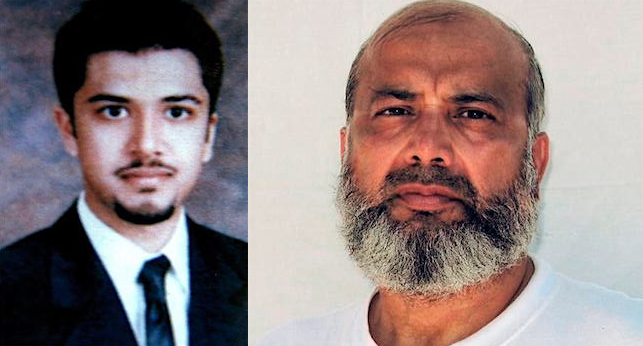
For anyone who has been paying attention not only to the long and horribly unjust Guantánamo saga, but also to the stories of others held in other circumstances as part of the “tangled web” of the “war on terror,” the recent announcement that Uzair Paracha, a Pakistani national, has been released from a US jail and repatriated after 17 years in prison, with a judge throwing his conviction out of court, is extremely good news.
If there is any justice, Uzair Paracha’s release ought to secure the release from Guantánamo of his father, Saifullah, although, when it comes to Guantánamo, of course, it has rarely been the case that anything involving that prison has ever had any meaningful connection to justice.
I first came across Saifullah Paracha’s story in 2006, while researching my book The Guantánamo Files, and I came across his son’s story in 2007, which prompted me to write about a possible miscarriage of justice in my article, Guantánamo’s tangled web: Khalid Sheikh Mohammed, Majid Khan, dubious US convictions, and a dying man.
International Criminal Court Authorizes Investigation into War Crimes in Afghanistan, Including US Torture Program

Please support my work as a reader-funded journalist! I’m currently trying to raise $2500 (£2000) to support my writing and campaigning on Guantánamo and related issues over the next three months of the Trump administration. If you can help, please click on the button below to donate via PayPal.
Good news from The Hague, as the Appeals Chamber of the International Criminal Court (ICC) has approved an investigation into war crimes and crimes against humanity committed in Afghanistan since May 2003 “by US armed forces and members of the CIA, the Taliban and affiliated armed groups, and Afghan government forces,” as the Center for Constitutional Rights (CCR) explained in a press release.
The investigation, as CCR also explained, will include “crimes against humanity and war crimes … committed as part of the US torture program,” not only in Afghanistan but also in “the territory of other States Parties to the Rome Statute implicated in the US torture program”; in other words, other sites in the CIA’s global network of “black site” torture prisons, which, notoriously, included facilities in Poland, Romania and Lithuania. As CCR explained, “Although the United States is not a party to the ICC Statute, the Court has jurisdiction over crimes committed by US actors on the territory of a State Party to the ICC,” and this aspect of the investigation will look at crimes committed since July 1, 2002.
AS CCR also explained, “The investigation marks the first time senior US officials may face criminal liability for their involvement in the torture program.”
As Torture Rears Its Ugly Head at Guantánamo, Let’s Not Forget That the Entire Prison Must Be Closed

Please support my work as a reader-funded journalist! I’m currently trying to raise $2500 (£2000) to support my writing and campaigning on Guantánamo and related issues over the next three months of the Trump administration. If you can help, please click on the button below to donate via PayPal.
I wrote the following article for the “Close Guantánamo” website, which I established in January 2012, on the 10th anniversary of the opening of Guantánamo, with the US attorney Tom Wilner. Please join us — just an email address is required to be counted amongst those opposed to the ongoing existence of Guantánamo, and to receive updates of our activities by email.
2020 has, to date, been noteworthy for how much attention has been focused on Guantánamo, the US naval base in Cuba that is home to the “war on terror” prison established in January 2002, and also to the inappropriately named Camp Justice, where trial proceedings for some of the men held in the prison take place.
First up was the 18th anniversary of the opening of the prison, on January 11, when campaigners from numerous NGOs and campaigning groups — including Close Guantánamo — held a rally outside the White House to call for the prison’s closure. I flew over from the UK to take part in this rally, as I have done every year since 2011, and then stayed on for a week to take part in two speaking events, six radio interviews, and an interview with RT, the only TV interview in the whole of the US broadcast media that dealt with the anniversary.
I returned to the UK on January 20, just as a second round of more prominent Guantánamo-related activity began at Camp Justice. For the first time in many years, dozens of journalists had flown to the naval base for the latest round — the 40th, astonishingly, since hearings began in 2012 — of pre-trial hearings for the proposed trial of Khalid Sheikh Mohammed and four other men accused of involvement in the terrorist attacks of September 11, 2001.
As “The Report,” About the CIA Torture Program, Is Released Online, Guantánamo Prisoner Ahmed Rabbani Urges People to Watch It

Please support my work as a reader-funded journalist! I’m currently trying to raise $2500 (£2000) to support my writing and campaigning on Guantánamo and related issues over the next three months of the Trump administration. If you can help, please click on the button below to donate via PayPal.
Two weeks ago I published an article about the new movie “The Report” — which looks at the CIA’s post-9/11 torture program — entitled, CIA Torture Report Author Says More Than 119 Prisoners Were Held in “Black Sites” and More Than Three Were Waterboarded, in which I drew on a Vice News interview with former Senate staffer Daniel J. Jones, the lead author of the Senate Intelligence Committee’s report into the torture program, on which the film is based.
Jones — and his team — are true American heroes, having, despite considerable opposition, trawled through six million CIA documents to produce a 6,700-page report that, via its 500-page executive summary, which is all that has been publicly released, is unstinting in its denunciation of the brutality and pointlessness of the torture program. I made his comments available — and focused in particular on the troubling statistics in the article’s title — because I thought it was extremely significant that Jones concluded that there were clearly more than the 119 prisoners included in the report, because the CIA “had no idea how many people they detained,” and that more than three prisoners were subjected to waterboarding, because, as he says, “We found a picture of a waterboard at a detention site where there were no records of any waterboarding taking place, but it had clearly been used.”
“The Report” had its theatrical release on November 15, to generally enthusiastic reviews — an 83% approval rating on the movie aggregator site Rotten Tomatoes, based on 178 reviews, with 83% approval from audiences too. Last week, I spoke about it on a US radio show, and in just three days’ time, on November 29, it will be released on Amazon Prime.











 Who's still at Guantánamo?
