Never-Ending Injustice: State Secrets and the Torture of Abu Zubaydah

Please support my work as a reader-funded journalist! I’m currently trying to raise $2500 (£2000) to support my writing and campaigning on Guantánamo and related issues over the next three months. If you can help, please click on the button below to donate via PayPal.
I wrote the following article for the “Close Guantánamo” website, which I established in January 2012, on the 10th anniversary of the opening of Guantánamo, with the US attorney Tom Wilner. Please join us — just an email address is required to be counted amongst those opposed to the ongoing existence of Guantánamo, and to receive updates of our activities by email.
On Wednesday, the Supreme Court heard arguments in the case of the notorious torture victim and Guantánamo prisoner Abu Zubaydah, for whom the US’s post-9/11 torture program was invented. Zubaydah, whose real name is Zayn al-Abidin Muhammad Husayn, was held and tortured in CIA “black sites” for four and a half years, after his capture in a house raid in Pakistan in March 2002, until his eventual transfer to Guantánamo with 13 other so-called “high-value detainees” in September 2006, and he has been held there without charge or trial ever since.
Wednesday’s hearing was the result of an appeal by the government against a ground-breaking ruling two years ago, by the Ninth Circuit Court of Appeals, in which the judges openly declared that Abu Zubaydah had been tortured. It was, as Abu Zubaydah’s attorney, Cornell University law professor Joseph Margulies, explained, “the first time an appellate court” had “come right out and said that the enhanced interrogation techniques were torture.”
While this was significant, it wasn’t the main topic of the case, which involved the state secrets privilege, whereby government officials can argue that sensitive information whose disclosure, they claim, might endanger national security, must not be disclosed in a court. Abu Zubaydah’s lawyers were — and still are — seeking permission for the architects of the torture program, the contractors James Mitchell and Bruce Jessen, to be questioned about the details of his torture while he was held in a “black site” in Poland, in 2002-03, after his initial torture in a “black site” in Thailand in 2002, for use in the Polish government’s ongoing investigation.
On the 20th Anniversary of the 9/11 Attacks, the US Needs to Close Guantánamo and Bring to an End the Broken Military Commission Trials

Please support my work as a reader-funded journalist! I’m currently trying to raise $2500 (£2000) to support my writing and campaigning on Guantánamo and related issues over the next three months. If you can help, please click on the button below to donate via PayPal.
I wrote the following article for the “Close Guantánamo” website, which I established in January 2012, on the 10th anniversary of the opening of Guantánamo, with the US attorney Tom Wilner. Please join us — just an email address is required to be counted amongst those opposed to the ongoing existence of Guantánamo, and to receive updates of our activities by email.
On the 20th anniversary of the terrorist attacks of September 11, 2001, the United States’ response to those attacks, both militarily and in terms of the law, couldn’t, in all honesty, have ended up more broken, unjust and embarrassing.
Having invaded Afghanistan a month after the attacks, the last US troops withdrew last month, effectively conceding defeat to the Taliban, whose overthrow had been one of the two justifications for the invasion, the other being the destruction of Al-Qaeda, the organization allegedly responsible for the attacks.
In fact, the Taliban were quite swiftly defeated after the US-led invasion, but, instead of withdrawing, US forces stayed on, blundering around the country, largely unable to identify allies from enemies, and definitively losing “heart and minds” through repeated bombing raids, often based on poor intelligence, that killed an enormous number of Afghan civilians, and through imprisoning many thousands of Afghans in lawless and often brutal conditions at Bagram and Guantánamo.
How the Law Failed at Guantánamo

Please support my work as a reader-funded journalist! I’m currently trying to raise $2500 (£2000) to support my writing and campaigning on Guantánamo and related issues over the next three months. If you can help, please click on the button below to donate via PayPal.
Just five days ago, on July 11, the prison at Guantánamo Bay marked another sad and unjustifiable milestone in its long history — nineteen and a half years since it first opened on January 11, 2002.
From the beginning, Guantánamo was a project of executive overreach — of the US government, under George W. Bush, deciding, after the 9/11 attacks, that the normal rules governing the imprisonment of combatants during wartime should be swept aside. The men who arrived at Guantánamo were deprived of the protections of the Geneva Conventions, and were designated as “unlawful enemy combatants,” who, the Bush administration claimed, could be held indefinitely. For those who were to be charged with crimes, the Bush administration revived the military commission trial system, last used for German saboteurs in the Second World War, deciding that acts of terrorism — and even some actions that were a normal part of war, such as engaging in firefights — were war crimes. The result was that soldiers came to be regarded as terrorists, and alleged terrorists came to be regarded as warriors, with the former denied all notions of justice, and the latter provided only with a legal forum that was intended to lead to their execution after cursory trials.
The mess that ensued has still not been adequately addressed. Nearly two and a half years after Guantánamo opened, the Supreme Court took the unusual step of granting habeas corpus rights to wartime prisoners, having recognized that the men held had no way whatsoever to challenge the basis of their imprisonment if, as many of them claimed, they had been seized by mistake. That ruling, Rasul v. Bush, allowed lawyers into the prison, to begin preparing habeas corpus cases, but on the same day, in another ruling, Hamdi v. Rumsfeld, the Supreme Court essentially approved Guantánamo as the venue for the exercise of a parallel version of the wartime detention policies of the Geneva Conventions, ruling that prisoners could be held until the end of hostilities — an unwise move, given that the Bush administration regarded its “war on terror” as a global war that ignored geographical context, and could last for generations.
On UN Torture Day, Please Remember the 40 Torture Victims Still Held at Guantánamo

Please support my work as a reader-funded journalist! I’m currently trying to raise $2500 (£2000) to support my writing and campaigning on Guantánamo and related issues over the next three months. If you can help, please click on the button below to donate via PayPal.
Today, June 26, is the UN International Day in Support of Victims of Torture, which was first established 23 years ago, on June 26, 1998, to mark the 11th anniversary of the day that, in 1987, the UN Convention Against Torture and Other Cruel, Inhuman or Degrading Treatment or Punishment came into effect.
The long struggle against the use of torture began nearly 40 years before, on December 10, 1948, when, as the UN explains, “the international community condemned torture and other cruel, inhuman or degrading treatment in the Universal Declaration of Human Rights adopted by the United Nations General Assembly.”
Created in response to the horrors of the Second World War, the Universal Declaration of Human Rights represented an aspiration for a better world, which “set out, for the first time, fundamental human rights to be universally protected.” Now translated into over 500 languages, it is “widely recognized”, as the UN also explains, “as having inspired, and paved the way for, the adoption of more than seventy human rights treaties, applied today on a permanent basis at global and regional levels,” including the Convention Against Torture.
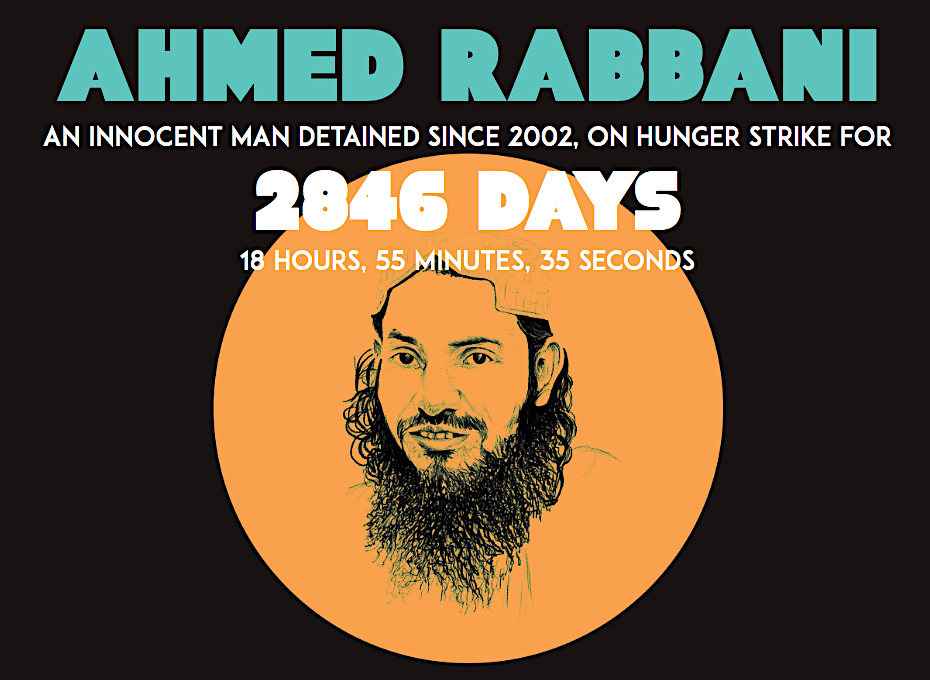
As You Read This, Guantánamo Prisoner Ahmed Rabbani Has Been On A Hunger Strike for 2,846 Days
Please support my work as a reader-funded journalist! I’m currently trying to raise $2500 (£2000) to support my writing and campaigning on Guantánamo and related issues over the next three months. If you can help, please click on the button below to donate via PayPal.
With the media spotlight hopefully being shone anew on the prison at Guantánamo Bay, now that Joe Biden has been elected as the US president, it is to be hoped that, as I explained in my recent article, President Elect Biden, It’s Time to Close Guantánamo, arrangements will be made to release the five men still held who were unanimously approved for release by high-level government review processes under President Obama, and that there will be an acceptance within the Biden administration that holding 26 other men indefinitely without charge or trial is unacceptable.
These 26 men — accurately described as “forever prisoners” by the media — were recommended either or for prosecution, or for ongoing imprisonment without charge or trial, on the basis that they were “too dangerous to release,” even though it was acknowledged that insufficient evidence — or insufficient untainted evidence — existed for them to be charged, by the first of Obama’s two review processes, the Guantánamo Review Task Force, in 2009.
Four years later, the 26 — along with 38 others — were deemed eligible for a second review process, the Periodic Review Boards. Unlike the first process, which involved officials assessing whether prisoners should be freed, charged or held on an ongoing basis without charge or trial, the PRBs were a parole-type process, in which the men were encouraged to express contrition for the activities in which they were alleged to have been involved (whether those allegations were accurate or not), and to present credible proposals for a peaceful and constructive life if released.
In Historic Ruling, Case of Four Survivors of CIA Rendition and “Black Site” Torture To Be Heard By Inter-American Commission on Human Rights

Please support my work as a reader-funded journalist! I’m currently trying to raise $2500 (£2000) to support my writing and campaigning on Guantánamo and related issues over the next three months of the Trump administration. If you can help, please click on the button below to donate via PayPal.
I wrote the following article for the “Close Guantánamo” website, which I established in January 2012, on the 10th anniversary of the opening of Guantánamo, with the US attorney Tom Wilner. Please join us — just an email address is required to be counted amongst those opposed to the ongoing existence of Guantánamo, and to receive updates of our activities by email.
When it comes to the crimes committed by the US government in the brutal “war on terror” declared after the terrorist attacks of September 11, 2001, the wheels of justice move so slowly that their motion is almost imperceptible.
A case in point involves four survivors of the CIA’s rendition and torture program — British residents Binyam Mohamed and Bisher al-Rawi, Abou Elkassim Britel, an Italian citizen, and Mohamed Farag Ahmad Bashmilah, a Yemeni. Also see my extensive archive about Binyam Mohamed’s case, which I covered in great detail in 2008 and 2009.
Last month, on July 8, in what the ACLU accurately described as a “historic decision,” the Inter-American Commission on Human Rights — an international human rights tribunal based in Washington, D.C., which reviews cases throughout the Americas, and whose judgments are meant to be binding on the states involved — determined that the four men, “survivors of the US secret detention and torture program,” have “the right to present their case before the regional tribunal.”
Military Judge Rules That Terrorism Sentence at Guantánamo Can Be Reduced Because of CIA Torture

Please support my work as a reader-funded journalist! I’m currently trying to raise $2500 (£2000) to support my writing and campaigning on Guantánamo and related issues over the next three months of the Trump administration. If you can help, please click on the button below to donate via PayPal.
I wrote the following article for the “Close Guantánamo” website, which I established in January 2012, on the 10th anniversary of the opening of Guantánamo, with the US attorney Tom Wilner. Please join us — just an email address is required to be counted amongst those opposed to the ongoing existence of Guantánamo, and to receive updates of our activities by email.
It’s been nearly two years since I last reported on the military commission trial system at Guantánamo, which is less an oversight than a tacit acknowledgement that the entire system is broken, a facsimile of justice in which the defense teams for those put forward for trials are committed to exposing the torture to which their clients were subjected in secret CIA “black sites,” while the prosecutors are just as committed to keeping that information hidden.
I’m pleased to be discussing the commissions again, however, because, in a recent ruling in the case of “high-value detainee” Majid Khan, a judge ruled that, as Carol Rosenberg described it for the New York Times, “war court judges have the power to reduce the prison sentence of a Qaeda operative at Guantánamo Bay, Cuba, as a remedy for torture by the CIA.”
When I last visited the commissions, the chief judge, Army Col. James L. Pohl, who had also been the judge on the case of the five men accused of involvement in the 9/11 attacks since the men were arraigned in May 2012, had just caused a stir by ruling that confessions obtained by so-called “clean teams” of FBI agents, after the men were moved to Guantánamo from the CIA “black sites” where their initial confessions were obtained through the use of torture, would not be admitted as evidence. In a second blow, he announced his resignation.
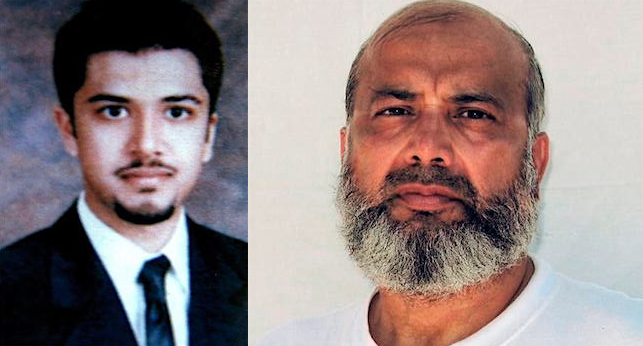
Uzair Paracha, Victim of Tortured Terrorism Lies, is Freed from US Jail; Why Is His Father Still at Guantánamo?
Please support my work as a reader-funded journalist! I’m currently trying to raise $2500 (£2000) to support my writing and campaigning on Guantánamo and related issues over the next three months of the Trump administration. If you can help, please click on the button below to donate via PayPal.
I wrote the following article for the “Close Guantánamo” website, which I established in January 2012, on the 10th anniversary of the opening of Guantánamo, with the US attorney Tom Wilner. Please join us — just an email address is required to be counted amongst those opposed to the ongoing existence of Guantánamo, and to receive updates of our activities by email.
For anyone who has been paying attention not only to the long and horribly unjust Guantánamo saga, but also to the stories of others held in other circumstances as part of the “tangled web” of the “war on terror,” the recent announcement that Uzair Paracha, a Pakistani national, has been released from a US jail and repatriated after 17 years in prison, with a judge throwing his conviction out of court, is extremely good news.
If there is any justice, Uzair Paracha’s release ought to secure the release from Guantánamo of his father, Saifullah, although, when it comes to Guantánamo, of course, it has rarely been the case that anything involving that prison has ever had any meaningful connection to justice.
I first came across Saifullah Paracha’s story in 2006, while researching my book The Guantánamo Files, and I came across his son’s story in 2007, which prompted me to write about a possible miscarriage of justice in my article, Guantánamo’s tangled web: Khalid Sheikh Mohammed, Majid Khan, dubious US convictions, and a dying man.
International Criminal Court Authorizes Investigation into War Crimes in Afghanistan, Including US Torture Program

Please support my work as a reader-funded journalist! I’m currently trying to raise $2500 (£2000) to support my writing and campaigning on Guantánamo and related issues over the next three months of the Trump administration. If you can help, please click on the button below to donate via PayPal.
Good news from The Hague, as the Appeals Chamber of the International Criminal Court (ICC) has approved an investigation into war crimes and crimes against humanity committed in Afghanistan since May 2003 “by US armed forces and members of the CIA, the Taliban and affiliated armed groups, and Afghan government forces,” as the Center for Constitutional Rights (CCR) explained in a press release.
The investigation, as CCR also explained, will include “crimes against humanity and war crimes … committed as part of the US torture program,” not only in Afghanistan but also in “the territory of other States Parties to the Rome Statute implicated in the US torture program”; in other words, other sites in the CIA’s global network of “black site” torture prisons, which, notoriously, included facilities in Poland, Romania and Lithuania. As CCR explained, “Although the United States is not a party to the ICC Statute, the Court has jurisdiction over crimes committed by US actors on the territory of a State Party to the ICC,” and this aspect of the investigation will look at crimes committed since July 1, 2002.
AS CCR also explained, “The investigation marks the first time senior US officials may face criminal liability for their involvement in the torture program.”
In Abu Zubaydah Court Case, US Judges Admit That He Was Tortured

Please support my work as a reader-funded journalist! I’m currently trying to raise $2500 (£2000) to support my writing and campaigning on Guantánamo and related issues over the next three months of the Trump administration. If you can help, please click on the button below to donate via PayPal.
When it comes to the disgraceful US prison at Guantánamo Bay, where men are held — on a seemingly endlessly basis — without charge or trial, and where many of the 40 men still held were the victims of torture in CIA “black sites” before their arrival at the prison, the dominant reaction, from the mainstream US media and the American people in general, as Guantánamo nears the 18th anniversary of its opening, is one of amnesia.
With the valiant exception of Carol Rosenberg, who has been visiting the prison since it opened, and who, these days, is often the only journalist visiting and paying attention to its despairing prisoners and its broken trials, the mainstream media largely pays little or no attention to Guantánamo, as was apparent in June, when a significant court victory for the prisoners — challenging the long-standing nullification of the prisoners’ habeas corpus rights, dating back to 2011 — was completely ignored. I wrote about it here for Close Guantánamo, and also posted it here, where it secured significant interest from the small community of people who still care about the injustices of Guantánamo, but it was dispiriting that no one else noticed.
Two weeks ago, the mainstream US media once more largely failed to notice a significant court ruling relating to Guantánamo — and the US torture program — which was delivered by judges in the Ninth Circuit Court of Appeals in relation to Abu Zubaydah, held at Guantánamo since September 2006, and the prisoner for whom the CIA’s torture program was first developed back in 2002.











 Who's still at Guantánamo?
