Guantánamo Resettlements in Turmoil as Oman Forcibly Repatriates Yemenis Given New Homes Between 2015 and 2017

Please support my work as a reader-funded journalist! I’m currently trying to raise $2500 (£2000) to support my writing and campaigning on Guantánamo and related issues over the next three months. If you can help, please click on the button below to donate via PayPal.
I wrote the following article for the “Close Guantánamo” website, which I established in January 2012, on the 10th anniversary of the opening of Guantánamo, with the US attorney Tom Wilner. Please join us — just an email address is required to be counted amongst those opposed to the ongoing existence of Guantánamo, and to receive updates of our activities by email.
In genuinely dispiriting news, Spencer Ackerman has reported, via his Forever Wars website, that the majority of the 28 former Guantánamo prisoners from Yemen who were resettled in Oman between 2015 and 2017 have been forcibly repatriated to their home country over the last few weeks.
The news is particularly dispiriting because, until now, the Sultanate of Oman had appeared to be one of the most successful countries involved in resettling former Guantánamo prisoners, all unanimously approved for release by high-level US government review processes, but who could not be safely repatriated.
This was either because the State Department regarded it as unsafe for them to be sent home (on the basis of human rights concerns, or concerns about their potential recruitment or targeting by forces hostile to the US), or because provisions inserted by Republicans into the annual National Defense Authorization Act (NDAA) proscribe certain countries, including Yemen, from receiving their citizens (again, for reasons of national security), or, in a few cases, because they were essentially stateless.
Video and Report: The Incredibly Powerful “Close Guantánamo!” Event in the EU Parliament, September 28, 2023

Please support my work as a reader-funded journalist! I’m currently trying to raise $2500 (£2000) to support my writing and campaigning on Guantánamo and related issues over the next three months. If you can help, please click on the button below to donate via PayPal.
I’m just back from the most extraordinary three-day trip to Brussels, the centrepiece of which was “Close Guantánamo!,” an astonishing and deeply moving three-hour event in the EU Parliament featuring nine speakers.
Three of the speakers were former prisoners, including Mansoor Adayfi, held for over 14 years at Guantánamo and subsequently resettled in Serbia, where, after nearly seven years, he has only this year secured a passport and been able to travel outside the country. Also speaking were two lawyers, a UN Rapporteur and myself, as well as the former Muslim Chaplain at the prison, and the relative of a victim of the 9/11 attacks.
The full video is below, via YouTube, and I hope that you have time to watch it, and that you’ll share if if you find it as inspiring as those who attended it, and those who took part in it. An edited version will hopefully be available soon, including the contents of PowerPoint presentations that were made by some of the speakers, which are not visible in this recording of the event, and the removal of some of the dead time — for example, the general milling about between the first and second sessions.
Sep. 28: EU Parliament Holds “Most Significant Gathering Ever Assembled on Guantánamo”, With Former Prisoners, Lawyers, Myself and Others

Please support my work as a reader-funded journalist! I’m currently trying to raise $2500 (£2000) to support my writing and campaigning on Guantánamo and related issues over the next three months. If you can help, please click on the button below to donate via PayPal.
POSTSCRIPT: See here for my report about, and the video of the event, plus photos.
On Thursday September 28, a very special event, described by its organizers as “the most significant gathering ever assembled on Guantánamo in the European Parliament,” is taking place in Brussels.
Ten speakers will be taking part in the event, which runs from 9am until noon. Three are former prisoners — Mansoor Adayfi, a Yemeni held for 14 years, who was resettled in Serbia in 2016, and is the author of the devastating memoir, “Don’t Forget Us Here: Lost and Found at Guantánamo,” published in 2021, which manages, simultaneously, to be harrowing, hilarious and full of humanity; Moazzam Begg, the author of “Enemy Combatant,” published in 2006; and Lakhdar Boumediene, an Algerian resettled in France in 2009, who is the co-author, with Mustafa Art Idr, of “Witnesses of the Unseen: Seven Years in Guantánamo,” published in 2017.
Also attending is Fionnuala Ní Aoláin, the UN Special Rapporteur on the Promotion and Protection of Human Rights and Fundamental Freedoms while Countering Terrorism, who was the first Rapporteur to visit Guantánamo, earlier this year, and whose devastating report, published in June, described an ongoing regime that, despite some tinkering by Presidents Obama and Biden, constitutes, as she described it, “ongoing cruel, inhuman, and degrading treatment,” which “may also meet the legal threshold for torture.”
Five More Prisoners Approved for Release from Guantánamo: 18 of the 39 Remaining Men Are Now Waiting to Be Freed

Please support my work as a reader-funded journalist! I’m currently trying to raise $2500 (£2000) to support my writing and campaigning on Guantánamo and related issues over the next three months. If you can help, please click on the button below to donate via PayPal.
I wrote the following article for the “Close Guantánamo” website, which I established in January 2012, on the 10th anniversary of the opening of Guantánamo, with the US attorney Tom Wilner. Please join us — just an email address is required to be counted amongst those opposed to the ongoing existence of Guantánamo, and to receive updates of our activities by email.
In the run-up to the shameful 20th anniversary of the opening of the prison at Guantánamo Bay on January 11, I had the sneaking suspicion that President Biden would seek to divert attention from his general inaction on Guantánamo in his first year in office by announcing that more of the facility’s “forever prisoners” had been approved for release.
In his first year in office, President Biden released just one prisoner, even though he inherited six men approved for release from the previous administrations, but crucially, via the Periodic Review Boards, the review process established by President Obama, he has also now approved an additional 13 men for release — one-third of the remaining 39 prisoners — bringing to 18 the total number of men still held who the US government has conceded that it no longer wants to hold.
This is definitely progress — although it means nothing until the men in question are actually released — but it does show a willingness to move towards the prison’s closure, and also indicates that the administration has taken on board the criticism of numerous former officials, and, in particular, 24 Senators and 75 members of the House of Representatives, who wrote to President Biden last year to point out how unacceptable it is that the government continues to hold men indefinitely without charge or trial.
Who Are the Two “Forever Prisoners” Approved for Release from Guantánamo by Periodic Review Boards?

Please support my work as a reader-funded journalist! I’m currently trying to raise $2500 (£2000) to support my writing and campaigning on Guantánamo and related issues over the next three months. If you can help, please click on the button below to donate via PayPal.
In extraordinary news from Guantánamo, two more “forever prisoners” — the Yemeni tribal leader Abdulsalam al-Hela, 53, and Sharqawi al-Hajj, 47, another Yemeni, and a long-term hunger striker — have been approved for release by Periodic Review Boards, the parole-type system established under President Obama, to add to the three approved for release in May.
Eleven of the 40 men still held have now been approved for release — the five under Biden, one under Trump, the only two of the 38 men approved for release by the PRBs under Obama who didn’t manage to escape the prison before he left office, and three other men, still languishing in Guantánamo despite being approved for release by Obama’s first review process, the Guantánamo Review Task Force, in 2010.
No one who cares about the need for Guantánamo to be closed should be in any doubt about the significance of these decisions.
Both men arrived at Guantánamo from CIA “black sites” in September 2004, and were both regarded as being of significance when the Guantánamo Review Task Force published its report about what President Obama should do with the 240 prisoners he inherited from George W. Bush in January 2010. At that time, as was finally revealed when the Task Force’s “Dispositions” were released in June 2013, Sharqawi al-Hajj was one of 36 men “[r]eferred for prosecution,” while al-Hela was one of 48 others recommended for “[c]ontinued detention pursuant to the Authorization for Use of Military Force (2001), as informed by principles of the laws of war, subject to further review by the Principals prior to the detainee’s transfer to a detention facility in the United States.”
Great News from Guantánamo As Three “Forever Prisoners,” Including 73-Year Old Saifullah Paracha, Are Approved for Release

Please support my work as a reader-funded journalist! I’m currently trying to raise $2500 (£2000) to support my writing and campaigning on Guantánamo and related issues over the next three months. If you can help, please click on the button below to donate via PayPal.
In extremely encouraging news from Guantánamo, three men have been approved for release from the prison by Periodic Review Boards, the high-level government review process established under President Obama.
The three men are: 73-year old Pakistani citizen Saifullah Paracha, Guantánamo’s oldest prisoner; Abdul Rahim Ghulam Rabbani, another Pakistani citizen who is 54 years old; and Uthman Abd al-Rahim Uthman, a 41-year old Yemeni. All have been held without charge or trial at Guantánamo for between 17 and 19 years.
Between November 2013 and January 2017, when President Obama left office, the Periodic Review Boards — consisting of representatives of the Departments of State, Defense, Justice and Homeland Security, as well as the office of the Director of National Intelligence and the Office of the Joint Chiefs of Staff — reviewed the cases of 64 prisoners, to ascertain whether or not they should still be regarded as a threat to the US, and, in 38 cases, recommended the prisoners for release. All but two of these men were released before the end of Obama’s presidency.
Fears for Guantánamo Prisoner Resettled in Serbia, Where the Government Wants to Get Rid of Him
 Please support my work as a reader-funded journalist! I’m currently trying to raise $2500 (£2000) to support my writing and campaigning on Guantánamo and related issues over the next three months of the Trump administration.
I wrote the following article for the “Close Guantánamo” website, which I established in January 2012, on the 10th anniversary of the opening of Guantánamo, with the US attorney Tom Wilner. Please join us — just an email address is required to be counted amongst those opposed to the ongoing existence of Guantánamo, and to receive updates of our activities by email.
Here at “Close Guantánamo,” we have long taken an interest not just in getting the prison closed, and telling the stories of the men still held, to dispel the enduring myth that they are “the worst of the worst,”, but also in following up on prisoners after their release, and to that end we are delighted that Jessica Schulberg of the Huffington Post has recently highlighted the story of Mansoor Adayfi.
A Yemeni, Adayfi (identified in Guantánamo as Abdul Rahman Ahmed or Mansoor al-Zahari) was resettled in Serbia in July 2016, nine months after he was approved for release by a Periodic Review Board, a parole-type process introduced by Barack Obama in his last three years in office, which led to 36 prisoners being approved for release, men who had previously been categorized — often with extraordinarily undue caution — as being too dangerous to release.
Adayfi’s story is fascinating. An insignificant prisoner on capture — with the US authorities eventually conceding that he “probably was a low-level fighter who was aligned with al-Qa’ida, although it is unclear whether he actually joined that group” — he only ended up being regarded as threat to the US because of his behavior in Guantánamo. Read the rest of this entry »
Curator of Guantánamo Art Show Responds to Authorities’ Threats to Burn Prisoners’ Work: “Art Censorship and Destruction Are Tactics of Terrorist Regimes, Not US Military”
 Please support my work as a reader-funded journalist! I’m currently trying to raise $2500 (£2000) to support my writing and campaigning on Guantánamo and related issues over the next three months of the Trump administration.
Stung by criticism of its paranoid and heavy-handed approach to Guantánamo prisoners’ art, the Pentagon now seems to be involved in a rearguard damage limitation exercise, but it may be too late.
Last week, as I explained here, the Miami Herald reported that “Ode to the Sea: Art from Guantánamo Bay,” a show of prisoners’ art in New York, featuring 36 works by eight prisoners, four of whom are still held, had led the US military to say that it would be stopping prisoners from keeping any artwork they have made, and to threaten to burn it, prompting widespread criticism.
In a powerful op-ed in the New York Times, which I’m cross-posting below, Erin Thompson, a professor of art crime and one of the curators of the show at John Jay College of Criminal Justice, stated, “Art censorship and destruction are tactics fit for terrorist regimes, not for the US military. The art poses no security threat: It is screened by experts who study the material for secret messages before it leaves the camp, and no art by current prisoners can be sold. Guantánamo detainees deserve basic human rights as they await trial. Taking away ownership of their art is both incredibly petty and utterly cruel.” Read the rest of this entry »
Persistent Dehumanization at Guantánamo: US Claims It Owns Prisoners’ Art, Just As It Claims to Own Their Memories of Torture
 Please support my work as a reader-funded journalist! I’m currently trying to raise $2500 (£2000) to support my writing and campaigning on Guantánamo and related issues over the next three months of the Trump administration.
I wrote the following article (as “The Persistent Abuse of Guantánamo Prisoners: Pentagon Claims It Owns Their Art and May Destroy It, But U.S. Has Long Claimed It Even Owns Their Memories of Torture“) for the “Close Guantánamo” website, which I established in January 2012, on the 10th anniversary of the opening of Guantánamo, with the US attorney Tom Wilner. Please join us — just an email address is required to be counted amongst those opposed to the ongoing existence of Guantánamo, and to receive updates of our activities by email.
After years of letting Guantánamo prisoners keep the artwork they have made at the prison, subject to security screening, the Pentagon has suddenly secured widespread condemnation for banning its release, and, it is alleged by one of prisoners’ attorneys, for planning to burn it.
The story was first reported on November 16 by Carol Rosenberg of the Miami Herald, and updated on November 20. Rosenberg explained how, for years, prisoners’ art had been released “after inspection by prison workers schooled in studying material for secret messages under the rubric of Operational Security.”
However, as Rosenberg explained, “Ode to the Sea: Art from Guantánamo Bay,” an exhibition in the President’s Gallery of New York’s John Jay College of Criminal Justice until January 16, 2018, which features “paintings and other works by current and former captives” — and “which garnered international press coverage” — “apparently caught the attention of the Department of Defense,” because of an email address provided for people “interested in purchasing art from these artists.” Read the rest of this entry »
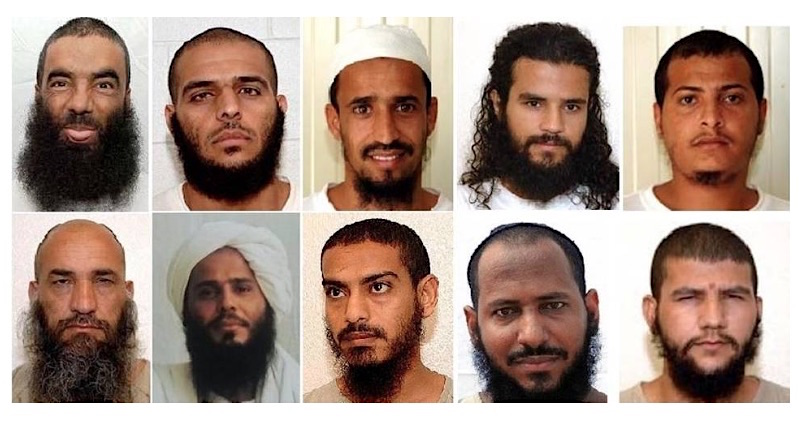
Who Are the Ten Guantánamo Prisoners Released in Oman, Leaving 45 Men Still Held, Including Nine Approved for Release?
 Please support my work! I’m currently trying to raise $2500 (£2000) to support my writing and campaigning on Guantánamo during the first two months of the incoming Trump administration.
So there was great news from Guantánamo on Monday, when ten men — eight Yemenis and two Afghans — were released and sent to Oman, which has previously taken in 20 Yemenis. The Yemenis have been the most difficult category of prisoners to be freed from Guantánamo, because the entire US establishment is unwilling to repatriate them, fearing the security situation in their home country, meaning that third countries must be found that are prepared to offer them a new home — and are prepared to overlook the fact that the US itself is unwilling to do that, and, in fact, that Congress has, for many years, passed laws specifically preventing any Guantánamo prisoner from being brought to the US mainland for any reason.
The ten releases leave 45 men still held at Guantánamo, with three or four more releases expected before President Obama leaves office on Friday, according to the latest reports. At present, however, nine men approved for release are still held, and the release of those left behind when Obama leaves the White House must be a priority for campaigners as soon as Donald Trump takes office.
Of the ten men released, two were approved for release in 2009 by the high-level, inter-agency Guantánamo Review Task Force that President Obama established shortly after first taking office, while the other eight were approved for release between May 2014 and December 2016 by Periodic Review Boards, another high-level, inter-agency review process, and one that campaigners must also press Donald Trump to keep. Read the rest of this entry »












 Who's still at Guantánamo?
