On the 20th Anniversary of the 9/11 Attacks, the US Needs to Close Guantánamo and Bring to an End the Broken Military Commission Trials

Please support my work as a reader-funded journalist! I’m currently trying to raise $2500 (£2000) to support my writing and campaigning on Guantánamo and related issues over the next three months. If you can help, please click on the button below to donate via PayPal.
I wrote the following article for the “Close Guantánamo” website, which I established in January 2012, on the 10th anniversary of the opening of Guantánamo, with the US attorney Tom Wilner. Please join us — just an email address is required to be counted amongst those opposed to the ongoing existence of Guantánamo, and to receive updates of our activities by email.
On the 20th anniversary of the terrorist attacks of September 11, 2001, the United States’ response to those attacks, both militarily and in terms of the law, couldn’t, in all honesty, have ended up more broken, unjust and embarrassing.
Having invaded Afghanistan a month after the attacks, the last US troops withdrew last month, effectively conceding defeat to the Taliban, whose overthrow had been one of the two justifications for the invasion, the other being the destruction of Al-Qaeda, the organization allegedly responsible for the attacks.
In fact, the Taliban were quite swiftly defeated after the US-led invasion, but, instead of withdrawing, US forces stayed on, blundering around the country, largely unable to identify allies from enemies, and definitively losing “heart and minds” through repeated bombing raids, often based on poor intelligence, that killed an enormous number of Afghan civilians, and through imprisoning many thousands of Afghans in lawless and often brutal conditions at Bagram and Guantánamo.
The Taliban’s Victory in Afghanistan Mustn’t Prevent the Closure of Guantánamo

Please support my work as a reader-funded journalist! I’m currently trying to raise $2500 (£2000) to support my writing and campaigning on Guantánamo and related issues over the next three months. If you can help, please click on the button below to donate via PayPal.
I wrote the following article for the “Close Guantánamo” website, which I established in January 2012, on the 10th anniversary of the opening of Guantánamo, with the US attorney Tom Wilner. Please join us — just an email address is required to be counted amongst those opposed to the ongoing existence of Guantánamo, and to receive updates of our activities by email.
As the final US troops left Afghanistan two weeks ago, and the Taliban rolled into Kabul, taking the Presidential Palace on August 15 after President Ashraf Ghani fled, the presence of one particular Taliban member — Mullah Abdul Qayyum Zakir — caught the attention of the western media, when he declared that he had been held at Guantánamo for eight years.
Guantánamo: the mere mention of the word, from the mouth of a conquering Talib, standing in the very place so recently occupied by the US-backed president, reinvigorated the right-wingers in Congress, and in the US media, who had been worried that President Biden might finally close their beloved gulag once and for all.
Once upon a time, the merest mention of Guantánamo had summoned up images of bloodthirsty Al-Qaeda terrorists, hell-bent on the destruction of America, that had helped to keep ordinary Americans docile, and in a state of fear. However, over the years, as the horrors of Guantánamo leaked out to the world, revealing the use of torture and other forms of abuse on prisoners who, for the most part, were not involved in any kind of terrorism at all, defending its existence became more difficult. By his second term, even George W. Bush was aware that it was an embarrassment, and left office having released 532 of the 779 men he had imprisoned there.
The Bleak Legacy of Donald Rumsfeld: Guantánamo, Torture and Two Failed and Astonishingly Destructive Wars

Please support my work as a reader-funded journalist! I’m currently trying to raise $2500 (£2000) to support my writing and campaigning on Guantánamo and related issues over the next three months. If you can help, please click on the button below to donate via PayPal.
If there was any justice in this world, Donald Rumsfeld, the former US defense secretary from 2001 to 2006 under George W. Bush, who has died at the age of 88, would have been held accountable for his crimes against humanity at Guantánamo, in Afghanistan and in Iraq; instead, he apparently passed away peacefully surrounded by his family in Taos, New Mexico.
In response to the terrorist attacks of September 11, 2001, Rumsfeld directed the US-led invasion of Afghanistan in October 2001, when the Geneva Conventions regarding the treatment of prisoners in wartime were shamefully jettisoned, and he was also responsible for the establishment of the prison at Guantánamo Bay, which opened on January 11, 2002.
At Kandahar and Bagram — and at numerous other prisons across Afghanistan — all those who came into US custody were regarded as “enemy combatants,” who could be held without any rights whatsoever. The torture and abuse of prisoners was widespread, and numerous prisoners were killed in US custody, as I reported in When Torture Kills: Ten Murders In US Prisons In Afghanistan, an article I published 12 years ago today.
9/11 at 19: Endless Wars, Guantánamo and 37 Million People Displaced

Please support my work as a reader-funded journalist! I’m currently trying to raise $2500 (£2000) to support my writing and campaigning on Guantánamo and related issues over the next three months of the Trump administration. If you can help, please click on the button below to donate via PayPal.
It’s 19 years today since the terrorist attacks of September 11, 2001 on the US mainland, in New York City and Washington, D.C., and I’m shocked to discover that one-third of my life has elapsed since the attacks took place. I was 38 years old when 9/11 happened, and now I’m 57. Even more shocking is the realization that my son, who is 20 now, was just one year old at the time.
On the morning of 9/11, my partner, Dot, called me to urgently come and watch the TV after the first plane had hit, and together we watched as the second plane hit. I remember thinking that it was blowback for American imperialism, and worrying how George W. Bush and his administration would react, but I had no idea what was to come. Instead, I got on with my life. Our baby son had been very ill, so I proposed marriage to his mother as a positive event to unite us, on Boxing Day 2001, just 16 days before the prison at Guantánamo opened, when the Marines were preparing the cages of Camp X-Ray.
We got married in July 2002, just before the “torture memos” prepared by John Yoo and signed by Jay S. Bybee were issued (in secret, of course), and in September I began work on what would be my first book, Stonehenge: Celebration and Subversion, a counter-cultural history of Stonehenge that was published in June 2004, after the first British prisoners had been released (and whose accounts massively piqued my curiosity about just what was going on at Guantánamo), and just before the Supreme Court’s ruling in Rasul v Bush, establishing that the prisoners had habeas corpus rights.
Uzair Paracha, Victim of Tortured Terrorism Lies, is Freed from US Jail; Why Is His Father Still at Guantánamo?
Please support my work as a reader-funded journalist! I’m currently trying to raise $2500 (£2000) to support my writing and campaigning on Guantánamo and related issues over the next three months of the Trump administration. If you can help, please click on the button below to donate via PayPal.
I wrote the following article for the “Close Guantánamo” website, which I established in January 2012, on the 10th anniversary of the opening of Guantánamo, with the US attorney Tom Wilner. Please join us — just an email address is required to be counted amongst those opposed to the ongoing existence of Guantánamo, and to receive updates of our activities by email.
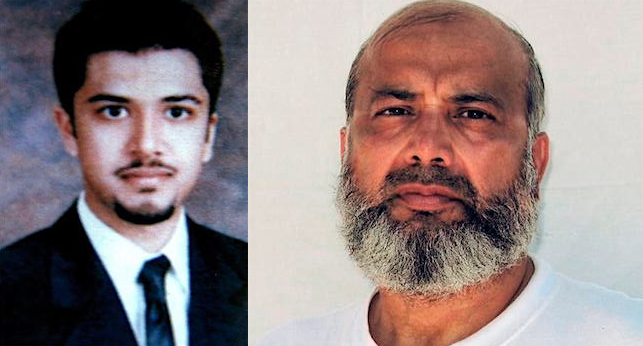
For anyone who has been paying attention not only to the long and horribly unjust Guantánamo saga, but also to the stories of others held in other circumstances as part of the “tangled web” of the “war on terror,” the recent announcement that Uzair Paracha, a Pakistani national, has been released from a US jail and repatriated after 17 years in prison, with a judge throwing his conviction out of court, is extremely good news.
If there is any justice, Uzair Paracha’s release ought to secure the release from Guantánamo of his father, Saifullah, although, when it comes to Guantánamo, of course, it has rarely been the case that anything involving that prison has ever had any meaningful connection to justice.
I first came across Saifullah Paracha’s story in 2006, while researching my book The Guantánamo Files, and I came across his son’s story in 2007, which prompted me to write about a possible miscarriage of justice in my article, Guantánamo’s tangled web: Khalid Sheikh Mohammed, Majid Khan, dubious US convictions, and a dying man.
The Case for Closing Guantánamo: The New Yorker’s Major Profile of Mohamedou Ould Salahi and His Former Guard Steve Wood

Please support my work as a reader-funded journalist! I’m currently trying to raise $2500 (£2000) to support my writing and campaigning on Guantánamo and related issues over the next three months of the Trump administration. If you can help, please click on the button below to donate via PayPal.
I wrote the following article for the “Close Guantánamo” website, which I established in January 2012, on the 10th anniversary of the opening of Guantánamo, with the US attorney Tom Wilner. Please join us — just an email address is required to be counted amongst those opposed to the ongoing existence of Guantánamo, and to receive updates of our activities by email.
Over the 13 years that I’ve been working to close Guantánamo, some of the most rewarding moments I’ve experienced have been when former prisoners or former guards have got in touch to thank me for my work.
I was enormously gratified when Moazzam Begg said that he turned to my book The Guantánamo Files to find out who he was at Guantánamo with, because he was held in solitary confinement, and when Omar Deghayes told me that I wrote about Guantánamo as though I had been in the prison with him and the other prisoners.
I was also moved when former guards got in touch — Brandon Neely, for example, who had been at Guantánamo in its early days, and who got in touch with me when his discomfort with what he had been required to do, which had haunted him, turned into public criticism that persists to this day. On another occasion, I recall, a former guard got in touch. He didn’t want go public, but he wanted to talk about Mohamedou Ould Slahi, who he had been guarding.
Saifullah and Uzair Paracha: Victims of US Vengeance in the “War on Terror”?
 Please support my work as a reader-funded journalist! I’m currently trying to raise $2500 (£2000) to support my writing and campaigning on Guantánamo and related issues over the next three months of the Trump administration. If you can help, please click on the button below to donate via PayPal.
I wrote the following article for the “Close Guantánamo” website, which I established in January 2012, on the 10th anniversary of the opening of Guantánamo, with the US attorney Tom Wilner. Please join us — just an email address is required to be counted amongst those opposed to the ongoing existence of Guantánamo, and to receive updates of our activities by email.
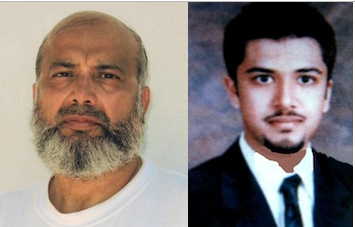
In the “war on terror” established by the US in the wake of the terrorist attacks of September 11, 2001, one of the most distressing developments has been the death of the presumption of innocence and of any form of due process.
In response to the attacks, the Bush administration tore up and discarded all the laws and treaties regarding the treatment of prisoners, and as a result everyone they rounded up as a terrorist (or a terrorist sympathizer or facilitator) was regarded as guilty — without the need for any proof.
The terrible legacy of this time is still with us. Although the processing prisons in Afghanistan (Bagram, for example) and the CIA “black sites” have closed, 40 men are still held in the prison at Guantánamo Bay, the defining icon of the US’s post-9/11 lawlessness.
Of the 779 men held by the US military at Guantánamo since it opened over 17 years ago, on January 11, 2002, 729 men have been released, but only 39 of those 729 have been released through any legal process — 33 through the US courts, as a result of them having their habeas corpus petitions granted by judges in the District Court in Washington, D.C., and six others through the military commission trial process at Guantánamo itself (one after a trial, and five through plea deals). Read the rest of this entry »
Guantánamo’s Periodic Review Boards: The Escape Route Shut Down by Donald Trump
 Please support my work as a reader-funded journalist! I’m currently trying to raise $2500 (£2000) to support my writing and campaigning on Guantánamo and related issues over the next three months of the Trump administration. If you can help, please click on the button below to donate via PayPal.
Anyone paying close attention to the prison at Guantánamo Bay will know that its continued existence, nearly 17 years after it first opened, is largely down to the success of some wildly inaccurate claims that were made about it when its malevolent business first began — claims that it held “the worst of the worst” terrorists, who were all captured on the battlefield.
In fact, as my research, and that of other researchers has shown, very few of the 779 men held by the US military at Guantánamo since the prison opened on January 11, 2002 can realistically be described as having had any meaningful involvement with al-Qaeda or the Taliban; perhaps just 3 percent, and certainly less than 5 percent. No one was captured on the battlefield, and the majority were either foot soldiers for the Taliban in an inter-Muslim civil war that predated 9/11, or civilians swept up in ill-advised dragnets. Many, if not most of those who ended up at Guantánamo were sold to the US by their Afghan and Pakistani allies for bounty payments, which averaged $5,000 a head, a huge amount of money in that part of the world.
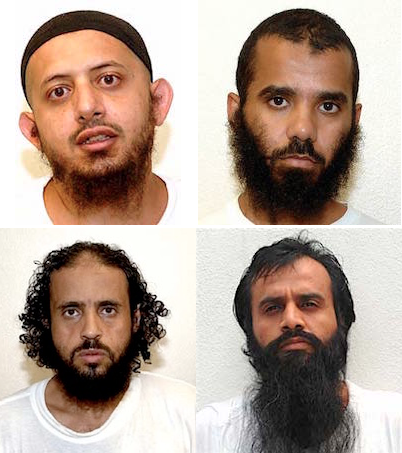
Just 40 men are still held at Guantánamo, after George W. Bush released 532 men, and Barack Obama released 196. Nine men died, one was transferred to the US, to face a trial in which he was successfully prosecuted, and one more was reluctantly released by Donald Trump, or, rather, was transferred back to Saudi Arabia for ongoing imprisonment, as part of a plea deal negotiated in his military commission trial proceedings in 2014. Read the rest of this entry »
Really? Trump Lawyer Argues in Court that Guantánamo Prisoners Can Be Held for 100 Years Without Charge or Trial
 Please support my work as a reader-funded journalist! I’m currently trying to raise $2500 (£2000) to support my writing and campaigning on Guantánamo and related issues over the next three months of the Trump administration.
Last Wednesday, as I flagged up in a well-received article the day before, lawyers for eleven of the 40 prisoners still held at Guantánamo finally got the opportunity to follow up on a collective habeas corpus filing that they submitted to the District Court in Washington D.C. on January 11, the 16th anniversary of the opening of the prison. The filing, submitted by lawyers from organizations including the Center for Constitutional Rights (CCR) and Reprieve on behalf of 11 of the remaining 40 prisoners, argued, as CCR described it after the hearing, that “their perpetual detention, based on Trump’s proclamation that he will not release anyone from Guantánamo regardless of their circumstances, is arbitrary and unlawful.”
CCR added that the motions of eight of the 11 men were referred to Senior Judge Thomas F. Hogan, who heard the argument today”, and stated that the lawyers had “asked the judge to order their release.”
CCR Legal Director Baher Azmy, who argued the case in court, said after the hearing, “Our dangerous experiment in indefinite detention, after 16 years, has run its course. Due process of law does not permit the arbitrary detention of individuals, particularly at the hands of a president like Donald Trump, who has pledged to prevent any releases from Guantánamo. That position is based not on a meaningful assessment of any actual threat, but on Trump’s animosity towards Muslims, including these foreign-born prisoners at Guantanamo — the height of arbitrariness. Short of judicial intervention, Trump will succeed.” Read the rest of this entry »
A Devastating Condemnation of Guantánamo’s Military Commissions by Palestinian-American Journalist P. Leila Barghouty
 Please support my work as a reader-funded journalist! I’m currently trying to raise $2500 (£2000) to support my writing and campaigning on Guantánamo and related issues over the next three months of the Trump administration.
I wrote the following article for the “Close Guantánamo” website, which I established in January 2012, on the 10th anniversary of the opening of Guantánamo, with the US attorney Tom Wilner. Please join us — just an email address is required to be counted amongst those opposed to the ongoing existence of Guantánamo, and to receive updates of our activities by email.
Six years and three months since Tom Wilner and I launched the Close Guantánamo campaign, we are becalmed in horribly unjust waters, with Donald Trump resolute that no one should leave the prison under any circumstances, and, as a result, 41 men held in what must appear to be a never-ending limbo, even though five of them were approved for release by high-level government review processes under President Obama, and another man, Ahmed al-Darbi, continues to be held despite being promised his release — to be re-imprisoned in Saudi Arabia — four years ago in a plea deal in his military commission trial.
Twenty-six other men are held indefinitely — and lawyers for some of them submitted a habeas corpus petition on their behalf on January 11, the 16th anniversary of the opening of the prison, on the basis that, as the New York-based Center for Constitutional Rights explained, “[Donald] Trump’s proclamation against releasing anyone from Guantánamo, regardless of their circumstances, which has borne out for the first full year of the Trump presidency, is arbitrary and unlawful and amounts to ‘perpetual detention for detention’s sake.’”
The other men still held — nine in total — have been through the military commission process, or are facing trials, and this latter category of Guantánamo prisoner came under the spotlight recently in an article written for a new website, The Outline, by P. Leila Barghouty, a journalist and filmmaker based in New York City, whose work has appeared on Al Arabiya, National Geographic, Slate, CNN, Vice News and Netflix. Read the rest of this entry »











 Who's still at Guantánamo?
