Archive for April, 2011
Bagram and Beyond: New Revelations About Secret US Torture Prisons in Afghanistan
 This is the fifth article in “Bagram Week” here at Andy Worthington, with seven articles in total exploring what is happening at the main US prison in Afghanistan through reports, analyses of review boards, and the voices of the prisoners themselves, and ongoing updates to the definitive annotated Bagram prisoner list.
With perfect timing, as “Bagram Week,” my series looking at US detention policies in Afghanistan, continues, the Associated Press has published an exclusive report about secret US prisons in Afghanistan, including the notorious Tor Jail at Bagram, which I discussed in my recent article, The “Dark Side” of Bagram: An Ex-Prisoner’s Account of Two Years of Abuse. In that article, a former prisoner, seized in a house raid with eight others (including a 12-year old boy), and held for two and a half years, even though the raid was based on lamentably poor inteligence, explained how he was held in the Tor Jail for 33 days before being transferred to the main prison facility at Bagram:
After our arrest we were first taken to Tor Jail, or the Black Jail. It was terrible. They didn’t treat us like humans at all. They didn’t allow us to sleep. There was nothing to cover ourselves with. They insulted the Quran. Whenever we were taken to the bathroom, they left the door open. We never knew when it was time to pray or which direction we should face. We never saw sunlight. We were treated rudely during interrogation.
Although the original US prison at Bagram airbase, housed in a gloomy Soviet-era factory building, has recently been replaced with a brand-new, state-of-the-art facility, and renamed — or rebranded — as the Detention Facility at Parwan (even though this is a transparent attempt to banish the brutal reputation that clung to Bagram throughout its long existence), the US authorities have found it impossible to suppress reports about abuse in the Tor Jail (as I explained in an article last year, entitled, What is Obama Doing at Bagram? (Part One): Torture and the “Black Prison”). The authorities have also found it impossible to suppress reports about abuse in other short-term detention facilities, housed in forward operating bases throughout Afghanistan, which I reported in another article last year, Bagram: Graveyard of the Geneva Conventions, and which were also discussed in an important article by Anand Gopal.
The persistent stories about the Tor Jail and these other shadowy facilities have gnawed away at President Obama’s otherwise decent record when it comes to banishing the bleak ghosts of the network of CIA “black sites” that was established under the Bush administration. Obama ordered the “black sites” to be closed in an executive order issued on his second day in office (along with another promising the closure of Guantánamo, which has been spectacularly unsuccessful), but to be honest, it is unlikely that any “black sites” were still in operation by 2009, and Obama’s fine words are further undermined by the realization that, although the “black sites” may have been banished, he has failed to hold anyone accountable for torture, and has, in many ways, merely replaced the Bush administration’s contentious detention policies with drone attacks instead — a policy of “kill rather than capture,” if you are looking for a description.
For the AP’s exclusive report, unidentified US officials explained, as the agency described it, that “suspected terrorists are still being held under hazy circumstances with uncertain rights in secret, military-run jails across Afghanistan, where they can be interrogated for weeks without charge.”
The Pentagon has previously acknowedged holding prisoners in temporary detention sites, but officials have stated that the maximum time permitted for their detention was 14 days — although they have also conceded that the 14-day limit could be extended “under extraordinary circumstances.”
Now, however, officials have told the AP that prisoners are being held in a number of shadowy, frontline jails “for up to nine weeks, depending on the value of information they produce.” According to the AP, there are “roughly 20” of these sites, which accords with a report I received over a year ago, when a reliable Afghan source informed a US lawyer friend of mine that:
there were, at the time, about two dozen secret facilities in Afghanistan, including three or four in Herat, four or five in northern Afghanistan, and three or four in Kabul. According to this source, the majority were US facilities, although a few were run by the National Directorate of Security (NDS), the Afghan government’s domestic intelligence agency, and a few others were run by the Afghan Army.
According to the AP, the “most secretive” site, run by the Joint Special Operations Command (JSOC), a suitably shadowy counter-terrorism unit , is at Bagram — the long-mentioned Tor Jail, or Black Jail, which, as described to the AP, is “responsible for questioning high-value targets … suspected of top roles in the Taliban, al-Qaida or other militant groups.”
JSOC’s role has been disputed, as, for example, in an article in the Atlantic last year by Marc Ambinder, which I discussed in my own analysis of the secret prison last June:
[According to Ambinder,] “JSOC, a component command made up of highly secret special mission units and task forces, does not operate the facility. Instead, it is manned by intelligence operatives and interrogators who work for the … Defense Counterintelligence and Human Intelligence Center (DCHC),” a branch of the Defense Intelligence Agency (DIA), the Pentagon’s main military intelligence department.
Complicating matters further, Ambinder also explained that DCHC “perform interrogations for a sub-unit of Task Force 714, an elite counter-terrorism brigade,” which, last year, was described to Spencer Ackerman of the Washington Independent by a National Security Council staffer as “‘small groups of Rangers going wherever the hell they want to go’ in Afghanistan and operating under legal authority granted at the end of the Bush Administration that President Obama has not revoked.”
Explaining how the nine-week detention period can come about, US officials told the AP that, when prisoners are first seized and interrogated in the field, the intention is to discover, fairly swiftly, what their status is, and what intelligence they might therefore possess. Generally, after 14 days maximum, they are then moved to Parwan (Bagram) or released.
Vice Adm. Robert Harward, who is in charge of detention operations in Afghanistan, has explained that Taliban foot soldiers “often provide useful information about how insurgent networks work, who runs them and who pays the bills,” but that, “if detainees can provide unusually valuable information on the location of a bomb-building factory or are willing to identify the local Taliban commander, their interrogators can ask to keep them longer,” as the AP described it.
There is, at first, a three-week extension, for reasons including “producing good tactical intel” or being “too sick to move,” and then a month’s extension, leading to nine weeks in total. After that, officials would have to appeal to the defense secretary Robert Gates, or even President Obama, although apparently that has never happened. If the prisoners produce useful information after this period, they are then moved to Parwan, to await a decision to transfer them to Afghan custody to face prosecution.
No one knows how many prisoners are held in this manner. A military spokeswoman, Capt. Pamela Kunze, said it was not more than “a small fraction of the total number of detainees,” and the AP noted that 1,900 prisoners are currently held at Parwan, but that, last year, only 1,300 out of a total of 6,600 suspects arrested across Afghanistan ended up at Parwan, according to Vice Adm. Harward.
Despite the best explanations of the military, this report only confirms that the United States, in Afghanistan, continues to behave in a manner that demonstrates the government’s disdain for international law, and senior officials’ belief that they are a law unto themselves.
Beyond the obvious fact that the sleep deprivation and isolation used in the Tor Jail, and, by extension, in the other secret prisons, is clearly abusive, and that the entire set-up reveals how the US military remains in the post-9/11 world shaped by Bush’s first defense secretary Donald Rumsfeld, who presided over the terrible departure from the Geneva Conventions, and the torrent of torture, abuse and murder that followed, the current snapshot of US activities, as revealed by the Associated Press, also relies on readers’ trust that US operatives in Afghanistan know what they are doing.
And on this point, unfortunately, the US also fails. As I have been discovering through my analyses of the limited number of stories that have emerged from the Detainee Review Boards at Bagram — or Parwan — in which panels of military officers have decided whether to release prisoners, whether to continue holding them, or whether to transfer them to Afghan custody, what passes for intelligence has often been revealsed as woefully lacking in substance.
The most shocking example in the first article I published on ths topic, Voices from Bagram: Prisoners Speak in Their Detainee Review Boards (Part One of Three), was in the case of Fazel Rahman, a shopkeeper, whose review board thought long and hard about whether to conclude that he could be detained as a supporter of the Taliban because he “allowed” them to rob him at his shop. In the end, common sense prevailed, and the board recommended his release, but it could have gone either way.
In Part 2 of “Voices from Bagram” (forthcoming), I have just been examining the case of Nek Marjan, a cab driver from a village in Khost province, whose continued detention was approved by two out of three board members, even though the dissent of the third official was based on the fact that there was absolutely no evidence that he had done anything wrong. As the official report stated, “Notwithstanding the majority vote, the evidence was so weak that one board member found no internment criteria.”
With reports like these — and the recollections of the young man detained in the Tor Jail for no reason — it is impossible to have any faith that America’s ongoing refusal to obey the Geneva Conventions in Afghanistan serves any purpose, other than to continue to allow the military to abuse individuals who were never even a threat to them in he first place.
It’s a grim scenario, to be honest — a project called “Losing Hearts and Minds,” which has been going on for nearly ten years in Afghanistan. The wonder is that it can continue with such impudence, and apparently still with no end in sight …
 Andy Worthington is the author of The Guantánamo Files: The Stories of the 774 Detainees in America’s Illegal Prison (published by Pluto Press, distributed by Macmillan in the US, and available from Amazon — click on the following for the US and the UK) and of two other books: Stonehenge: Celebration and Subversion and The Battle of the Beanfield. To receive new articles in your inbox, please subscribe to my RSS feed (and I can also be found on Facebook, Twitter, Digg and YouTube). Also see my definitive Guantánamo prisoner list, updated in July 2010, details about the new documentary film, “Outside the Law: Stories from Guantánamo” (co-directed by Polly Nash and Andy Worthington, on tour in the UK throughout 2011, and available on DVD here — or here for the US), my definitive Guantánamo habeas list and the chronological list of all my articles, and, if you appreciate my work, feel free to make a donation.
As published exclusively on Cageprisoners.
On Guantánamo and Torture, Campaigners Send A Letter to the Justice Department: “US Democracy is in Far Sorrier Shape Than We Feared”
 In its tenth year of operations, Guantánamo continues to recede in the news, as though ignoring it will make it go away, rather than continuing to skew America’s moral compass from wherever it is that horrors go when they are hidden. However, while Guantánamo is still a largely unacknowledged crime scene, its existence — and its 172 remaining hostages — will not actually disappear by being ignored.
As President Obama deals another blow to hopes that he will close the prison, as he promised, this time refusing to try the alleged 9/11 co-conspirators in a federal court, as his Attorney General wanted — and announced 16 months ago — and as he himself claimed to want, until voices were raised in dissent, and he retreated, as he has so often on Guantánamo and on the legacy of torture he inherited, it is time for those who care strongly about this scandal to speak out more forcefully than ever.
With Obama’s failure, it is time for those who are concerned by his perilous role as the man who failed to turn back the clock to before 9/11, when the rule of law meant something, and Dick Cheney had not yet begun to drag America down to the “dark side,” to find new ways to address this disaster. Otherwise, sadly, those who have embraced the “dark side” — and whose corrosive influence pollutes the very heart of American society — wil have won.
As one example of how this can be done — and the kind of passion that can be harnessed, and the kind of language that can be used — I’m cross-posting below a letter that has just been delivered to the Justice Department by the campaigning group Witness Against Torture, who take the torture and illegal imprisonment of the men at Guantánamo very personally, holding a 10-day fast and vigil outside the White House every January, to mark the anniversary of the prison’s opening, and regularly seeking arrest in pursuit of their aims.
Last June, members of Witness Against Torture, plus representatives of the Center for Constitutional Rights, Defending Dissent and the Torture Abolition and Survivors Support Coalition International met with Portia Roberson, the head of the Office of Public Liaison at the Justice Department, to discuss their grievances, and expressed satisfaction that she “conveyed repeatedly that she appreciates our disappointment and anger even, and was very intent on learning more about our point of view. She was particularly impressed that we are not, for the most part, professional human rights advocates but instead ‘everyday people.’ Her message was that she’d love to advocate, internal to DoJ, on our behalf.”
Nine months on, and the doors at the DoJ are firmly shut. In January, when I joined Witness Against Torture, the Center for Constitutional Rights and other groups for a protest outside The White House on the 9th anniversary of Guantánamo’s opening, and then followed WAT activists to the DoJ, where I made a brief speech, I was taken aback by the palpable sense of hostility emanating from the massed ranks of police “guarding” the building.
In light of this shutdown of all communication, I commend Witness Against Torture for putting together the letter cross-posted below, and hope it provides readers with some inspiration. (For further information, I have added links to the original letter).
A letter from Witness Against Torture to the Justice Department, April 7, 2011
Ms. Portia Roberson
Director of the Office of Public Liaison
United States Department of Justice
950 Pennsylvania Avenue, NW
Washington, D.C. 20530-0001
April 7, 2011
Dear Director Roberson,
This is Witness Against Torture. You are aware of who we are and what we believe, as well as our longstanding desire — repeatedly conveyed to your office over the past 7 months — to meet with DoJ officials to discuss Guantánamo, torture, and issues of accountability.
For ten days In January, we were outside the DoJ office, ready to meet; we informed you and other DoJ employees of our presence. While declining in January to meet with us (with the explanation that “it is not possible at this time”), you nonetheless concluded your email saying: “It is my hope that going forward you might continue to utilize this office and my staff to express your concerns.” Indeed, we would like to take you at your word and have an opportunity to address our concerns, in person, to DoJ staff in positions of real power in the Department. Our request, in short, remains unchanged. We will be again in Washington the week of June 20 and would appreciate working with your office to arrange such a meeting (June 23 would be ideal).
 We should say that we have by now scarcely any hope that our request will be granted. We — and the cause we have tried to honorably represent — have been treated with discourtesy, disrespect, and even contempt by an institution (the DoJ) and an administration from which we expected far better. Avoiding our phone calls; not answering letters and emails; whatever efforts DoJ and White House staff, Homeland Security, the DC police, and whoever else made to manage the “crisis” of 40 people in jumpsuits holding vigil at your entrance in the January snow — it all seems to us the pathetic dealings of a bureaucracy too afraid to face up to the truth of its decisions and answer to citizens who seek, and deserve, answers. We have taken word of the futility of our efforts to engage our government back to our communities; uniformly, our stories summon the lament that American democracy is in far sorrier shape than our listeners had feared.
When the Office of Public Liaison functions as a firewall to prevent real dialogue with the public, there is a problem. The conduct of your office seems, however, but a small part of a much bigger, disturbing picture. The President has by now decisively gone back on his promises with respect to Guantánamo and detention policy, mocked the spirit and letter of nearly every good intention he once professed. The prison camp remains open and will remain so, perhaps forever. The Military Commissions, once suspended, will resume, providing means to convict men — themselves often the victims of torture by the US — by a diluted standard of due process. Innocent men — victorious in their habeas cases or cleared for release by the US government — remain imprisoned, rendering the habeas right all but meaningless and the process of administrative review a sham. A system of indefinite detention without charge or trial has been authorized by Executive Order.
The Justice Department echoes this disgraceful record. It has thrown roadblock after roadblock in front of the efforts of innocent men to win their release. It has cowered to baseless fears in essentially abandoning the civilian justice system for terror suspects. It has fought tooth and nail, in case after case, to ensure that no US official need suffer any consequence for having committed or authorized torture. And it has worked to prevent any victim of US torture from securing justice in any court, anywhere.
President Obama pledged to restore the rule of law. The Justice Department is duty bound to enforce the law — whether domestic laws against torture or international agreements mandating the prosecution of alleged torturers. But the rule of law remains broken, divisible, travestied by reason of cowardice and cruelty. We have tried to get our heads around this tragic fact: the United States can kidnap and torture people, steal years of their lives, destroy their families, injure their communities, and the victims of this abuse have resolutely no legal recourse, no promise of a day in proper court. We reject this terrible reality, and must denounce any institution that enables it to persist. For the last two years, issues of right and wrong and the rule of law have been smothered by the pestilent vapors of political calculation, whose sole determination is what the administration can reasonably get away with without paying too high a price among its “base.” We likewise reject this cynicism and say “shame” to anyone who perpetuates it.
Reading this, you may be inclined to respond that “you’re sorry we feel this way.” Our response is that how we feel is ultimately irrelevant: what concerns us, and should concern you, are the circumstances we describe. President Obama and his Justice Department had both the opportunity and obligation to dismantle the pseudo-legal apparatus designed by the Bush administration that authorized, “legalized,” and immunized American crimes. With this came the obligation to reckon with the nation’s wrongs and provide justice and restitution to the victims. The administration blew this chance, so resolutely that reasonable people like ourselves may wonder if there was ever any real conviction behind the promise of true change. Regardless, the result has been a moral disaster — profound damage to American ideals and institutions that we fear may become permanent.
By now we sense the near-total futility of appealing to principle or our expectation of how a government agency should respond to the honest concern of the public. So we appeal here to your very personal sense of honor, as well as that of others in your institution, in imploring you to grant us the opportunity to discuss these grave matters with those who need to hear from us.
If you are inclined to pay us small favor, please circulate this note — as well as our past correspondence, if you wish — to anybody at the Justice Department apt to listen.
Witness Against Torture
Jeremy Varon
Matt Daloisio
Frida Berrigan
Richard Sroczynski
Helen Schietinger
Michael S. Foley
Andy Worthington is the author of The Guantánamo Files: The Stories of the 774 Detainees in America’s Illegal Prison (published by Pluto Press, distributed by Macmillan in the US, and available from Amazon — click on the following for the US and the UK) and of two other books: Stonehenge: Celebration and Subversion and The Battle of the Beanfield. To receive new articles in your inbox, please subscribe to my RSS feed (and I can also be found on Facebook, Twitter, Digg and YouTube). Also see my definitive Guantánamo prisoner list, updated in July 2010, details about the new documentary film, “Outside the Law: Stories from Guantánamo” (co-directed by Polly Nash and Andy Worthington, on tour in the UK throughout 2011, and available on DVD here — or here for the US), my definitive Guantánamo habeas list and the chronological list of all my articles, and, if you appreciate my work, feel free to make a donation.
The “Dark Side” of Bagram: An Ex-Prisoner’s Account of Two Years of Abuse
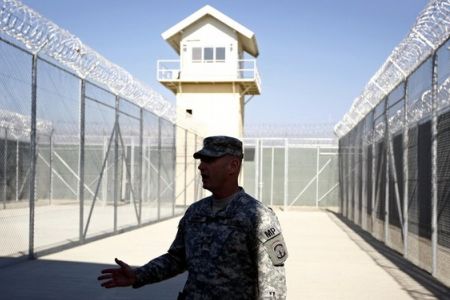 This is the fourth article in “Bagram Week” here at Andy Worthington, with seven articles in total exploring what is happening at the main US prison in Afghanistan through reports, analyses of review boards, and the voices of the prisoners themselves, and ongoing updates to the definitive annotated Bagram prisoner list.
As part of “Bagram Week” here at Andy Worthington, I’m cross-posting a rather harrowing story, originally published on the Afghanistan Analysts Network, that I came across recently, and then lost again. I retrieved it via my colleague Mathias Vermeulen, who, on his blog The Lift, picked out a key passage in this bleak account by a former Bagram prisoner of the time he spent in the Tor jail — Bagram’s secret torture prison — before his transfer to the main facility. This is the passage:
After our arrest we were first taken to Tor Jail, or the Black Jail. It was terrible. They didn’t treat us like humans at all. They didn’t allow us to sleep. There was nothing to cover ourselves with. They insulted the Quran. Whenever we were taken to the bathroom, they left the door open. We never knew when it was time to pray or which direction we should face. We never saw sunlight. We were treated rudely during interrogation.
This entire article is a damning revelation — an insider’s account not only of the “enhanced interrogation techniques” used in the Tor Jail, but more generally of the cruelty and incompetence that fuels Bagram as surely as it fueled Guantánamo, with random arrests, threats, psychological abuse, poor intelligence, incompetent translators, “segregation” — in isolation cells — used as persistently as it was in Guantánamo on perceived troublemakers, and, worse than Guantánamo (but as Bagram was in its early days) the death of a prisoner that was, it seems, effortlessly covered up and not reported. The account is also revealing about the dysfunctional relationship between the Afghan and American detention facilities, where there is supposed to be cooperation regarding trials, but where in fact chaos reigns, and prisoners are being lost between the two systems, abandoned unless they can pay a substantial bribe.
Overall, this article should, I think, be widely circulated as an antidote to all the claims that the move from Bagram to the new Detention Facility in Parwan has suddenly done away with abusive patterns of behavior that, it seems, are engrained in the operations, and in the casual racism and dehumanization of war, and that have nothing to do with the buildings themselves. Of all the accounts I have read, this one rings the truest, not just becasue it accords with other insider reports I have heard over the last few years about the ongoing physical and psychological abuse of prisoners, but also because it so clearly echoes what we know about detention operations throughout the “War on Terror,” which will not fundamentally change until someone draws a line under it all, and actually starts all over again, with respect for the geneva Conventions that were shredded by the Bush administration, and that have not been thoroughly reintroduced under President Obama.
Stories people tell: Bagram prison; not a single good day
By Martine van Bijlert, Afghanistan Analysts Network, March 9, 2011
There are so many stories of people who get caught up in the nightly operations by American and Afghan forces. In the search for ‘kill & capture’ targets the net is cast wide: once a door is kicked in all males in a household are usually taken for interrogation. And it is then anyone’s guess when they will be released again. One story — out of many — of how an unlucky sleep-over resulted in years of detention, and what those years were like.
I was arrested by American and Afghan Special Forces about two and a half years ago. It was night and I was staying as a guest in a house when the forces came. I had saved money to open a small medicine shop and that night I had gone to see this man to buy medicine. Maybe someone reported him to the Americans; in Afghanistan there are so many enmities. Maybe they thought there was some kind of meeting or program going on, because there were other guests as well. I don’t know why they arrested us, but they took all the men in the house: nine in total, including a 12-year old boy.
When they came we were sleeping. None of us was wearing shoes or proper clothes. One of us was only wearing his underwear. They took us with them just like that. We had to walk through the mud. After our arrest, one of the men was handed to the NDS (National Directorate for Security); he was a friend of the owner of the house. The four sons and a nephew were released after about two weeks. Then two other guests were released. They had come that night to get a tahwiz (religious amulet). They were released a few months before me. The owner of the house and I were released last, now a few weeks ago.
After our arrest we were first taken to Tor Jail, or the Black Jail. It was terrible. They didn’t treat us like humans at all. They didn’t allow us to sleep. There was nothing to cover ourselves with. They insulted the Quran. Whenever we were taken to the bathroom, they left the door open. We never knew when it was time to pray or which direction we should face. We never saw sunlight. We were treated rudely during interrogation. Some people were also beaten, but that didn’t happen to me.
After 33 days in the Black Jail I was transferred to the big jail. Here we were visited by ICRC [the International Committee of the Red Cross], which was good even though they had no authority. They brought letters, but they didn’t tell the press about us or about the circumstances we were in. The Human Rights Commission (AIHRC) didn’t come to the prison; maybe they were not allowed in. About a month before my release they came, but they were so young. What could they do?
 Many things were really bad. For instance, I was locked up in ‘segregation’ sixteen times, sometimes for 10 or 20 days at a time. I did nothing special to provoke this. I didn’t do anything serious like hit them or attack them. It happened when I asked for my rights.That was reason enough to call me shureshi (trouble maker, revolter). I just asked for food, for instance, or I complained that they were interfering with our prayers. The food in segregation was especially bad; they called it ‘low-grade food’. It smelled and tasted horrible and made you sick. They even put an old man of 75 years in segregation, with bare feet and a bare head. The guards also used gas on the prisoners, it was like teargas and it made it very difficult to breathe.
There was one group of [American] guards who were called badmashi (thugs). They behaved very badly and rudely with the prisoners. One of them once told me he would kill me. When that group left things got a little better. But we did not see one good day in that place. The Black Jail of course was worse. At least in the big prison I was registered with ICRC. I knew they could not just execute me. Other prisoners said that from Tor Jail many people had disappeared.
There was a man from Uruzgan; he was about 30 years old. He became very agitated, but the doctor said he was alright. When the doctor finally came, he had died. Those kinds of things happen. But they don’t appear in the press, nobody pays attention.
There was also a young boy, he was mute and had psychological problems. When he was put in our cell, he was climbing the walls and trying to hurt himself. We tried to calm him down and to stop him. I told those in charge that it was not our job to look after him and that he should receive proper treatment. They said he was a suicide bomber. In the end they put him in segregation. When I was released he was still there. By that time he had been there for three months. He didn’t receive any medication. He was very loud and kept all the prisoners in that section awake.
There were also no facilities for handicapped or wounded people. Many prisoners had no legs or had other handicaps. It was difficult for them to go to the bathroom. There was one person in my cell who had fallen off the roof when he was arrested. His 10-year old son was shot during the raid. He arrived in prison with two broken legs. For two months we carried him to the bathroom.
About one year ago things in the prison became a bit better. A mullah was appointed. He belonged to the Americans and he helped improve the situation. Then the ANA [Afghan National Army] took over and we were transferred to a new jail. The new jail was better, there were bigger cells. But the Americans were still in charge. The Afghan soldiers had no right to talk to the prisoners. In every block there was a station, one at the north and one at the south, where there were Americans. They had to be informed about any request the prisoners had. The Afghan soldiers complained that they were just like waiters or sweepers in a hotel and that they weren’t allowed to do anything. Even the officers felt like that.
I was interrogated so many times. They asked me, “Do you know this person? Have you done that?” Once they showed me some pictures of what looked like explosives. I don’t know what it was, but they kept saying that it belonged to me. I was tied to a chair until nine o’clock at night. The Americans say that they don’t do zulm (oppression, cruelty), but they do. They bothered prisoners in a psychological way. They threatened them.
Once they told me that they would bring my father to the prison. I said that I would be very happy, because my father had died several years ago and I would like to see him again. But they did the same to other prisoners, who really became worried. Especially those who were not educated, who didn’t know whether the Americans might really do this or not. Sometimes the Americans even told the prisoners they would bring their wives or sisters to the prison. There was one man from Zabul. When they arrested him they took pictures of all the women in his family. During the interrogation they showed him the pictures and said they were going to make copies and distribute them in the whole of Zabul. They also took pictures of prisoners while they were having a shower and threatened to distribute them in their home areas. These kinds of things can give you psychological problems.
There were also problems with the translators. Some of them didn’t understand Afghan vocabulary at all. Once when I was being interrogated I told them that I had done two namaz (prayers) and that there were two left. He translated that I had shot two rockets and that there were two left. I didn’t know it at the time, but they confronted me with this during an interrogation much later. The whole thing was like a stupid joke.
There was a commander who was also detained. After six and a half years they told him, “We still have doubts that you are a Hezb-e Islami commander”. He said, “You have doubts? There is no doubt! I am a Hezb-e Islami commander, for sure. But what is my crime?” He was a commaner and a malek, a person who tried to build up the government, but they kept him detained for such a long time for no reason. There was another man called Abu Baqer. The Americans thought he was Commander Abu Baqer, because his name was the same, so they kept him detained for seven years. In the meantime the real Commander Abu Baqer was still moving around and everybody knew it.
Some prisoners did not see their relatives for a year or more. There was a man from Khost. When his relatives asked about him, the Americans told them that he was not there — but he was. After a year and a half he was finally given a meeting. After that he was released.
I was released a few weeks ago. At my release an American colonel apologized to me. He said that they had concluded that I was innocent and that I had worked for the good of Afghanistan. He said that after two and a half years! They gave me a bottle of perfume, but they did not return my possessions. When I was arrested I had $6000 on me, as an advance for the medicines, and also my mobile phone and some afghanis. They did not give them back. At the time I didn’t say anything; I just wanted to leave. But they should give it back.
Now I am in a bad situation. I feel like half my life is gone. My economic situation is bad, my savings are gone. My health is not well. My legs hurt, I don’t know why, maybe because of the lack of exercise. On the day of arrest I also hit my leg, when they pushed me into the car while I was blindfolded. For the first few months I couldn’t walk properly. My back also hurts. We went on strike for a while in the prison, because of the bad conditions and because we were upset that our fate was not clear. After four and a half months they came in with force to break up the strike. One man broke a leg and an old man broke a rib. Two guards fell on top of me with their heavy jackets. My back still aches from that.
One prisoner wrote a book. He actually wrote two books. While he was in prison he gathered toilet paper and wrote on it with a pen. We were not allowed pens, but he had received one from an ANA guard. The books are called ‘Gift from Bagram’ and ‘From Karez Mir to Bagram’. I don’t know if they have been published yet.
According to Afghan and international law you can detain a person for three months, but they hold people for years and years without any decision. Since the demonstrations there are now reviews every six months, but there are so many people who have already been kept for years and who are still in the prison. Their detention just gets extended every time. Once when I was getting ready for the DRB (Detention Review Board), the representative gave me a piece of paper and said that if I read that at the meeting I would be released. The paper said that I had killed people. I said I cannot read that, but he said if you do you will be handed over to the Afghan government. I went to the court but I did not read the paper. My detention was extended for six months.
In the end I was sent to two Afghan courts. They decided to release me. Two months after that the Americans released me. They don’t care about the Afghan courts, and the Afghan courts are not processing the cases. There are more than 300 prisoners that are in between the two systems. Their files have been sent to the Afghans, but they are still in the American prison. They are lost. If they don’t give money, their file will never be found again.
I wasted two and a half years of my life. I don’t feel well at all. I am afraid that, because this happened once for no reason, it may happen again. Who can guarantee me that I will not be unlucky again? When I was arrested I was engaged. I still am, but I have no money or income. So much happened in those years, I cannot remember it all. I have only told you what I remembered. I think it might be good if my story is published. The world should know what it was like. There was not one good day in all those years. We were not treated like humans. Even though we had done nothing wrong and they had no information against us.
Andy Worthington is the author of The Guantánamo Files: The Stories of the 774 Detainees in America’s Illegal Prison (published by Pluto Press, distributed by Macmillan in the US, and available from Amazon — click on the following for the US and the UK) and of two other books: Stonehenge: Celebration and Subversion and The Battle of the Beanfield. To receive new articles in your inbox, please subscribe to my RSS feed (and I can also be found on Facebook, Twitter, Digg and YouTube). Also see my definitive Guantánamo prisoner list, updated in July 2010, details about the new documentary film, “Outside the Law: Stories from Guantánamo” (co-directed by Polly Nash and Andy Worthington, on tour in the UK throughout 2011, and available on DVD here — or here for the US), my definitive Guantánamo habeas list and the chronological list of all my articles, and, if you appreciate my work, feel free to make a donation.
After Wisconsin and the “We Are One” Rallies, Where Now for Mass Protest in America?
 On April 4, the anniversary of the assassination of Martin Luther King Jr., over a thousand events — teach-ins, vigils, faith services and town hall meetings — took place across the United States, as part of a campaign, backed by unions, faith groups, civil and human rights activists, students and progressive groups, entitled, “We Are One: Respect Our Rights.”
As the “We Are One” website stated:
These actions honor the legacy of the Rev. Martin Luther King Jr., who was assassinated April 4, 1968 in Memphis, Tenn., where he had gone to stand with sanitation workers demanding their dream: The right to bargain collectively for a voice at work and a better life. The workers were trying to form a union with AFSCME.
Union members, people of faith, and civil and human rights activists, students and other progressive allies are joining with working people in Wisconsin, Ohio, Indiana and dozens of other states where well-funded, right-wing corporate politicians are trying to take away the rights Dr. King gave his life for: the freedom to bargain, to vote, to afford a college education and justice for all workers, immigrant and native-born.
43 years after Dr. King’s assassination, there was a particular resonance to the “We Are One” actions, partly because the campaign for collective bargaining rights for sanitation workers in 1968 found its modern-day counterpart in attempts by numerous Republican governors — led by Scott Walker in Wisconsin — to remove collective bargaining rights from public sector workers, using budget deficits as an excuse for a policy driven solely by a malignant right-wing ideology.
Unnoticed by Walker, and other Tea Party candidates who found themselves in power because of a rightward lurch on the part of voters in the mid-term elections, there had not actually been a commensurate shift in people’s attitudes, and his assault on workers’ fundamental rights — far from gaining him support — turned into a protest movement whose size and intensity astonished everyone, as 100,000 people converged on Madison, the state capitol, and thousands of protestors occupied the capitol building.
I covered these events in my articles, The New American Revolution: Are Wisconsin’s 100,000 Protestors A Sign of Further Resistance to Come? and Video: Michael Moore Tells Wisconsin Protestors, “America Ain’t Broke! The Only Thing That’s Broke is the Moral Compass of the Rulers”, and I’d like to add another perspective below, by Jenni Dye, a Madison-area attorney who has been actively involved in the protests at the Wisconsin Capitol, and maintains a blog here. This is an excellent insight into how a solidarity movement can inspire people to push for real change, and my only complaint is with Jenni’s statement, “I knew that this was different than anything I’d seen before and, possibly, anything I’ll ever see again” — not because I disagree with the first part of that sentence, but because I think the second part unnecessarily suggests that what has been happening in Madison may not, in fact, be the harbinger of something bigger to come, when it absolutely needs to be the start of something, and not some kind of one-off event.
Fifty days of Wisconsin labor solidarity have changed my life
By Jenni Dye, The Isthmus, April 5, 2011
 Monday, April 4, marked the 50th day since protests started at the Wisconsin Capitol in Madison over a bill that would gut public employees’ collective bargaining rights. Fifty days of Wisconsinites standing up and making their voices heard. Through hearing testimony, through meetings with their elected officials, through letters and emails to the governor’s office. Through protests, through where they chose to sleep, through signs, through chants. Through showing up and taking part. Through recall canvassing and through adding their signatures to recall petitions. Fifty days.
When the protests started, I didn’t know enough about the bill to know what its impact would be. I just knew that I was opposed to the idea of a budget repair bill that substantially changed workers’ rights being rammed through the Legislature in a week, which was the reported Republican plan. I thought that, at the very least, it was an issue that deserved more time for the public to gather information and participate in the debate. So I showed up at the Capitol to make sure my voice was heard. My dad showed up. My friends showed up. People who I never even knew were interested in politics showed up. And it became something a lot bigger than any of us.
On February 16, when I stood in the stairwell leading to the room in which the Joint Finance Committee was about to vote, I yelled with the crowd “The people united will never be defeated,” and I knew that this was different than anything I’d seen before and, possibly, anything I’ll ever see again. As that first week unfolded, I educated myself about the contents of the bill and found I didn’t at all like what it contained. My motivations changed from merely procedural to substantive — I wanted to stop that proposal in its tracks. I wanted compromise. I wanted our elected officials to sit at a table and talk.
During that first week, which I mostly spent protesting with my dad, my former teachers and a few close friends, I felt a sort of hope that had been dormant for years. Hope that people joining forces really can make a difference. On Day 50, I stood on the State Street steps to the Capitol and listened as Rev. Jesse Jackson spoke about Dr. Martin Luther King’s legacy on the anniversary of his assassination.
Jackson told the crowd that it was our responsibility to ensure that Dr. King lived on through us, that his dream was not ended with a single bullet. As Jackson spoke, I stood next to a fellow protester whom I had never met 50 days ago, but now consider a friend. Behind me, two protesters held a sign bearing the Martin Luther King quote: “Our lives begin to end the day we become silent about things that matter.”
Our voices have been largely ignored by Gov. Scott Walker, Sen. Scott, Rep. Jeff Fitzgerald and their allies. They tried to trample our hope by locking us out of the Capitol. But we brought our sleeping bags and blankets and showed them that it didn’t matter if we slept inside or out, our opposition remained steady.
They held public meetings with minimal notice, trying to cut us out of the process. But we showed up in force anyway, and we refused to allow violations of Wisconsin’s open meetings law to go unchallenged. They tried to make us go away by “passing” the legislation, but that night, we filled the streets surrounding the Capitol and continued our protest. And now, seven weeks after we started, we are still standing up and making our voices heard. Letting them know we don’t like their budget repair bill, their infringement of our constitutional rights, or their way of “opening” Wisconsin for business by closing our open government.
We may not have gotten through to Gov. Walker or the Fitzgeralds or their friends yet. But those of you who have also devoted your time and your energy to this movement have gotten through to me in a way that is permanent and life-changing. For every moment in my past where I have questioned whether there are good people out there, the compassion and commitment of those raising their voices at our Capitol have proved 10 times over that there are people who care about each other. Care about perfect strangers. Care about Wisconsin. Care about democracy and open government. Care that things are done the right way, even when the proposal itself is abhorrent.
There have been days when my voice is not strong, but I’ve found that I can rely on others to carry the load. There have been days when I literally might have collapsed into a sobbing heap on the Capitol floor were it not for the kindness of friends and perfect strangers. There are days when a hug is an absolute lifeline to maintaining any sanity at all. Sometimes relief and renewal have come in the form of inspiration from the words of speakers at a rally and sometimes from perfect strangers who are also dedicating their time to the cause. I’ll never be able to thank you all individually. I’ll never be able to thank you all enough.
It’s not enough, but I will forever be grateful for what the individuals involved in this movement have given me. And I plan to keep giving it my all until we take Wisconsin back.
***
 What happens next remains to be seen. On the specific problems emanating from Republicans’ assault on workers’ rights, the struggle continues, as Jenni Dye indicated. In polls, the Republicans’ misreading of the public mood was confirmed by a Gallup poll last week, in which 48 percent of those polled sided with the unions, against 39 percent who sided wth governor Walker and other aggressive Republican governors, and Walker’s political response to the protest is also under examination.
After 14 Democrat senators fled Wisconsin to prevent Walker from pushing through his bill, which, as well as bringing collective bargaining rights to an end, inflicted savage spending cuts on the public sector, Walker and his fellow Republicans responded, as Green Left Weekly reported, by “separat[ing] out the anti-union measures from the rest of the budget “repair” bill — claiming it was only budget measures that required the Democrat senators to be present for the vote” — and on March 11 Walker signed his bill into law.
As high school students staged a walkout throughout the state, and 100,000 protestors again converged on Madison, there were calls for a national strike — not seen in Wisconsin since 1934 — and Mark Miller, the leader of the Democrats in Wisconson’s Senate, who had fled to Illinois on Feb. 17 to block the vote, told the New York Times, “In 30 minutes, 18 state senators undid 50 years of civil rights in Wisconsin,” adding, “Their disrespect for the people of Wisconsin and their rights is an outrage that will never be forgotten.”
What has been happening in Madison, Wisconsin — and in other state capitols — is clearly a huge movement, largely ignored by the mainstream media, which appears to have a momentum of its own. It is this momemtum that will need to be maintained if the protests are to continue (and to be confirmed as a national movement), and this will partly depend on local developments — in Wisconsin, for example, the implementation of governor Walker’s changes has, for the time being, been blocked by a state judge who is hearing a challenge to the way it was approved — but it will also depend on whether there are enough people with enough charisma and persuasion to create a true mass movement calling for genuine political change.
The timing is undoubtedly right, as exploitative lawmakers reveal that they no longer care about the majority of their voters, and care only about protecting the interests of the rich and the powerful (as is also happening in the UK), but to grasp what is needed, I believe that people need to look once more at the legacy of Martin Luther King, Jr., and, in particular, at how the radical message of his later years has been written out of the history books.
To that end, I’m concluding this article by cross-posting below an important article by veteran activists Jeff Cohen (most recently, the co-founder of Roots Action) and Norman Solomon, president of the Institute for Public Accuracy, first published, I believe, in 1995, which addresses these particular omissions, noting, at its heart, how, in the last years before his murder, Dr. King “decried the huge income gaps between rich and poor, and called for ‘radical changes in the structure of our society’ to redistribute wealth and power,” declaring that “True compassion is more than flinging a coin to a beggar; it comes to see that an edifice which produces beggars needs restructuring.”
The Martin Luther King You Don’t See on TV
By Jeff Cohen and Norman Solomon
 It’s become a TV ritual: Every year on April 4, as Americans commemorate Martin Luther King’s death, we get perfunctory network news reports about “the slain civil rights leader.”
The remarkable thing about these reviews of King’s life is that several years — his last years — are totally missing, as if flushed down a memory hole.
What TV viewers see is a closed loop of familiar file footage: King battling desegregation in Birmingham (1963); reciting his dream of racial harmony at the rally in Washington (1963); marching for voting rights in Selma, Alabama (1965); and finally, lying dead on the motel balcony in Memphis (1968).
An alert viewer might notice that the chronology jumps from 1965 to 1968. Yet King didn’t take a sabbatical near the end of his life. In fact, he was speaking and organizing as diligently as ever.
Almost all of those speeches were filmed or taped. But they’re not shown today on TV.
Why?
It’s because national news media have never come to terms with what Martin Luther King Jr. stood for during his final years.
In the early 1960s, when King focused his challenge on legalized racial discrimination in the South, most major media were his allies. Network TV and national publications graphically showed the police dogs and bullwhips and cattle prods used against Southern blacks who sought the right to vote or to eat at a public lunch counter.
But after passage of civil rights acts in 1964 and 1965, King began challenging the nation’s fundamental priorities. He maintained that civil rights laws were empty without “human rights” — including economic rights. For people too poor to eat at a restaurant or afford a decent home, King said, anti-discrimination laws were hollow.
Noting that a majority of Americans below the poverty line were white, King developed a class perspective. He decried the huge income gaps between rich and poor, and called for “radical changes in the structure of our society” to redistribute wealth and power.
“True compassion,” King declared, “is more than flinging a coin to a beggar; it comes to see that an edifice which produces beggars needs restructuring.”
By 1967, King had also become the country’s most prominent opponent of the Vietnam War, and a staunch critic of overall U.S. foreign policy, which he deemed militaristic. In his “Beyond Vietnam” speech delivered at New York’s Riverside Church on April 4, 1967 — a year to the day before he was murdered — King called the United States “the greatest purveyor of violence in the world today.” (Full text/audio here, and also see below for the audio).
From Vietnam to South Africa to Latin America, King said, the U.S. was “on the wrong side of a world revolution.” King questioned “our alliance with the landed gentry of Latin America,” and asked why the U.S. was suppressing revolutions “of the shirtless and barefoot people” in the Third World, instead of supporting them.
In foreign policy, King also offered an economic critique, complaining about “capitalists of the West investing huge sums of money in Asia, Africa and South America, only to take the profits out with no concern for the social betterment of the countries.”
You haven’t heard the “Beyond Vietnam” speech on network news retrospectives, but national media heard it loud and clear back in 1967 — and loudly denounced it. Time magazine called it “demagogic slander that sounded like a script for Radio Hanoi.” The Washington Post patronized that “King has diminished his usefulness to his cause, his country, his people.”
In his last months, King was organizing the most militant project of his life: the Poor People’s Campaign. He crisscrossed the country to assemble “a multiracial army of the poor” that would descend on Washington — engaging in nonviolent civil disobedience at the Capitol, if need be — until Congress enacted a poor people’s bill of rights. Reader’s Digest warned of an “insurrection.”
King’s economic bill of rights called for massive government jobs programs to rebuild America’s cities. He saw a crying need to confront a Congress that had demonstrated its “hostility to the poor” — appropriating “military funds with alacrity and generosity,” but providing “poverty funds with miserliness.”
How familiar that sounds today, over 40 years after King’s efforts on behalf of the poor people’s mobilization were cut short by an assassin’s bullet.
In 2011, in this nation of immense wealth, the White House and most in Congress continue to accept the perpetuation of poverty. They fund foreign wars with “alacrity and generosity,” while being miserly in dispensing funds for education and healthcare and environmental cleanup.
And those priorities are largely unquestioned by mainstream media. No surprise that they tell us so little about the last years of Martin Luther King’s life.
***
Below is a video made by AFSCME, comparing Dr. King’s legacy with today’s problems, and below that I’ve posted the audio tapes of the “Beyond Vietnam” speech, mentioned above, that Dr. King delivered in New York on April 4, 1967:
Andy Worthington is the author of The Guantánamo Files: The Stories of the 774 Detainees in America’s Illegal Prison (published by Pluto Press, distributed by Macmillan in the US, and available from Amazon — click on the following for the US and the UK) and of two other books: Stonehenge: Celebration and Subversion and The Battle of the Beanfield. To receive new articles in your inbox, please subscribe to my RSS feed (and I can also be found on Facebook, Twitter, Digg and YouTube). Also see my definitive Guantánamo prisoner list, updated in July 2010, details about the new documentary film, “Outside the Law: Stories from Guantánamo” (co-directed by Polly Nash and Andy Worthington, on tour in the UK throughout 2011, and available on DVD here — or here for the US), my definitive Guantánamo habeas list and the chronological list of all my articles, and, if you appreciate my work, feel free to make a donation.
Andy Worthington Discusses the Guantánamo Prisoners’ “Habeas Hell” and Obama’s Cowardly Retreat on the 9/11 Trial on Antiwar Radio
 In a show described as “Life in Prison without Trial,” I joined Scott Horton of Antiwar Radio on Monday for our 25th interview — the first since my recent health problems and a stay in hospital, the first since I gave up smoking, and the first I’ve ever done under the influence of morphine (for medical purposes, please note!) The full 17-minute interview is here.
Scott had called me primarily to discuss a recent article of mine — Mocking the Law, Judges Rule that Evidence Is Not Necessary to Hold Insignificant Guantánamo Prisoners for the Rest of Their Lives — which I was delighted to revisit (along with another article from six weeks ago, Habeas Hell: How the Great Writ Was Gutted at Guantánamo), as the whole premise of both articles — that fanatical rightwing dinosaurs in the D.C. Circuit Court have gutted habeas corpus of all meaning, with relation to the prisoners at Guantánamo — is enormously significant, even though it barely registers with the mainstream media.
We also spoke about the ongoing problems for the Yemenis in Guantánamo, cleared for release but consigned to ongoing detention as political prisoners because of shameful political capitulation on the part of the administration, and I spoke about how disappointing it is that the revolutionary movements in the Middle East are unlikely to lead to the release of, for example, Tunisian prisoners from Guantánamo because right-wingers will almost certainly whine about how the loss of the Middle East’s dictators has only made the world a more dangerous place, and has created a vacuum into which terrorists will spread — ignoring the true message of these revolutionary times, which is that the “War on Terror” is over, that its excesses and its brutality and its paranoia are no longer required (and were never, in fact, required), and that it is the ordinary people — young people, workers, professionals — who have been driving the change in the Middle East, and not Islamists, who have been content to stay in the background, and who want to play a part in a democratic process.
We also touched briefly on what was, at that point, brand-new breaking news: the administration’s decision to capitulate once again to critics, this time abandoning the promised federal court trial for Khalid Sheikh Mohamed and four other men accused of involvement in the 9/11 attacks, and trying them by Military Commission instead, which I have just covered in my article, Holder, Obama and the Cowardly Shame of Guantánamo and the 9/11 Trial.
This is how Scott described the show, and I hope you enjoy it if you have 17 minutes to spare. It was a pleasure, as always:
Andy Worthington, author of The Guantánamo Files, discusses the right-wing judges on the DC Circuit Court who think prisoners can be detained indefinitely with no evidence and who habitually reverse lower court decisions on Guantánamo habeas petitions; why today’s Supreme Court would either deadlock or rule differently on Boumediene v. Bush; the 15-month ban on releasing Yemeni Guantánamo prisoners, due entirely to their nationality; getting fed up and depressed after 5 years of Gitmo coverage, including 2 years of the “hope and change” Obama administration; and Attorney General Eric Holder’s announcement that suspected 9/11 mastermind Khalid Sheikh Mohammed will not get a federal trial, after all.
Andy Worthington is the author of The Guantánamo Files: The Stories of the 774 Detainees in America’s Illegal Prison (published by Pluto Press, distributed by Macmillan in the US, and available from Amazon — click on the following for the US and the UK) and of two other books: Stonehenge: Celebration and Subversion and The Battle of the Beanfield. To receive new articles in your inbox, please subscribe to my RSS feed (and I can also be found on Facebook, Twitter, Digg and YouTube). Also see my definitive Guantánamo prisoner list, updated in July 2010, details about the new documentary film, “Outside the Law: Stories from Guantánamo” (co-directed by Polly Nash and Andy Worthington, on tour in the UK throughout 2011, and available on DVD here — or here for the US), my definitive Guantánamo habeas list and the chronological list of all my articles, and, if you appreciate my work, feel free to make a donation.
Holder, Obama and the Cowardly Shame of Guantánamo and the 9/11 Trial
 Since May 2009, when President Obama first bowed to Republican pressure on national security issues, and abandoned a plan by White House Counsel Greg Craig to rehouse on the US mainland a couple of cleared prisoners at Guantánamo who were at risk of torture if repatriated, it has been apparent that no principles are sufficiently important to the administration that officials won’t jettison them the moment that critics start howling.
After this first success with the cleared prisoners — blocking entry to the US for the Uighurs, Muslims from China’s Xinjiang province, who had been cleared for release by a US court — Republicans, and, to a lesser extent, dissenters within Obama’s own party, realized that the power to shape national security issues was in their hands, particularly when the magic word “Guantánamo” was invoked.
As a result, when a young Nigerian, apparently recruited in Yemen, tried to blow up a Detroit-bound plane on Christmas Day 2009, and the critics howled that no Yemenis in Guantánamo should be released, the President didn’t point out that this was unacceptable, and was, moreover, a call for him to endorse a policy of “guilt by nationality.” Instead, he immediately capitulated, imposing a moratorium on the release of Yemenis from Guantánamo that still stands 15 months later, and that, single-handedly, undermined the President’s own promise to close the prison.
A similar success for Obama’s critics took place after Attorney General Eric Holder announced on November 13, 2009 that Khalid Sheikh Mohammed and four other men accused of involvement in the 9/11 attacks would face a federal court trial in New York, on the same day that he announced that five other men would face trials by Military Commission at Guantánamo.
Although this announcement went down well initially, with most of the complaints coming from critics of the Commissions — myself included — who were dismayed that Obama and Holder had brought the much-criticized military trial system back from the dead, a cynical backlash soon started against the proposed federal court trial for the alleged 9/11 co-conspirators. This was orchestrated by Keep America Safe, an organization founded by 9/11 widow Debra Burlingame, rightwing pundit William Krystol, and Liz Cheney, the daughter of former Vice President Dick Cheney, which might, more appropriately, have been called “Keep America Afraid.” However, it succeeded in its mission, because, predictably by now, when the critics’ complaints were loud enough, Obama again backed down, effectively shelving the plans, and leaving Holder looking foolish.
Nevertheless, the Attorney General at least maintained some principles. Aware of the significance of the trial of Khalid Sheikh Mohammed and his alleged co-conspirators, Holder told Jane Mayer of the New Yorker last February that he was “determined not to capitulate on the idea of holding a 9/11 trial.” Mayer’s report continued:
“I don’t apologize for what I’ve done,” he told me at one point. “History will show that the decisions we’ve made are the right ones.” Holder said that he regarded trying Khalid Sheikh Mohammed in a courtroom as “the defining event of my time as Attorney General.” But, he added, “between now and then I suspect we’re in for some interesting times.”
 Those “interesting times” have seen Holder’s boss make no effort to fight back against his critics, so that, by the end of last year, supporters of Guantánamo in Congress were so emboldened, and so certain that Obama would do nothing to oppose them, that they inserted provisions into an important military spending bill explicitly prohibiting the administration from bringing Guantánamo prisoners to the US mainland to face a trial — specifically mentioning Khalid Sheikh Mohammed by name, in case anyone missed the point.
When the bill was passed, Obama could have vetoed it and fought to remove the offending provision, or he could, more contentiously, have issued a signing statement refusing to accept it, but predictably he did neither, meaning that Khalid Sheikh Mohammed and his co-accused would either remain in Guantánamo without facing a trial at all, or that the President would accept that he had been bullied into putting them forward for trial by Military Commission.
Announcing the bullying option on Monday, Eric Holder did not even bother to disguise his disappointment. He began by explaining that, when he had examined the best option for the trial in 2009, he had done so with an open mind, and had concluded that “the best venue for prosecution was in federal court.” He added, pointedly, “I stand by that decision today,” and then provided a compelling defense of the federal court decision:
[W]e were prepared to bring a powerful case against Khalid Sheikh Mohammed and his four co-conspirators — one of the most well-researched and documented cases I have ever seen in my decades of experience as a prosecutor. We had carefully evaluated the evidence and concluded that we could prove the defendants’ guilt while adhering to the bedrock traditions and values of our laws. We had consulted extensively with the intelligence community and developed detailed plans for handling classified evidence. Had this case proceeded in Manhattan or in an alternative venue in the United States, as I seriously explored in the past year, I am confident that our justice system would have performed with the same distinction that has been its hallmark for over two hundred years.
Holder then proceeded to condemn Congress for interfering in the decision for political reasons, generously citing the President’s complaint that these “unwise and unwarranted restrictions undermine our counterterrorism efforts and could harm our national security,” but primarily expressing his own dismay far more eloquently, and inadvertently revealing how, in contrast, nothing that relates to Guantánamo is of particular importance to Obama, who has not spoken with conviction on the topic since becoming President:
Decisions about who, where and how to prosecute have always been — and must remain — the responsibility of the executive branch. Members of Congress simply do not have access to the evidence and other information necessary to make prosecution judgments. Yet they have taken one of the nation’s most tested counterterrorism tools off the table and tied our hands in a way that could have serious ramifications.
Although Holder proceeded to express faith in the Commissions as a system capable of delivering justice, his preference for federal courts was apparent, as he launched into a passionate defense of federal court trials, which was prompted by “a number of unfair, and often unfounded, criticisms.” This was probably a reference to the way in which Republican critics tried to make political capital out of the federal court trial of Ahmed Khalfan Ghailani, the only Guantánamo prisoner brought to the US mainland (in May 2009), whose recent conviction and life sentence was portrayed by critics as a failure, because the judge barred the use of evidence derived through the use of torture (as he is required to do by law), and because the jury threw out all but one of the 285 counts against Ghailani.
In his defense of the federal court system, Holder wrote:
[F]ederal courts have proven to be an unparalleled instrument for bringing terrorists to justice. Our courts have convicted hundreds of terrorists since September 11, and our prisons safely and securely hold hundreds today, many of them serving long sentences. There is no other tool that has demonstrated the ability to both incapacitate terrorists and collect intelligence from them over such a diverse range of circumstances as our traditional justice system.
In conclusion, Holder lamented that the 9/11 case “has been marked by needless controversy since the beginning.” As he proceeded to explain, “the prosecution of Khalid Sheikh Mohammed and his co-conspirators should never have been about settling ideological arguments or scoring political points,” but should “always [have] been about delivering justice for [the] victims of [9/11], and for their surviving loved ones. Nothing else.”
This is another poor day for justice, in an administration that has been marked by an absence of good news when it comes to dealing appropriately with national security issues. Eric Holder deserves only faint praise overall, because of the way in which he was evidently involved in sheltering Bush administration lawyers from prosecution for their involvement in the “torture memos” of August 2002, and for his failure to oversee the Guantánamo habeas legislation, which has proceeded as aggressively as if Bush was still in power. On the 9/11 trial, however, and through his obvious exasperation with a political climate in which terrorism — when related to Guantánamo — is shamelessly played by political opportunists or seized upon by rightwing ideologues who have whipped themselves up into an unseemly frenzy of hysteria and paranoia, Holder at least continues to express a belief in certain principles, however rmuch he has been obliged to ignore them.
Elsewhere in the administration, and particularly in the actions of Barack Obama, who has consistently failed to provide leadership when it is needed, there has not even been a glimmer of recognition that certain principles have been lost, and that, it seems to me, ought to be a cause for great concern as the cheerleaders for Guantánamo — and for the false thesis that terrorists are warriors who must be tried in war crimes trials — score another victory at Obama’s expense.
Andy Worthington is the author of The Guantánamo Files: The Stories of the 774 Detainees in America’s Illegal Prison (published by Pluto Press, distributed by Macmillan in the US, and available from Amazon — click on the following for the US and the UK) and of two other books: Stonehenge: Celebration and Subversion and The Battle of the Beanfield. To receive new articles in your inbox, please subscribe to my RSS feed (and I can also be found on Facebook, Twitter, Digg and YouTube). Also see my definitive Guantánamo prisoner list, updated in July 2010, details about the new documentary film, “Outside the Law: Stories from Guantánamo” (co-directed by Polly Nash and Andy Worthington, on tour in the UK throughout 2011, and available on DVD here — or here for the US), my definitive Guantánamo habeas list and the chronological list of all my articles, and, if you appreciate my work, feel free to make a donation.
As published exclusively on the website of the Future of Freedom Foundation.
Voices from Bagram: Prisoners Speak in Their Detainee Review Boards (Part One of Three)
 This is the third article in “Bagram Week” here at Andy Worthington, with seven articles in total exploring what is happening at the main US prison in Afghanistan through reports, analyses of review boards, and the voices of the prisoners themselves, and ongoing updates to the definitive annotated Bagram prisoner list.
Since the US prison at Bagram airbase in Afghanistan opened in December 2001, the voices of the prisoners held there have never been made available to the outside world by the US authorities. When they have become known, it is either after the prisoners’ release, or, for those sent to Guantánamo from Bagram between 2002 and 2004, through the transcripts of their tribunals and review boards at Guantánamo, when some spoke about what happened to them in Bagram.
The prison has changed over the years. It was a place of mayhem and murder in the early years, when horrendous brutality accompanied its role as the prison used for processing prisoners for Guantánamo. After the transfer of ordinary prisoners ceased (in November 2003), and most of the additional prisoners who had passed through a variety of secret prisons were also disposed of (by September 2004, when some were sent to Guantánamo and others were forcibly repatriated), Bagram became Guantánamo’s dark mirror, untouched by the lawyers who, at Guantánamo, fought for and secured habeas corpus rights for the men held there.
Under Obama, attempts have been made to pry Bagram open. Three foreign nationals, seized in other countries and rendered to Bagram, where they have been held for many years (since 2002, in two of the cases), had their habeas corpus petitions granted in a court in Washington D.C. in March 2009, when Judge John D. Bates ruled that their circumstances were essentially the same as the Guantánamo prisoners and that therefore the habeas rights that the Supreme Court granted the Guantánamo prisoners in June 2008 extended to foreigners rendered to Bagram as well. This was undoubtedly true, but the ruling was overturned on appeal last May, hurling the men back into a legal black hole.
In an attempt to hide this blatant unfairness, the Obama administration introduced a new review process at Bagram, replacing the disgraceful set-up under President Bush, whereby prisoners had to make a statement before they were even told what the allegations against them were. Obama’s solution was to introduce a process almost identical to the Combatant Status Review Tribunals at Guantánamo — which the Supreme Court found to be “inadequate” — in which the prisoners are assigned personal representatives, instead of lawyers, and are not allowed to see or hear any evidence that the government regards as classified.
The Detainee Review Boards, which began in September 2009, are therefore as “inadequate” as the tribunals at Guantánamo, in particular because they maintain the Bush administration’s unchallenged fiction that the Geneva Conventions do not apply to current US wars, and that prisoners seized by the US since 9/11 are therefore not prisoners of war.
The Review Boards also reveal the chaotic nature of detention policies in Afghanistan, where there are prisons run by the Americans and prisons run by the Afghans, and the Boards, as a result, are given a smorgasbord of options for dealing with the prisoners: releasing them, continuing to hold them, or transferring them to Afghan custody, either to face criminal prosecutions, or to be put through a process of reconciliation and rehabilitation.
Although the Review Boards have led to the release of hundreds of prisoners, it would be difficult to regard them as a success, not only because they continue the unacceptable sidelining of the Geneva Conventions, but also because the entire process of holding hearings for prisoners who are not allowed to have lawyers and are not able to see or hear classified evidence against them is fundamentally unfair, as was demonstrated at Guantánamo, and as has also been demonstrated in reports from Bagram over the last year, as discussed in my articles, What is Obama Doing at Bagram? (Part Two): Executive Detention, Rendition, Review Boards, Released Prisoners and Trials and Broken Justice at Bagram — for Afghans, and for Foreign Prisoners Held by the US.
Nevertheless, the Detainee Review Boards have produced the first documents that reveal the words of the prisoners themselves, albeit in a heavily redacted form. In documents obtained by the ACLU through FOIA (Freedom of Information Act) requests, the Pentagon not only released documents providing summaries of the review boards’ conclusions (which I began analyzing here), but also released 58 documents relating to specific prisoners, which contain more information than those brief summaries — the Commander’s Final Decision Memo, a Memo from the DRB President to the Commander or the Deputy Commander, a DRB Report of Findings and Recommendations, and, most importantly, a Summary of the DRB Hearing, which, between redactions, usually contains some of the allegations against the prisoners, which are otherwise unknown, and some of the prisoners’ own statements and their responses to questions from the panel.
Below, I’m posting synopses of the first 18 of these documents, and will cover the other 40 in two articles to follow. Individually, they are not always revealing — although in some cases they clearly are — but cumulatively they help to provide an overview of the entire process, and, unfortunately, echo the problems with the tribunals at Guantánamo on which they were modelled.
18 Stories from Bagram
ISN 1433: Salah Mohammed Ali
Ali is — or was — a Pakistani prisoner, who was just 20 years old when he was seized. His Detainee Review Board took place on June 5, 2010, when he had, by his own reckoning, been held for six and a half years. The board recommended that he should be released in Pakistan, having concluded that he was “not an Enduring Security Threat.” During his DRB, he made the following statement:
I never belonged to any of the organizatIons that were mentioned. I came to study at a madrassa in Lahore. A group came to the madrassa school based on Islamic teaching. They brainwashed me against Americans. They talked a lot about Americans and that they are very bad people. They said Americans did bad things in Iraq, killing innocent kids and raping women. They said Americans came for the oil. I. am not associated with any organization like LET [Lashkar-e-Tayyiba] or Al-Qaeda. No one told me to join them. The other people who came to the madrassa might belong to them [redacted]. I accept that I went there for Jihad. That was a serious mistake in my life and I was too young to understand the consequences of that.
ISN 2619: Shafiq
On October 8, 2009, a Detainee Review Board concluded that Shafiq, assessed as “an insurgent member” who had “been involved in coalition attacks,” should be transferred to the Afghan authorities “for participation in a reconciliation program.” The board found that, although he was “not an Enduring Security Threat,” “internment is necessary to mitigate the threat [he] poses.”
In his hearing, Shafiq “sat on the floor and refused to make any statements.”
ISN 2638: Mullah Abdullah
On October 8, 2009, a Detainee Review Board concluded that Mullah Abdullah, assessed as “a low-level Taliban member and informant,” should be transferred to the Afghan authorities “for criminal prosecution.” The board found that, although he was “not an Enduring Security Threat,” “internment is necessary to mitigate the threat [he] poses.”
In his hearing, Mullah Abdullah asked a number of questions indicating that he did not believe the allegations against him:
- If I am Taliban, then who told you this?
- If weapons were found in the village, then it is not my fault. If I had weapons, then they should have taken a picture.
- The weapons were not 10 feet away. The weapons were 200 feet away. I was in my home at the time of the capture.
- I am mad because no one asked me anything for 4 years.
ISN 3151: Abdul Rahman Jan
On June 7, 2010, a Detainee Review Board concluded that Jan, a recently seized prisoner who was not included in the list of prisoners held in September 2009, should be released. The board “found no support for [his] internment.”
In statements, he explained that he was seized after taking his son to Pakistan, because he was sick, and then returning to meet a friend who had just returned from the Hajj (pilgrimage to Mecca). The exact circumstances of his arrest were redacted, but it was clearly something to do with allegations about a cousin of his, which he said were mistaken, as US forces had a different name to that of his cousin. Specifically, he said, “I don’t know anything about any weapons or radios found in the area I was captured. It was not my house, or my village. I didn’t see anyone carrying any weapons that day.”
He also explained that he had been captured before, and sent to Bagram, but that he did not bear a grudge against US forces:
I was captured in my own house in 2007. There were four of us captured … I don’t have any hard feeiings about the coalition forces, even though they’ve captured me twice. They didn’t disrespect me. They didn’t beat me. I am satisfied with and have confidence in the government. The government brings prosperity and security. I just want to explain to the board that I am a poor person and I’m not involved in any of the activities I’m accused of.
ISN 3154: Qari Mohamand (aka Mohmand)
On October 8, 2009, a Detainee Review Board concluded that Qari Mohamand, captured on February 6, 2007 and “assessed to be an insurgent facilitator,” should be transferred to the Afghan authorities “for criminal prosecution.” The board found that, although he was “not an Enduring Security Threat,” “internment is necessary to mitigate the threat [he] poses.”
In his hearing, Qari Mohamand said, “I have never fought with anyone. I am innocent. It is common for Afghans to make up stories. Nobody found any evidence.” He added, “I went to school at the Madrassa when I was 8 years old. I am only a farmer and I do not know anyone with explosives.”
ISN 3273: Said Wali Jan
On June 7, 2010, a Detainee Review Board concluded that Said Wali Jan was “an Enduring Security Threat,” and should “continue to be detained at the Detention Facility in Parwan.”
In his hearing, Jan, who evidently worked as a baker, said:
There is no proof of the allegation against me. it you have proof, I am willing to take whatever punishment you give me. If you can prove that I was involved in any suicide mission against the coalition forces, either by training or supplying materials, then bring the proof to me and I will accept it. There is not any proof that I was involved in [redacted]. If I had ties to these types of attacks or operations, I would not have been captured in my bakery. I see Coalition Forces, ANP, and ANA every day while running my bakery. These people come and buy bread from me. If I was that type of person they could have captured me anytime they wanted.
ISN 3314: Maulawi Ahmad Jan
On September 24, 2009, in his Detainee Review Board, it was decided that Jan did not meet the criteria for internment, and that he should be released without conditions. It was stated that he was captured on September 10, 2007 and that “He was but no longer is assessed to be a Taliban commander.”
Most of the case against him was not clear from the documents (as is the case with most of these hearings), but it was stated at the time of his capture that he was regarded as the Taliban district commander of Andar, in Ghazni province, and that he was “known to be extensively involved in the coordination of insurgent activities in Ghazni Province” and had “directed IED and ambush attacks against ANSF and Coalition forces throughout the region.”
Although Army Maj. Chris Belcher, a Combined Joint Task Force-82 spokesperson, said at the time of his capture, “With Ahmad Jan now detained, Ghazni will be a less dangerous place,” it may be that this was not the case, and that he was released because he was not who the US thought he was, or had far less influence than was thought.
Whatever the exact story, Maulawi Ahmed Jan’s dissatisfaction was clear from the following comments he made in response to various allegations:
- I am not part of the Taliban. I was brought here by force.
- I was not captured at home.
- My feet and wrists are injured from fighting with the guards.
- I am frustrated today because people hit me.
- I want to go home so that I can be a farmer.
- I have a wife and children. I have communicated with my family since I have been here.
- I was captured by the Taliban.
ISN 3451: Amanullah
At a Detainee Review Board on September 24, 2009, it was decided that Amanullah was “part of, or substantially supported Taliban or al-Qaeda forces, or associated forces that are engaged in hostilities aginst the United States or its coalition partners,” and the Board recommended that he should be transferred to the Afghan authorities for prosecution.
It was not made clear what he was supposed to have done, but it evidently involved his alleged knowledge of another individual in his village. In statements, he said, “I am a poor farmer and not Taliban. If I was guilty, then I would have run away from the scene. I have always been calm and cooperated with you.”
ISN 3483: Mak Mali Jan
At a Detainee Review Board on October 1, 2009, Mak Mali Jan’s release without conditions was recommended, even though a box was ticked which indicated that he was “part of, or substantially supported Taliban or al-Qaeda forces, or associated forces that are engaged in hostilities aginst the United States or its coalition partners.”
What Jan, a schools inspector, was supposed to have done was unclear, although it may have involved him allowing — or being prevailed upon to allow — someone to stay at his home who subsequently brought trouble on him. In statements from his hearing, he said:
- I am an innocent man.
- I work for the government so we have the same goal.
- I am an anti-coalition enemy.
- I do not know [redacted]. I do not want them to stay at my home.
- I check the curriculum for schools for the government. I like GIRoA [the Government of the Islamic Republic of Afghanistan]. They are a good government. If I get released, I will do my previous job.
ISN 3485: Qari Abdul Wali
At a Detainee Review Board on October 8, 2009, Qari Abdul Wali’s release without conditions was recommended, even though, as with Mak Mali Jan (above), a box was ticked which indicated that he was “part of, or substantially supported Taliban or al-Qaeda forces, or associated forces that are engaged in hostilities against the United States or its coalition partners.”
Although it was stated that he was “reported as a Taliban facilitator,” this was clearly not the case. As he stated at his hearing:
- I have always been cooperative and I will continue to be. When I was captured, they asked me my name and where I was coming from. It is outrageous to call me a Taliban member.
- I never said I was a Taliban member. I am not a driver for the Taliban.
- If I say that I know Taliban, then you will say that I am a bad person. If I say that I do not know any Taliban, then it does me no good because I am already in jail.
ISN 3665: Yakoub
At a Detainee Review Board on September 17, 2009, it was stated that Yakoub was “part of, or substantially supported Taliban or al-Qaeda forces, or associated forces that are engaged in hostilities against the United States or its coalition partners,” and the Board recommended that he be transferred to the Afghan authorities for criminal prosecution.
Whether this was fair or not was impossible to ascertain, as all Yakoub’s statements were redacted, although the inference that he was involved with the insurgency can be easily reached from the the recorder, Specialist [redacted], who “presented the board with the unclassified information and internment criteria” and “further stated that a vehicle with five RPGs, six RPG propellants, one tank mine, a link of 7.62-mm rounds, one pressure plate, and two fragmentation grenades were found with the detainee.”
ISN 3670: Sadik
At a Detainee Review Board on October 15, 2009, it was recommended that Sadik be released without conditions, because he did not meet the criteria for internment. Although he was assessed to be “part of or supporting Taliban engaged in hostilities against the US and Coalition forces,” it was clear that he had been falsely regarded as harbouring an insurgent who attacked US forces. As he said, “The guy did not come from my vehicle. I have seen the soldier by my own eyes. I am innocent.”
He also said:
- I deny any part of any forces against the US. My little brother is 15 years old. I am poor. I transport things in my truck. I am innocently in jail. My truck is now ruined because it was shot up. I am innocent. Are you going to pay for my truck and pay me for the time I’ve been here innocently? Once I’m out, I expect someone to pay for my truck.
- I am innocent. If I stay, it is unfair to hold an innocent person for another 6 months.
ISN 3686: Ghulam Yaya
At a Detainee Review Board on October 15, 2009, it was recommended that Ghulam Yaya, described as “part of, or substantially supported Taliban or al-Qaeda forces, or associated forces that are engaged in hostilities against the United States or its coalition partners,” should be transferred to the Afghan authorities for participation in a reconciliation program.
The exact cause of his detention was unclear, although it obviously involved his uncle, whose purported connections with the insurgency he claimed to know nothing about, and a white car. As he explained:
- I haven’t seen the white car. I am a working man, What. have I been brought here for? I haven’t done anything. Look at my file and ask about me. What is my fault? Why am I here?
- I am a peasant. That morning I was sleeping. I heard gunfire so I went outside to see what was going on. They put my wife, and children in a corner and asked me questions.
- For God’s sake, I have not done anything. I have a wife. It is cruelty that I am here. Please, don’t be cruel to me.
ISN 3687: Mohammad Nazar
At a Detainee Review Board on November 15, 2009, it was recommended that, even though Nazar was “part of, or substantially supported Taliban or al-Qaeda forces, or associated forces that are engaged in hostilities against the United States or its coalition partners,” he should be transferred to the Afghan authorities for participation in a reconciliation program.
In a statement at his hearing, it was claimed that “pressure plate IEDs, six pressure cooker IEDs, two propane tank IEDs, one PKM, three AK-47s, five chest rigs, two hand grenades, and multiple amounts of ammo” were found near his point of capture, and that, according to a sworn statement by a US soldier, Nazar “was seen fleeing the raid.”
Whether Nazar had any connection to this cache of weapons and a firefight that is mentioned in the documents is unknown, but from his testimony he appeared to be a nobody, seized only because he was around and had run away. He said:
- I am new to this village, and I am just a farmer. All accusations are wrong. I am a poor farmer just trying to feed my family. I have done nothing wrong. I have nothing to feed my family, and it is not good for my family that I am in here. I moved to Baqua to work for [redacted]. I have three daughters, two sons, and a wife. I have no idea on why you are holding me here.
- I live at someone else’s home. The house does not have a door. I was inside, with my family. I will do labor job to feed my kids.
He also complained about being the victim of violence after his capture:
After I was cuffed I was hit. I did not resist arrest. It was too dark to tell who hit me … They hit me on the head and many other.places. I was bleeding after being hit in the head. I was hit with a gun, and I was kicked. I talked to the investigators about it, many times.
It was clear that he was an extremely unsophisticated man, nothing more than the laborer he said he was, because, in the words of a US Army sergeant who was called as a witness, “The detainee is not good with seeing himself in pictures because he is not used to it.”
ISN 3691: Noor Ahmad
At a Detainee Review Board on November 15, 2009, it was recommended that Ahmed, designated as someone who was “part of, or substantially supported Taliban or al-Qaeda forces, or associated forces that are engaged in hostilities against the United States or its coalition partners,” should be transferred to the Afghan authorities for criminal prosecution.
Ahmad was evidently seized in the same raid as Mohammad Nazar, above, as it was stated that his arrest involved “a white vehicle containing four pressure plate IEDs, one PKM, three AK-47s, five chest rigs, two hand grenades, and various amounts of ammo.”
Ahmed also spoke less than Mohammad Nazar, and all that was unredacted in the report of his hearing were the following statements, which make it impossible to know whether he played any role in the events that led to his capture:
- These things are not true, Everything you are saying is not true. I am a poor person. I have told everything to the 10 or 15 investigators, make your decision off of them.
- Everything is in my file. Please don’t beg me to speak.
ISN 3748: Shahbodin
At a Detainee Review Board on October 8, 2009, it was recommended that Shahbodin, designated as someone who was “part of, or substantially supported Taliban or al-Qaeda forces, or associated forces that are engaged in hostilities against the United States or its coalition partners,” should be transferred to the Afghan authorities for criminal prosecution.
In an “Unclassified Summary” included with the documents — not made available in any other cases — it was stated that Shahbodin had “confessed to IED activitiy” and had led his Afghan captors to “a site where he had hidden IED material.” He was then transferred to other Afghan forces, who discovered that he had been abused by his previous captors. Nevertheless, he then “confessed to placing IEDs wth intent to target CF [Coalition Forces]” during an interview after he was handed over to US forces a few days later.
In statements, Shahbodin explained that he had been involved in a planned IED attack, but had not been in charge, and had handed himself in because he was not happy with his involvement:
I have been here for 30 months, I am an Afghan and I would not destroy my country. I was present when the IEDs/mines were placed. I turned myself in because I realized it was wrong. I took the authorities to show them where they were placed.
After explaining that he used to “ship bread to Pakistan” from Ghazni, he spoke about meeting two men, whose names were redacted, who, he claimed, were in charge of the operation and recruited him. One of the men, he said, “gave me a speech about the Americans being bad and how he wanted to kill them,” and while these two men “placed the mines,” Shahbodin said, “I was the watch man.”
ISN 3771: Fazel Rahman
At a Detainee Review Board on June 5, 2010, “the board members found that [he] did not meet the criteria for internment,” and a more senior military figure then ordered his release. It was disclosed that Fazel Rahman, also identified as Hajji Nazar Gul, was a shopkeeper, and the following extraordinary passage explained why his “support” for the Taliban was no basis for his detention — because it consisted of him standing by while they robbed him:
Overall the DRB assessed that if Fazel Rahman provided any support at all to the Taliban it was most !ikely in the form of him standing by while they took items without payment from the store. The DRB considered this kind of support to be unwilling and under implied threat of violence.
The Review Board also noted:
- Notably, there is some evidence that Fazel Rahman smokes hashish and supplements his income in the off season by working in opium fields. The DRB considered these habits inconsistent with the tenets of some of the puritanical types of Taliban.
- Lacking any substantial support of or membership of an insurgent group, the DRB voted that Fazel Rahman, ISN 3771, does not meet internment criteria.
The Board also explained that Fazel Rahman’s small shop sold “chai, candies, sugar, chewing gums, candy, and groceries,” and that he understood that he was “accused of having a nefarious relationship” with someone whose name was redacted, but the mention of whose name prompted him to say that he “knows three of them, a shopkeeper, a barber, and a mullah,” who “is a suspected Taliban member.” The Board considered that he “was forthcoming when admitting ‘borderline’ nefarious conduct, lending a sense of credibility to his testimony generally,” and mentioned that he “discussed his travel to Iran for work. including the use of smugglers to cross the border.”
He also said that his brother and others would vouch for him: “They can tell the DRB what kind of person he is. When released he will try to help Americans. He likes the Americans because they build clinics, madrassas, and roads.”
In statements, Fazel Rahman said:
- I appreciate the respect I have received while here. I want to help Americans but I cannot because I’m a detainee. I have a shop and almost all the people know me and my brother and they all would have good things to say about me.
- I am receiving excellent medical treatment here. I have received two [doctors’ visits] since being here. I was trying to tell the guard I needed to go to the Dr. and they would not take me so I spit on the guard. Yes, I threw my feces at the guard. I did it because I’m a sick person.
ISN 3776: Gul Haider
At a Detainee Review Board on June 9, 2010, the board members found that Gul Haider met detention criteria, but recommended that internment was not necessary to mitigate the threat that he posed, and that he should be released without conditions.
In his hearing it was stated that Gul Haider had admitted that his brother was a “known Taliban member,” and that he also “expresse[d] personal knowledge of numerous Taliban personalities and details regarding Taliban activities.”
In a statement, Gul Haider said:
- Thank you very much for giving me the time to speak, here. I was never a Taliban. When my father was sick I went to Kabul and stayed at the hospital for 19 days. If I was a Taliban I would have never gone to the hospital ran by the government. I am very happy with my government and happy for the Coalition Forces. If I was a Taliban I could not have stayed in Kabul for so long. When I was captured by the Americans I knew that I would be safe but I have been captured too long. If I am released I will still say that I like the Americans. I am very happy with the education classes here. I have signed up for English and farming. This is really nice for people here but I should not be here because I have done nothing wrong. My behavior has been good here.
- The government is not bad; with your help we can build our country. I like the Coalition Forces; they are building schools and roads. They are good for this country.
He also said:
- I have never been a part of the Taliban. I have never wanted to become a part of the Taliban. I said before that the Taliban came to my house and I gave them food, but only one time.
- How can I admire my brother? Because of him I have been put in jail. He has caused me a lot of suffering so how can I like him? We are brothers and we have the same family but we each have our own five fingers. I have my own mentality and can think for myself. Each person has their own mentality so people living together don’t always do the same things.
- If your enemy comes in your home you have to be hospitable and when he leaves then you can say what you want.
Note: For more information about the prisoners at Bagram, see: Bagram: The First Ever Prisoner List (The Annotated Version).
Andy Worthington is the author of The Guantánamo Files: The Stories of the 774 Detainees in America’s Illegal Prison (published by Pluto Press, distributed by Macmillan in the US, and available from Amazon — click on the following for the US and the UK) and of two other books: Stonehenge: Celebration and Subversion and The Battle of the Beanfield. To receive new articles in your inbox, please subscribe to my RSS feed (and I can also be found on Facebook, Twitter, Digg and YouTube). Also see my definitive Guantánamo prisoner list, updated in July 2010, details about the new documentary film, “Outside the Law: Stories from Guantánamo” (co-directed by Polly Nash and Andy Worthington, on tour in the UK throughout 2011, and available on DVD here — or here for the US), my definitive Guantánamo habeas list and the chronological list of all my articles, and, if you appreciate my work, feel free to make a donation.
As published exclusively on Cageprisoners.
Broken Justice at Bagram — for Afghans, and for Foreign Prisoners Held by the US
 This is the second article in “Bagram Week” here at Andy Worthington, with seven articles in total exploring what is happening at the main US prison in Afghanistan through reports, analyses of review boards, and the voices of the prisoners themselves, and ongoing updates to the definitive annotated Bagram prisoner list.
So what’s happening at Bagram, the main US prison in Afghanistan, which has been wracked by scandals, including a number of murders, and allegations of torture and abuse since it opened in December 2001?
Unrecognizable since those early days, the prison at Bagram — once housed in a Soviet-era machine shop — is now in an entirely new building, known as the Detention Facility in Parwan. This, according to the Pentagon, is part of a larger Afghan Justice Center in Parwan, which “will become Afghanistan’s central location for the pre-trial detention, prosecution and post-trial incarceration of national security suspects.”
Bagram only occasionally attracts media attention, but in February the prison — in its new location — was officially relaunched as part of America’s revised approach to detention in the Afghan warzone, with more focus on rehabiitation, and less on punishment and isolation. At the time, I was too busy to write about or to cross-post reports by journalists who visited the facility for this relaunch — whose reports were published in the Huffington Post, Stars and Stripes and McClatchy Newspapers — so I thought I’d gather them together here, for anyone else who missed them, as part of my special coverage of Bagram this week. This coverage includes an update to the definitive Bagram prisoner list (the updated prisoner list is here), and “Voices from Bagram,” a three-part series drawing on the Detainee Review Boards at Bagram, and featuring rare examples of the testimony of prisoners.
I was planning to do a clever edit of these three articles, but instead I’m going to content myself with cross-posting them in their entirety, as they all have something to offer. First up is an article in the Huffington Post on February 13 by Daphne Eviatar of Human Rights First, looking primarily at the problems with clearing foreign prisoners for release, but then continuing to hold them (something that also has echoes at Guantánamo). This is based on a useful analysis of the work of the Detainee Review Boards, introduced by President Obama in September 2009, which are used to formalize detention at Parwan/Bagram, in a form that is an improvement on the Bush years, but is still problematical, not only because they are not leading to the release of foreign prisoners, thereby undermining their credibility, as Daphne explains, but also because they still bear no resemblance to the Geneva Conventions, which were throughly sidelined by the Bush administration, and are stlll, it seems, missing in action under President Obama.
This article is followed by a McClatchy Newspapers article from February 25, looking primarily at the success of the new, more humane regime at Parwan, but also touching on problems with abuse at the point of capture, and the prisoners’ difficulties when it comes to mounting meaningful challenges to the evidence against them in their Detainee Review Boards, where they do not have access to lawyers, or, in any adequate sense, to the outside world as a whole, where witnesses might be located who would be able to help them.
The concluding article, published in Stars and Stripes on February 21, examines the difficulties of establishing the guilt or innocence of prisoners, again revisiting important questions that need to be raised about the Detainee Review Boards, and about the type of screening that needs to take place in wartime, by focusing on one particular story — that of former Bagram prisoner Ghullam Sarwar Jamili. This is an excellent case study, juggling the many different elements of detention in Afghanistan — in particular, how the Afghans’ hopes of “build[ing] a law-based state, where due process in a courtroom is the basis for incarceration,” clashes with the US approach.
Defending their use of open-ended detention and review boards — despite the fact that they constitute a unilateral abrogation from the Geneva Conventions — US officials appear to be unconcerned that Afghan prosecutors are complaining that they receive nothng more than “vague case files” from intelligence officials at Bagram, provoking doubts that “the right people are landing behind bars” because “the detentions are based more on confidential intelligence than on releasable evidence.”
US officials also appear unconcerned by complaints from “human rights groups, along with the Bagram detainees themselves,” who say that “their inability to adequately refute the claims against them breeds bitter contempt against the Americans.”
As the articles reveal, the physical conditions at Bagram may have improved for the majority of the prisoners held, but complaints remain that America is still operating under an assumption that it can make up rules as it goes along, and that no one is listening when critics — either Afghan officials, or the priosners, or human rights groups — complain that these innovations have not led to fairness, and to success in the crucial arena of winning Afghan hearts and minds, but have, instead, often led to more confusion, resentment and bitterness, and a belief that Bagram and justice are incompatible.
Justice Remains Elusive for Many at U.S. Prison in Afghanistan
By Daphne Eviatar, Huffington Post, February 13, 2011
 In the summer of 2008, the United States military captured a 16-year-old Pakistani boy and imprisoned him at the Bagram air base in Afghanistan. According to his lawyers, for over a year his family had no idea where he was. When he was finally allowed to speak to relatives nearly two years later due to intervention by the Red Cross, Hamidullah Khan told his brother that he had had a hearing in the U.S. prison. The U.S. military judges had admitted lacking any evidence against him and recommended he be returned home to his family in Pakistan. Months later, he remains imprisoned at the U.S. detention facility in Afghanistan.
Hamidullah Khan is not alone. Of the 41 men who come from outside Afghanistan and remain locked in the U.S.-run prison at Bagram, more than a dozen have been recommended for release by U.S. military tribunals. Yet only one is currently scheduled to be sent home.
I arrived in Afghanistan last week to research U.S. detention here. According to the recently-released detainees I interviewed, prison conditions and treatment have significantly improved in recent years and prisoners now at least have a chance to plead their case in a hearing — a big step up from the policies of the Bush administration. But I was shocked to learn that for some reason no one seems to know, prisoners from outside Afghanistan who are imprisoned here aren’t being sent home even after they’ve won their case and been recommended for release.
Known as Detainee Review Boards, the hearings take place at the United States’ recently-built Parwan Justice Center on the Bagram air base. Detainees are supposed to get a hearing about every six months, but they’re not represented by lawyers and don’t get to see much of the evidence against them. (I’ll be writing more about this later). But it’s still the only opportunity prisoners at Bagram have to make their case, ask relatives or village elders to speak on their behalf, and plead for release. Last year about 350 U.S. prisoners were released this way. But in some cases, even though a panel of military judges has ruled that the prisoner does not pose a security threat and the military has no evidence that he’s done anything wrong, these men — who come from Pakistan, Tunisia, Kuwait, Yemen and even Germany — are still locked up in prison. At least one has been at Bagram since 2002. [Actually, two men, Mohammed Amin al-Bakri, a Yemeni seized in Thailand, and Ridha Ahmad Najjar, aka Redha al-Najar, a Tunisian seized in Karachi, were seized in 2002. They, and another Bagram prisoner, Fadi al-Maqaleh, won a habeas corpus petition in a US court in March 2009, but this was overturned by an appeals court in May 2010. However, just two days after this article was published, Judge Bates gave them an opportunity to present new evidence in support of their habeas petitions, as discussed here].
Since arriving in Kabul a week ago, I’ve asked about a half dozen U.S. military and State Department officials in Afghanistan why that is. Nobody seems to know.
The reluctance to release these men may have something to do with the parallel holdup at Guantánamo Bay, where almost 90 prisoners have been approved for transfer or release but remain stuck in the U.S. prison there. Most of those detainees come from unstable countries such as Yemen, where the U.S. government categorically refuses to return Gitmo prisoners ever since one Yemeni over a year ago [actually a Nigerian, allegedly recruited in Yemen] tried to blow up a plane bound for Detroit. Others, such as the Chinese Muslim Uighurs, don’t want to return to home because they legitimately fear being tortured upon their return. Finding a place for these detainees to go is a challenge — particularly since the United States has refused to accept a single one of them. [For more on these stories, see my articles, Does Obama Really Know or Care About Who Is at Guantánamo?, Guantánamo and Yemen: Obama Capitulates to Critics and Suspends Prisoner Transfers and No Escape from Guantánamo: Uighurs Lose Again in US Court].
Congress just made returning Guantánamo prisoners even more difficult by blocking their transfer unless the Defense secretary and secretary of State will certify that the receiving country will prevent the detainee from getting involved in any future anti-U.S. activities. [See my article, With Indefinite Detention and Transfer Bans, Obama and the Senate Plumb New Depths on Guantánamo].
But there’s no legal bar on returning home innocent men, like Hamidullah Khan, who’ve been recommended for release from Bagram. Yet for some reason, the U.S. government isn’t doing it.
Officials in both the Defense and State Departments I spoke to say they’re aware of the problem but it’s out of their hands. When I was at the Parwan Justice Center at Bagram earlier this week watching Detainee Review Board hearings, one soldier complained about how frustrating it is to be unable to tell innocent prisoners when they’ll be going home, or what’s causing the holdup. The problem, according to the U.S. officials I spoke to in Afghanistan, is somewhere in Washington.
Why should Washington start paying more attention to the problems of a dozen or so men? One military commander at Bagram I spoke to insisted this group makes up just a tiny percentage of the more than 1500 prisoners at Bagram — not something to be too worried about, given the number of detainees. But it’s still a big concern to the family of Hamidullah Khan. And outraging extended families in the region isn’t going to help the United States.
What’s more, the belief that the United States is imprisoning people without cause is widespread in Afghanistan. For a long time, that was because the U.S. didn’t give detainees at Bagram any opportunity to defend themselves at all. They could be locked up for years without even knowing the charges against them. There are now almost three times as many prisoners at Bagram as there were during the Bush Administration. Although now they get hearings, they’re not allowed to have lawyers and much of the evidence against them remains secret. The detainees never get to see or challenge it. Still, some detainees manage to win recommendations for release. But the United States’ refusal to release the non-Afghans among them tells the entire prison population that this new so-called “justice” system — and with it, U.S. respect for the rule of law — is meaningless.
That’s not going to help the U.S. military effort in Afghanistan.
What happened earlier this week in Jalalabad is illustrative. On Monday, hundreds of Taliban sympathizers rallied in an anti-U.S. protest at the funeral of a Guantánamo detainee who was returned home in a coffin after he died last week [actually on February 1] in the U.S. prison. Although the United States insists he was a known Taliban commander, 48-year-old Awal Gul was never charged or put on trial, so the government never proved its case. The Taliban and their sympathizers eagerly capitalized on that at home in Afghanistan. “Death to America!” was the rallying cry at the funeral. [For more on this story, see my articles, Guantánamo Prisoner Dies After Being Held for Nine Years Without Charge or Trial and In Afghanistan, 5,000 Attend Funeral of Prisoner Who Died in Guantánamo, as Afghan Peace Council Calls for Release of Former Taliban Official].
As the war in Afghanistan drags into its tenth year, the United States doesn’t need more martyrs. It does need to do a much better job of winning regional support for its mission. Sending innocent prisoners home would be a good start.
With new Bagram prison, U.S. looks to put bad press of years past to rest
By Saeed Shah, McClatchy Newspapers, February 25, 2010
BAGRAM AIR BASE, Afghanistan — The bearded Taliban prisoners at Bagram broke off from a spirited game of soccer in the yard to greet a McClatchy Newspapers reporter, the first journalist allowed into the notorious U.S. jail in Afghanistan since detainees there were moved into a new multimillion-dollar facility.
“Nice to see you guys!” one of the prisoners said with unexpected cheerfulness, in English with an American accent, rushing over and showing off some prayer beads made in the prison workshop. “These should be in retail somewhere.”
The prisoners were running around in bright orange Afghan-style baggy shirts and trousers, a slight variation on the orange jumpsuits made infamous at the Guantánamo Bay prison in Cuba. The detainees, all young men allegedly associated with the Taliban or al-Qaida, wore prayer caps and the long, unkempt beards that fundamentalist Muslims favor.
“Colonel Garrity has brought us a lot of good things,” the prisoner volunteered. He spoke through a metal fence and didn’t identify himself, and McClatchy’s reporter wasn’t allowed to ask any questions.
Col. John Garrity runs the new Bagram jail, formerly known as the Detention Facility in Parwan, and he aims to bury years of bad press. Garrity, brought in last year from Fort Bragg, N.C., to take over the jail, admitted that not all his charges feel so warmly toward him.
“I know most of them, and I know all of their stories,” Garrity said as he conducted a lengthy tour. “This is COIN” — counterinsurgency — “inside the wire, turning an insurgent into a productive citizen.”
Journalists weren’t allowed to visit the old Bagram prison, in another part of the vast air base 30 miles outside Kabul, where prisoners were kept in cages in a converted aircraft hangar and widespread abuse has been documented, including two homicides in 2002.
While the Obama administration plans to close Guantánamo, Bagram not only has been retained, it’s also been expanded in its new location, leading some critics to dub it “Guantánamo Two.”
Bagram is the test of President Barack Obama’s ambition to improve the treatment of detainees the U.S. military captures in its anti-terrorism fight. The new American approach to the Afghan conflict also rests partly on the conditions for detainees, in order to win over an outraged population that for years has dined on stories of torture and religious abuse.
Jonathan Horowitz, a consultant with the Open Society Institute, an independent group based in the U.S. that promotes democracy, said that there were “very few, if any” indications that the institutionalized physical abuse reported at Bagram from 2003 to 2005 was continuing. However, he said that many detainees at Bagram remained there because of mistaken identity or on the basis of false information provided against them.
Reports of prisoner abuse began to decline in 2006 and now are rare.
Horowitz said two big problems remained: physical abuse at the point of capture and the inability of detainees at Bagram to “meaningfully” challenge the allegations against them, despite procedural reforms that were instituted in September.
The average detainee spends 24 months at Bagram — some spend many years there — and no one sees a lawyer once during that time.
“There has to be a credible and fair process that can get these detainees out of the fog of war, to be able to make an accurate assessment of who should stay in detention and who should get to go home to their families,” said Horowitz, who’s worked extensively with former Bagram detainees.
The new $60 million facility, to which the detainees were transferred in recent weeks, is a spotless, modern prison. Human rights groups, who were allowed to visit before the prisoners arrived, say the new building is a vast improvement.
Inside the cells, the guards — 1,200 American military personnel are deployed there — were using the prisoners’ recreation time to search through their few possessions — mattresses, blankets and clothing — for banned items. Their Qurans, provided for each prisoner and stacked in a corner, also would be checked, but by a Muslim employee.
At 10:30 a.m. one recent day, those prisoners who were still in their spartan cells mostly were napping or lying on their mattresses staring into space, while a few were bent over in prayer. Although officials had warned that the prisoners might spit at visitors or even throw feces, there was no hostility.
Each cell was crammed with about 20 prisoners, a rubber mat on the floor marking the spots where each would place a thin mattress. Food is passed into the cells. Piles of Afghan flatbread were stacked outside the cells, waiting for lunchtime. The Bagram authorities boasted that the average prisoner gains 36 pounds during his detention.
In one section of the jail, detainees were speaking by video link to friends or relatives — bearded, turbaned men were on the screens at the other end — an experience they appeared to relish. According to Garrity, better facilities, including space to hold classes and separate “negative detainees,” mean that Bagram can attempt to rehabilitate some detainees.
“If we treat him with dignity and respect, he’s less of a threat to you. He’s not angry at the guard force,” Garrity said. “We change Taliban, one detainee at a time.”
Under a legal revamp last September [actually, September 2009], a new detention-review procedure means that detainees are present for their hearings and get “personal representatives” or military officers to argue for them and, in theory, to call witnesses. This, however, is technically “internment,” so no charges are ever brought, nor is anyone found guilty or innocent.
The U.S. plans to hand over the new Bagram to the Afghan military next January, a demanding target that some think it will be unable or unwilling to meet. Afghan guards are due to start arriving this spring to be trained. This appears to be the reason, officially at least, for expanding the capacity so dramatically, from 600 prisoners at the old site to 1,000 currently and up to 2,300 when the new building is completed.
“This will be the enduring detention facility for the next 50, 60 years. It’s world class,” said Navy Vice Adm. Robert Harward, who’s in charge of U.S. detention programs in Afghanistan and who was visiting Bagram. “For the Afghans, this means that they will immediately be able to separate the insurgents from the criminal population.”
One obstacle is funding, though. It costs $5 million a year to maintain the new facility, plus an additional cost per detainee, Garrity said. That’s way beyond the budget of the Afghan authorities for a single jail, so it remains unclear how the new prison will be financed.
Parwan detention center reviews suspects’ cases, but finds neither guilt nor innocence in a war zone
By Dianna Cahn, Stars and Stripes, February 21, 2011
 KABUL — It would be easy to take Ghullam Sarwar Jamili at his word — that this smiling and dedicated family man has survived a hard life swept up in his country’s endless travails.
Behind his glasses, one lid is closed over a missing eye. Jamili’s leg, hidden beneath his traditional Afghan cloak, bears battle scars from almost 20 years ago, during the civil war. His scarred and ruined arm does not fully extend.
Jamili’s family sits around the soft-spoken man with the salt and pepper beard and jokes easily, quick to defend this 59-year-old patriarch who raised nine children as a refugee outside his native Afghanistan, educating them through college and beyond.
But there is another, more menacing portrait of Gullam Sarwar Jamili — that of an Islamic revolutionary committed to violent struggle for Afghanistan and accused of recruiting young militants to fight against U.S. and Afghan forces. That is the man whom U.S. soldiers say they imprisoned in 2007 and held behind the concrete and razor wire walls of Afghanistan’s most secretive prison, the U.S. detention center at Bagram Air Field in Parwan province, for three and half years.
Throughout his detention, Jamili held fast to his declarations of innocence, while American officials and some observers familiar with the case insisted the suspicions against him were warranted.
But even after he was released last September, the truth remained hidden. Jamili, like most of the thousands of detainees held in Bagram since 2002, or the new Parwan facility nearby, found himself consigned to a legal purgatory, never found guilty of any crime, but never quite cleared, either.
U.S. officials say they have no choice but to hold suspected Afghan militants like Jamili without formal charges. In a time of war, they say, it’s the only way to keep dangerous enemy fighters off the battlefield.
But Afghan government officials looking to the Americans to help them build a law-based state, where due process in a courtroom is the basis for incarceration, are instead being presented with a very different, extra-judicial example based on the laws of armed conflict.
For Afghan prosecutors, who receive vague case files from U.S. officials at Bagram, there is skepticism that the right people are landing behind bars because the detentions are based more on confidential intelligence than on releasable evidence.
Meanwhile, human rights groups, along with the Bagram detainees themselves, say their inability to adequately refute the claims against them breeds bitter contempt against the Americans.
“Once you are in Bagram, it doesn’t matter what country you came from or how you got there,” said Tina Foster, executive director of the International Justice Network that represents dozens of Bagram detainees, though it has never had access to them. “You are in a black hole. You have no legal recourse anywhere in the world.”
Human rights groups complained for years that detainees at Bagram languished with little or no knowledge of the accusations against them, no rights to challenge their detentions and no legal representation. In the early years of the war, two detainees were killed in Bagram and several U.S. soldiers were convicted of or pleaded guilty to abusing inmates.
More recently, conditions have improved. In the past year, the U.S. replaced the old facility with a pristine new complex dubbed the Detention Facility in Parwan and moved the detainees there. It has roomier housing, space for family visitations and, most importantly, new detainee review boards that allow detainees to receive some information regarding the suspicions against them. Suspects can also rebut those accusations and call witnesses to appear on their behalf.
The facility, which many still refer to as Bagram prison, also opened its gates to visits by human rights groups and journalists, who are permitted to attend hearings.
“Part of the goal of our command was to increase transparency,” said Michael Gottlieb, a State Department attorney who advises the year-old Task Force 435 that runs the complex. “Stories of people disappearing and families not knowing where there their relatives were, especially in the 2004 to 2007 period, were a common gripe.”
Nevertheless, rights groups say that the system remains fundamentally flawed. Detainees still don’t have lawyers, and there is no threshhold of proof to keep them indefinitely behind bars. Information gathered through intelligence remains secret. And a determination that a detainee poses a threat is enough to extend his detention.
“They might have improved buildings, they might have made it prettier, they might have improved their own internal proceedings,” Foster said. “But nothing has changed regarding the rights of these people.”
A history of violence
Jamili’s story is the story of Afghanistan, a chronicle of strife and displacement that began more than 30 years ago.
It was 1979 and Soviet forces were assisting their client government in Kabul to fight U.S.-backed mujahadeen rebels.
Jamili, then an educated 27-year-old, said he spent a year in prison for his anti-communist views. In 1982, he said, he fled to Peshawar, Pakistan, with his wife and three young children, and ultimately settled at the Shamshatu refugee camp run by the Islamist Hezbi-e-Islami movement of Gulbuddin Hekmatyar, or HiG.
Jamili said he spent the next 10 years working for HiG political agencies, first in the refugee section in Shamshatu and later as a party communications officer in Tehran. He taught his children to speak and teach English, and the family was well known in the camp.
Jamili said he followed the mujahadeen briefly to Kabul in 1994, and that he was wounded when his car got caught in the crossfire of warring parties. He was shot in the arm and in the head, a life-threatening wound that cost him an eye.
After recuperating in Pakistan, Jamili said, he spent four more years as a principal of a madrassa, or religious school, in Iran, and returned to Shamshatu in 2000.
By then, the Taliban was in control in Kabul, and HiG had aligned itself with the Taliban and al-Qaida in Pakistan. When al-Qaida terrorists attacked the United States on Sept. 11, 2001, Jamili said, he was no longer involved.
Jamili’s eldest sons supported the family. Javid, the oldest, was a journalist. Anwar, who went to medical school, brought home extra money by playing a part on a popular BBC radio soap opera. Both later moved to Kabul, where Anwar worked with USAID and then an affiliate charity where he ultimately became country director.
In July 2007, the Jamili clan gathered in Kabul for a niece’s wedding. Anwar was about to set his parents and youngest siblings up in Kabul permanently. Life was good.
Then, on July 11, Jamili said he was walking down the street with his son and son-in-law when an unmarked car pulled up alongside them. An undercover officer declared that Jamili needed to come with them.
At the police station, Jamili recalled, two Americans took his photograph. The hours passed, and he said two U.S. soldiers blindfolded him and cuffed his arms and legs. They took him somewhere where he could hear helicopter rotors.
And then he found himself in a cell in Bagram.
‘A pretty robust process’
The Americans in charge like to describe the detainee review boards as the real change. Detainees get to appear and answer questions regarding the accusations against them. Each is assigned a uniformed U.S. soldier familiar with the case who is tasked with helping to defend the detainee. Witnesses also may be called on a detainee’s behalf.
“It’s a pretty robust process,” said Gottlieb. “We’ve had over 1,300 Afghan witnesses testify before the board this year.”
Across Afghanistan in 2010, U.S. forces detained more than 5,000 suspected combatants, Gottlieb said. Of those, 1,000 were sent to Parwan, where each came before a detainee review board.
Review boards last year ruled that 60 percent of those being held met the minimum criteria for detention and should remain in custody, Gottlieb said. Eleven percent did not meet the criteria and were released. An additional 10 percent were found suitable for reintegration; that is, they met the criteria for being held but the board decided to release them. And 10 percent were handed over to the Afghans for prosecution. Gottlieb did not account for the remaining detainees, but said some were foreigners who were found eligible for extradition to other countries.
A detainee review board is not a criminal trial, the military says, and it is not intended to prove guilt or innocence. Instead, its purpose, based on evidence and intelligence, is to determine whether a detainee continues to pose a threat.
“The purpose is to remove an insurgent from the battlefield during a time of hostility,” Gottlieb said, “not to … prove an individual’s guilt beyond a reasonable doubt.”
Military officials say that the process is the only way to protect intelligence they gather on suspected insurgents or terrorists. But that’s a sticking point for rights groups.
“There may have been devastating intel for these detainees — we just don’t know,” said Rachel Reid, an Afghanistan analyst with Human Rights Watch. “As a counterinsurgency strategy, the U.S. wants to be seen as a fair actor. As long as they keep this process secret, it is very difficult to show Afghans that they are getting a fair process.”
‘Not even No. 100’
At first, Jamili believed he would be released quickly. But when days turned to weeks, then months, Jamili resigned himself to his detention.
Physically, he said, he was treated well.
“It’s enough if you are in a cage with no link to the outside world,” Jamili said, “and no certainty about your future and no connection to your family.”
In the old facility, he said, detainees were shackled together in a chain gang to go outside and exercise. But that stopped once they moved to the new facility, he said. If prisoners misbehaved or protested, Jamili said, guards took away everyone’s blankets and mats.
Occasionally, Jamili said, if a prisoner taunted a guard, there were beatings, but they were rare.
Jamili’s description matched those provided by other detainees who spoke during a recent release ceremony at the facility.
“No one is mistreated, but if one detainee makes a problem, all the detainees are punished,” said Mullah Abdul Rauf, a madrassa teacher from Paktiya province who said he was held in Bagram for two years.
Throughout his more than three years in detention, Jamili steadfastly denied that he’d played any role in the insurgency.
But an officer with one independent international organization that monitors detentions, who spoke on condition that neither he nor his agency be identified, said that Jamili was “a dangerous man,” a recruiter who solicited young Afghan refugees to fight against the Afghan government and U.S. soldiers.
U.S. officials won’t comment on reasons for holding or releasing individual detainees. But one official, speaking on condition of anonymity, said that Jamili’s detention was not an accident. He’d been reviewed repeatedly and review boards continued to find reason to hold him, the official said.
Others backed Jamili’s claim of innocence. Ghairat Baheer, Hekmatyar’s son-in-law and a spokesman for HiG, was in Bagram at the same time. He recounted how his jailers questioned him about Jamili.
“When he was captured, they told me that they had captured a senior person in HiG,” said Baheer, who has since been released and was reached by telephone in Pakistan. “I said he’s not No. 2, No. 3, No. 10, not even No. 100.”
Outside the prison walls, Anwar, Jamili’s son, reached out to everyone he could. He hired an Afghan lawyer and contacted Foster at the International Justice Network. He called the U.S. Embassy repeatedly. Meanwhile, Javid, who had moved to Paris, contacted rights groups there.
When the brothers appeared before a review board for their father last summer, Anwar said he confronted the Americans.
“We told them, ‘How could we be al-Qaida when we are working with the government, the educated?’ ” Anwar recounted.
When Jamili was released from U.S. detention in September, it was not to be set free. The U.S. military handed him over to Afghan prosecutors, who were asked to determine whether to put him on trial.
Problematic handover
The U.S. military has been negotiating with the Afghan government to eventually transfer the prison at Parwan to Afghan control.
But that process is fraught with problems. Afghanistan’s judicial system is steeped in corruption and its jails are known for torture, creating a dilemma for international armies wishing to hand over suspected insurgents or terrorists.
Hoping to create a model for a new justice system, the U.S. military is building an entire judicial complex near the prison, training judges, defense lawyers and prosecutors and setting up a crime lab that includes equipment for forensics and DNA analysis.
“One of the reasons we built the judicial complex in Parwan is because we know corruption is endemic in the Afghan justice system,” said the State Department’s Gottlieb.
When Jamili was finally handed over to Afghan custody in September, his case file was incomplete. Afghan prosecutors said they found no indication of insurgent activity, and they allowed a reporter to go through the file.
Though Jamili was held until September 2010, his file ends in July 2008, making reference to just three interrogations and three polygraph tests.
Jamili stuck to his account throughout, stating that “he hated the Taliban,” and that he knew the camp in Pakistan was run by HiG, but “… when you do not have a place to stay or eat from, you would do anything for your family,” according to the file.
After each recorded interview, the American representative would make an assessment.
“The detainee did not show indication of deception and was willing to cooperate,” wrote one, noting that Jamili might have more information to reveal if asked the right questions.
“The detainee, in my opinion, remains a moderate threat to U.S./coalition forces and would not continue to be a part of the HiG group,” the representative concluded. Still, he recommended that Jamili remain in detention.
Afghan prosecutor Maulavi Saddiqi said he believed that someone likely framed Jamili.
“The main problem is with our own people — they give bad reports to the U.S. Army because of personal conflicts,” Saddiqi said. Saddiqi’s team decided there was no case against Jamili and six weeks later, they released him.
The stigma remains
At the time of his father’s arrest, Anwar Jamili was at first relieved when he heard that his father was in American hands.
“I said at the time that if we went to the coalition, he will be back in 10 days. If it were Afghan forces, it could be longer, but these were the Americans.”
But as time went on, the family grew angry. Anwar went to the American Embassy and asked them what he should do.
“I told them we can’t go back to Pakistan because I work with a U.S. NGO. You think we are al-Qaida. What should we do?”
Foster, from the International Justice Network, said Jamili was one of the lucky ones. He and his family were educated and able to navigate the complex system.
“The thing that was most helpful at his [Detainee Review Board hearing] was his ability to present witnesses who were sympathetic to folks who detained them,” she said. “They spoke English, were modern, had Western attitudes.”
Still, the stigma of detention remains, she added.
“It’s impossible to clear your name after having been captured by the U.S. government.”
Jamili might very well have been a terrorist recruiter who used his intellect and education to fight Americans. Or he could have been an educated Afghan refugee swept up in the turmoil of a conflict that has taken a terrible toll on his country.
In mid-November, Jamili’s family members gathered for their first Eid holiday together since the patriarch’s release. Jamili sat surrounded by his eight sons and his daughter, who is in law school, and shook his head.
“This is the reason that after 10 years the American people cannot win against the Taliban and al-Qaida,” Jamili said. “They are always preaching about human rights and respect for religious cultures. But in reality, they are not doing this, and it just increases the hatred of the people.”
Andy Worthington is the author of The Guantánamo Files: The Stories of the 774 Detainees in America’s Illegal Prison (published by Pluto Press, distributed by Macmillan in the US, and available from Amazon — click on the following for the US and the UK) and of two other books: Stonehenge: Celebration and Subversion and The Battle of the Beanfield. To receive new articles in your inbox, please subscribe to my RSS feed (and I can also be found on Facebook, Twitter, Digg and YouTube). Also see my definitive Guantánamo prisoner list, updated in July 2010, details about the new documentary film, “Outside the Law: Stories from Guantánamo” (co-directed by Polly Nash and Andy Worthington, on tour in the UK throughout 2011, and available on DVD here — or here for the US), my definitive Guantánamo habeas list and the chronological list of all my articles, and, if you appreciate my work, feel free to make a donation.
Updating the Definitive Bagram Prisoner List — 200 Review Board Decisions to Release, Transfer or Detain Added
 This is the first article in “Bagram Week” here at Andy Worthington, with seven articles in total exploring what is happening at the main US prison in Afghanistan through reports, analyses of review boards, and the voices of the prisoners themselves, and ongoing updates to the definitive annotated Bagram prisoner list.
My apologies. I have been so busy with other projects that I have let my attention wander from Bagram in recent months, which is unwise when this particular prison — America’s largest prison in Afghanistan — is not only a legal black hole that makes Guantánamo look like a facility that is transparent and fair (it’s not, by the way, although civlian lawyers are allowed to visit, and prisoners nominally have habeas relief), but also the place where the Bush administration’s disregard for the Geneva Conventions has been most consistently apparent, and has not been reversed by President Obama.
Bagram occasionally attracts media attention because of the persistent stories about the “Tor prison,” a secret facility associated with the prison, where, according to those held there, “enhanced interrgation techniques” supposedly banned by President Obama — primarily involving isolation and sleep deprivation — are still used. This is bad, although it may be largely out of Obama’s control, in the hands of one of the shady organizations in America’s bloated security apparatus that effectively runs itself. This ought to be worrying in and of itself, but even if there are areas over which Obama has little control, he ought to be able to keep control of the main facility at Bagram — or, as it has been rebranded, Parwan, where up to 1,500 prisoners are held, and where the government recently made a point of showing off its new facility, boasting about ts transparency and the humane manner in which the prisoners are treated.
It certainly appears to be the case that, in general, America has belatedly worked out from Iraq that running prisons in a war zone humanely is more successful than treating everyone with brutality, especially given how random and chaotic the rounding up of prisoners has been throughout the “War on Terror.”
Despite this, Bagram — or Parwan — remains a showcase for what happened to the US military under Donald Rumsfeld in the “War on Terror,” when the Geneva Conventions were discarded, and prisoners were held for as long as the authorities saw fit, and, in addition, tortured when it was felt that they were not providing adequate “intelligence.”
Nominally, all this came to an end when Rumsfeld was replaced, under George W. Bush, with Robert Gates (who was then taken on by Obama, in the absense, presumably, of anyone in his team with a foot in the Pentagon’s door). In reality, however, although the Supreme Court insisted in June 2006, in Hamdan v. Rumsfeld, that everyone in US custody must be treated humanely, and, most crucially, that everyone is protected by Common Article 3 of the Geneva Conventions (which prevents “cruel treatment and torture” and “outrages upon personal dignity, in particular humiliating and degrading treatment.”), this successful overturning of one of the most despicable decisions undertaken by Bush (the executive order announcing that the Geneva Conventions did not apply in the “War on Terror,” which was issued on February 7, 2002) did not actually restore the Geneva Conventions to how the military operates.
At Bagram, for example, instead of holding prisoners unmolested until the end of hostilites (and holding Article 5 competent tribunals, close to the time and place of capture, to ascertain whether those not captured in uniform were combatants or civilians seized by mistake), the US authorities have been holding everyone for an unspecified amount of time before subjecting them to Detainee Review Boards, modeled on the Combatant Status Review Tribunals — used at Guantánamo to ascertain whether the prisoners had been correctly labeled as “enemy combatants” on capture, and found to be “inadequate” by the Supreme Court in Boumediene v. Bush, the 2008 case in which the prisoners were granted constitutionally guaranteed habeas corpus rights.
These habeas rights should have extended to foreign prisoners rendered to Bagram from other countries, as was decided by District Court Judge John D. Bates in March 2009, when he ruled on a number of habeas cases brought by foreign nationals seized in other counries and rendered to Bagram from 2002 onwards. Judge Bates correctly ruled that their circumstances — though not the circumstances of any of the Afghan prisoners, even those who were also seized in other countries — were comparable to the Guantánamo prisoners, and that therefore they should have the same rights, but his ruling was overturned by the D.C. Circuit Court last May, as I explained in an article entitled, The Black Hole of Bagram.
This was a great shame — and it remains one of many black marks against the Obama administration, indicative of the general manner in which, when decisive action has been needed to overturn and thoroughly repudiate the novel exceesses of the Bush administration, President Obama has shown himself to be sadly lacking in fulfilling the promise of change that he spoke about so eloquently as a Senator and on the campaign trail.
In a separate article, I’ll be pulling together three reports filed from Bagram in February, which, in particular, examine how the Detainee Review Boards — which are, admittedly, an improvement on the scandalously poor review process that existed at Bagram under Bush — have been progressing, but in the meantime I thought that readers might also be interested to know about what I did yesterday.
Alerted by a friend to the existence of FOIA documents about Bagram obtained by the ACLU, which I had not yet examined, I spent yesterday updating the first definitive Bagram prisoner list that the ACLU obtained last January. When that list was issued it was the first time that the US government had released any information about who was held at Bagram, and I examined its significance in two articles entitled, Dark Revelations in the Bagram Prisoner List and Bagram: Graveyard of the Geneva Conventions.
At the time, there was no information about who the 645 prisoners listed were, or what had happened to them since the list was compiled in September 2009, so as a result I researched the names of the 645, creating what I described as Bagram: The Annotated Prisoner List (A Cooperative Project), and yesterday I cross-referenced this list with the documents obtained by the ACLU, adding the results of around 100 Detainee Review Boards, and also adding around 100 new cases — with internment numbers, but not with names, sadly — of prisoners seized since the master list was compiled in September 2009.
These are fascinating, in that they help to shed light on what has happened to the prisoners, and how long it has taken for them to receive something resembling justice, although it remains a disturbing process, as the information confirms America’s flight from the Geneva Conventions, and also explains how chaotic detention policies are when there is not only an American system that has evolved based on the presumed need for intelligence, rather than the requirements of the Geneva Conventions, but also when another detaining authority is involved — in this case, of course, the Afghan government, which has been installed since November 2004, but still shares power uneasily with its American occupier.
All of these complications are laid out clearly in the documents, as the US review boards ascertain whether to release prisoners, whether to continue holding them, or whether to transfer them to Afghan custody for criminal prosecution or to be included in a process of reconciliation and rehabilitation. In the documents, these are often referred to as being proposed for the consideration of the Aloko Commission, named after Afghan Attorney General Mohammad Ishaq Aloko, and the Americans’ perceived problems with the Commission were revealed in one of the US diplomatic cables leaked to WikiLeaks, which was made available last December.
There’s much more to be done in adding information to the master list from the documents obtained by the ACLU, as I have only, to date, analyzed and transferred information from Set 1 of the 7 Sets listed under “10/11/2010 – Commander’s Final Decision Memos” and have not yet added imformation from other important documents at “10/29/2010 – More complete documents relating to an illustrative sample of 60 DRB hearings,” which I’m currently writing about in a series of three articles for Cageprisoners, and together with some cross-posted articles from elsewhere, shedding more light on the prison, the treatment of prisoners, the detention policies, and the review process, I have, I think, enough to declare that this week is “Bagram Week” at Andy Worthington.
If anyone wants to help with this project by undertaking an analysis of Sets 2 to 7 of the Final Decision Memos, then please let me know, and we can work out how to proceed.
Andy Worthington is the author of The Guantánamo Files: The Stories of the 774 Detainees in America’s Illegal Prison (published by Pluto Press, distributed by Macmillan in the US, and available from Amazon — click on the following for the US and the UK) and of two other books: Stonehenge: Celebration and Subversion and The Battle of the Beanfield. To receive new articles in your inbox, please subscribe to my RSS feed (and I can also be found on Facebook, Twitter, Digg and YouTube). Also see my definitive Guantánamo prisoner list, updated in July 2010, details about the new documentary film, “Outside the Law: Stories from Guantánamo” (co-directed by Polly Nash and Andy Worthington, on tour in the UK throughout 2011, and available on DVD here — or here for the US), my definitive Guantánamo habeas list and the chronological list of all my articles, and, if you appreciate my work, feel free to make a donation.
Torture and Terrorism: In the Middle East It’s 2011, In America It’s Still 2001
 The gulf between what’s happening on the ground in the Middle East and the way it is perceived by the US intelligence services — as well as the gulf between how critics perceive America’s counterterrorism policies in the Middle East, and how those policies are perceived by US intelligence — were recently exposed in an article in the Wall Street Journal by Julian E. Barnes and Adam Entous, entitled, “Upheaval in Mideast Sets Back Terror War.”
“For nearly a decade,” the article explained, “the US has conducted a major cloak-and-missile campaign against al-Qaeda, teaming up with friendly Arab leaders to swap intelligence, interrogate suspects, train commandos or carry out military strikes from Morocco to Iraq … Now popular movements sweeping the region have knocked some counterterrorism allies from power, and left others too distracted or politically vulnerable to risk open cooperation with the US. Intelligence-sharing has already slowed in some areas as the US struggles to identify reliable counterparts in reshuffled governments.”
One official said, “It’s difficult to share information when you don’t know who the players are.”
The article also claimed, “The upheaval has upended US foreign policy in the region, with old friends shaken or gone and the allegiance of emerging leaders uncertain. The effects on counterterrorism efforts are one of the aftershocks that worry the intelligence community the most.”
Barnes and Embus also quoted government officials as telling them that they had “lost track of many former Guantánamo detainees who had been sent home to the Middle East and North Africa,” and that losing track of these former prisoners was “a sign that unrest in the region is disrupting critical terror-fighting relationships America has built up since the Sept. 11 attacks.”
Why US intelligence officials’ statements to the Wall Street Journal are disturbing
There were problems with these claims that neither journalist picked up; namely, that the claim about “losing track” of former prisoners is, to put it bluntly, a lie, and also that the revolutionary “unrest” that has toppled the regimes of Zine El-Abidine Ben Ali in Tunisia and Hosni Mubarak in Egypt can legitimately be viewed not as “disrupting” what US intelligence agencies regard as “critical terror-fighting relationships” but as hugely popular revolutionary movements that have removed from power two hated dictators whose oppression of their people was only possible because they were backed by the US and by other Western countries.
For these home-grown revolutionary movements, the description of their hated dictators as “friendly Arab leaders,” with whom the United States was cosily involved in “swap[ping] intelligence” and “interrogat[ing] suspects,” will, if widely disseminated in the region, only reinforce the notion that America cannot be trusted. This is because one of the drivers of the revolutionary movement in Egypt was a thorough disgust at how the government’s “emergency powers,” enforced continually throughout Mubarak’s 30 years in power, underpinned an essentially unaccountable regime of torture prisons run by the state security services, and secretive courts handing down punitive sentences and laundering information derived through the use of torture, without anything resembling due process. Similar complaints also drove the Tunisian uprising, which lit the spark of revolution throughout the Middle East in the first place.
The tension between America’s perceived security needs and the desires of the people of the Middle East was clearly recognized in the Wall Street Journal article, which noted, “Publicly, the Obama administration has embraced the democratic tide, arguing that political freedoms will diminish the standing of al-Qaeda in the Middle East and beyond,” and quoting defense secretary Robert Gates stating that “the pro-democracy protests ‘give the lie’ to al-Qaeda’s message that change is possible only through violence,” and that they “are an extraordinary setback for al-Qaeda.”
This ought to be the key message that America takes from the upheavals sweeping the Middle East, although the Wall Street Journal also noted, “Privately, counterterrorism officials in the US and Europe are watching the sweeping changes with a mixture of alarm and dread,” worried about Yemen, long regarded as a dangerously unstable nation, and also “worried that the level of cooperation from security services in Tunisia and Egypt, longtime partners, will decline as new leaders distance themselves from past abuses.”
It should also be noted that, when Robert Gates referred to the pro-democracy movements giving the lie to al-Qaeda’s message that “change is only possible through violence,” he ought to have reflected that the same message should apply equally to the US. Such an epiphany seems unlikely, but although this places America in an unusual position with regard to the bigger picture of the upheavals in the region — largely confined to watching as people’s movements take the initiative themselves — on other details, such as claims about the value of America’s relationship with regimes notorious for their use of torture, and the significance of prisoners released from Guantánamo, it is more than possible to refute claims that seek to suggest that the crimes, mistakes and distortions of the Bush administration’s “War on Terror” are in any way justified.
Why there is no threat from former Guantánamo prisoners in Egypt or Tunisia
In the first instance, to thoroughly undermine the claim that the US government is “losing track” of former prisoners — and to demonstrate that this encounter between the Wall Street Journal and US intelligence was therefore something of a propaganda construct — it is only necessary to consider that, in the only countries where “unrest” has toppled dictators — Tunisia and Egypt — only four former Guantánamo prisoners have been released, and none of them are even remotely involved in anything to do with terrorism.
 In Egypt, one of the two men is Sami El-Laithi (aka El-Leithi, and spelled Allaithy by the US authorities). Now 55 years old, he had been teaching at the University of Kabul when the US-led invasion of Afghanistan began in October 2001, and, like many hundreds of others, he was seized and sent to Guantánamo after escaping to Pakistan. Unlike any other Guantánamo prisoner, however, El-Laithi was so brutally set upon by guards in Guantánamo one evening that they broke his spine, and he has been confined to a wheelchair ever since. Returned to Egypt on October 1, 2005, he was then held by Egypt’s state security agency at a special prison section in Cairo’s El-Qasr Al-Eini Hospital, and has stated his belief that, had he not been physically handicapped, he would not have been released. Now largely confined to his home village, outside Cairo, he is neither a threat nor an unknown quantity.
Had El-Laithi not been crippled, his thoughts about how he would not have been released from Egyptian custody reflect what happened to Reda Fadel El-Weleli (identified in Guantánamo as Fael Roda Al-Waleeli), the first Egyptian transferred from Guantánamo to Egypt, who arrived in Cairo on July 1, 2003, and subsequently disappeared. In October 2009, Martin Scheinin, the UN Special Rapporteur on the promotion and protection of human rights and fundamental freedoms while countering terrorism, complained that, after a visit to Egypt in April 2009, he “regrets that the Government of Egypt did not reply to his questions on the fate of … El-Weleli,” although I was later told that UN representatives finally succeeded in tracking him down, and that he was a broken figure, and very obviously a threat to nobody, who explained that, after his return from Guantánamo, he had been held and tortured in a secret prison in Egypt for three and a half years.
In Tunisia, the US government also knows the whereabouts of the two men it transferred to Tunisian custody in June 2007, who, it should be noted, had been cleared for release by a military review board convened under President Bush. Until very recently, both were in prison, having been imprisoned after show trials on their return, despite the signing of a “diplomatic assurance” between the US government and President Ben Ali, which purported to guarantee that they would be treated fairly when repatriated.
One of the two, Lotfi Lagha, was freed after his three-year sentence came to an end last year, and the other, Abdallah Hajji, was freed in February this year after the flight of Ben Ali. The eight-year sentence he had been given in 2007 was overturned, amidst the recognition that he had never been involved in any kind of terrorism, and was, instead, a member of Ennahdha, the Islamic opposition group, banned by Ben Ali, whose members were conveniently labeled as terrorists during the “War on Terror.” Both men can easily be found in Tunisia, as a former exiled political opponent of the regime, Fathi Messaoudi, explained to me when I met him a few days ago.
Having recently returned to Tunisia for the first time in 20 years, Messaoudi, a charismatic blind man who was regarded as such a threat by Ben Ali that he had been given a 75-year prison sentence by the former regime, told me that he met Abdallah Hajji and that, although he relished his freedom, he too was a broken man, and had been haunted, since his imprisonment on his return to Tunisia, by threats that his wife and daughters would be brought before him by the secret police and raped.
Why America’s intelligence services still love arbitrary detention and torture
In addition, another intention regarding the US claims about former prisoners in Tunisia and Egypt appears to be to cast doubts on the security of both countries following their popular revolutions and the flight of their dictators. This, too, is groundless, and is nothing more than scaremongering, because, although there are policing problems in Tunisia, the country is ruled by an interim government that consists primarily of Ben Ali’s former colleagues (in other words, America’s long-standing allies in the region). Similarly, in Egypt, the interim government — the Supreme Council of the Armed Forces — consists of Mubarak’s former colleagues, even though, in the end, the army’s senior generals chose to seize power themselves rather than entrusting it to Hosni Mubarak’s chosen successor, Omar Suleiman.
 As was noted before Mubarak’s fall, if there was to be meaningful change in Egypt, it could not involve Suleiman, the former spy chief who not only symbolized the brutality of Egypt’s police state to its own citizens, but was also central to the key role played by Egypt as a partner in the Bush administration’s “War on Terror,” personally overseeing the brutal torture of terror suspects seized by the CIA, including the Australian Mamdouh Habib, the Pakistani scholar Mohammed Saad Iqbal Madni, and the Libyan Ibn al-Shaykh al-Libi, the emir of a training camp in Afghanistan. Under torture — almost certainly at Suleiman’s hands — al-Libi falsely confessed that Saddam Hussein had met two al-Qaeda operatives to discuss obtaining chemical and biological weapons, a tortured lie that, although retracted by al-Libi (who was later returned to Libya and a suspicious death by “suicide” in 2009), was used by the Bush administration to justify its illegal invasion of Iraq in March 2003, when Secretary of State Colin Powell was persuaded to use it in a key presentation to the United Nations the month before.
Even so, positive perceptions of Omar Suleiman and Hosni Mubarak are at the heart of the US intelligence officials’ complaints about the changing political landscape in the Middle East. “Obviously, our most important relationship over the last decade has been Egypt,” a senior US intelligence official told the Wall Street Journal. “And clearly that is in line for significant change. We won’t re-create the relationship we had with Mubarak.”
Examining the importance of that relationship, the article proceeded to mention — with obvious approval — how, “Before this year’s revolts, the secret police in authoritarian countries like Egypt and Tunisia had far more leeway than the US and its European allies to hold detainees indefinitely and use interrogation methods widely regarded by human-rights groups as torture to try to extract information,” and that the Egyptian government also “secretly held and interrogated Islamist militants who had been captured by the CIA and the US military under a practice known as rendition, widely condemned by human-rights groups.”
Remove the careful caveats from the sentences above, and what you have is a clear statement that the US and at least some of its Western allies enjoyed the fact that, under Hosni Mubarak, prisoners could be kidnapped anywhere in the world and rendered to Egypt, where they could be detained indefinitely and tortured — and it is, to be honest, rather disturbing to be hearing US officials stating so openly, in 2011, how they wish that torture was still something they could use.
Why there is no threat from former Guantánamo prisoners in Libya or Yemen
 With the US intelligence services’ love of torture exposed, and the misinformation about former prisoners in Tunisia and Egypt debunked, it is clear that the central premises of the Wall Street Journal article — that former Guantánamo prisoners, unmonitored, are on the loose in the Middle East, and that the governments responsible for monitoring them have either been toppled or are too distracted by their own revolutionary movements — do not stand up to any kind of scrutiny.
Moreover, looking at countries other than Tunisia and Egypt, similar problems can be perceived. The article, for example, also specifically mentioned Libya and Yemen. “The flow of information from Libya, Yemen and other governments in the region about the whereabouts and activities of the former Guantánamo detainees, along with other Islamists released from local prisons, has slowed or even stopped,” officials told the Wall Street Journal, adding that “they fear that former detainees will re-join al-Qaeda and other Islamist groups.”
Again, on close inspection, what is portrayed as a problem engendered by the revolutionary movements spreading across the Middle East, and also as one on a significant scale, is easily dismissed when the facts are introduced. In Libya, for example, where, rather terrifyingly, the counterterrorism relationship between the US and Gaddafi, another blatant torturer, was described by a senior US official as “especially productive,” only two former Guantánamo prisoners have been released, and as I explained in a recent article, “Deranged Gaddafi Blames Ex-Guantánamo Prisoners for Unrest in Libya, Even Though Only One Ex-Prisoner Has Been Released,” one of these men is still imprisoned in Tripoli, and the other, freed last summer, is verifiably not involved in any al-Qaeda activities. Nor, outside of wild claims by Colonel Gaddafi, has there been any serious suggestion that al-Qaeda, as such, is involved in the Libyan people’s uprising against their hated dictator, which, as elsewhere, is led primarily by young people rather than religious organizations, and supported by trade unionists and intellectuals.
With this in mind, it is noticeable that the Wall Street Journal‘s commentary on the Guantánamo prisoners repatriated to Libya was nothing more than a succession of errors. “In Libya, the US has been completely cut off,” the article claimed, citing an Obama administration official stating, “It’s dead with Gaddafi. We don’t know the status of the people [the returned prisoners].” The article then falsely claimed that both men had been returned in 2006, when one was returned in October 2007, and although it was correctly stated that, since their return, “US officials have paid multiple visits to the men in Libyan prisons,” it was, again, mistaken to suggest that, “once the uprising in Libya boiled over into a full-blown rebellion and the US called for Col. Moammar Gaddafi to step down, American officials lost track of the two men,” because, as indicated above, one remains in prison, and the other can easily be traced, and is very clearly no threat to anyone — as the Americans realized when they released him in 2007.
Similarly, in Yemen, the explicit claims made in the article that “US and European officials are increasingly concerned that former Guantánamo detainees are no longer under much, if any, government surveillance” is, fundamentally, nothing more than unjustifiable scaremongering. The authorities may well be concerned because they have, according to the article, “detected an uptick in activity by al-Qaeda in the Arabian Peninsula,” with a senior counterterrorism official claiming that “the group is ‘very actively’ plotting new strikes against the US during the lull in American and Yemeni counterterrorism operations” caused by the revolutionary upheavals in Yemen in the last two months.
However, this has nothing to do with the prisoners released from Guantánamo. According to US intelligence, a handful of Saudi ex-prisoners released by President Bush have been involved in al-Qaeda in the Arabian Peninsula, but only one Yemeni ex-prisoner — Hani Abdo Shaalan (aka Hani Abdu Shu’alan), released in June 2007 and apparently killed by Yemeni security forces in December 2009.
To get the Yemeni story in perspective, only 23 Yemeni prisoners have ever been released from Guantánamo, and in the last 15 months, just one Yemeni — Mohammed Hassan Odaini, a student seized by mistake while visiting other students in a university dormitory in Pakistan, who won his habeas corpus petition — has been freed.
Of the other 89 Yemenis still held in Guantánamo, 58 were cleared for release by President Obama’s interagency Guantánamo Review Task Force, which reviewed all the Guantánamo cases throughout 2009, but they are still held because of an ongoing and open-ended moratorium on releasing any Yemenis, which was announced by President Obama in January 2010, after it was claimed that the failed plane bomber on Christmas Day 2009, the Nigerian Umar Farouk Abdulmutallab, had been recruited in Yemen.
Of the prisoners returned to Yemen, it is not actually difficult to establish that the overwhelming majority of them can be located easily, and are trying, with varying degrees of success, to rebuild their shattered lives. I recently, for example, spoke to David Remes, the attorney for several of the released prisoners, who told me about his recent meetings with them on a visit to Yemen, and updated me about their working lives, their hopes and aspirations, and their families.
Behind the headline-grabbing fears, this is the norm for Yemenis returned from Guantánamo, and the biggest problem Yemen causes to the US, when it comes to Guantánamo, is not those who have been released, but those who have not, because clearing men for release, and then not releasing them because of the perceived threat of terrorism from Yemen in general, tars the entire Yemeni population as terrorist sympathizers, and is, essentially, “guilt by nationality,” which is a deep insult to the Yemeni people, and a guaranteed basis for ill-feeling. In addition, as I have been explaining all year, it makes those held into political prisoners, no longer held because of any just or judicial process, but because of the whims of an unaccountable government.
If the US should draw one obvious lesson from what is happening throughout the Middle East, it ought to be that it is time for the paranoia and state-sanctioned violence of the “War on Terror” to be brought to an end. After all, Islamist militants have been conspicuously absent during the upheavals, which have been led primarily by young people, and the Islamic groups who have appeared have shown themselves willing to take part in the democratic process.
Nearly ten years after the 9/11 attacks, there is now an historic opportunity for the US to recognize that it is time to move on from a decade dominated by the lawlessness and brutality of al-Qaeda, and the lawlessness and brutality with which America responded, and to learn a lesson from the revolutionaries of the Middle East — that living in hope is far better than living in fear.
POSTSCRIPT April 3: A misleading article in the Wall Street Journal has focused on the role played in the resistance to Gaddafi by former opponents with alleged ties to al-Qaeda; specifically, Sufyan Ben Qumu (aka Abu Sufian Hamouda or Abu Sufian bin Qumu), the former Guantánamo prisoner who was freed from Libyan custody last year, after returning to Libya in 2007 and being subsequently imprisoned. Described by the Wall Street Journal as “training many of the city’s rebel recruits [in Darna],” which may be true, but sounds like an attempt to beef up a suggestion that he has volunteered to join the resistance to Gaddafi, it was also claimed that he was a “Libyan army veteran who worked for Osama bin Laden’s holding company in Sudan and later for an al Qaeda-linked charity in Afghanistan,” whereas, as I explained in a recent article:
[H]e had served in the Libyan army as a tank driver from 1979 to 1990, but was “arrested and jailed on multiple occasions for drug and alcohol offenses.” Having apparently escaped from prison in 1992, he fled to Sudan, where he worked as a truck driver. In an attempt to beef up the evidence against him, the Department of Defense alleged that the company he worked for, the Wadi al-Aqiq company, was “owned by Osama bin Laden,” and also attempted to claim that he joined the Libyan Islamic Fighting Group … even while admitting that an unidentified “al-Qaeda/LIFG facilitator” had described him as “a noncommittal LIFG member who received no training.”
After relocating to Pakistan, [he] apparently stayed there until the summer of 2001, when he and a friend crossed the border into Afghanistan, traveling to Jalalabad and then to Kabul, where [he] found a job working as an accountant for Abdul Aziz al-Matrafi, the director of al-Wafa, a Saudi charity which provided humanitarian aid to Afghans, but which was regarded by the US authorities as a front for al-Qaeda … while working for al-Wafa, he traveled to Kunduz “to oversee the distribution of rice that was being guarded by four to five armed guards.” In Guantánamo, it seems, even the distribution of rice can be regarded as a component in a military operation.
Please note that no evidence was ever produced to establish that al-Wafa was “an al-Qaeda linked charity,” as the Wall Street Journal suggested so casually, and everyone connected with the organization, including al-Matrafi, was released from Guantánamo.
Fathi Messaoudi, the Tunisian dissident mentioned above, also told me that I was incorrect in describing Abdallah Hajji, the former Guantánamo prisoner freed in Tunisia following Ben Ali’s fall (after serving over three years of a sentence he was given after a show trial on his return in 2007), as a member of Ennahdha, even though that has been reported widely for many years. According to Messaoudi, Ennahdha members sought refuge in European countries, and none of them traveled to Afghanistan or Pakistan like other opponents of the regime.
Andy Worthington is the author of The Guantánamo Files: The Stories of the 774 Detainees in America’s Illegal Prison (published by Pluto Press, distributed by Macmillan in the US, and available from Amazon — click on the following for the US and the UK) and of two other books: Stonehenge: Celebration and Subversion and The Battle of the Beanfield. To receive new articles in your inbox, please subscribe to my RSS feed (and I can also be found on Facebook, Twitter, Digg and YouTube). Also see my definitive Guantánamo prisoner list, updated in July 2010, details about the new documentary film, “Outside the Law: Stories from Guantánamo” (co-directed by Polly Nash and Andy Worthington, on tour in the UK throughout 2011, and available on DVD here — or here for the US), my definitive Guantánamo habeas list and the chronological list of all my articles, and, if you appreciate my work, feel free to make a donation.
As published exclusively on the website of the Future of Freedom Foundation.












 Who's still at Guantánamo?
