Archive for September, 2010
Quarterly Fundraising Appeal: Please Support My Work on Guantánamo, Rendition and Torture

Please support my work!
Every three months, I ask my readers and supporters to help me continue my long-standing project, which I began in the spring of 2006: to chronicle the crimes committed in the “War on Terror,” to tell the stories of the prisoners, and to call for accountability for those who instigated torture and established secret prisons and detention without charge or trial.
If you can help out at all, please click on the “Donate” button above to make a payment via PayPal. All contributions are welcome. Readers can pay from anywhere in the world, but if you’re in the UK and want to help without using PayPal, you can send me a cheque (address here — scroll down to the bottom of the page).
With just two days to go until the 9th anniversary of the terrorist attacks on New York and Washington D.C. on September 11, 2001 that prompted the launch of the Bush administration’s “War on Terror,” the need for continued pressure on these issues remains as acute as ever. Far from closing Guantánamo, as he promised in an executive order on his second day in office, President Obama now oversees a culture of indifference with regard to the fate of the Guantánamo prisoners, those held in the US prison at Bagram airbase, and others subjected to the CIA’s program of “extraordinary rendition” and secret prisons, many of whom are still unaccounted for.
Regular readers will know that I have maintained pressure on these key points, and with your help, I will continue to do so. There are, sadly, so many areas of concern that monitoring it all — and ensuring that stories are not missed or under-reported — remains a full-time job. I am grateful to the organizations and publications that support me financially — primarily, Cageprisoners, the Future of Freedom Foundation and Truthout — but I still conduct independent, unpaid research and writing, and am grateful for any financial help that readers can provide.
In the three months since my last fundraising appeal, I have updated my definitive Guantánamo prisoner list, and have continued to monitor the stories of prisoners released from Guantánamo, although only five men were released in this period, and one, repatriated against his will, faced possible torture in Algeria. I have also continued to follow the prisoners’ habeas corpus petitions in the District Court in Washington D.C., and, more alarmingly, the appeals being dealt with by the D.C. Circuit Court (with its dangerously right-wing elements).
I have also kept a keen eye on the revived trials by Military Commission, and on the fate of Ibrahim al-Qosi, a cook for Osama bin Laden who accepted a secretive plea deal in July, and Omar Khadr, a former child prisoner, abandoned by the Canadian government, whose trial continues to splutter sporadically into life like the broken-down ghost of justice that it is.
Along the way, I have also covered other stories — the fourth anniversary of the mysterious deaths of three men at Guantánamo in June 2006 and the first anniversary of another mysterious death in June 2009, discussions in the UN Human Rights Council regarding secret detention as a global phenomenon (in which I also cross-posted sections of a UN report on secret detention that examined in detail the Bush administration’s entire program of rendition and secret prisons), an ethics complaint against one of the architects of the US torture program, some desperate pleading by Jay Bybee, another of the torture program’s prime movers, and new revelations regarding the CIA’s secret prison in Poland.
I also conducted a rigorous examination of the flawed conclusions of President Obama’s interagency Guantánamo Review Task Force, covered the story of three former Guantánamo prisoners freed in Slovakia who launched a hunger strike to protest about the conditions in which they were held, and also covered developments in the UK, providing a cautious welcome for the new government’s announcement of a torture inquiry, and analyzing disturbing new revelations that emerged in a civil claim for damages against the government filed by former Guantánamo prisoners, and I also kept an eye on Britain’s unjust anti-terror laws, which have still not been repealed.
In the weeks and months to come, I will be working with Cageprisoners to present profiles of the remaining prisoners, delving deeper into the still-elusive details of the CIA’s program of extraordinary rendition and secret prisons, and providing detailed analyses of the District Court judges’ rulings in the Guantánamo prisoners’ habeas petitions over the last six months — as well as responding to whatever unexpected news surfaces.
Thanks for all your support, and I hope you’ll stay with me. It’s going to be a bumpy road ahead, with the mid-term elections looming, and those of us who remain committed to the closure of Guantánamo and accountability for the criminals of the Bush administration need all the help we can get.
Andy Worthington
London
September 9, 2010
Andy Worthington is the author of The Guantánamo Files: The Stories of the 774 Detainees in America’s Illegal Prison (published by Pluto Press, distributed by Macmillan in the US, and available from Amazon — click on the following for the US and the UK) and of two other books: Stonehenge: Celebration and Subversion and The Battle of the Beanfield. To receive new articles in your inbox, please subscribe to my RSS feed (and I can also be found on Facebook and Twitter). Also see my definitive Guantánamo prisoner list, updated in January 2010, details about the new documentary film, “Outside the Law: Stories from Guantánamo” (co-directed by Polly Nash and Andy Worthington, currently on tour in the UK, and available on DVD here), and my definitive Guantánamo habeas list.
Respected Think-Tank Calls Afghan War a Disaster, Says Al-Qaeda Threat is Exaggerated
 For years, we have been told by our elected leaders that US and British soldiers have been dying in Afghanistan to prevent al-Qaeda from committing another terrorist attack, or to keep them off the streets of Britain. On December 1, 2009, announcing a “surge” of 30,000 extra troops to Afghanistan, President Obama claimed in a speech at West Point, “Our overarching goal remains the same: to disrupt, dismantle, and defeat al-Qaeda in Afghanistan and Pakistan, and to prevent its capacity to threaten America and our allies in the future.”
In the UK, in a televised debate on April 22, before the General Election, Prime Minister Gordon Brown played up domestic fears, stating, “To keep the streets safe in Britain we have to take on al-Qaeda wherever it is,” and this view has not noticeably changed under the new Prime Minister David Cameron, who, during a visit to Afghanistan in June, said, “I can sum up this mission in two words. It is about our national security back in the UK. Clearing al-Qaeda out of Afghanistan, damaging them in Pakistan, making sure this country is safe and secure — it will make us safe and secure back home in the UK.”
As a result, it came as some surprise when, on June 27, Leon Panetta, the director of the CIA, admitted on primetime US TV that al-Qaeda’s presence in Afghanistan was now “relatively small,” with perhaps less than 50 members in the entire country. “I think at most, we’re looking at maybe 50 to 100, maybe less,” Panetta told ABC’s Jake Tapper, adding that “there’s no question that the main location of al-Qaeda is in tribal areas of Pakistan” — although even there, according to a report in December 2009, there are no more than “several hundred” al-Qaeda fighters.
With figures like these so readily available, it is a wonder that more voices have not been raised, questioning the entire rationale for remaining in Afghanistan. Al-Qaeda, of course, is not the whole story, as combat operations are predominantly geared towards bending the Taliban to the will of the West, and it is the Taliban, rather than al-Qaeda, that tends to dominate discussions about what Western forces are doing in Afghanistan. As an example, when asked in June “to describe what winning in Afghanistan would look like,” Leon Panetta told ABC News, “Winning in Afghanistan is having a country that is stable enough to ensure that there is no safe haven for al-Qaeda or for a militant Taliban that welcomes al-Qaeda.”
However, given the obvious futility of trying to bend the Taliban to the will of the US and its allies, and the obvious exaggerations regarding al-Qaeda that are used by cynical or deluded leaders to prop up an ailing occupation and counter-insurgency, it is surely time for someone in a position of authority to try to call a halt to this aimless, destructive and seemingly endless project. Moreover, this need is made all the more pressing with the realization that the over-played “end of combat operations” in Iraq is only freeing up more soldiers to join the pointless escapade in Afghanistan.
Fortunately, on Tuesday, the International Institute for Strategic Studies, described by the Guardian as “one of the world’s leading security think-tanks,” and “a respected but usually uncontroversial body,” issued a stark warning about the mistakes and failures of the Afghan mission, in its annual “Strategic Survey” of world affairs, which the Guardian described as follows:
The threat posed by al-Qaeda and the Taliban is exaggerated and the western-led counter-insurgency campaign in Afghanistan risks becoming a “long, drawn-out disaster”, [because it] has “ballooned” out of proportion to the original aim of preventing al-Qaeda from mounting terrorist attacks there, and must be replaced by a less ambitious but more sensible policy of “containment and deterrence.”
As the Guardian also explained, IISS officers made clear that they had “departed from their normal practice because of the serious threat to the west’s security interests in pursuing the current Afghan strategy.” The Guardian added:
In an effort to ignite a fresh debate and bring about a new approach towards Afghanistan, they challenge claims, not least from David Cameron, that the presence of thousands of British troops in Afghanistan is necessary to prevent al-Qaeda from returning and thus increasing the threat to the UK.
As John Chipman, the IISS Director-General, explained, “It is not clear why it should be axiomatically obvious that an Afghanistan freed of an international combat presence in the south would be an automatic magnet for al-Qaeda’s concentrated reconstruction.”
Nigel Inkster, an IISS director and a former deputy chief of Britain’s intelligence service, added that al-Qaeda was now “engaged in Pakistan in very small numbers,” which “were not remotely comparable to the situation in Afghanistan pre-September 2001.” He also added, crucially, “No such threat is likely to come from al-Qaeda elsewhere, including Yemen and Somalia,” sending out a clear message of restraint to the United States, whose dealings with Yemen have been somewhat hysterical since it was revealed that the failed Christmas Day plane bomber, Umar Farouk Abdulmutallab, had been recruited in Yemen. These responses have included drone assassinations, descriptions of an al-Qaeda offshoot in Yemen as a “mortal threat,” and an indefensible moratorium on releasing any of the 58 Yemenis in Guantánamo who have been cleared for release by President Obama’s Guantánamo Review Task Force.
Nigel Inkster’s comments also undercut claims made by Gordon Brown during the televised debate in April, when, as the Daily Telegraph described it, he “said there were already problems emerging with al-Qaeda in Somalia and Yemen and the UK would continue to have to act internationally to combat this.”
For readers interested in the IISS’s suggestions regarding a policy of “containment and deterrence” in Afghanistan, rather than the inept attempt at nation-building that grew out of the occupation’s “original strategic goal” — “to disrupt, dismantle and defeat al-Qaeda in Afghanistan and prevent its return” — I reproduce below the remarks made by John Chipman at the launch of the IISS Strategic Survey 2010, which, with the solitary exception of commentary on the use of drone assassinations in Pakistan (in which he failed to mention that they are illegal, largely indiscriminate and horrendously counter-productive), provides a far more sensible approach to the occupation, as it nears its tenth anniversary a month from now, than can be found emanating from the mouths of politicians.
Remarks about Afghanistan, delivered by Dr. John Chipman, Director-General and Chief Executive of the International Institute for Strategic Studies, at the launch of the IISS Strategic Survey 2010
The counter-insurgency (COIN) strategy approved by President Obama was in sum a grand strategy for Afghanistan. The goal was very little short of a secure and stable Afghanistan. As the campaign passes the ten-year mark, public tolerance for the generation-length commitment that political and military leaders in the West have sometimes spoken about is waning.
The original strategic goal was to disrupt, dismantle and defeat al-Qaeda in Afghanistan and prevent its return. War aims traditionally expand, but in Afghanistan they ballooned into a comprehensive strategy to develop and modernise the country and its government. Defeat of the Taliban insurgency was seen as virtually synonymous with the defeat of al-Qaeda, even though much of its organised capacities had been displaced to Pakistan. Many worry that the large presence of foreign troops is what sustains and fuels the Taliban fighters. Reconciling the insurgents to a distant government in Kabul whose legitimacy is questioned and authority weak will be hard.
Finding a constitutional dispensation that recognises the very loosely federal reality of Afghan regional fealty and governance structures would require an enormous political effort that included not just all local actors but all regional states. That in time might be necessary. In the interim, and as the military surge reaches its peak and begins to wind down, it is necessary and advisable for outside powers to move to a containment and deterrence policy to deal with the international terrorist threat from the Afghan/Pakistan border regions. At present, the COIN strategy is too ambitious, too removed from the core security goals that need to be met, and too sapping of diplomatic and military energies needed both in the region and elsewhere.
Let us recall what British Prime Minister David Cameron said on 14 June in a statement to the House of Commons: ‘I am advised that the threat from al-Qaeda from Afghanistan and Pakistan has reduced, but I am also advised that if it were not for the current presence of UK and international coalition forces, al-Qaeda would return to Afghanistan and the threat to the UK would rise.’
The first part of this statement is clearly a fact as the specific international threat from Afghanistan itself is insignificant while that from Pakistan is being dealt with partly by the Pakistani military and partly by the decapitating drone strikes against elements of the al-Qaeda leadership and other ‘high value targets’ in Pakistan that are being carried out by international forces.
The second part of this statement is more of a judgement. It is not clear why it should be axiomatically obvious that an Afghanistan freed of an international combat presence in the south would be an automatic magnet for al-Qaeda’s concentrated reconstruction. Al-Qaeda leadership, such as it is, may be quite content to stay where it is, while Taliban leaders who remained in Afghanistan might think twice of the advantages to them of inviting al-Qaeda back given the experience of the last decade. At least they could be made to think twice. The problem with judging that al-Qaeda would just return or that the Taliban would turn itself into an international or global threat following a major withdrawal of coalition forces is that this presumes that no other policies would be implemented to contain the terrorist threat from the Afghan/Pakistan border areas or to deter it.
It is the outlines of a containment and deterrence strategy that need now to be more firmly drawn. This is a strategy that at some point will need to be implemented. It will be needed as combat forces withdraw, and is one towards which the international community could move quickly if it was judged that there was sufficient local and regional support for a containment and deterrence approach.
Containing the international threat from the Afghan/Pakistan border and deterring the reconstitution of al-Qaeda in Afghanistan would, like all such strategies, have political, diplomatic, economic and military elements. It would require political deals in Afghanistan and among key regional powers including India, Pakistan, Iran and the Central Asian states. It would entail promises of economic and development support to its supporters as well as the threat of military strikes against any re-concentration of international terrorist forces. It too would be a grand strategy of sorts, but unlike the counter-insurgency grand strategy, would not be so dependent on orchestrating near-ideal internal political and developmental outcomes in Afghanistan. Nor would it necessarily require the degradation of Taliban capacities to the point of near surrender, a prospect that is by no means immediate.
A containment and deterrence approach would be a strategy that was limited to dealing with the threat as originally defined by the coalition forces that intervened in Afghanistan. Outlining such an approach earlier rather than later would demonstrate that the long-term strategy need not depend on winning an ever-lengthening succession of tactical local battles against an enemy incentivised by the presence of foreign forces. It would replace the impression that an eventual drawdown of combat forces from Afghanistan would constitute victory for the enemy, with the reality of a strategy that could be maintained for a longer period while meeting the principal security goal.
The strategic debate on how to progress in Afghanistan must be focused on:
First, structuring combat forces in Afghanistan to deter and prevent the reconstitution of an organised terrorist threat from within Afghanistan. This would mean their organised redeployment to the north and the arrangement of a status of forces agreement that would allow their intervention in the south against any reconstitution of al-Qaeda jihadist capacities that could pose an international threat. That may include continued precise operations, for example, against elements of the Haqqani network, but would not include attacks on Taliban forces that posed no extra-provincial threat and were open to compromises on the reach of their power and ambitions. The military effort will have to be concentrated on developing within Afghanistan the rapid-reaction capacity to prevent the Taliban cooperating with al-Qaeda in areas that they control, defend against any Taliban effort to extend control to non-Pashtun provinces or Kabul, and to frustrate any efforts by Taliban in Afghanistan from effectively supporting anti-government forces in Pakistan. The direct combat role in Afghanistan is out of proportion to the threat that the Afghan Taliban pose outside Afghanistan.
Second, orchestrating a more con-federal Afghanistan, where the provinces accept that formal rule and external authority resides in the capital and the capital cedes practical sovereignty on most issues to the provinces. A more balanced power-sharing system would invite a less contested political-security space. However paradoxical it may sound, a balance of weakness between the capital and the provinces may be more conducive to Afghan stability. It would allow all the international cooperation in Afghanistan that remains necessary, without investing more power in a central government that cannot deliver. Ultimately, formal constitutional change to acknowledge this reality, and create a structure that simultaneously reflects Afghan provincial primacy while supporting the strong sense of Afghan nationhood, is vitally necessary. The political dispensation must in effect move to a situation where the provinces have control of their destiny but pretend to be ruled by the centre, and the centre retains power over broad international and financial policy but does not seek to interfere in most areas of provincial government.
Third, the new strategy should accept that the Afghan National Army will itself need to have a con-federal character to it. Local forces with genuine local roots willing and able to provide security could be badged ANA and have a stronger chance of being successful. General Petreus has discussed with President Karzai the creation of uniformed local security forces already. Giving national recognition to them is a way of demonstrating that the central government respects localism and contributes to the respect for regional variations by a distant central authority that is necessary.
Fourth, the US and others will have to further deepen the engagement with Pakistan and convince Islamabad that contact with a wide variety of actors in Afghanistan is necessary to create a more sustainable national order. Managing Indian and Pakistani strategic goals in the country needs to be an important priority. A tripartite dialogue between Afghanistan, India and Pakistan is desirable; not least to diminish risks that enduring conflict could escalate to civil-war proportions. Central Asian states, Russia and Iran will have competing concerns in Afghanistan that will have to be reconciled, but a less ambitious coalition military posture in Afghanistan should be used to make this possible.
Strategic Survey 2010 does not seek to lay out a new comprehensive strategy for Afghanistan. It does however argue that for Western states to be pinned down militarily and psychologically in Afghanistan will not be in the service of their wider political and security interests. The challenge of Afghanistan must be viewed and addressed in proportion to the other threats to international security and the other requirements for foreign-policy investment. With economic, financial and diplomatic activity moving at such a pace and with such varied outcomes internationally, military operations in general have to be all the more carefully considered. Precision and adaptability will be essential watchwords. For heavy, large, military deployment, the longue durée will be seen as an attitude for other times, other centuries.
The Afghan campaign has involved not just mission creep but mission multiplication; narrowing the political-military engagement to core goals as described will allow for proper attention to be paid to other areas posing international terrorist risks, and indeed to other matters affecting international security.
Note: Yesterday, the Afghanistan Study Group, described by the Washington Post as “an ad hoc group of former government officials, well-known academics and policy experts assembled by the New America Foundation,” also released a critical report, “A New Way Forward: Rethinking US Strategy in Afghanistan,” which echoed many of the IISS complaints. As Asia Times described it, the report calls for “an accelerated timetable for reducing the US military presence,” and “intensified efforts to reach a negotiated solution with the Pashtun-based Taliban,” and “argue[s] that the administration’s ambitious ‘nation-building’ efforts in Afghanistan [are] costing too much in US blood and treasure and that, in any event, ‘prospects for success are dim.’”
In the Washington Post, Katrina vanden Heuvel provided the following synopsis, revealing that the Afghanistan Study Group, like the IISS, is also concerned by the exaggerated threat posed by al-Qaeda, and, moreover, is appalled by the insane cost of the ongoing occupation:
The report offers a thorough analysis of why and how we must dramatically reduce America’s footprint in our nation’s longest and most expensive war. Although the war is justified by its proponents as an effort to eradicate al-Qaeda, the report notes that “there are only some 400 hard-core al-Qaeda members remaining in the entire Af-Pak theater, most of them hiding in Pakistan’s northwest provinces.”
Meanwhile, the war costs US taxpayers approximately $100 billion a year — about seven times Afghanistan’s annual gross domestic product of $14 billion and more than the cost of the Obama administration’s health-care plan. Considering that price tag alongside the number of troops killed or seriously wounded, the report concludes that “the US interests at stake in Afghanistan do not warrant this level of sacrifice.”
Andy Worthington is the author of The Guantánamo Files: The Stories of the 774 Detainees in America’s Illegal Prison (published by Pluto Press, distributed by Macmillan in the US, and available from Amazon — click on the following for the US and the UK) and of two other books: Stonehenge: Celebration and Subversion and The Battle of the Beanfield. To receive new articles in your inbox, please subscribe to my RSS feed (and I can also be found on Facebook and Twitter). Also see my definitive Guantánamo prisoner list, updated in July 2010, details about the new documentary film, “Outside the Law: Stories from Guantánamo” (co-directed by Polly Nash and Andy Worthington, currently on tour in the UK, and available on DVD here), and my definitive Guantánamo habeas list, and, if you appreciate my work, feel free to make a donation.
RIP Sid Rawle, Land Reformer, Free Festival Pioneer, Stonehenge Stalwart
 So farewell, then, Sid Rawle, who passed away, aged 64, at the end of his annual SuperSpirit summer camp, overlooking the River Severn near Rodley, on August 31. The “King of the Hippies,” as the press dubbed him — although it was never a title that he claimed for himself — Sid played a major part in the British counter-culture from the 1960s until his death, although he is, of course, best known for his involvement in the free festival movement, first at Windsor, from 1972 to 1974, and then at Stonehenge, until the violent suppression of the festival in 1985.
The author and activist Jeremy Sandford (who died in 2003) described him as “the squatter to end them all, having squatted flats, houses, commons, forests, a village, boats, an island, an army camp, Windsor Great Park,” and I would only add that, if I was to be asked to identify one topic for which he should be remembered, it was his passion for land reform in the UK, something that the State always regards with the utmost fear and suspicion.
I only met Sid once, when I was invited to attend his SummerSpirit camp in August 2004, following the publication of my book Stonehenge: Celebration and Subversion. I arrived to find Sid and the author and historian Ronald Hutton sitting together at a table in the camp’s café, greeting me warmly and congratulating me on writing the social history of Stonehenge and the counter-culture that they had hoped someone would eventually write (which was a great honour), and I spent a thoroughly enjoyable few days hanging out, holding a few workshops, at which I read out excerpts from the book and Sid chipped in, drawing on his vast repertoire of memories of the time, and, one evening, watching political folk-rockers Seize the Day play a storming set.
People tended to either love or loathe Sid, but I was given the most gracious welcome, and have nothing but respect for his revolutionary example. At the time of my visit, he was surrounded by supportive family members, who all made me feel extremely welcome, and his camp — which aimed to have no more than 400 people present — appeared to be a refined example of the kind of gatherings that he was involved in establishing in the 1970s — often chaotic affairs, but ones that were seeking out a new world.
Below I publish excerpts from Stonehenge: Celebration and Subversion that deal with Sid’s life, interspersed with some contemporary commentary, and at the end of this article I publish Sid’s manifesto, “The Vision of Albion,” and some comments by Jeremy Sandford regarding his failings, and his attempts to address them in later life.
Sid Rawle and his contributions to the British counter-culture
In the mid-1960s, Sid was already a colourful figure in London’s counter-cultural scene, where he gave the youthful squatting movement some historical ballast by establishing the Hyde Park Diggers, inspired by the example of the original seventeenth century Diggers, founded by Gerrard Winstanley […]
By 1970, John Lennon was so impressed by Sid Rawle’s revolutionary rhetoric that he summoned him to the offices of Apple, the Beatles’ short-lived and ill-conceived Utopian business offshoot, and offered him custodianship of Dorinish Island — a small, uninhabited island off the coast of County Mayo that Lennon had bought in 1967 — for use as a Digger commune, ‘for the common good’. After a brief recruitment drive amongst the hippies of London, twenty-five adults and a baby duly set off for the west coast of Ireland. Rawle described their initial experience as follows: ‘We decided we would hold a six-week summer camp on the island. Then we would see what came out of that and decide if we wanted to extend our stay. It was heaven and it was hell. We lived in tents because there were no stone buildings on the island at all’, although he concluded that, ‘Most of the time it was really good’.
In the end, the Diggers stayed for two years, growing their own vegetables, which they stored in specially dug hollows, and cadging lifts off the local oyster fishermen every fortnight or so for supplementary shopping trips to Westport on the mainland. There was a certain amount of conflict — in March 1971 The Connaught Telegraph declared, ‘After a year of seething anger, Westport has finally declared war on the ‘Republic of Dorinish’ — but the commune finally closed down of its own volition the year after, when a fire destroyed the main tent used to store supplies.
Rawle had made sporadic visits to England throughout the duration of the commune. At the Glastonbury Fayre in June 1971, for example, free food had been provided by two groups — the wittily named Communal Knead, and Sid’s Diggers, now known as the Digger Action Movement. On his return to London in the spring of 1972, he took the Diggers’ message on from Dorinish and Glastonbury to a new and more politically explosive location. Along with members of the Free City of Camden, ‘a loose street-by-street network of squatters, revolutionaries and artists’ and the ubiquitous White Panthers, he was involved in setting up the first People’s Free Festival in Windsor Great Park over the August Bank Holiday weekend, under the leadership of Bill ‘Ubi’ Dwyer, a well-known anarchist activist, ‘on the basis of an acid vision he’d had’.
Windsor was the most direct affront to the land rights of the establishment yet seen. By squatting the Queen’s own backyard, the festival’s organizers were joining the Diggers in taking on unfinished historical business. Windsor’s park had been common land before it was enclosed by King George III to provide himself with an exclusive hunting ground. The hippies were simply taking back land that had been stolen from the people for 200 years.
 The People’s Free Festival ran for three years, growing in size and influence, with the result that, in 1974, it was violently suppressed by the authorities. In the meantime, another charismatic individual, Phil Russell (aka Wally Hope) had established the Stonehenge Free Festival at Britain’s most celebrated ancient monument. Phil died in mysterious circumstances the following year, but the Stonehenge Free Festival had already taken root, and Sid Rawle soon became involved:
Imprisoned after the last Windsor festival along with Bill Dwyer, Sid came to Stonehenge as one of the chief organizers of the fourth People’s Free Festival, which took place in August 1975 at Watchfield, a disused airfield in Oxfordshire. Set up as a one-off replacement for the bitterly contested Windsor site, Watchfield was an extraordinary event — the only instance in British history of the government providing a free festival site. Although no inquest had taken place after the brutal suppression of Windsor the year before, Home Secretary Roy Jenkins clearly felt that the hippies were due some kind of compensation. Independent reports suggested that the police’s instructions for people to leave the site had not been clearly heard, that the Drug Squad broke the law in searching suspects for drugs, that excessive force had been used in the eviction of the site, and in particular that the 220 people arrested had been treated with unnecessary harshness. Taken to a nearby army barracks, suspects were made to undress completely, and were subjected to anal and vaginal searches, according to one of the doctors present.
Watchfield duly cemented the success of the second Stonehenge Free Festival, running for nine days, attracting over 5,000 people, and providing the clearest working example to date of the free festival as a self-regulating alternative community, despite a persistent police presence that led to ninety-five arrests, and despite sporadic violence from the Windsor chapter of the Hell’s Angels. Festival regular Convoy Steve ‘especially liked the daily site meetings where everyone sat around and said their piece. Policy was made, site matters were discussed and it felt like real democracy in action’ […]
In the end, however, the most significant aspect of the trade-off between the festival-goers and the government that led to the provision of Watchfield was that it also included the Stonehenge Free Festival in its ambit. According to Sid Rawle, ‘the representatives stated that if they [the festival-goers] kept away from Windsor Great Park, they would be left alone at Stonehenge’.
From 1976 to 1984, Sid was a key figure in the summer solstice celebrations at Stonehenge, where, as I explained in relation to my own visit in 1984, “on solstice morning the fences came down, the sun shone out in all its summer glory, and the Druids and the festival-goers were once more at the stones together. There were pagan weddings, children were blessed, there was nakedness, and all manner of other rituals were performed, from the profound to the impenetrable.”

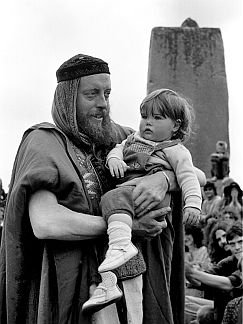
Summer solstice at Stonehenge, 1984 (Sid Rawle, arms outstretched, greets the sun). Photo copyright Alan Lodge.
During this period, Sid was also involved in establishing the enormously influential Tipi Valley community in south Wales (also see here, here and here), where he lived from 1976 to 1982. He was then involved in setting up the Peace Convoy, which traveled from Stonehenge to Greenham Common in 1981, in solidarity with the Women’s Peace Camp, and in 1984 was involved in establishing the Rainbow Village at Molesworth in Cambridgeshire, the proposed site for the second cruise missile base in the UK after Greenham, which was broken up by the largest peacetime mobilization of the military in February 1985.
He was also involved in numerous other free festivals — mainly in the West Country and Wales — that were part of the travelling free festival community’s summer itinerary, and in establishing smaller, more sustainable gatherings than Stonehenge, whose unfettered anarchy — and crowds of 50,000 or more throughout the month of June — prompted the violent clampdown at the Beanfield in June 1985.
In the summer of 1980, for example:
[T]he first Ecology Party Summer Gathering was held at Worthy Farm in Pilton. This small but significant step for the nascent ecological movement was convened by Michael Eavis in the absence of the Glastonbury festival, which he’d been forced to cancel for a year while he juggled the financial loss he’d made in 1979 with his ambitious plans for a larger festival in 1981. Significantly, the Summer Gathering brought the existing green pioneers, including Jonathan Porritt, into contact with the ecological leanings of the free festival scene for the first time. Music was provided by Roy Harper and Nik Turner’s Inner City Unit, and Sid Rawle became so involved that he was duly elected to the Party Council at the Autumn Conference in Cardiff, when ‘a controversial motion for the legalisation of cannabis was passed’.
In July 1982, Sid was involved in establishing the first Green Gathering at Worthy Farm, a development of the Ecology Party meetings that attracted over 5,000 people. As I explained in Stonehenge: Celebration and Subversion:
As well as widening the scope of the green movement, the gathering also established a template for sustainable gatherings that were able to maintain the ethos of the free festivals in the face of a growing influx of less focused ‘consumers’. The music was restricted to acoustic music only, everyone was encouraged to participate — financially, physically and spiritually — and it’s significant that the Green Gatherings, as well as other small scale gatherings along the same lines, are still running today [although see this report about the cancellation of the Big Green Gathering in 2009].
In 1985, after the Battle of the Beanfield, when over 1,300 police from six counties cornered a convoy travelling to Stonehenge to establish the 12th free festival and subjected men, women and children to brutal treatment, abruptly ending the festival and signaling an end to the state’s tolerance of the burgeoning new age traveller movement — and its interest in land reform and political campaigning against militarism and nuclear power — Sid retired from the road, settling in the Forest of Dean with his family, where he lived until his death.
On the day of the Beanfield, as I explained in my book The Battle of the Beanfield, Sid “was so convinced that the state was planning a disproportionate response to the threat posed by the convoy that he stayed behind in Savernake [Forest, the location from which the convoy for Stonehenge had set off], arguing that if all the travellers stayed put and waited for thousands more people to join them, the authorities would be powerless to break up the ever-growing movement that he had worked for so long to encourage.”
He may have been right, but we will never know. Personally, I think that, even if disaster had been avoided at the Beanfield, the State was committed to destroying the travellers’ movement. The Beanfield took place just four months after the eviction of Molesworth, and the two events were not unconnected. Both the Greenham women and the Rainbow Village had attracted the wrath of Margaret Thatcher’s government by opposing cruise missile bases on UK soil, and I have always maintained that the only reason that the authorities could not truncheon the Greenham protestors into submission — as they did with the travellers at the Battle of the Beanfield — was because they were women. With the Rainbow Village, however, the Stonehenge connection meant that “decommissioning” the travellers en route to Stonehenge could be sold to the media and the public as ridding the country of a violent anarchic scourge.
Sid subsequently became involved with the Green Party (as it developed from its original incarnation as the Ecology Party), and, after also playing a part in the Oak Dragon and Rainbow Circle camps — developments of the smaller scale gatherings pioneered in the early 1980s — set up Rainbow 2000, which held a number of camps each summer, including the SuperSpirit camp at which he passed away, while packing up on its final day.

Sunset at the SuperSpirit summer camp, August 2004.
The Vision of Albion
By Sid Rawle
In the end it all gets back to land. Looking back, I see that a link that runs through my life concerns the right to land and property on it.
Shared out equally, there would be a couple of acres for every adult living in Britain. That would mean each family or group could have a reasonably sized small holding of ten or twenty acres and learn once again to become self sufficient.
The present day reality is the reverse, with some folk owning hundreds of thousands of acres and others owning none. That can’t be fair!
There’s talk of community in wartime. We can be ordered to go and fight and die for Queen and country. In peacetime is it too much to ask for just a few square yards of our green and pleasant land to rear our children on?
That’s all we want, myself and the squatters and travellers and hippy movements I’ve been involved with. Just a few square yards of this land that we can quite easily be asked to go out and die for.
And if we ever achieve that, what else? What else is what I call the Vision of Albion.
 Albion, the most ancient name of this fair country. It was in Albion that the industrial revolution occurred. And I and many others now have a sneaking suspicion that in Albion will be forged the first post industrial society, a Green Community in this green land, living in equity and peace.
The Vision of Albion is a vision of one world united in love, a vision of unity in diversity. Not the same chant every day. Not everyone finding the same cure for the same ills. But a vision of all people uniting in love and respect for one another.
We have to find out how all us individuals in the world can have enough space to live in love and harmony, enough to be self-sufficient and be ourselves, and how to give everyone else this space. That is the vision of Albion, that is the vision of the Rainbow people.
It is the Rainbow vision because the rainbow is the symbol of God’s promise. And it is the vision of Albion because there is a sneaking feeling amongst some of us that it is from these islands, the islands that make up Albion, that change will come. So many of the white man’s dreadful fuck-ups in the world originated here. It is from these islands that peace and harmony must come.
Because although we’ve given the world so many of its institutions and a common language to communicate to each other in, we’ve lost our own real ancient roots. We don’t know who built our stone circles, how they did it, how they loved, what their economic system was, what their religion was, all this we’re ignorant of.
All over the world there are other peoples who do remember what their roots are, people who are still in touch with their tribal history. What lies deep in their systems must also lie deep within our system. We have to learn to find it again.
We have to reclaim or rediscover some of their ancient wisdom, the wisdom of ancient Albion.
There’s no magic in this, no mystery, however. The mystery is that we keep ourselves in hell when we could be in heaven. That’s the mystery.
Note: Sid attracted criticism as well as praise during his life, and it would not be fair and balanced to present this article without acknowledging his failings. The best comments I have seen came from Jeremy Sandford, who explained how his “enthusiastic breaking down of what were then perceived as the shackles of sexual taboos, including boundaries of age, sex, or style, which were such a feature of the sixties, were in Sid’s case characterised by a fervour which, though not unusual then, became inappropriate when carried on into the time of vastly different sexual mores of the 80s and 90s.” He added that Sid, “although still admired by many, was not sufficiently able to change, or change enough, in these areas.”
After working with Sid on his unpublished memoirs, Jeremy Sandford noted, “Speaking very frankly of all of this and while defending his actions in many cases and roundly condemning his critics, there are areas in which the present day mature Sid feels he has erred and strayed into actions which he now regrets.” He also wrote that, in his memoirs, his “confession of mistakes, and what amounts to his first public confession and apology, gives to his book an added poignancy and resonance.” As I mentioned above, excerpts of the book are available here (scroll down for links that begin with “sid”), and I hope that someone will one day be able to make the whole manuscript available.
For further information about Sid Rawle, see the videos here, and the obituaries here, here and here. For information about the Beanfield and its impact on civil liberties, see this article I wrote for the Guardian last year, and this accompanying article, and also see the articles here and here, written to mark the 25th anniversary. Also see these articles about Stonehenge here, here and here (and also see here for information about a book of photos from the 1994 Solsbury Hill road protest). Also see the website of Alan Lodge, and the Festival Zone website.
Andy Worthington is the author of The Guantánamo Files: The Stories of the 774 Detainees in America’s Illegal Prison (published by Pluto Press, distributed by Macmillan in the US, and available from Amazon — click on the following for the US and the UK) and of two other books: Stonehenge: Celebration and Subversion and The Battle of the Beanfield. To receive new articles in your inbox, please subscribe to my RSS feed (and I can also be found on Facebook and Twitter). Also see my definitive Guantánamo prisoner list, updated in July 2010, details about the new documentary film, “Outside the Law: Stories from Guantánamo” (co-directed by Polly Nash and Andy Worthington, currently on tour in the UK, and available on DVD here), and my definitive Guantánamo habeas list, and, if you appreciate my work, feel free to make a donation.
Nine Years After 9/11, US Court Concedes that International Laws of War Restrict President’s Wartime Powers
 Under President George W. Bush, a small group of advisors tied closely to Vice President Dick Cheney argued that neither Congress nor the judiciary should attempt to prevent the President from doing whatever he felt was appropriate as the Commander-in-Chief of a “War on Terror” that was declared after the terrorist attacks of September 11, 2001. As Sidney Blumenthal explained in an article for Salon in January 2006, the President and his advisors believed in the “unitary executive” theory — “the idea that the President as Commander-in-Chief is the sole judge of the law, unbound by hindrances such as the Geneva Conventions, and possesses inherent authority to subordinate independent government agencies to his fiat.” Blumenthal added, accurately, that this concept was “the cornerstone of the Bush legal doctrine.”
The extreme position taken by John Yoo regarding Presidential power
The most grisly public assertion of this purported dictatorial power came in December 2005, in a debate in Chicago between Notre Dame law professor Doug Cassel, and John Yoo, a lawyer in the Justice Department’s Office of Legal Counsel, who had written two memoranda in August 2002 purporting to redefine torture so that it could be used by US personnel. This was the exchange:
Doug Cassel: If the president deems that he’s got to torture somebody, including by crushing the testicles of the person’s child, there is no law that can stop him?
John Yoo: No treaty.
Doug Cassel: Also no law by Congress. That is what you wrote in the August 2002 memo.
John Yoo: I think it depends on why the president thinks he needs to do that.
 As recently as February this year, Yoo continued to defend the President’s absolute right to do what he considered “necessary” in wartime without opposition, and was, to a distressing extent, justified in doing so when a senior Justice Department official, David Margolis, rewrote the conclusion of a four-year internal investigation into the “torture memos,” claiming that Yoo (and Jay S. Bybee, the head of the OLC), were not guilty of “professional misconduct,” as the report’s authors had asserted, but had, instead, merely exercised “poor judgment.”
The Obama administration must bear the responsibility for allowing Margolis to doctor the report so shamefully, especially because, on his second day in office, President Obama issued a number of executive orders, one of which thoroughly repudiated his predecessor’s reliance on claims of unfettered executive power. In cleaning up the “mess” inherited from the Bush administration with regard to torture and detention without charge or trial, Obama also issued an executive order upholding the absolute ban on torture, and made it clear that, in authorizing the detention of prisoners seized in the “War on Terror” who were held at Guantánamo, he would only rely on legislation passed by Congress.
The problems with Obama’s reliance on Congress and the Authorization for Use of Military Force
Although there are gray areas regarding Obama’s torture ban (particularly with regard to the US prison at Bagram airbase in Afghanistan, where challenges to prisoners’ detention have also been resisted), the President has been true to his word regarding the detention of prisoners at Guantánamo, relying only on the Authorization for Use of Military Force, passed the week after the 9/11 attacks, which authorized the President to “use all necessary and appropriate force against those nations, organizations, or persons he determines planned, authorized, committed, or aided the terrorist attacks that occurred on September 11, 2001, or harbored such organizations or persons, in order to prevent any future acts of international terrorism against the United States,” and which, as interpreted by the Supreme Court in Hamdi v. Rumsfeld, in 2004, involved the assertion that “Congress has clearly and unmistakably authorized detention” of individuals covered by the AUMF.
Unfortunately, this apparent distinction between relying on claims of executive power or relying on Congressional authority means little in reality to the prisoners held at Guantánamo, because the AUMF is an overbroad policy, which fails to distinguish between al-Qaeda and the Taliban, and seems to justify holding even the most peripheral figures in the military conflict in Afghanistan in 2001 (as well as genuine terror suspects) in the same sort of open-ended detention created by President Bush. The result is complacency on the part of the administration regarding the importance of trying or freeing the remaining prisoners, after over eight years of detention.
In addition, in the District Court in Washington D.C., where judges have been ruling on the prisoners’ habeas corpus petitions for the last two years, the overbroad scope of the AUMF has led to the denial of 16 out of 54 petitions, mostly because the men in question were foot soldiers for the Taliban, and not because they had ever demonstrated any involvement in terrorism.
While I believe that the majority of these rulings also fail to fulfill the AUMF’s requirement that the men detained are being deprived of their liberty “to prevent any future acts of international terrorism against the United States,” adding to the unsuitability of the AUMF as a substitute for holding soldiers as prisoners of war according to the Geneva Conventions, a more pressing problem is that, as the prisoners have been challenging these rulings, they have discovered that the Court of Appeals has been resolutely looking the other way. In a number of rulings, judges in the D.C. Circuit Court have demonstrated that they are determined not only to deny the prisoners’ appeals, but also to tell the government that its powers of detention are far more sweeping than the AUMF suggests.
The case of Ghaleb al-Bihani, a cook
 This bizarre, and genuinely disturbing scenario first surfaced in January this year, in the case of Ghaleb al-Bihani, a Yemeni who had cooked for Arab forces supporting the Taliban in a military capacity, and had lost his habeas corpus petition in January 2009. In a ruling denying his appeal (PDF), two of the most conservative judges in the D.C. Circuit Court — Judge Janice Rogers Brown, and Judge Brett M. Kavanaugh, both appointees of George W. Bush — not only defended al-Bihani’s detention under the terms of the AUMF, but also dismissed arguments made by al-Bihani that “rel[ied] heavily on the premise that the war powers granted by the AUMF and other statutes are limited by the international laws of war.” The judges claimed, “This premise is mistaken.”
Judge Brown also described the international laws of war as not “a fixed code,” refused to “quibble over the intricate application of vague treaty provisions and amorphous customary principles,” and concluded that “their lack of controlling legal force and firm definition render their use both inapposite and inadvisable when courts seek to determine the limits of the President’s war powers.”
In response, Senior Circuit Judge Stephen F. Williams, the third judge, who concurred with the overall judgment and with part of the majority opinion, took exception to this conclusion, noting that the paragraph ending in “This premise is mistaken” was “hard to square with the approach that the Supreme Court took in Hamdi.” Judge Williams quoted Justice Souter, who stated explicitly, “[W]e understand Congress’ grant of authority for the use of ‘necessary and appropriate force’ to include the authority to detain for the duration of the relevant conflict, and our understanding is based on longstanding law-of-war principles.”
This may not be much, but it was refreshing that Judge Williams at least perceived that the Supreme Court had set limits on the Executive’s wartime detention powers, and that he chastised the other judges for putting forward an argument that “goes well beyond what even the government has argued in this case” — that “[t]he authority conferred by the AUMF is informed by the laws of war.”
Judge Williams’ opinion chimed with that of numerous legal experts who were appalled by the Circuit Court’s Bush-like advocacy of unfettered executive power — and also, as he pointed out, endorsed powers for the Obama administration which went “beyond what even the government ha[d] argued in this case.” His reference to the government’s argument resurfaced in May, when the government submitted a brief (PDF), in which, although lawyers opposed en banc review and agreed with the Circuit Court on almost every point in its January opinion, they disagreed with the court’s opinion about Presidential power and the international laws of war.
As the government’s lawyers explained in their brief:
Petitioner cites the panel majority’s statement that the “premise that the war powers granted by the [Authorization for Use of Military Force] and other statutes are limited by the international laws of war is mistaken.” The Government agrees that this broad statement does not properly reflect the state of the law. The Government interprets the detention authority permitted under the AUMF as informed by the laws of war.
In addition, as I explained in a recent article:
The lawyers proceeded to explain that their interpretation was “consistent” with Hamdi, as cited above, “and with longstanding Supreme Court precedent that statutes should be construed as consistent with applicable international law.” The lawyers also pointed out that the government had accepted “its detention authority under the AUMF to be informed by the laws of war” in a court filing on March 13, 2009, in response to a request for clarification from Judge John D. Bates, which I discussed in an article entitled, “Guantánamo: The Nobodies Formerly Known As Enemy Combatants.”
The D.C. Circuit Court backs down on Presidential power
Last Tuesday, the Court of Appeals finally issued an opinion on al-Bihani’s appeal (PDF). Predictably, all nine judges turned down the appeal, but in an unusual move, seven of the judges — Chief Judge David B. Sentelle and Judges Douglas H. Ginsburg, Karen LeCraft Henderson, Judith Ann Wilson Rogers, David S. Tatel, Merrick B. Garland, and Thomas B. Griffith — issued the following joint statement:
We decline to en banc this case to determine the role of international law-of-war principles in interpreting the AUMF because, as the various opinions issued in the case indicate, the panel’s discussion of that question is not necessary to the disposition of the merits.
Although the decision does nothing to challenge the fundamental problem with detaining al-Bihani under the AUMF, rather than as a prisoner of war, it is enormously significant, as was pointed out by Stephen Vladeck, Professor of Law at American University Washington College of Law, who filed an amicus brief in support of the en banc appeal. Vladeck told the New York Times that the note by the seven judges “amounted to a nullification of the more sweeping parts of the January ruling without the court bothering to rehear it.” He added, as the Times described it, that the paragraph “tells the world that the section of the January ruling about international law should be treated like what lawyers call ‘dicta’ — editorializing about issues that are not necessary to decide the matter at hand, which has little controlling authority for other cases.” As Vladeck explained,
They’ve basically removed the single biggest complaint people had with that opinion. They said, “We don’t think we need to rehear the whole case just to limit the opinion — we can just say it, and going forward this is how we understand it.” That matters a lot.
Confirmation of Vladeck’s opinion can be found in the responses of Judge Brown and Kavanaugh. In a desperate attempt to salvage their defense of sweeping war powers, unrestrained by the international laws of war, Judge Brown issued a 15-page opinion, attacking her colleagues for “appending ‘a cryptic statement’ that she said would ‘muddy the clear holding’ that international law does not limit the war powers Congress authorized,” and Judge Kavanaugh issued an 87-page opinion, arguing that “only rules explicitly enacted by Congress, not international laws of armed conflict, can constrain what an American president can do in wartime,” and stating, “International law is not a judicially enforceable limit on a president’s wartime authority unless Congress expressly says it is” (emphasis in original).
On Balkinization, Stephen Vladeck summed up the significance of the seven judges’ note by stating, “Whatever the merits of the decision in al-Bihani’s case, specifically, its significance in other cases has been unquestionably lessened (along with any chance that the Supreme Court would feel the need to step in).” This is to be welcomed, but although it is reassuring that seven judges (two nominated by Reagan, one by Bush Sr., three by Clinton and one by Bush Jr.) refused to endorse their colleagues’ extreme opinions, it is still apparent that the courts’ jurisdiction regarding the Guantánamo habeas cases leaves the fundamental problems with the AUMF untouched.
Why none of this helps al-Bihani — or other Guantánamo prisoners
 At the heart of al-Bihani’s appeal is his contention that the AUMF only authorizes detention “for the sole purpose of preventing future acts of terrorism against the US,” and that it therefore “authorizes preventative, not punitive, detention,” because the government has failed to prove that he poses a future threat to the United States. To my mind, this is a powerful argument, and it is one that was first advanced by Judge Ellen Segal Huvelle in March 2009, in the case of Yasim Basardah, a Yemeni prisoner.
What troubled Judge Huvelle, as I explained in an article last summer, was the fact that the Guantánamo prisoners were akin to prisoners of war, but without the ability to be released if it could be demonstrated that they no longer posed a threat to the United States. Drawing on the AUMF’s authorization to hold prisoners “in order to prevent any future acts of international terrorism,” she declared that the AUMF “does not authorize unlimited, unreviewable detention,” and “does not authorize the detention of individuals beyond that which is necessary to prevent those individuals from rejoining the battle, and it certainly cannot be read to authorize detention where its purpose can no longer be attained.”
Unfortunately, judges in other habeas cases have failed to follow up on Judge Huvelle’s suggestion, but even more worrying, for the prisoners, must be the fact that one other judge, Senior Judge A. Raymond Randolph (who was not part of the nine last week), has thrown another hurdle in the prisoners’ way. In an appeal in July, reversing a successful habeas petition last August — that of Mohammed al-Adahi, another Yemeni — Judge Randolph, notorious for upholding every Bush decision on detention in the “War on Terror” that was subsequently overturned by the Supreme Court, drifted off the point as dangerously as Judges Brown and Kavanaugh, indicating that he believed that the standard of evidence required in the habeas cases was too high for the government.
Given that all that is required is for the government to prove, “by a preponderance of the evidence,” that plaintiffs in the habeas cases were involved in some way with al-Qaeda and/or the Taliban, and that this standard is much lower than it would be in criminal trials, Judge Randolph was clearly using some creativity to reach the same ideological place as Judges Brown and Kavanaugh — that, in wartime, the President should not be subjected to constraints on his power.
How this will affect future cases has not yet become apparent, although it will surely strengthen the hand of those in the Justice Department — and elsewhere in the administration — who have been pushing for appeals in the cases of prisoners who have won their habeas petitions, and have, to date, appealed five successful petitions, as well as repeatedly appealing against an order to release 17 other men (the Uighurs) into the United States.
Compared to that, last Tuesday’s ruling, though welcome in its restraint on executive power, still does nothing to free men from Guantánamo or have them redesignated as prisoners of war, even when, as with Ghaleb al-Bihani, they were nothing more than a cook who, as far as we know, never fired a single shot at US forces.
Andy Worthington is the author of The Guantánamo Files: The Stories of the 774 Detainees in America’s Illegal Prison (published by Pluto Press, distributed by Macmillan in the US, and available from Amazon — click on the following for the US and the UK) and of two other books: Stonehenge: Celebration and Subversion and The Battle of the Beanfield. To receive new articles in your inbox, please subscribe to my RSS feed (and I can also be found on Facebook and Twitter). Also see my definitive Guantánamo prisoner list, updated in July 2010, details about the new documentary film, “Outside the Law: Stories from Guantánamo” (co-directed by Polly Nash and Andy Worthington, currently on tour in the UK, and available on DVD here), and my definitive Guantánamo habeas list, and, if you appreciate my work, feel free to make a donation.
As published exclusively on the website of the Future of Freedom Foundation, as “Restricting Presidential Wartime Powers.” Cross-posted on Cageprisoners, Uruknet, Eurasia Review, New Left Project and Dandelion Salad.
For an overview of all the habeas rulings, including links to all my articles, and to the judges’ unclassified opinions, see: Guantánamo Habeas Results: The Definitive List. For a sequence of articles dealing with the Guantánamo habeas cases, see: Guantánamo and the Supreme Court: the most important habeas corpus case in modern history and Guantánamo and the Supreme Court: What Happened? (both December 2007), The Supreme Court’s Guantánamo ruling: what does it mean? (June 2008), Guantánamo as Alice in Wonderland (Uighurs’ first court victory, June 2008), What’s Happening with the Guantánamo cases? (July 2008), Government Says Six Years Is Not Long Enough To Prepare Evidence (September 2008), From Guantánamo to the United States: The Story of the Wrongly Imprisoned Uighurs (October 2008), Guantánamo Uyghurs’ resettlement prospects skewered by Justice Department lies (October 2008), Guilt By Torture: Binyam Mohamed’s Transatlantic Quest for Justice (November 2008), After 7 Years, Judge Orders Release of Guantánamo Kidnap Victims (November 2008), Is Robert Gates Guilty of Perjury in Guantánamo Torture Case? (December 2008), A New Year Message to Barack Obama: Free the Guantánamo Uighurs (January 2009), The Top Ten Judges of 2008 (January 2009), No End in Sight for the “Enemy Combatants” of Guantánamo (January 2009), Judge Orders Release of Guantánamo’s Forgotten Child (January 2009), How Cooking For The Taliban Gets You Life In Guantánamo (January 2009), Lies, Damned Lies and Statistics (February 2009), Bad News And Good News For The Guantánamo Uighurs (February 2009), The Nobodies Formerly Known As Enemy Combatants (March 2009), Farce at Guantánamo, as cleared prisoner’s habeas petition is denied (April 2009), Obama’s First 100 Days: A Start On Guantánamo, But Not Enough (May 2009), Judge Condemns “Mosaic” Of Guantánamo Intelligence, And Unreliable Witnesses (May 2009), Pain At Guantánamo And Paralysis In Government (May 2009), Guantánamo: A Prison Built On Lies (May 2009), Free The Guantánamo Uighurs! (May 2009), Guantánamo And The Courts (Part One): Exposing The Bush Administration’s Lies (July 2009), Obama’s Failure To Deliver Justice To The Last Tajik In Guantánamo (July 2009), Obama And The Deadline For Closing Guantánamo: It’s Worse Than You Think (July 2009), How Judge Huvelle Humiliated The Government In Guantánamo Case (Mohamed Jawad, July 2009), As Judge Orders Release Of Tortured Guantánamo Prisoner, Government Refuses To Concede Defeat (Mohamed Jawad, July 2009), Guantánamo As Hotel California: You Can Check Out Any Time You Like, But You Can Never Leave (August 2009), Judge Orders Release From Guantánamo Of Kuwaiti Charity Worker (August 2009), Guantánamo And The Courts (Part Two): Obama’s Shame (August 2009), Guantánamo And The Courts (Part Three): Obama’s Continuing Shame (August 2009), No Escape From Guantánamo: The Latest Habeas Rulings (September 2009), First Guantánamo Prisoner To Lose Habeas Hearing Appeals Ruling (September 2009), A Truly Shocking Guantánamo Story: Judge Confirms That An Innocent Man Was Tortured To Make False Confessions (September 2009), 75 Guantánamo Prisoners Cleared For Release; 31 Could Leave Today (September 2009), Resisting Injustice In Guantánamo: The Story Of Fayiz Al-Kandari (October 2009), Justice Department Pointlessly Gags Guantánamo Lawyer (November 2009), Judge Orders Release Of Algerian From Guantánamo (But He’s Not Going Anywhere) (November 2009), Innocent Guantánamo Torture Victim Fouad al-Rabiah Is Released In Kuwait (December 2009), What Does It Take To Get Out Of Obama’s Guantánamo? (December 2009), “Model Prisoner” at Guantánamo, Tortured in the “Dark Prison,” Loses Habeas Corpus Petition (December 2009), Judge Orders Release From Guantánamo Of Unwilling Yemeni Recruit (December 2009), Serious Problems With Obama’s Plan To Move Guantánamo To Illinois (December 2009), Appeals Court Extends President’s Wartime Powers, Limits Guantánamo Prisoners’ Rights (January 2010), Fear and Paranoia as Guantánamo Marks its Eighth Anniversary (January 2010), Rubbing Salt in Guantánamo’s Wounds: Task Force Announces Indefinite Detention (January 2010), The Black Hole of Guantánamo (March 2010), Guantánamo Uighurs Back in Legal Limbo (March 2010), Guantánamo and Habeas Corpus: The Torture Victim and the Taliban Recruit (April 2010), An Insignificant Yemeni at Guantánamo Loses His Habeas Petition (April 2010), With Regrets, Judge Allows Indefinite Detention at Guantánamo of a Medic (April 2010), Mohamedou Ould Salahi: How a Judge Demolished the US Government’s Al-Qaeda Claims (April 2010), Judge Rules Yemeni’s Detention at Guantánamo Based Solely on Torture (April 2010), Why Judges Can’t Free Torture Victims from Guantánamo (April 2010), How Binyam Mohamed’s Torture Was Revealed in a US Court (May 2010), Guantánamo and Habeas Corpus: Consigning Soldiers to Oblivion (May 2010), Judge Denies Habeas Petition of an Ill and Abused Libyan in Guantánamo (May 2010), Judge Orders Release from Guantánamo of Russian Caught in Abu Zubaydah’s Web (May 2010), No Escape from Guantánamo: Uighurs Lose Again in US Court (June 2010), Does Obama Really Know or Care About Who Is at Guantánamo? (June 2010), Guantánamo and Habeas Corpus: 2 Years, 50 Cases, 36 Victories for the Prisoners (June 2010), Obama Thinks About Releasing Innocent Yemenis from Guantánamo (June 2010), Calling for US Accountability on the International Day in Support of Victims of Torture (June 2010), Judge Orders Release from Guantánamo of Yemeni Seized in Iran, Held in Secret CIA Prisons (July 2010), Innocent Student Finally Released from Guantánamo (July 2010), Guantánamo and Habeas Corpus: Prisoners Win 3 out of 4 Cases, But Lose 5 out of 6 in Court of Appeals (Part One) (July 2010), Obama and US Courts Repatriate Algerian from Guantánamo Against His Will; May Be Complicit in Torture (July 2010), In Abu Zubaydah’s Case, Court Relies on Propaganda and Lies (July 2010), Guantánamo and Habeas Corpus: Prisoners Win 3 out of 4 Cases, But Lose 5 out of 6 in Court of Appeals (Part Two) (July 2010), Judge Orders Release from Guantánamo of Mentally Ill Yemeni; 2nd Judge Approves Detention of Minor Taliban Recruit (August 2010), Judge Denies Habeas Petition of Afghan Shopkeeper at Guantánamo (September 2010).
Andy Worthington Discusses Obama’s Guantánamo Inertia on Antiwar Radio
 On Friday, I was delighted to take part in my 18th interview with Scott Horton of Antiwar Radio. The one-hour show is available here (and here as an MP3), and my interview begins 35 minutes in. Scott was standing in for Gustavo Arellano on Pacifica Radio’s KFPK channel in Los Angeles, and our interview follows fascinating interviews with Patrick Cockburn, the Middle East correspondent for The Independent, discussing Iraq and his new book Muqtada Al-Sadr and the Battle for the Future of Iraq, about the Shia cleric and political leader), and Michael Hastings, who wrote the extraordinary Rolling Stone article “The Runaway General” that triggered the dismissal of Gen. Stanley McChrystal.
In our 18-minute interview, Scott and I ran through the latest news from Guantánamo, focusing, as Scott described it, on “the proceedings at Guantánamo that are grinding to a halt, why ‘material support for terrorism’ charges have no relation to war crimes and should be tried in federal courts, the political realities that make Guantánamo’s timely closure highly unlikely and the 58 Yemeni prisoners still in custody despite being cleared for release.”
Further information about these topics can be found in my recent articles — in particular, Bin Laden Cook Expected to Serve Two More Years at Guantánamo – And Some Thoughts on the Remaining Sudanese Prisoners, Lawlessness Haunts Omar Khadr’s Blighted War Crimes Trial at Guantánamo and No Surprise at Obama’s Guantánamo Trial Chaos.
It was great to talk to Scott, as ever, and I hope I managed to summon up the necessary outrage regarding Obama’s lamentable inertia, the moral depravity of lawmakers in Congress, and the deplorable absence of debate about Guantánamo in the mainstream media. I hope you enjoy the show — and if you have the time, please listen to the whole hour, as Patrick Cockburn and Michael Hastings both have excellent insights into the truth on the ground in Iraq and Afghanistan.
Andy Worthington is the author of The Guantánamo Files: The Stories of the 774 Detainees in America’s Illegal Prison (published by Pluto Press, distributed by Macmillan in the US, and available from Amazon — click on the following for the US and the UK) and of two other books: Stonehenge: Celebration and Subversion and The Battle of the Beanfield. To receive new articles in your inbox, please subscribe to my RSS feed (and I can also be found on Facebook and Twitter). Also see my definitive Guantánamo prisoner list, updated in July 2010, details about the new documentary film, “Outside the Law: Stories from Guantánamo” (co-directed by Polly Nash and Andy Worthington, currently on tour in the UK, and available on DVD here), and my definitive Guantánamo habeas list, and, if you appreciate my work, feel free to make a donation.
Judge Denies Habeas Petition of Afghan Shopkeeper at Guantánamo
 On Friday September 3, in the District Court in Washington D.C., Judge John D. Bates handed another victory to the government in its ongoing effort to continue holding insignificant prisoners at Guantánamo, when he denied the habeas corpus petition of Shawali Khan, an Afghan prisoner. Khan was accused of providing assistance to members of Hezb-e-Islami Gulbuddin (HIG), an anti-US militia headed by the Afghan warlord Gulbuddin Hekmatyar (who, ironically, had received the lion’s share of US funding as a leader of the Afghan resistance to the Soviet occupation in the 1980s, which was channeled to him by the Pakistani authorities who championed his cause).
19 Afghans are still held in Guantánamo, following the release of around 200 others over the last eight years, and Friday’s ruling was the first in the case of an Afghan, and the 16th victory for the government, in the two years since the first habeas ruling took place. The ruling was part of a process that has, to date, resulted in judges granting a significantly larger number of petitions. 38 prisoners have won their habeas petitions, although, as the Obama administration seems to delight in dragging its heels, or appealing successful petitions, 13 of these 38 men are still held, and a 14th recently had his successful petition reversed on appeal.
Judge Bates’ unclassified opinion has not yet been released, so it is impossible at present to know what evidence he relied on to make his judgment, but the decision is particularly shocking because, last year, after reviewing the classified evidence against Khan, Judge Bates declared that all of the allegations came from reports containing “multiple levels of hearsay,” that “all of the information contained in the reports could come from a single individual,” and that “no source is identified by name.”
This alone made the government’s case look flimsy, but it is not the only reason to doubt the outcome of Friday’s ruling. Over the last two years, Khan’s attorney, Len Goodman, a lawyer in Chicago, has pieced together his client’s story, and has also conducted research in Afghanistan to establish that he was not involved in insurgent activities against US forces.
The story of Shawali Khan, a shopkeeper from Kandahar
Goodman agreed to represent Shawali Khan in mid-2007. However, because it takes at least six months for attorneys or translators to receive security clearance to visit Guantánamo, he was not cleared to visit Khan until the summer of 2008. His first visit to his client took place in the fall of 2008. Goodman described Khan as “a small man with sad eyes … who comes from a small farming village near Kandahar, Afghanistan,” and is now in his mid-40s. Over the course of his visits he established Khan’s story, describing it in an article in the US magazine In These Times (in September 2009) and also in an article on his website last month.
As Goodman explained, “In 2000, there had been a drought on the farm and Khan had moved with his father and brother to Kandahar City where they opened a shop selling petrol products. When US forces invaded Afghanistan in 2001, Khan continued to run his oil shop and even worked, for a short time, for the Karzai government as a driver.”
However, on November 13, 2002, while riding his motorcycle from his home to the market, he was seized by Afghans working for Gul Agha Sherzai, the US-backed governor of Kandahar, who had assisted US forces in seizing Kandahar from the Taliban in November 2001, but had then established a regime that was noted for its corruption. According to Goodman, the men who seized Khan told US officials that he was “a terrorist, plotting against US interests in and around Kandahar.” He added, “It is almost certain that the US paid a bounty to Khan’s captors but this cannot be confirmed because, while the US admits paying large cash bounties to warlords who turned in ‘al-Qaeda and Taliban fighters,’ it has refused to release any of these files.”
Goodman also explained that, “around the time of his capture, one or more Afghan informants told US intelligence officials in Kandahar that Khan was an active member of a local insurgent group that was plotting to bomb Americans in and around the Kandahar region.” However, “The US intelligence officer did not bother to record the informant’s name or whether he was paid a bounty. Nor did he inquire how the informant acquired his information or whether the informant is a credible person or a criminal. Nor did the official attempt to corroborate the allegations against Khan before sending him off to the newly built prison at Guantánamo.”
This, sadly, is typical of the Guantánamo cases (and is a pattern that was repeated again and again with the Afghan prisoners at Guantánamo). However, although it is understandable that administrative details can be missed in the heat of war, a more fundamental problem, identified by Goodman, is that US forces repeatedly demonstrated that they had made no attempts whatsoever to ascertain whether their sources were reliable.
In Khan’s case, the allegations, as presented in a military review board in September 2005, were that in September 2002 he was directed by HIG commander Zabit Jalil “to carry out a terrorist operation targeted at US military personnel located at Gecko base, Kandahar,” that he delivered “a radio-controlled binary detonation device and two blasting caps” to a HIG operative in November 2002, that he tried to purchase rockets in September 2002, that he undertook military and explosives training at a HIG camp in Pakistan, and that after his arrest tanks, rockets and guns were found in his family orchard, and that he was “found with a 50m spool of detonation cord.”
As I explained in a profile of Khan last year:
This was a fairly comprehensive list, but the allegations seem to have been based on the fact that Zabit Jalil was his uncle (his mother’s brother). Khan denied all knowledge of his uncle’s activities. As far as he was concerned, Zabit Jalil worked for the Karzai government, and he told the tribunal that he (Khan) had also worked for the government “for a while” as a driver. In a personal statement, he said, “the Afghans caught me and took me to the Americans. I talked to the Americans and I showed them my house and I showed them my shop. Those Afghan people took my money and my motorcycle and gave me to the Americans.” He explained that a list of weapons that was in his possession at the time of his capture was a receipt, given to him by his uncle, because all weapons had to be accounted for to the Karzai government, but he repeatedly denied knowledge of the alleged weapons cache in his orchard. He also said that the Afghans gave him “a hard time” in Kabul, but that the Americans had treated him better. He suggested that “the intelligence people, the reporters, or spies … were capturing everybody to give them to the Americans for money.”
As I also explained:
As with many other stories, it would have made sense for the US military to try and contact the Afghan authorities in the Kandahar area, to find out whether Zabit Jalil had in fact been working for the Karzai government, but as usual there is no evidence that any attempt was made to conduct even the most rudimentary investigation of Khan’s story.
Khan’s attempts to secure justice in a US court, despite being cleared for release on two occasions
After he was seized, Khan was taken by US forces to the prison at Bagram airbase, where, as Goodman described it, “he repeatedly told his interrogators that he and his family had an oil shop in Kandahar and were not enemies of the Americans.” Although the interrogators wrote in their reports that Khan “appeared honest,” he was sent to Guantánamo in February 2003, where he had to wait for over four years before he was assigned a lawyer. Last month, Len Goodman helpfully summarized Khan’s attempts to secure justice via the US courts, in a sequence of events that reveals obstruction on the part of the government, and evident confusion, as he was twice declared cleared for release, but was not actually freed:
By far the most frustrating part about representing a Gitmo detainee is that there is so little lawyers can do for their clients. In June 2008, right after Boumediene [v. Bush, in which the Supreme Court reasserted that the Guantánamo prisoners had habeas corpus rights], I filed a habeas corpus petition in the D.C. District Court demanding an evidentiary hearing and Khan’s release. During my first visit in the fall of 2008, I excitedly told Khan about this petition and about the great writ of habeas corpus. Khan informed me that the guards had recently told him that he was cleared for release and would soon be going home to Afghanistan. He had even been visited by representatives of the Red Cross to help prepare him for the journey. This was news to me, but about a year later, the government lawyers finally disclosed that Khan had in fact been cleared for release but that decision had been revoked.
During my second visit, in January 2009, I again told Khan about the virtues of habeas corpus. I explained that his case was pending before a real federal judge and that he would have a real hearing where the government would have to produce real evidence to justify his continued detention (unlike the Mickey Mouse CSRT hearings Khan had already received at Gitmo). I further explained that Khan would have an opportunity to testify at his hearing via video conference. Khan agreed to participate and requested that this hearing be held as soon as possible. I promised to push the judge for the earliest hearing date.
During my next visit in mid-2009, I had to explain to Khan that the Court had granted the government’s request for a stay of all habeas proceedings while it conducted a new search through archived intelligence files for additional evidence against Khan. Khan was angry and frustrated. The fact that I shared his frustration did not comfort him.
That fall, the Court finally set Khan’s case for a merits hearing. I wrote to Khan to tell him the good news. But then, in December, the government again successfully moved, over my strenuous objection, to stay the merits hearing on the grounds that Khan had again been “cleared for transfer” at some future date unspecified. In January 2010, I visited Khan for the fourth time and delivered the bad news that his hearing had again been postponed. (Shortly after this visit, Khan fired me but then later agreed to let me represent him at his hearing.)
In February 2010, the Court lifted the stay and reset the merits hearing, acknowledging perhaps that the government was merely stalling for time. On May 13, 2010, Khan’s hearing commenced, closed to the press and the public.
The government produced no live witnesses at the merits hearing. Instead, it offered classified documents from US intelligence officers reporting that certain unidentified Afghan informants had named Khan as an anti-US insurgent. In response, the defense offered nine sworn declarations from Khan’s family and neighbors, all of which refuted the charge that Khan was a terrorist. The defense also presented the live testimony of a professor and expert on Afghan terror groups and the published memoir of a US journalist who had lived in Kandahar during 2002, each of which supported the defense claim that the allegations against Khan were fabricated by bounty hunters.
As Goodman also explained, “The only other detainee at Guantánamo from the Kandahar region was shown Khan’s photograph. He told his interrogators that Khan ‘was a shopkeeper who sold gasoline in Kandahar’ and was not a terrorist.”
On May 17, seven and a half years after his capture, Shawali Khan was finally able to tell the court, through a secure and encrypted video link, that “he was a shopkeeper and not a terrorist or enemy of the United States,” but his testimony — and the evidence provided by his witnesses — was obviously in vain, because, on Friday, Judge John D. Bates denied his habeas corpus petition, assigning him to endless, ongoing detention at Guantánamo on an apparently legal basis.
Apart from the fact that it remains insupportable that the justification for holding prisoners at Guantánamo — the Authorization for Use of Military Force, passed by Congress the week after the 9/11 attacks — allows prisoners of war to be held at Guantánamo, and not in a prisoner of war camp, with the full protections of the Geneva Conventions, Judge Bates’ ruling appears to be unsupported by the facts. Perhaps, as in the case of a Yemeni prisoner last summer, he decided that, although the government’s evidence was “gossamer thin,” it was sufficient to endorse the ongoing detention of man who had twice been cleared for release — once by a Bush-era military review board, and once by the Obama administration’s Guantánamo Review Task Force.
I must admit, however, that this strikes me as unlikely. As someone close to the case explained to me over the weekend, when I asked if there were any compelling reasons to doubt the government’s story, “Yes, Shawali Khan’s defense team had nine affidavits from his rural village and from Kandahar where he drove for the Karzai government before he supposedly started an HIG cell in an area hundreds of miles from any HIG cells.”
Andy Worthington is the author of The Guantánamo Files: The Stories of the 774 Detainees in America’s Illegal Prison (published by Pluto Press, distributed by Macmillan in the US, and available from Amazon — click on the following for the US and the UK) and of two other books: Stonehenge: Celebration and Subversion and The Battle of the Beanfield. To receive new articles in your inbox, please subscribe to my RSS feed (and I can also be found on Facebook and Twitter). Also see my definitive Guantánamo prisoner list, updated in July 2010, details about the new documentary film, “Outside the Law: Stories from Guantánamo” (co-directed by Polly Nash and Andy Worthington, currently on tour in the UK, and available on DVD here), and my definitive Guantánamo habeas list, and, if you appreciate my work, feel free to make a donation.
As published exclusively on Cageprisoners. Cross-posted on The Public Record, Free Detainees, Dandelion Salad, Uruknet, Eurasia Review, New Left Project and Fubar and Grill.
For an overview of all the habeas rulings, including links to all my articles, and to the judges’ unclassified opinions, see: Guantánamo Habeas Results: The Definitive List. For a sequence of articles dealing with the Guantánamo habeas cases, see: Guantánamo and the Supreme Court: the most important habeas corpus case in modern history and Guantánamo and the Supreme Court: What Happened? (both December 2007), The Supreme Court’s Guantánamo ruling: what does it mean? (June 2008), Guantánamo as Alice in Wonderland (Uighurs’ first court victory, June 2008), What’s Happening with the Guantánamo cases? (July 2008), Government Says Six Years Is Not Long Enough To Prepare Evidence (September 2008), From Guantánamo to the United States: The Story of the Wrongly Imprisoned Uighurs (October 2008), Guantánamo Uyghurs’ resettlement prospects skewered by Justice Department lies (October 2008), Guilt By Torture: Binyam Mohamed’s Transatlantic Quest for Justice (November 2008), After 7 Years, Judge Orders Release of Guantánamo Kidnap Victims (November 2008), Is Robert Gates Guilty of Perjury in Guantánamo Torture Case? (December 2008), A New Year Message to Barack Obama: Free the Guantánamo Uighurs (January 2009), The Top Ten Judges of 2008 (January 2009), No End in Sight for the “Enemy Combatants” of Guantánamo (January 2009), Judge Orders Release of Guantánamo’s Forgotten Child (January 2009), How Cooking For The Taliban Gets You Life In Guantánamo (January 2009), Lies, Damned Lies and Statistics (February 2009), Bad News And Good News For The Guantánamo Uighurs (February 2009), The Nobodies Formerly Known As Enemy Combatants (March 2009), Farce at Guantánamo, as cleared prisoner’s habeas petition is denied (April 2009), Obama’s First 100 Days: A Start On Guantánamo, But Not Enough (May 2009), Judge Condemns “Mosaic” Of Guantánamo Intelligence, And Unreliable Witnesses (May 2009), Pain At Guantánamo And Paralysis In Government (May 2009), Guantánamo: A Prison Built On Lies (May 2009), Free The Guantánamo Uighurs! (May 2009), Guantánamo And The Courts (Part One): Exposing The Bush Administration’s Lies (July 2009), Obama’s Failure To Deliver Justice To The Last Tajik In Guantánamo (July 2009), Obama And The Deadline For Closing Guantánamo: It’s Worse Than You Think (July 2009), How Judge Huvelle Humiliated The Government In Guantánamo Case (Mohamed Jawad, July 2009), As Judge Orders Release Of Tortured Guantánamo Prisoner, Government Refuses To Concede Defeat (Mohamed Jawad, July 2009), Guantánamo As Hotel California: You Can Check Out Any Time You Like, But You Can Never Leave (August 2009), Judge Orders Release From Guantánamo Of Kuwaiti Charity Worker (August 2009), Guantánamo And The Courts (Part Two): Obama’s Shame (August 2009), Guantánamo And The Courts (Part Three): Obama’s Continuing Shame (August 2009), No Escape From Guantánamo: The Latest Habeas Rulings (September 2009), First Guantánamo Prisoner To Lose Habeas Hearing Appeals Ruling (September 2009), A Truly Shocking Guantánamo Story: Judge Confirms That An Innocent Man Was Tortured To Make False Confessions (September 2009), 75 Guantánamo Prisoners Cleared For Release; 31 Could Leave Today (September 2009), Resisting Injustice In Guantánamo: The Story Of Fayiz Al-Kandari (October 2009), Justice Department Pointlessly Gags Guantánamo Lawyer (November 2009), Judge Orders Release Of Algerian From Guantánamo (But He’s Not Going Anywhere) (November 2009), Innocent Guantánamo Torture Victim Fouad al-Rabiah Is Released In Kuwait (December 2009), What Does It Take To Get Out Of Obama’s Guantánamo? (December 2009), “Model Prisoner” at Guantánamo, Tortured in the “Dark Prison,” Loses Habeas Corpus Petition (December 2009), Judge Orders Release From Guantánamo Of Unwilling Yemeni Recruit (December 2009), Serious Problems With Obama’s Plan To Move Guantánamo To Illinois (December 2009), Appeals Court Extends President’s Wartime Powers, Limits Guantánamo Prisoners’ Rights (January 2010), Fear and Paranoia as Guantánamo Marks its Eighth Anniversary (January 2010), Rubbing Salt in Guantánamo’s Wounds: Task Force Announces Indefinite Detention (January 2010), The Black Hole of Guantánamo (March 2010), Guantánamo Uighurs Back in Legal Limbo (March 2010), Guantánamo and Habeas Corpus: The Torture Victim and the Taliban Recruit (April 2010), An Insignificant Yemeni at Guantánamo Loses His Habeas Petition (April 2010), With Regrets, Judge Allows Indefinite Detention at Guantánamo of a Medic (April 2010), Mohamedou Ould Salahi: How a Judge Demolished the US Government’s Al-Qaeda Claims (April 2010), Judge Rules Yemeni’s Detention at Guantánamo Based Solely on Torture (April 2010), Why Judges Can’t Free Torture Victims from Guantánamo (April 2010), How Binyam Mohamed’s Torture Was Revealed in a US Court (May 2010), Guantánamo and Habeas Corpus: Consigning Soldiers to Oblivion (May 2010), Judge Denies Habeas Petition of an Ill and Abused Libyan in Guantánamo (May 2010), Judge Orders Release from Guantánamo of Russian Caught in Abu Zubaydah’s Web (May 2010), No Escape from Guantánamo: Uighurs Lose Again in US Court (June 2010), Does Obama Really Know or Care About Who Is at Guantánamo? (June 2010), Guantánamo and Habeas Corpus: 2 Years, 50 Cases, 36 Victories for the Prisoners (June 2010), Obama Thinks About Releasing Innocent Yemenis from Guantánamo (June 2010), Calling for US Accountability on the International Day in Support of Victims of Torture (June 2010), Judge Orders Release from Guantánamo of Yemeni Seized in Iran, Held in Secret CIA Prisons (July 2010), Innocent Student Finally Released from Guantánamo (July 2010), Guantánamo and Habeas Corpus: Prisoners Win 3 out of 4 Cases, But Lose 5 out of 6 in Court of Appeals (Part One) (July 2010), Obama and US Courts Repatriate Algerian from Guantánamo Against His Will; May Be Complicit in Torture (July 2010), In Abu Zubaydah’s Case, Court Relies on Propaganda and Lies (July 2010), Guantánamo and Habeas Corpus: Prisoners Win 3 out of 4 Cases, But Lose 5 out of 6 in Court of Appeals (Part Two) (July 2010), Judge Orders Release from Guantánamo of Mentally Ill Yemeni; 2nd Judge Approves Detention of Minor Taliban Recruit (August 2010).
Ex-Guantánamo Prisoner Freed in Libya After Three Years’ Detention – And Information About “Ghost Prisoners”
 On Tuesday evening — the day before Colonel Muammar Gaddafi marked the 41st anniversary of the coup that brought him to power — 37 political prisoners were released from the notorious Abu Salim prison in Tripoli, site of a brutal massacre of prisoners in 1996, when up to 1,200 men were murdered.
Although the release of the 37 men was obviously timed to shift attention from protests marking the anniversary by the regime’s many opponents — including family members of those whose deaths or disappearances have never been acknowledged — it is, nevertheless, a sign of progress, as well as political opportunism.
Under the influence of Saif al-Islam, one of Gaddafi’s sons and the head of the Gaddafi Foundation, a charity that includes a human rights committee, the Libyan regime has, in recent years, sought to reconcile itself with former political opponents, leading to the release of hundreds of prisoners since 2007. As Reuters explained, “Saif al-Islam has campaigned for reconciliation with Islamists who promise to lay down their arms. His initiative has met resistance from conservatives in his father’s entourage with whom he is competing for influence.”
According to official Libyan figures, 705 prisoners have been released as part of the initiative. Tuesday’s release followed the release of 214 men in March, and on Tuesday Mohamed al-Allagi, the chairman of the human rights committee of the Gaddafi Foundation, stated, “These releases come in the context of national reconciliation and social peace,” adding, as AFP reported, that ”these people had completed their rehabilitation program, which was aimed at getting the prisoners to renounce violence and reintegrate them into Libyan society.” Although over 300 prisoners “accused of having ties to Islamist militant groups” are still imprisoned, al-Allagi also explained that the foundation was “working to free the other detainees so that there will no longer be any prisoners of opinion in Libya.”
As Reuters explained, five of the prisoners released on Tuesday had links to the Libyan Islamic Fighting Group (LIFG), according to Abdelhakim Belhadj, a former leader of the group who was freed in March. Formed by former Libyan mujahideen who had traveled to Afghanistan in the 1980s to fight the Soviet Union, the LIFG was formed in 1995, and dedicated to the overthrow of the Gaddafi regime. In 2007, as AFP explained, “Al-Qaeda announced that the LIFG had joined the jihadist network and Abu Laith al-Libi, one of bin Laden’s top lieutenants, was thought to be directing it for a time from Central Asia. Libi was killed in a 2008 US missile strike in the tribal zone of northwest Pakistan and last year, the Gaddafi Foundation announced that Islamists being held in Libyan prisons that had previously had links with Al-Qaeda had renounced those ties.”
Belhadj, one of three significant LIFG figures released in March, along with “military chief” Khaled Sharif and “ideological official” Sami Saadi (as AFP described them) also said that the rest of the prisoners released on Tuesday had been detained “because they sympathized with Islamist militant movements, but were not LIFG members.”
The release of ex-Guantánamo prisoner Abu Sufian Hamouda
They included a former Guantánamo prisoner transferred to Libyan custody nearly three years ago, in October 2007, named by AFP as Abu Sofian Ben Guemou, and by Reuters as Sofiane Ibrahim Gammu. Reuters noted that media reports had “quoted an official in the Gaddafi Foundation as saying Gammu was a former driver for al-Qaeda leader Osama bin Laden,” but as he left the prison on Tuesday, he stated, “I am not bin Laden’s driver. It’s a misunderstanding.”
This was almost certainly true. Identified in Guantánamo as Abu Sufian Hamouda or Abu Sufian bin Qumu, his story, as revealed in publicly available documents, suggests that the bin Laden connection was only relevant in relation to a job that he took in Sudan for a company owned by bin Laden, when the al-Qaeda leader was involved in construction work and other activities unrelated to terrorism between 1992 and 1996, prior to his expulsion from Sudan and his return to Afghanistan.
As Hamouda explained in Guantánamo (and as I reported at the time of his transfer to Libyan custody):
[H]e had served in the Libyan army as a tank driver from 1979 to 1990, but was “arrested and jailed on multiple occasions for drug and alcohol offenses.” Having apparently escaped from prison in 1992, he fled to Sudan, where he worked as a truck driver. In an attempt to beef up the evidence against him, the Department of Defense alleged that the company he worked for, the Wadi al-Aqiq company, was “owned by Osama bin Laden,” and also attempted to claim that he joined the Libyan Islamic Fighting Group … even while admitting that an unidentified “al-Qaeda/LIFG facilitator” had described him as “a noncommittal LIFG member who received no training.”
After relocating to Pakistan, [he] apparently stayed there until the summer of 2001, when he and a friend crossed the border into Afghanistan, traveling to Jalalabad and then to Kabul, where [he] found a job working as an accountant for Abdul Aziz al-Matrafi, the director of al-Wafa, a Saudi charity which provided humanitarian aid to Afghans, but which was regarded by the US authorities as a front for al-Qaeda.
In the years since Hamouda’s transfer to Libyan custody, everyone connected to al-Wafa, including Abdul Aziz al-Matrafi, has been released, but in any case, as I also explained at the time:
[His] involvement with the organization centered on its humanitarian work … In the “evidence” presented for his Combatant Status Review Tribunal — under factors purporting to demonstrate that he “supported military operations against the United States or its coalition partners” — it was stated that, while working for al-Wafa, he traveled to Kunduz “to oversee the distribution of rice that was being guarded by four to five armed guards.” In Guantánamo, it seems, even the distribution of rice can be regarded as a component in a military operation.
I also explained:
Captured in Islamabad, after fleeing from Afghanistan following the US-led invasion, [he] was held for a month by the Pakistani authorities, and was then handed over to the Americans, who began mining him for the flimsy “evidence” of terrorist activities outlined above. Earlier this year [2007], he was cleared for release, and, despite misgivings on the part of his lawyers, stated that he was prepared to return to Libya, even though what awaits him may not be any better than what he was suffered over the last five years. Perhaps, as one of Guantánamo’s truly lost men, he has decided that, if he is to spend the rest of his life in prison for no apparent reason, he would rather be in Libya, where his wife and his family might be able to see him, than in Guantánamo, where, like every other detainee, he was more isolated from his relatives than even the deadliest convicted mass murderer on the US mainland.
In September 2008, Human Rights Watch stated in a report that, according to the US State Department, officials had visited Hamouda in December 2007, and that, although the Libyan security forces “were holding him on unknown charges and apparently without access to a lawyer … he did not complain of maltreatment [and] was scheduled to receive a family visit” at the end of the month. The Gaddafi Foundation subsequently claimed that he had indeed been “granted a family visit,” and added that the foundation was providing an apartment for his family in Tripoli.
As a result, Hamouda may indeed be regarded as fortunate, given that, two years after the Human Rights Watch report, he has eventually been released, and also because so many of the men held with him in Guantánamo are still there, are still totally isolated from their families, and have no notion of when, if ever, they will be released. However, it should also be noted that being returned to Libya from Guantánamo — or from any of the secret prisons operated by the Bush administration — is no guarantee that prisoners will finally be released after three years in Abu Salim prison.
Not released: Muhammad al-Rimi, transferred from Guantánamo to Libyan custody in December 2006
In December 2006, Muhammad al-Rimi (also identified as Muhammad al-Futuri or Abdesalam Safrani), a 40-year old who had been held at Guantánamo for four years, also voluntarily accepted repatriation. Accused of being a member of the LIFG, al-Rimi had denied the charges (and had been approved for release from Guantánamo by a US military review board), although he did tell the authorities, “I have a problem with the Libyan government and it is a long story.”
According to the Human Rights Watch report in September 2008, the Gaddafi Foundation stated that al-Rimi was treated for tuberculosis upon his return. An official also said that he would “go back to his family soon,” but by all accounts he is still held in Abu Salim prison, three years and eight months after his return. The US State Department told Human Rights Watch in January 2008 that US officials visited al-Rimi in August and December 2007 and stated that “Libyan security forces were detaining him but were treating him well.” Human Rights Watch also noted that, at the meeting in December 2007, which took place in the presence of Libyan officials and an official from the Gaddafi Foundation, al-Rimi was not informed of the charges against him, and apparently explained that he “had not seen a lawyer since his return” and “had received no family visits.”
Reasons to be wary: the death of Ibn al-Shaykh al-Libi
 Moreover, al-Rimi is not the only returnee from US custody who might be tempted to regard Abu Sufian Hamouda as fortunate. The most horrendous recent story is that of Ali Mohamed Abdelaziz al-Fakheri, more commonly known as Ibn al-Shaykh al-Libi, a former CIA “ghost prisoner,” who, notoriously, was sent to Egypt by the CIA after his capture on the Pakistani border in December 2001, where, under torture, he made a false confession about connections between al-Qaeda and Saddam Hussein, regarding the use of chemical weapons, that was used by the Bush administration to justify the invasion of Iraq in March 2003.
Al-Libi was subsequently held in a variety of secret prisons in a number of different countries, either directly run by the CIA (in Afghanistan) or on behalf of the CIA (in countries including Jordan and Morocco), but was finally returned to Libya in 2006, where, last May, he reportedly died in Abu Salim prison by committing suicide, even though most observers concluded that this was highly unlikely — and also noted that, with suspicious timing, the US embassy in Tripoli reopened just three days after his death.
Al-Libi’s death, in such dubious circumstances, reinforces the warnings contained in recent reports by Amnesty International (PDF, June 2010) and Human Rights Watch (December 2009) that, although improvements have been made in recent years, “The human rights situation in Libya remains dire” (as Amnesty International described it), and Libya’s human rights record “remains poor, despite some limited progress in recent years,” as Human Rights Watch explained.
Other Libyans held in secret CIA prisons
For cases involving the United States, al-Libi’s remains the bleakest of benchmarks for suspicion of all the parties involved, but questions also remain about the fate of a number of other men repatriated after being held in secret CIA prisons. As the UN explained in a major report on secret detention earlier this year, four other Libyans (along with al-Libi) were returned to Libya in 2005 or 2006. The four men were:
Hassan Raba’i and Khaled al-Sharif, both captured in Peshawar, Pakistan, in 2003, who had “spent time in a CIA prison in Afghanistan”; Abdallah al-Sadeq, seized in a covert CIA operation in Thailand in the spring of 2004; and Abu Munder al-Saadi, both held briefly before being rendered to [Libya]. In May 2009, Human Rights Watch reported that its representatives briefly met Ibn al-Shaykh al-Libi on a visit to Abu Salim prison in Tripoli, although he refused to be interviewed. Human Rights Watch interviewed four other men, who claimed that, “before they were sent to [Libya], United States forces had tortured them in detention centers in Afghanistan, and supervised their torture in Pakistan and Thailand.” One of the four was Hassan Raba’i, also known as Mohamed Ahmad Mohamed al-Shoroeiya, who stated that, in mid-2003, in a place he believed was Bagram prison in Afghanistan, “the interpreters who directed the questions to us did it with beatings and insults. They used cold water, ice water. They put us in a tub with cold water. We were forced [to go] for months without clothes. They brought a doctor at the beginning. He put my leg in a plaster. One of the methods of interrogation was to take the plaster off and stand on my leg.”
In a visit to Abu Salim prison in May 2009 (the details of which were not reported until June 2010), representatives of Amnesty International confirmed that the four men discussed above were held, and also that two other men previously held in secret CIA prisons — al-Mahdi Jawda, aka Ayoub al-Libi, and Majid Abu Yasser, aka Adnan al-Libi — were also held. These were important revelations, as the whereabouts of both men were previously unknown, and they provide a few more crucial details for the handful of researchers — myself included — who continue to regard the fate of the 94 prisoners held in secret prisons, and the unknown number rendered to prisons in other countries, as an outstanding crime of the Bush administration that needs exposing, and that President Obama has lamentably failed to address.
Noticeably, three of these men were released in March this year, as AFP mentioned: in their report, Khaled Sharif is Khaled al-Sharif, Sami Saadi is Abu Munder al-Saadi (also identified as Sami Mustafa al-Saadi) and Abdelhakim Belhadj is Abdallah al-Sadeq. Their release apparently brings to an end their long, extra-legal detention as a result of cooperation between the US and Libyan authorities, although it is of concern that the other three are still held, and as the Amnesty report pointed out, “To the best of Amnesty International’s knowledge, before they were released Abdelhakim Belhadj was sentenced to death and Khaled al-Sharif aka Abu Hazem was facing trial proceedings for terrorism-related offences” that could also lead to a death penalty being imposed. Although these sentences have now been suspended, their imposition obviously means that a great weight still hangs over both men.
During visits by Amnesty representatives in 2009 and 2010, only one of these men, Khaled al-Sharif, agreed to speak to them, and his descriptions of his treatment are worth repeating, if only to emphasize how a full accounting for the Bush administration’s program of rendition and detention in secret prisons remains of the utmost importance. As Amnesty described al-Sharif’s testimony:
He described his arrest by US and Pakistani forces in Peshawar on 3 April 2002 along with Mohamed Shu’iya, known as Hassan Ruba’i, and his detention in various facilities in Afghanistan and Pakistan — in Peshawar, Islamabad, Kabul and Bagram. He recounted being tortured in a detention facility in Peshawar, where he spent a week, by Pakistani officials who beat him with a leather belt and stepped on his injured foot, while being questioned by an American man. He also said that he was tortured while detained in Kabul for about a year [perhaps in the CIA’s “Salt Pit” prison], including by having icy water poured on him and being punched in the stomach. He also described being attached to the ceiling and left suspended for days and being handcuffed to an iron bar in an uncomfortable position for months — the handcuffs were only removed for 15 minutes during meals, either once or twice a day. He was not allowed to shower during the time spent attached to the iron bar. He said that in Kabul, he was interrogated and tortured by US officers. After about a year, he was transferred to Bagram in Afghanistan, where he spent another year before being taken to a US airbase and flown to Libya with Mahdi Jawda, aka Ayoub al-Libi in April 2005.
What this means for the future
The lesson from all this — beyond the hope that calls will be made for President Obama to reveal the names of all those held in Bush’s secret program, and what happened to them — is that, although Saif al-Islam and the Gaddafi Foundation are to be cautiously congratulated for their reforms, the release of the 37 men on Tuesday — and of Abu Sufian Hamouda in particular — cannot be regarded as providing the Obama administration with a viable rationale for repatriating any of the four remaining Libyans in Guantánamo, unless they are clear about what awaits them.
This year, two Libyans who feared repatriation were given new homes — one, Abdul Ra’ouf al-Qassim, who had been fighting against enforced repatriation since 2007, was sent to Albania in February, and Abdul Hamid al-Ghizzawi was sent to Georgia in March. As I have recently heard uncomfortable rumors that the US authorities are sounding out the possibility of repatriating other Libyans from Guantánamo, the lesson of Abu Sufian Hamouda and Muhammad al-Rimi should not be forgotten — unless, of course, the men in question have concluded, as Hamouda and al-Rimi did under George W. Bush, that anything is better than remaining in Guantánamo with less chance of being released under Barack Obama than existed under his predecessor.
And that, sadly, is a very real possibility.
Note: For a good report on the release of the former LIFG leaders in March this year, see this CNN article.
Andy Worthington is the author of The Guantánamo Files: The Stories of the 774 Detainees in America’s Illegal Prison (published by Pluto Press, distributed by Macmillan in the US, and available from Amazon — click on the following for the US and the UK) and of two other books: Stonehenge: Celebration and Subversion and The Battle of the Beanfield. To receive new articles in your inbox, please subscribe to my RSS feed (and I can also be found on Facebook and Twitter). Also see my definitive Guantánamo prisoner list, updated in July 2010, details about the new documentary film, “Outside the Law: Stories from Guantánamo” (co-directed by Polly Nash and Andy Worthington, currently on tour in the UK, and available on DVD here), and my definitive Guantánamo habeas list, and, if you appreciate my work, feel free to make a donation.
As published exclusively on Cageprisoners.
First Glimpse of Guantánamo Prisoners’ Art
 I hesitate to do anything that might create the impression that Guantánamo is a humane, well-functioning prison, because it is, of course, an experimental project in detention without charge or trial, in which the men held have no idea of when, if ever they will be released. In this particular respect, it is unlike any other prison, and remains an abomination, distinct from any other facility where those held have been convicted after a trial, and are also allowed family visits.
As such, it is to Barack Obama’s undying shame that he has not followed through on his promise to close the prison (however much that might stir up a hornet’s nest of controversy) primarily because, as long ago as October 2003, in a break with protocol, Christophe Girod of the International Committee of the Red Cross told the New York Times that, at Guantánamo, “The open-endedness of the situation and its impact on the mental health of the population has become a major problem.”
This will not change until Guantanámo is finally closed, however many articles are written about how well-fed the prisoners allegedly are, or how eagerly they are devouring the Harry Potter novels of J.K. Rowling, but in terms of the day-to-day living conditions of the majority of the 176 prisoners still held, it is also apparent that there has been a modicum of change under President Obama, leading to a greater degree of communal living, and “privileges” that would have been unthinkable for all but the most compliant prisoners under President Bush.
As an example of these improvements, Tim Fitzsimons of Slate recently returned from a tour of the prison, where, although reporters are still forbidden from talking to a single prisoner, or photographing them so that they can be recognized, he discovered that the rules prohibiting reporters from taking photos of the prisoners’ artwork had been relaxed. As he explained:
These drawings were from prisoners’ art classes, the soldier [escorting Fitzsimons and other reporters] explained. Prisoners were allowed to take art classes as a reward for good behavior. Some of the drawings and paintings were quite impressive. The prisoners had a lot of time to practice, he admitted.
Until recently, taking photos of these drawings was forbidden. But in the weeks before a planeload of journalists arrived in Gitmo to cover the trial of Omar Khadr, the 23-year-old prisoner whose case is being heard by a tribunal court after nearly eight years in detention, that rule changed. The drawings were deemed safe for public consumption.
Navy Cmdr. Bradley Fagan, the chief of Guantánamo’s Public Affairs Office, declined later to explain exactly how the art was screened. But the guards at the library suggested that it was checked for identifying information, references to violence, or any sort of coded message.
Some of this artwork is reproduced below (and at the top of this article), and more images are available in a slideshow on the Slate website, and I’m cross-posting the images because they provide an insight into the prisoners that we are normally prohibited from seeing: that of men, deprived of their liberty in a monstrously unjust manner, turning their attention, when allowed, to creative and artistic expression.
These pictures also remind me of the artwork produced by Muslim prisoners in Britain, held without charge or trial on the basis of secret evidence relating to purported terrorist activities, which were exhibited in London two years ago, in an exhibition entitled, “Captivated: The Art of the Interned” (photos here and here), which was organized by Cageprisoners and Together, a charity that supports people with mental health needs.
I hope that the Slate article receives wide coverage, as it provides an all too rare demonstration that, behind the veil of secrecy that still shrouds most of the Guantánamo prisoners, are real human beings, most of whom have nothing to do with terrorism, but who have been written off by those too lazy, or too gullible, to challenge the cynical portrayal of them by the Bush administration as the “worst of the worst.”


Andy Worthington is the author of The Guantánamo Files: The Stories of the 774 Detainees in America’s Illegal Prison (published by Pluto Press, distributed by Macmillan in the US, and available from Amazon — click on the following for the US and the UK) and of two other books: Stonehenge: Celebration and Subversion and The Battle of the Beanfield. To receive new articles in your inbox, please subscribe to my RSS feed (and I can also be found on Facebook and Twitter). Also see my definitive Guantánamo prisoner list, updated in July 2010, details about the new documentary film, “Outside the Law: Stories from Guantánamo” (co-directed by Polly Nash and Andy Worthington, currently on tour in the UK, and available on DVD here), and my definitive Guantánamo habeas list, and, if you appreciate my work, feel free to make a donation.
As published exclusively on Cageprisoners.
The Blair Bitch Project: But Behind the Savaging of Gordon Brown, Praise for George W. Bush, Defence of Iraq War and Guantánamo
 OK, I admit that the heading is more accurate in relation to Tony Blair’s sniping at Gordon Brown in his recently released memoir than it is to the issues that really concern us here — Iraq, Guantánamo, and the “War on Terror” — but I couldn’t resist using it.
So what are Blair’s revelations about his decision to take Britain into an illegal war, one which, as various American friends have told me, was more crucial to swaying public opinion in America than most Brits realize?
“I can’t regret the decision to go to war,” he writes, although he adds, “I can say that never did I guess the nightmare that unfolded, and that too is part of the responsibility. The truth is we did not anticipate the role of al-Qaeda or Iran. Whether we should have is another matter; and if we had anticipated, what we would have done about it is another matter again.”
This is pretty pathetic, to be honest, as anyone remotely aware of history — rather than in an uninformed notion of the importance of “humanitarian intervention” (the so-called “Blair Doctrine,” first formulated during the Kosovo war in 1999) — would have told Blair that, in post-Saddam Iraq, Iran would obviously benefit, and would also have been able to perceive that a “holy war” in Iraq’s post-Saddam vacuum was exactly what al-Qaeda wanted too. In his denials of these basic facts, Blair resembles the media pundits berated by Glenn Greenwald on Tuesday for claiming that “there was no way they ‘could have known’ what was to happen.” Substitute “Tony Blair” for “American elites” in Greenwald’s passage below:
The predominant attribute of American elites is a refusal to take responsibility for any failures. The favored tactic for accomplishing this evasion is the “nobody-could-have-known” excuse. Each time something awful occurs … one is subjected to an endless stream of excuse-making from those responsible, insisting that there was no way they “could have known” what was to happen.
Like US pundits, and many supposedly intelligent warmongers in the UK, Tony Blair — if he were to be honest — would have to concede that, actually, he didn’t give a damn what critics said, or he, like Greenwald, might have taken note of commentaries providing detailed reasons why the war was an incredibly stupid idea, such as those written by Jim Webb of the Washington Post in September 2002, and delivered by Howard Dean in a speech at Duke University in February 2003.
Paying tribute to fallen soldiers, and to Iraqis who lost their lives, Blair asks, “Do they really suppose I don’t care, don’t feel, don’t regret with every fibre of my being the loss of those who died?” He continues, “The anguish arises from a sense of sadness that goes beyond conventional description or the stab of compassion you feel on hearing tragic news. Tears, though there have been many, do not encompass it. I feel desperately sorry for them, sorry for the lives cut short, sorry for the families whose bereavement is made worse by the controversy over why their loved ones died, sorry for the utterly unfair selection that the loss should be theirs.”
These are fine words, but they are ultimately dismissive of the 100,000, 650,000 or one million-plus Iraqis who have paid with their lives for his war of choice, and his words are, therefore, more indicative of his colossal ego and his passive-aggressive tendencies than they are of any genuine remorse. In addition, after admitting that the intelligence regarding Saddam Hussein’s supposed WMD programme “turned out to be incorrect,” Blair still insists that the Iraqi leader only made a “tactical decision” to put the programme “into abeyance, not a strategic decision to abandon it,” leaving readers to wonder how he can square the tears he aleegedly cried with the fact that so many died for a seven-year bloodbath whose rationale was “sexed-up,” but which was apparently worth it because the removal of one man justified so many deaths.
For George W. Bush, Blair retains nothing but praise. He has “genuine integrity and as much political courage as any leader I ever met,” he writes effusively, only reinforcing long-held ideas that the men were far too close on a personal level — and through their shared notions of what “genuine integrity” and “political courage” meant — to allow anyone less exalted to burst their bubble. Alarmingly, he even seems to admire the bellicose madness of Dick Cheney, which he apparently encountered first-hand. Cheney, he writes, “would have worked through the whole lot, Iraq, Syria, Iran, dealing with all their surrogates … He thought the world had to be made anew … by force and with urgency.”
On Guantánamo, too, Blair remains supportive of the Bush administration’s decision to hold prisoners outside of established norms, describing “a policy that was both understandable and, done in a different way, justifiable,” although adding that it was handled “almost in the most provocative way possible.” He explains that prisoners seized in Afghanistan “had to be treated unconventionally because they could not be proved guilty in a ‘proper’ court of law but ‘would be a threat if released,’” as the Australian described it.
Not only does this echo the disdain for the Geneva Conventions that was at the heart of the Bush administration’s “War on Terror,” but it also explains why it took until 2006 for Blair to offer even the mildest criticism of Guantánamo, when he described it as an “anomaly.” It should also be of interest to the inquiry into the role of Britain’s intelligence services in the torture of prisoners abroad since 9/11, announced by the new coalition government in July, especially because, just a week after that announcement, documents released in a UK court as part of a civil claim for damages against the government submitted by six former Guantánamo prisoners revealed Blair’s interference in plans by the Foreign office to provide consular access to one of these men, Martin Mubanga, seized in Zambia, who was then rendered to Guantánamo.
There is more. He “compares the fight against Islamist extremism to the Cold War and says the struggle in Afghanistan and elsewhere must go on for ‘as long as is necessary’ — possibly decades,” as the Christian Science Monitor described it, and there is also the sabre-rattling about Iran that so shamefully dominated his appearance at the Chilcot Inquiry in January, which jars — as absurdly as it should — with his unfounded pride about his role as a supposed mediator in the Middle East. As the Guardian explained, “His appetite for international affairs, he admits, has been sharpened by his role,” and, in a postscript to A Journey, he claims, “Personally I have never felt a greater sense of frustration or indeed a greater urge to leadership.”
There is not a word about other matters, of course — how “regime change” in Iraq was actually agreed between Blair and George W. Bush at the President’s Texas ranch in April 2002, as Sir Christopher Meyer, Britain’s ambassador to the US, told the Chilcot Inquiry last November — but there is enough about Blair’s defence of the Iraq war, his admiration for George W. Bush, and his defence of the rationale behind Guantánamo, to conclude that, whatever his domestic policies, we are all much better off having him far from office, and unable to drag us into disaster again with his deranged view of foreign policy and his tendency to polarized — and, I think, dangerously deluded — beliefs about good and evil.
Andy Worthington is the author of The Guantánamo Files: The Stories of the 774 Detainees in America’s Illegal Prison (published by Pluto Press, distributed by Macmillan in the US, and available from Amazon — click on the following for the US and the UK) and of two other books: Stonehenge: Celebration and Subversion and The Battle of the Beanfield. To receive new articles in your inbox, please subscribe to my RSS feed (and I can also be found on Facebook and Twitter). Also see my definitive Guantánamo prisoner list, updated in July 2010, details about the new documentary film, “Outside the Law: Stories from Guantánamo” (co-directed by Polly Nash and Andy Worthington, currently on tour in the UK, and available on DVD here), and my definitive Guantánamo habeas list, and, if you appreciate my work, feel free to make a donation.
New London Screening of “Outside the Law: Stories from Guantánamo,” Sunday September 12, 2010
 After a summer hiatus, the first in a series of autumn screenings of “Outside the Law: Stories from Guantánamo,” the documentary film directed by Polly Nash and Andy Worthington, takes place at 11 am on Sunday September 12 at the Renoir Cinema in the Brunswick Centre, London WC1 (nearest tube Russell Square, and see a map here).
Screening the day after the 9th anniversary of the 9/11 attacks, this is a timely reminder of President Obama’s failure to close the prison (despite promising to do so by January this year), and also serves as a reminder that one of the men featured in the film, Shaker Aamer, a British resident with a British wife and children, is still held, despite being cleared for release in 2007. As with previous screenings (see here for details), a letter will be made available, for viewers to send to foreign secretary William Hague demanding the immediate return of Shaker Aamer, and a copy of a letter I prepared back in May can be found here.
The screening is organized by the London Socialist Film Co-Op, and tickets cost £10. (£8 concessions). Discounts are available for members (see details here). The film is showing in a double bill with “A Place In The City” (Jenny Morgan, South Africa, 2008), a 30-minute documentary examining the struggle against forcible eviction, and for decent services, initiated by inhabitants of a vast shack settlement in and around Durban. The screenings will be followed by a Q&A session with Andy Worthington, Polly Nash and Jenny Morgan, and, hopefully, former Guantánamo prisoner Omar Deghayes.
Further screenings of “Outside the Law: Stories from Guantánamo” are being lined up for October and November, and details will follow soon.
About the film
“[T]his is a strong movie examining the imprisonment and subsequent torture of those falsely accused of anti-American conspiracy.”
Joe Burnham, Time Out
As featured on Democracy Now!, ABC News and Truthout. Buy the DVD here.
“Outside the Law: Stories from Guantánamo” is a new documentary film, directed by Polly Nash and Andy Worthington, telling the story of Guantánamo (and including sections on extraordinary rendition and secret prisons) with a particular focus on how the Bush administration turned its back on domestic and international laws, how prisoners were rounded up in Afghanistan and Pakistan without adequate screening (and often for bounty payments), and why some of these men may have been in Afghanistan or Pakistan for reasons unconnected with militancy or terrorism (as missionaries or humanitarian aid workers, for example).
The film is based around interviews with former prisoners (Moazzam Begg and, in his first major interview, Omar Deghayes, who was released in December 2007), lawyers for the prisoners (Clive Stafford Smith in the UK and Tom Wilner in the US), and journalist and author Andy Worthington, and also includes appearances from Guantánamo’s former Muslim chaplain James Yee, Shakeel Begg, a London-based Imam, and the British human rights lawyer Gareth Peirce.
Focusing on the stories of three particular prisoners — Shaker Aamer (who is still held), Binyam Mohamed (who was released in February 2009) and Omar Deghayes — “Outside the Law: Stories from Guantánamo” provides a powerful rebuke to those who believe that Guantánamo holds “the worst of the worst” and that the Bush administration was justified in responding to the terrorist attacks of September 11, 2001 by holding men neither as prisoners of war, protected by the Geneva Conventions, nor as criminal suspects with habeas corpus rights, but as “illegal enemy combatants” with no rights whatsoever.
For further information, interviews, or to inquire about broadcasting, distributing or showing “Outside the Law: Stories from Guantánamo,” please contact Andy Worthington or Polly Nash.
“Outside the Law: Stories from Guantánamo” is a Spectacle Production (74 minutes, 2009), and copies of the DVD are now available.
Andy Worthington is the author of The Guantánamo Files: The Stories of the 774 Detainees in America’s Illegal Prison (published by Pluto Press, distributed by Macmillan in the US, and available from Amazon — click on the following for the US and the UK) and of two other books: Stonehenge: Celebration and Subversion and The Battle of the Beanfield. To receive new articles in your inbox, please subscribe to my RSS feed (and I can also be found on Facebook and Twitter). Also see my definitive Guantánamo prisoner list, updated in July 2010, details about the new documentary film, “Outside the Law: Stories from Guantánamo” (co-directed by Polly Nash and Andy Worthington), and my definitive Guantánamo habeas list, and, if you appreciate my work, feel free to make a donation.












 Who's still at Guantánamo?
