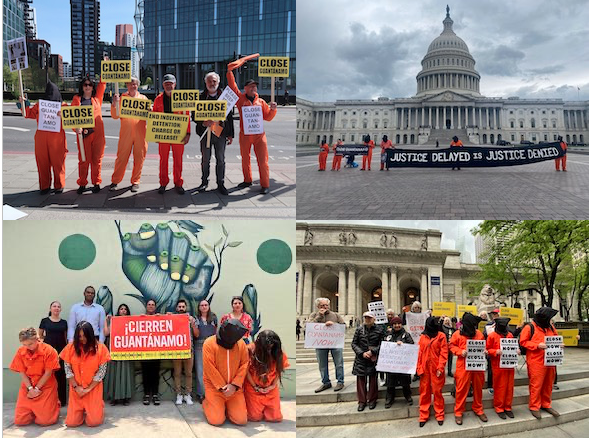
Photos and Report: The Coordinated Global Vigils for the Closure of Guantánamo in London, Washington, D.C., New York, Mexico City, Copenhagen, Brussels and Detroit on May 3, 2023
Please support my work as a reader-funded journalist! I’m currently trying to raise $2500 (£2000) to support my writing and campaigning on Guantánamo and related issues over the next three months. If you can help, please click on the button below to donate via PayPal.
On Wednesday (May 3), the latest coordinated global vigils for the closure of the prison at Guantánamo Bay took place in eight cities across the world — London, Washington, D.C. New York, Mexico City, Copenhagen, Brussels, Detroit and Los Angeles — and with former prisoner Mansoor Adayfi joining us in Belgrade.
The idea for coordinated vigils arose from the monthly vigils that the UK Guantánamo Network (a coalition of various Amnesty groups, Close Guantánamo and other groups) started last September, and I was inspired to try coordinating vigils worldwide after reflecting on the various actions marking the 21st anniversary of the opening of Guantánamo in January.
Fortunately, friends in Washington, D.C. agreed to join in in February, with New York and Mexico City joining in March, and Brussels, Los Angeles, Raleigh, NC and Cobleskill, NY joining last month, and this month we were delighted to also welcome campaigners in Copenhagen and Detroit.
Photos and Report: The Coordinated Global Vigils for the Closure of Guantánamo in the UK, the US, Mexico and Belgium on April 5, 2023

Please support my work as a reader-funded journalist! I’m currently trying to raise $2500 (£2000) to support my writing and campaigning on Guantánamo and related issues over the next three months. If you can help, please click on the button below to donate via PayPal.
Yesterday, Wednesday April 5, eight coordinated global vigils took place calling for the closure of the prison at Guantánamo Bay — and the release of the 17 men (out of the 31 still held) who have been approved for release.
Campaigners in the UK — with the UK Guantánamo Network, which includes various Amnesty International groups, Close Guantánamo, the Guantánamo Justice Campaign and the London Guantánamo campaign — began holding monthly vigils outside Parliament last September, and two months ago, following global actions to mark the 21st anniversary of the opening of Guantánamo, I asked fellow campaigners in Washington, D.C. to join us, which they did. Last month, campaigners in New York and Mexico City also joined us, and yesterday campaigners in Brussels, Los Angeles, Raleigh, NC and Cobleskill, NY also joined in.
Those taking part included the UK Guantánamo Network, Amnesty International, Close Guantánamo, Witness Against Torture, World Can’t Wait, CAIR (the Council on American-Islamic Relations), ICUJP (Interfaith Communities United for Justice and Peace), NC Stop Torture Now, Schoharie Peacemakers and the Comité Free.Assange.Belgium, while supporting organizations include NRCAT (the National Religious Campaign Against Torture), September Eleventh Families for Peaceful Tomorrows and NYC Veterans For Peace.
Wednesday April 5: The Next Global Coordinated Protests for the Closure of Guantánamo

Please support my work as a reader-funded journalist! I’m currently trying to raise $2500 (£2000) to support my writing and campaigning on Guantánamo and related issues over the next three months. If you can help, please click on the button below to donate via PayPal.
I wrote the following article for the “Close Guantánamo” website, which I established in January 2012, on the 10th anniversary of the opening of Guantánamo, with the US attorney Tom Wilner. Please join us — just an email address is required to be counted amongst those opposed to the ongoing existence of Guantánamo, and to receive updates of our activities by email.
With the release from Guantánamo three weeks ago of the Saudi citizen Ghassan al-Sharbi, the prison now holds just 31 men, out of the 779 held by the US military since it first opened over 21 years ago.
17 of these 31 men have been approved for release, and yet there is no way of knowing when, if ever, they will be released, because they did not have their release ordered by a court, but recommended by administrative review processes, and, as a result, they cannot appeal to a judge to order their release if, as is the case, the government shows no sense of urgency when it comes to freeing them.
Complicating matters, however, we acknowledge that, in the cases of 13 of these men, the US government must find third countries prepared to offer them new homes, because provisions inserted by Republicans into the annual National Defense Authorization Act since the early years of the Obama presidency prevent any repatriations from Guantánamo to countries including Yemen, Libya and Somalia, and eleven of these men are Yemeni, one is a Libyan, and another is a Somali. An additional complication is that none of these men can be resettled in the US, because another provision in the NDAA prevents any Guantánamo prisoner from being brought to the US mainland for any reason.
Photos and Report: The Global Vigils for the Closure of Guantánamo on International Women’s Day, and Victoria Brittain’s Speech in London

Please support my work as a reader-funded journalist! I’m currently trying to raise $2500 (£2000) to support my writing and campaigning on Guantánamo and related issues over the next three months. If you can help, please click on the button below to donate via PayPal.
Thanks to the many campaigners who turned up on Wednesday (March 8) in London, Washington, D.C., New York and Mexico City for four coordinated global vigils calling for the closure of the prison at Guantánamo Bay.
It was a day of extremes. Those in London for the UK Guantánamo Network’s vigil had to endure an extraordinarily cold, wet day, while in Washington, D.C. it was warm, and in Mexico City, apparently, it was almost unbearably hot.

Free the Guantánamo 18: New Campaign Posters for Coordinated Global Vigils for Prison’s Closure on March 8, International Women’s Day

Please support my work as a reader-funded journalist! I’m currently trying to raise $2500 (£2000) to support my writing and campaigning on Guantánamo and related issues over the next three months. If you can help, please click on the button below to donate via PayPal.
With the release from Guantánamo last week of the Rabbani brothers, Ahmed and Abdul Rahim, the last two Pakistanis in the prison, Guantánamo now holds just 32 men, at an annual cost of at least $17 million a prisoner.
18 of these men — like the Rabbanis — have been approved for release, and yet they are still held because the Biden administration is not legally compelled to free them — unlike Majid Khan, who completed a military commission sentence last year and was resettled in Belize a month ago.
This is because the high-level government review processes that determined, unanimously, that the US no longer wanted to hold these men were purely administrative, meaning that the men, unlike Khan, cannot ask a judge to order their release, even though none of them have never even been charged with a crime.
Close Guantánamo Events to Mark the 20th Anniversary of the Opening of the Prison

Please support my work as a reader-funded journalist! I’m currently trying to raise $2500 (£2000) to support my writing and campaigning on Guantánamo and related issues over the next three months. If you can help, please click on the button below to donate via PayPal.
I wrote the following article for the “Close Guantánamo” website, which I established in January 2012, on the 10th anniversary of the opening of Guantánamo, with the US attorney Tom Wilner. Please join us — just an email address is required to be counted amongst those opposed to the ongoing existence of Guantánamo, and to receive updates of our activities by email.
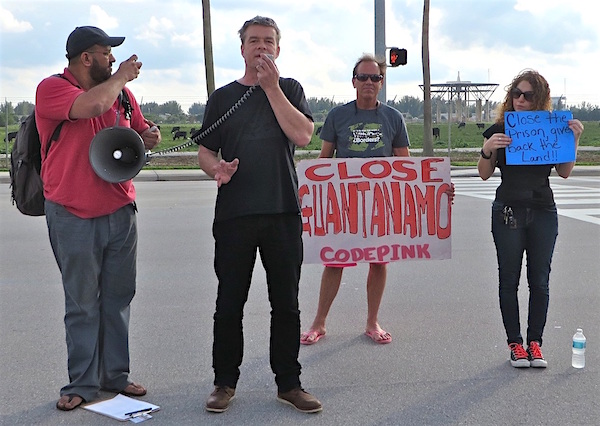
As we approach a grim anniversary that all decent people hoped would never arrive — the 20th anniversary of the opening of the prison at Guantánamo Bay — I’m taking part in a number of events to mark the anniversary — mostly online, although a few are carefully organized live events — along with Tom Wilner, with whom I co-founded the Close Guantánamo campaign ten years ago. We are also both available for interviews and media appearances.
Yesterday, the prison had been open for 7,300 days, and as I noted in a message to President Biden, to accompany his photo as part of our ongoing poster campaign, “How did this happen? It’s nearly a year since you took office, and yet you have only released one prisoner, even though 13 others — out of the 39 men still held — have been approved for release by high-level U.S. government review processes. Eight of these men have been approved for release since you took office, and yet none of them have been freed. Approving men for release means nothing unless they are actually freed.”
As I also explained, “In six days’ time, Guantánamo will have been open for 20 years. This is a truly shameful anniversary, and yet, despite making noises about wanting to close the prison, you and your administration have done nothing to demonstrate that you actually mean it. Please show some courage. Release the men approved for release, and announce how you intend to close the prison once and for all.”
Video: “Guantánamo in 2020: What is the Future of the Prison Camp after Eighteen Years?” at New America, Jan. 13, 2020

Please support my work as a reader-funded journalist! I’m currently trying to raise $2500 (£2000) to support my writing and campaigning on Guantánamo and related issues over the next three months of the Trump administration. If you can help, please click on the button below to donate via PayPal.
Today I’m delighted to be posting, via YouTube, the hour-long video of a panel discussion and Q&A session about the prison at Guantánamo Bay — and the need to close it — which I took part in at the New America think-tank in Washington, D.C. on January 13, two days after the 18th anniversary of the opening of the prison.
Also taking part was the attorney Tom Wilner, with whom I co-founded the Close Guantánamo campaign in 2012. Tom was Counsel of Record for the Guantánamo prisoners as they successfully sought habeas corpus rights before the Supreme Court in 2004 and 2008 — although those rights have since been gutted by ideologically malignant appeals court rulings — and we are grateful to New America for hosting a panel discussion about Guantánamo with us every year on or around the anniversary. The moderator for this year’s anniversary event was Melissa Salyk-Virk, Senior Policy Analyst in New America’s International Security Program.
As I hope readers have realized via my various articles about the anniversary, and my ten-day US visit to call for the prison’s closure — this year there was a real urgency, indignation and passion to the calls for the prison’s closure and of the need for urgent change in the political leadership in the US expressed by myself and other campaigners.
16 Years of Guantánamo: My Eighth Successive January Visit to the US to Call for the Closure of the Prison on the Anniversary of Its Opening
 Please support my work as a reader-funded journalist! I’m currently trying to raise $2500 (£2000) to support my writing and campaigning on Guantánamo and related issues over the next three months of the Trump administration, and my imminent visit to the US, discussed below.
On Monday, I fly into New York from London for what will be my eighth successive January visit to the US to call for the closure of the prison at Guantánamo Bay. Despite the generally inhospitable climate and the unpleasantness of the cause, it has always been exciting to visit, as I have met and got to know the people who should be running the US — the campaigners, principled lawyers and ordinary citizens who have made a stand against the existence of the prison, recognizing it as a profound injustice, established in the heat of vengeance after the terrorist attacks of September 11, 2001, which is a source of shame to all decent Americans every day that it remains open.
A majority of Americans, unfortunately, don’t understand how important it is to rely on established and internationally accepted procedures when depriving people of their liberty. Those imprisoned should either be criminal suspects, charged as swiftly as possible and put on trial in a federal court, or prisoners of war, protected by the Geneva Conventions, and held unmolested until the end of hostilities. At Guantánamo, however, the men held were deprived of all rights, and held as “unlawful enemy combatants” — “for the express purpose of denying them the rights that combatants normally receive,” as Human Rights First has explained in a briefing.
This would be bad enough, but the very basis for holding the men has always been a disgrace — although one, sadly, that has never received the mainstream coverage it cries out for. Contrary to claims that the men and boys held at Guantánamo were “the worst of the worst,” who were all captured on the battlefield, most were captured not by the US, but by their Afghan and Pakistani allies, who didn’t find them on the battlefield, and who often sold them to the US, which was paying bounties averaging $5000 a head for anyone who could be portrayed as a member of al-Qaeda or the Taliban. Read the rest of this entry »
Andy Worthington Visits the US for the 15th Anniversary of the Opening of Guantánamo, and for Donald Trump’s Troubling Inauguration
 Please support my work! I’m currently trying to raise $2500 (£2000) to support my writing and campaigning on Guantánamo over the next two months.
Dear friends and supporters,
I’m delighted to be writing to you from Heathrow Airport — despite a seriously disruptive Tube strike in London — awaiting a flight to New York City, for what will be my seventh annual visit at this time of year, to campaign for the closure of the prison at Guantánamo Bay on and around the anniversary of its opening, on Jan. 11.
I’m not delighted to have to keep calling for Guantánamo’s closure, of course, and this year, the 15th anniversary of the prison’s opening is a particular difficult occasion: simultaneously, a definitive black mark against President Obama for having failed to fulfill the promise to close the prison — within a year! — that he made when he first took office eight years ago, and the introduction to Guantánamo under a third president, the worryingly unpredictable Donald Trump, who has vowed to keep Guantánamo open, and to “load it up with bad dudes,” and who, just days ago, tweeted that there should be no more releases from Guantánamo.
Trump’s comments came in spite of the fact that 19 of the 55 men still held have been approved for release by high-level, inter-agency review processes, and others may well be approved for release in future by the latest review process, the Periodic Review Boards, unless he decides, unwisely, to scrap them.
I will be talking about these topics, and reflecting on Guantánamo’s history, what it means, who is held, and why the closure of the prison remains so essential, during my visit. Read the rest of this entry »
Rights Groups, Including Close Guantánamo, Issue Statement in the Run-Up to the 15th Anniversary of the Opening of Guantánamo
 Please support my work! I’m currently trying to raise $1000 (£800) to support my annual visit to the US to call for the closure of Guantánamo (from Jan. 9-21).
Dear friends and supporters,
It’s horrible to realize that, next Wednesday, January 11, the prison at Guantánamo Bay will have been open for 15 years, and will begin its 16th year of operations with just a week left under President Obama’s control, prior to Donald Trump taking it over. Trump, notoriously, promised on the campaign trail to “load it up with bad dudes,” and, just two days ago, tweeted, “There should be no further releases from Gitmo. These are extremely dangerous people and should not be allowed back onto the battlefield.”
As I have done every January since 2011, I will be in Washington, D.C. next Wednesday to call for the prison’s closure— a call aimed at the outgoing president, but, more specifically, now, aimed at Donald Trump.
I arrive in New York City on January 9, and travel to Washington, D.C. the day after, and I’ll soon be posting a more detailed itinerary — although I can tell you that at 2.30pm on January 11 I’ll be at New America to discuss Guantánamo at 15, and what we can expect from Donald Trump, with the attorney Tom Wilner, with whom I co-founded the Close Guantánamo campaign five years ago, Jim Moran, former congressional representative for Virginia’s 8th district and one of the representatives who led opposition to Guantánamo Bay, and New America fellow Rosa Brooks, who was Counselor to the Under Secretary of Defense for Policy and Special Coordinator for Rule of Law and Humanitarian Policy in the Pentagon from 2009-2011. If you want to attend this free event, please RSVP here. Read the rest of this entry »











 Who's still at Guantánamo?
