With Right on Our Side: The Inspiring Guantánamo 10th Anniversary Protest in Washington D.C.
 Last week, I was in Washington D.C., attending events to mark the 10th anniversary of the opening of the prison at Guantánamo Bay, Cuba, as part of a 12-day US tour organized by some of my great friends in the US — the activists of The World Can’t Wait, and their national director Debra Sweet, who is largely responsible for making sure that I don’t get lost, that I can find coffee when I need it, and that I don’t get too much sleep! — as well as being a tireless campaigner for justice.
In a progressively busier and busier schedule, Debra and I followed up on events in New York, which I wrote about here, with a bus trip to Washington D.C. on Monday, and a warm welcome at the house of Medea Benjamin of Code Pink, where we were very well looked after. On Tuesday lunchtime (January 10), we made our way to the first of two events that day, a panel discussion, filmed by C-SPAN, at the New America Foundation, moderated by my old college friend Peter Bergen, and featuring, as well as myself, Congressman Jim Moran, Col. Morris Davis and Tom Wilner, which I wrote about here (where there is also an embedded video of the event).
That was an excellent event, and afterwards Debra and I, and some other friends old and new, including Todd Peirce and Derek Poteet, military attorneys in the defense team for the Military Commissions at Guantánamo, whose lawyers I have met with, spoken with and occasionally briefed over the years, went for lunch, prior to Debra and I making our way to Busboys and Poets at 5th and K, for a screening of “Outside the Law: Stories from Guantánamo,” the documentary film that I co-directed with Polly Nash. The film, it seems, never fails to convey to audiences the tragic human cost of Guantánamo, as is made particularly clear in the testimony of former prisoner and British resident Omar Deghayes, whose statements are at the heart of the film. Read the rest of this entry »
A Tired Obsession with Military Detention Plagues American Politics
 Before the terrorist attacks on September 11, 2001, there were only two ways of holding prisoners — either they were prisoners of war, protected by the Geneva Conventions, or they were criminal suspects, to be charged and subjected to federal court trials.
That all changed when the Bush administration threw out the Geneva Conventions, equated the Taliban with al-Qaeda, and decided to hold both soldiers and terror suspects as “illegal enemy combatants,” who could be imprisoned indefinitely without charge or trial, and with no rights whatsoever.
The Bush administration’s legal black hole lasted for two and a half years at Guantánamo, until, in Rasul v. Bush in June 2004, the Supreme Court took the unprecedented step of granting habeas corpus rights to prisoners seized in wartime, recognizing — and being appalled by — the fact that the administration had created a system of arbitrary, indefinite detention, and that there was no way out for anyone who, like many of the prisoners, said that they had been seized by mistake. Read the rest of this entry »
US Injustice Laid Bare, As Afghan in Guantánamo Loses His Habeas Appeal
 Ten years after the “War on Terror” began, the distressing misconceptions and exaggerations on which it was founded continue to plague its victims — and also to corrode America’s belief that it is a nation founded on justice and the law.
Ten years ago, Congress launched this “war,” approving the Authorization for Use of Military Force, a sweeping and overbroad piece of legislation which allowed the President “to use all necessary and appropriate force against those nations, organizations, or persons he determines planned, authorized, committed, or aided the terrorist attacks that occurred on September 11, 2001,” or those who harbored them.
The AUMF led to the equation of al-Qaeda (a terrorist group) with the Taliban (the government of Afghanistan), and the fallout from this decision to regard soldiers and terrorists as one and the same, and to hold both as “enemy combatants” without rights, continues to resonate in the corridors of power, and in US courtrooms.
In tackling the predicament of the Guantánamo prisoners — held, initially, without any rights whatsoever — the Supreme Court granted them habeas corpus rights in June 2004, and, after Congress tried to take those rights away (in the Detainee Treatment Act of 2005 and the Military Commissions Act of 2006), the Supreme Court was obliged to reassert the prisoners’ habeas rights in June 2008, and to rule that Congress’s interference was unconstitutional. Read the rest of this entry »
Guantánamo and the Death of Habeas Corpus
 Last month, the third anniversary of Boumediene v. Bush (on June 12) passed without mention. This was a great shame, not only because it was a powerful ruling, granting the Guantánamo prisoners constitutionally guaranteed habeas corpus rights, but also because, after that bold intervention, which led to the release of 26 prisoners who subsequently won their habeas corpus petitions, the prisoners at Guantánamo have once more been abandoned by the courts.
The courts’ failure has come about largely because a number of judges in the D.C. Circuit Court, where appeals against the habeas rungs are filed, have revealed themselves to be at least as right-wing as the architects of the “War on Terror” in the Bush administration. Led by Judge A. Raymond Randolph, whose previous claim to fame on national security issues was that he supported every piece of Guantánamo-related legislation that was subsequently overturned by the Supreme Court, the Circuit Court has, in the last year, succeeded in gutting habeas corpus of all meaning, when its relief is sought by any of the 171 men still held at Guantánamo.
Throughout this year, I have followed, with despair, the Circuit Court’s rulings, which are distressing on two fronts: firstly, because judges have whittled away at the lower courts’ demands that the government establish its case “by a preponderance of the evidence,” which is a very low standard in the first place; and secondly, because the Circuit Court has reinforced the misconception at the heart of the “War on Terror,” almost delighting, it seems, in failing to acknowledge that soldiers are different from terrorists. Read the rest of this entry »
US Supreme Court Refuses to Allow Abu Ghraib Torture Victims to Sue Military Contractors
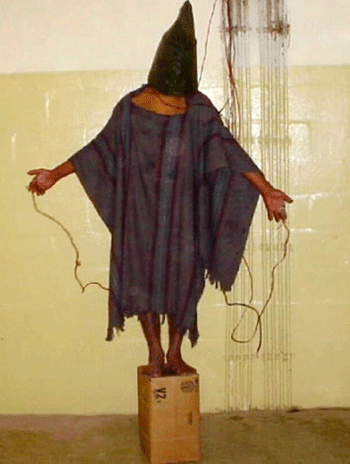 With what can only come across as cynical timing, the US Supreme Court on Monday, the day after the UN International Day in Support of the Victims of Torture, declined without comment to take up a lawsuit filed on behalf of 250 Iraqis — formerly prisoners at the notorious Abu Ghraib prison near Baghdad, home of the most significant scandal in the Bush administration’s “War on Terror,” which surfaced in April 2004 with the publication of photos showing the torture and abuse of Iraqi prisoners in US custody at the prison. The prisoners were seeking to hold Titan Corporation, which provided Arabic translation services, and CACI International, which provided interrogators, accountable for their role in the torture and abuse of prisoners at Abu Ghraib in 2003 and 2004.
Although a handful of serving US military personnel — eleven in total, referred to by President Bush as “a few bad apples” — were prosecuted for the abuse at Abu Ghraib, they were, in fact, scapegoated for implementing a policy that came from the highest levels of government, and which was designed to ensure that all aspects of the detention regime were dependant upon the whims of interrogators — as at Guantánamo, from where the system was exported by its commander, Maj. Gen. Geoffrey Miller, who was sent to “Gitmoize” Abu Ghraib with the results that the world saw to its horror in April 2004.
The case that was shunned by the Supreme Court on Monday, Saleh v. Titan Corporation, was an important attempt to extend accountability from the military to the contractors who make up such a huge part of America’s post-9/11 war machine, and who, unlike their official military counterparts, appear to be as much beyond the law as the senior administration officials — and their lawyers — who implemented, approved and oversaw every aspect of the “War on Terror” that should have shocked the conscience — involving torture, “extraordinary rendition,” secret prisons and the miseries of arbitrary detention at Guantánamo. As Human Rights First explained, “Army investigations implicated at least five private contractors in similar crimes,” although “no contractor was ever charged.” Read the rest of this entry »
Supreme Court Fails to Tackle Torture – in the Past or in the Future
 Since the dying days of the Bush administration, when the Supreme Court savaged the indifference of the executive branch and of Congress towards the cruel mess they had created at Guantánamo, by ensuring that the prisoners had constitutionally guaranteed habeas corpus rights, it has, sadly, all been downhill when it comes to judicial oversight of the national security state. Moreover, in two recent decisions, the Supreme Court has shown indifference to torture, either in the past or in the future.
In the three years since that landmark case, Boumediene v. Bush, the prisoners’ initial success in the District Court in Washington DC., where they won 38 of the first 52 cases, has been abruptly halted, as right-wing judges in the D.C. Circuit Court, led by Senior Judge A. Raymond Randolph, have pushed back, insisting that little evidence is required to continue holding men indefinitely, even if, as in most cases, they were nothing more than insignificant foot soldiers for the Taliban, rather than international terrorists.
In response to this repeated hurling down of gauntlets by Judge Randolph, who is notorious for approving every piece of Guantánamo-related legislation that was subsequently overturned by the Supreme Court, there has been no repeat of Boumediene. In the last few months, lawyers for the prisoners have tried to undermine Judge Randolph and his colleagues on numerous fronts. Eight Guantánamo cases have made their way to the Supreme Court, as SCOTUSblog reported back in December, but all have failed. Read the rest of this entry »
The Abandonment of Guantánamo’s Uighurs and Attorney Sabin Willett’s Powerful Requiem for Habeas Corpus in the US
 Before WikiLeaks unleashed a trove of classified military assessments from Guantánamo, revealing — to discerning eyes — how the entire edifice was buit on the lies extracted through the torture, coercion or bribery of the prisoners, and before Osama bin Laden was conveniently killed a week later, perhaps to divert attention back to the torture on which modern-day America is built, and the lies and the arbitrary detention of Muslims, which, to some dark and powerful forces at work in the United States, must not apparently be questioned, the prison at Guantánamo — the most visible icon of the Bush administration’s “War on Terror,” inherited and maintained by Barack Obama, despite his early enthusiasm for closing it — marked a particularly dark day in its miserable history.
On April 18, the Supreme Court, which had ruled twice that the prisoners at Guantánamo had habeas corpus rights, refused to consider the case of five men abandoned in the prison, despite being innocent.
These men — five Uighurs — are known to people who have been paying attention to what has been done in their name at Guantánamo, but are unknown to many others, even though their plight is emblematic of how cruel and paranoid America is in the 21st century. Read the rest of this entry »












 Who's still at Guantánamo?
