Video: Discussing Guantánamo on the 15th Anniversary of the Prison’s Opening – Andy Worthington, Tom Wilner, Jim Moran and Rosa Brooks at New America
 Please support my work! I’m currently in the US to campaign for the closure of Guantánamo, and trying to raise $1000 (£800) to support my visit.
Yesterday was the 15th anniversary of the opening of the “war on terror” prison at Guantánamo Bay, Cuba, and a typically busy day for me. My seventh annual visit to Washington, D.C. to call for the closure of Guantánamo on the anniversary began with a protest outside the Supreme Court with representatives from rights groups including Witness Against Torture, Amnesty International, the Center for Constitutional Rights and the National Religious Campaign Against Torture. As usual, there were speakers from all the groups involved, plus some powerful spoken word pieces by The Peace Poets, and video of my talk will hopefully be available soon.
The day continued with a panel discussion, Guantánamo Bay: Year 15, at New America, with my friend and colleague Tom Wilner, counsel of record to the Guantánamo prisoners in their Supreme Court cases in 2004 and 2008, with whom I co-founded the Close Guantánamo campaign five years ago, Jim Moran, former congressional representative for Virginia’s 8th district and a longtime opponent of Guantánamo, and Rosa Brooks, a Senior ASU Future of War Fellow at New America who also served in the Obama administration. The moderator was Peter Bergen, the Vice President of New America and the Director of the International Security Program.
I’m pleased to report that the panel discussion was streamed live, and that a video is available on YouTube. It’s cross-posted below and I do hope you have time to watch it, and to share it if you find it useful. Read the rest of this entry »
Rights Groups, Including Close Guantánamo, Issue Statement in the Run-Up to the 15th Anniversary of the Opening of Guantánamo
 Please support my work! I’m currently trying to raise $1000 (£800) to support my annual visit to the US to call for the closure of Guantánamo (from Jan. 9-21).
Dear friends and supporters,
It’s horrible to realize that, next Wednesday, January 11, the prison at Guantánamo Bay will have been open for 15 years, and will begin its 16th year of operations with just a week left under President Obama’s control, prior to Donald Trump taking it over. Trump, notoriously, promised on the campaign trail to “load it up with bad dudes,” and, just two days ago, tweeted, “There should be no further releases from Gitmo. These are extremely dangerous people and should not be allowed back onto the battlefield.”
As I have done every January since 2011, I will be in Washington, D.C. next Wednesday to call for the prison’s closure— a call aimed at the outgoing president, but, more specifically, now, aimed at Donald Trump.
I arrive in New York City on January 9, and travel to Washington, D.C. the day after, and I’ll soon be posting a more detailed itinerary — although I can tell you that at 2.30pm on January 11 I’ll be at New America to discuss Guantánamo at 15, and what we can expect from Donald Trump, with the attorney Tom Wilner, with whom I co-founded the Close Guantánamo campaign five years ago, Jim Moran, former congressional representative for Virginia’s 8th district and one of the representatives who led opposition to Guantánamo Bay, and New America fellow Rosa Brooks, who was Counselor to the Under Secretary of Defense for Policy and Special Coordinator for Rule of Law and Humanitarian Policy in the Pentagon from 2009-2011. If you want to attend this free event, please RSVP here. Read the rest of this entry »
Huge Victory for Prison Reform as California Ends Indeterminate Long-Term Solitary Confinement
 On Tuesday, a significant victory took place in the long struggle by campaigners — and prisoners themselves — to improve detention conditions in US prisons, when a settlement was reached in Ashker v. Governor of California, a federal class action lawsuit on behalf of prisoners held in the Security Housing Unit (SHU) at California’s Pelican Bay State Prison who have spent a decade or more in solitary confinement.
In a press release, the Center for Constitutional Rights, whose lawyers represented the prisoners, with co-counsel from other lawyers’ firms and the organizations California Prison Focus and Legal Services for Prisoners with Children, stated that the “landmark” settlement “will effectively end indeterminate, long-term solitary confinement in all California state prisons,” resulting in “a dramatic reduction in the number of people in solitary across the state and a new program that could be a model for other states going forward.”
As CCR noted, the class action “was brought in 2012 on behalf of prisoners held in solitary confinement at the Pelican Bay prison, often without any violent conduct or serious rule infractions, often for more than a decade, and all without any meaningful process for transfer out of isolation and back to the general prison population.” The case argued that California’s use of prolonged solitary confinement “constitutes cruel and unusual punishment and denies prisoners the right to due process.” Read the rest of this entry »
Retired Justice John Paul Stevens Calls for Compensation for the 57 Cleared Guantánamo Prisoners Still Held
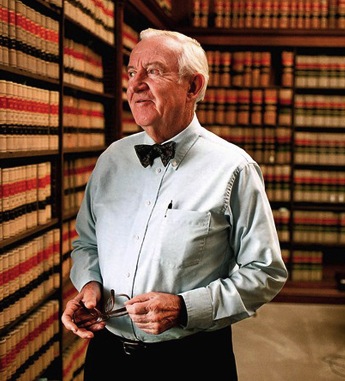 Last week, as three prominent Democratic Senators — Patrick Leahy, Dianne Feinstein and Dick Durbin — wrote to President Obama urging him to take urgent action to release the 57 men still held at Guantánamo who have been approved for release by high-level governmental review boards, and who, for the most part, have been waiting over five years to be freed, Justice John Paul Stevens, a Supreme Court Justice from 1975 until his retirement in 2010, made a speech at which he not only urged the release of these men, but also suggested that some of them may be due compensation for their long and ultimately unjustifiable ordeal. The 57 men make up almost half of the total of 122 men still held, and include, prominently, Shaker Aamer, the last British resident in the prison.
This is not, of course, the first time that former Justice Stevens, who is now 95 years old, has dealt with Guantánamo. When he retired, SCOTUSblog — the official Supreme Court blog — ran a series of articles about him, and in one of these articles, “Justice Stevens, Guantánamo, and the Rule of Law,” Daniel A. Farber, a law professor at Berkeley who clerked for him in 1976, explained the importance of his role in the 2004, 2006 and 2008 Supreme Court rulings that granted the prisoners habeas corpus rights (Rasul v. Bush in June 2004 and Boumediene v. Bush in June 2008, which I wrote about here), and that dealt with the legality — or rather the lack of it — of the military commission trial system at Guantánamo (Hamdan v. Rumsfeld in 2006).
Justice Stevens wrote the majority opinion in Rasul v. Bush, in which, almost two and a half years after Guantánamo opened, and after a long journey through the lower courts, the Supreme Court “held that the habeas statute covered Guantánamo,” and turned down the Bush administration’s argument that the prison was on foreign soil. Although Congress then passed legislation that purported to block the prisoners’ habeas rights, the ruling allowed lawyers to take on prisoners as clients, and to visit the prison, breaking through the veil of secrecy that had allowed torture and other forms of abuse to proceed unchecked. Read the rest of this entry »
Fawzi Al-Odah Freed from Guantánamo, Returns Home to Kuwait
 Congratulations to the Obama administration for arranging for Fawzi al-Odah, one of the last two Kuwaiti prisoners in Guantánamo, to be sent home, a free man, on the day after the US mid-term elections — although he will be held in Kuwaiti custody for a year and required to take part in a year-long rehabilitation program.
With control of the Senate passing from the Democrats to the Republicans, and the House of Representatives maintaining its Republican majority, it may be difficult for President Obama to engage constructively with lawmakers on the eventual closure of the prison during his last two years in office.
However, by releasing al-Odah, leaving 148 men still held at the prison, including the last Kuwaiti, Fayiz al-Kandari, the president has sent a clear signal that his administration remains committed to releasing prisoners approved for release by governmental review boards, following the rules laid down by Congress, which require the administration to give them 30 days’ notice prior to any release, and for the defense secretary to certify that he is satisfied that it is safe for the prisoner or prisoners in question to be released.
Al-Odah, who was born on May 6, 1977 and is 37 years old, was seized crossing from Afghanistan to Pakistan in December 2001 and transferred to US custody on January 2, 2002. He arrived at Guantánamo on February 13, 2002, and, as a result, spent over a third of his life at the prison, without ever having been charged or tried. Read the rest of this entry »
Shameful: US Judge Increases Prison Sentence of Tortured US Enemy Combatant Jose Padilla
 Of the tens of thousands of victims of the Bush administration’s novel approach to detention in the “war on terror” — which involved shredding the Geneva Conventions, the use of torture and indefinite detention without charge or trial, and, in some cases, extraordinary rendition — few of the victims were American citizens, but three particular individuals need to be remembered, because they were not only tortured and held without charge or trial for years, but their torture and lawless detention took place on US soil.
The three men are Jose Padilla, Yaser Hamdi and Ali al-Marri (the latter a legal US resident rather than a citizen), and Padilla — a former Chicago gang member who converted to Islam, and was held as an “enemy combatant” on US soil from May 2002, when he was seized after returning him from Pakistan, until November 2005 — was back in the news last week when a judge extended to 21 years the sentence of 17 years and four months he received in January 2008, when he was convicted of conspiracy to murder, kidnap and maim people abroad, and providing material support for terrorism.
The sentence was a disgrace, as I explained at the time in an article entitled, “Why Jose Padilla’s 17-year prison sentence should shock and disgust all Americans,” because of Padilla’s torture, which had destroyed his mind, because the judge prohibited all mention of his torture during the trial, and because the “dirty bomb plot” he had allegedly been involved in had turned out to be non-existent, and his trial and sentence was based instead on his involvement in a handful of phone calls that made reference to jihad. Read the rest of this entry »
Torture Began at Guantánamo with Bush’s Presidential Memo 12 Years Ago
 I wrote the following article for the “Close Guantánamo” website, which I established in January 2012 with US attorney Tom Wilner. Please join us – just an email address is required to be counted amongst those opposed to the ongoing existence of Guantánamo, and to receive updates of our activities by email.
This is a grim time of year for anniversaries relating to Guantánamo. Two days ago, February 6, was the first anniversary of the start of last year’s prison-wide hunger strike, which woke the world up to the ongoing plight of the prisoners — over half of whom were cleared for release by a Presidential task force over four years ago but are still held.
The hunger strike — which, it should be noted, resumed at the end of last year, and currently involves dozens of prisoners — forced President Obama to promise to resume releasing prisoners, after a three-year period in which the release of prisoners had almost ground to a halt, because of opposition in Congress, and President Obama’s unwillingness to overcome that opposition, even though he had the power to do so.
To mark the anniversary, a number of NGOs — the ACLU, Amnesty International, the Center for Constitutional Rights, Human Rights First and Human Rights Watch — launched a campaign on Thursday, “Take a Stand for Justice,” encouraging people to call the White House (on 202-456-1111) to declare their support for President Obama’s recent call for Guantánamo to be closed for good (in his State of the Union address, he said, “With the Afghan war ending, this needs to be the year Congress lifts the remaining restrictions on detainee transfers and we close the prison at Guantánamo Bay”). Please call the White House if you can, and share the page via social media. Read the rest of this entry »
Updated: My Definitive List of the Guantánamo Habeas Corpus Results
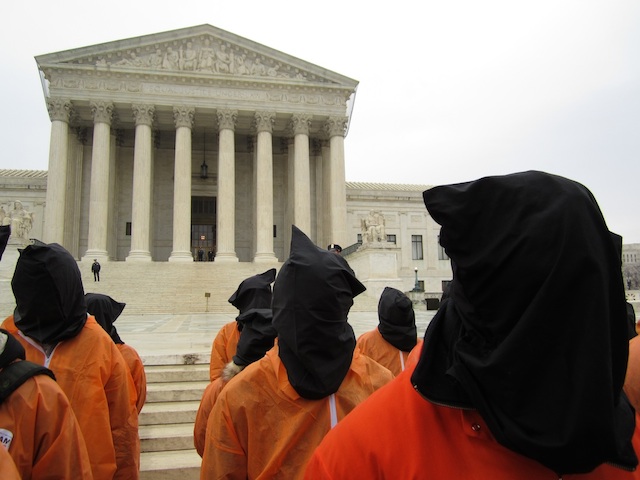
See the updated Guantánamo habeas list here.
Sometimes life takes us down unexpected routes, and yesterday, while looking for links for my last article, a transcript of a talk I gave in Los Angeles during my recent US tour calling for the closure of the prison at Guantánamo Bay on the 12th anniversary of its opening, I found myself visiting a page I first created in May 2010, entitled, “Guantánamo Habeas Results: The Definitive List.”
The page is a list of all the prisoners whose habeas corpus petitions were ruled on by judges in the District Court in Washington D.C. following the Supreme Court’s important ruling, in June 2008, in Boumediene v. Bush, granting the prisoners constitutionally guaranteed habeas corpus rights. At the time I created the list, there had been 47 rulings, and in 34 of those cases, after reviewing all the evidence, the judges concluded that the government had failed to demonstrate that they were connected in any meaningful manner with either al-Qaeda or the Taliban, an ordered their release.
This was humiliating for those who sought to defend Guantánamo, especially as the habeas hearings involved a low evidentiary hurdle — requiring the government to establish its case through a preponderance of the evidence rather than beyond any reasonable doubt. It was, moreover, a vindication for those like myself and some other journalists, as well as lawyers for the men, NGOs and others concerned by the existence of Guantánamo, like Lt. Col. Stephen Abraham, who had worked on the tribunals at Guantánamo, who had long maintained that the supposed evidence against the men was flimsy and untrustworthy, in large part because it was gathered using torture or other forms of coercion, or, in some cases at Guantánamo, because certain prisoners were bribed with better living conditions if they told lies about their fellow prisoners. Read the rest of this entry »
Close Guantánamo: Photos of Protestors outside the Supreme Court on the 11th Anniversary of the Opening of the Prison


Close Guantánamo: Protestors outside the Supreme Court on the 11th Anniversary of the Opening of the Prison, a set on Flickr.
These photos are from the protest in Washington D.C. on January 11, 2013 to mark the 11th anniversary of the opening of the “war on terror” prison at Guantánamo Bay, Cuba, an annual event that becomes more shameful for the United States with every passing year, and which has also come to test the endurance of those opposed to the prison’s existence.
Four years after President Obama came to office promising to close Guantánamo within a year, the blunt and unforgivable truth is that the prison is still open, and that all three branches of the US government — the administration, Congress and the courts — have failed the 166 men still held, and particularly the 86 men who were cleared for release by the interagency Guantánamo Review Task Force, established by President Obama in 2009, which spent a year reviewing the prisoners’ cases before reaching its sober and considered conclusions. In addition, some of these men were actually cleared by military review boards under the Bush administration, some as long ago as 2004. Read the rest of this entry »
Eleven Years of Guantánamo: Andy Worthington Visits the US to Campaign for the Prison’s Closure
 Contact me from 10am Eastern Time on January 9 (until January 16) on 347-581-2677.
It’s over 24 hours since I arrived in the US, with the support of Witness Against Torture, World Can’t Wait and Close Guantánamo, for a series of events to mark the 11th anniversary of the opening of the “war on terror” prison at Guantánamo Bay, Cuba, a shameful anniversary that should not have come to pass. Four years ago, when he took office, President Obama promised to close the prison within a year, but he failed to fulfil that promise. His lack of courage has been matched by opportunistic intervention from Congress, where lawmakers have passed legislation designed to thwart any efforts to close Guantánamo. To complete the failures of all three branches of the US government, the courts too have added their own contribution, with the D.C. Circuit Court gutting the habeas corpus rights of the prisoners, which lawyers spent many years fighting for, and the Supreme Court refusing to revisit the prisoners’ cases, when given the opportunity last year.
As I — and others who still care about the closure of Guantánamo — continue to point out, the ongoing existence of Guantánamo is an affront to all notions of justice and fairness. Distressingly, of the 166 men still held, 86 were cleared for release by President Obama’s interagency Guantánamo Review Task Force, and yet, through the combination of cowardice, indifference, opportunism and scaremongering outlined above, they remain held, even though one long-cleared prisoner, Adnan Farhan Abdul Latif, died at Guantánamo last September, and even though President Obama won reelection in November, and is now free to act to secure his legacy rather than focusing all his attention on campaigning — and not mentioning anything contentious. If he wants a legacy that doesn’t describe him, amongst other things, as the man who promised to close Guantánamo but then failed to do because it was politically inconvenient, he needs to act now. Read the rest of this entry »












 Who's still at Guantánamo?
