Video: “Guantánamo Forever?” – Jim Moran, Andy Worthington, Morris Davis and Tom Wilner at the New America Foundation, January 10, 2012
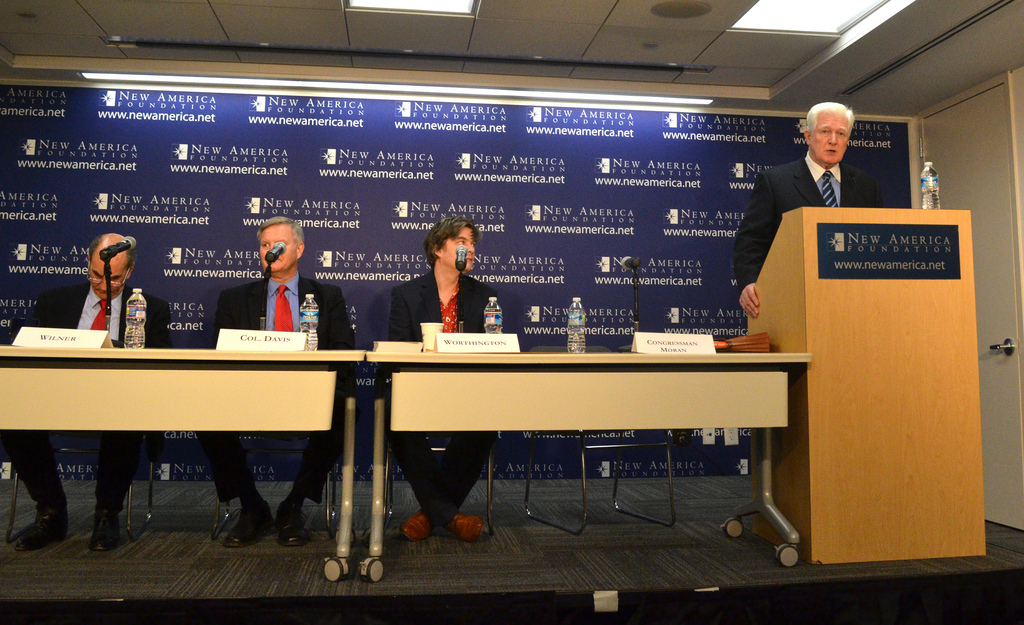 See the entire event on C-SPAN here (and also via YouTube, embedded below).
On the 10th anniversary of the opening of the Bush administration’s prison at Guantánamo Bay, Cuba, which belonged to George W. Bush for seven of those ten years, but has belonged to Barack Obama for the last three, there is no reason for anyone with a heart, a conscience or a respect for America and the rule of law to be cheerful.
On Tuesday lunchtime, however, as part of my ongoing US tour, when I met up, at the New America Foundation in Washington D.C. with Tom Wilner, Counsel of Record in the Guantánamo prisoners’ habeas corpus cases in the Supreme Court in 2004 and 2008, and Col. Morris Davis, the former chief prosecutor of the Military Commissions at Guantánamo, who resigned in 2007 in protest at the use of torture, Col. Davis found it impossible not to crack a joke about it. “We must stop meeting like this,” he said, referring to the fact that, exactly a year ago, he and Tom and I were on a panel discussing Guantánamo on the 9th anniversary of its opening. Read the rest of this entry »
A Tired Obsession with Military Detention Plagues American Politics
 Before the terrorist attacks on September 11, 2001, there were only two ways of holding prisoners — either they were prisoners of war, protected by the Geneva Conventions, or they were criminal suspects, to be charged and subjected to federal court trials.
That all changed when the Bush administration threw out the Geneva Conventions, equated the Taliban with al-Qaeda, and decided to hold both soldiers and terror suspects as “illegal enemy combatants,” who could be imprisoned indefinitely without charge or trial, and with no rights whatsoever.
The Bush administration’s legal black hole lasted for two and a half years at Guantánamo, until, in Rasul v. Bush in June 2004, the Supreme Court took the unprecedented step of granting habeas corpus rights to prisoners seized in wartime, recognizing — and being appalled by — the fact that the administration had created a system of arbitrary, indefinite detention, and that there was no way out for anyone who, like many of the prisoners, said that they had been seized by mistake. Read the rest of this entry »
Beyond Guantánamo, New York Times Examines How Federal Prisons Deal with Terrorists
 As the debate over the dreadful detainee provisions in the National Defense Authorization Act has demonstrated, when lawmakers, unprovoked, have unilaterally decided that what America needs is mandatory military custody for terror suspects (with the intention of holding people for life without charge or trial), something has gone horribly wrong, and a rational perspective on the success of federal court trials in prosecuting terror suspects has been shamefully discarded.
Above all, this is a sign of how lawmakers — Democrats as well as Republicans — have politicized terrorism, in their obsession with regarding terrorists not as criminals, but as “warriors” in a “war on terror” which they do not wish to end, despite the killing of Osama bin Laden this year, and despite the almost total eradication of al-Qaeda as an entity in Afghanistan and Pakistan.
In this absurd climate, lawmakers are shunning federal court trials for terror suspects, even though they have a successful track record, and even though, by any objective measure, that success has been purchased at a distinctly dubious cost — including a lamentable history of entrapment since 9/11, and the fact that the rules regarding material support for terrorism are so broadly drawn that prisoners are receiving punitive sentences for almost nothing. Read the rest of this entry »
Deranged Senate Votes for Military Detention of All Terror Suspects and a Permanent Guantánamo
 Yesterday the shameful dinosaurs of the Senate — hopelessly out of touch with reality, for the most part, and haunted by specters of their own making — approved, by 93 votes to 7, the passage of the National Defense Authorization Act (PDF), which contains a number of astonishingly alarming provisions — Sections 1031 and 1032, designed to make mandatory the indefinite military detention of terror suspects until the end of hostilities in a “war on terror” that seems to have no end (if they are identified as a member of al-Qaeda or an alleged affiliate, or have planned or carried out an attack on the United States), ending a long and entirely appropriate tradition of trying terror suspects in federal court for their alleged crimes, and Sections 1033 and 1034, which seek to prevent the closure of Guantánamo by imposing onerous restrictions on the release of prisoners, and banning the use of funds to purchase an alternative prison anywhere else. I have previously remarked on these depressing developments in articles in July and October, as they have had a horribly long period of gestation, in which no one with a grip on reality — and admiration for the law — has been able to wipe them out.
The four sections are connected, as cheerleaders for the mandatory military detention of terror suspects want them to be sent to Guantánamo, and have done, if I recall correctly, at least since Umar Farouk Abdulmutallab, the failed Christmas plane bomber in 2009, was arrested, read his Miranda rights, and interrogated by the FBI. Recently, Abdulmutallab, who told his interrogators all they wanted to know without being held in military custody — and, for that matter, without being tortured, which is what the hardcore cheerleaders for military detention also want — was tried and convicted in a federal court.
Hundreds of other terror suspects have been successfully prosecuted in federal court, throughout the Bush years, and under Obama, but supporters of military custody like to forget this, as it conflicts with their notions, held since the aftermath of 9/11 and the Bush administration’s horrendous flight from the law, that terrorists are warriors. Underpinning it all is the Authorization for Use of Military Force (AUMF), the founding document of the “war on terror,” passed the week after the 9/11 attacks. This authorizes the President to pursue anyone, anywhere who he thinks was involved in the 9/11 attacks, and it is a dreadfully open-ended excuse for endless war whose repeal I have long encouraged, but which some lawmakers have been itching to renew, even after the death of Osama bin Laden, and the obvious incentives for the winding-down of the ruinous, decade-long “war on terror.” Read the rest of this entry »
British MPs Write to Congress to Complain About Guantánamo and to Demand the Release of Shaker Aamer
 In Truthout today, four British MPs — Jeremy Corbyn, John Leech, Caroline Lucas and Michael Meacher — wrote an open letter to Congress seeking the return to the UK of Shaker Aamer, the last British resident in the prison. Mr. Aamer’s story is familiar to those of us who have long campaigned for the closure of Guantánamo, and I have been covering his story since I began writing articles about Guantánamo on a regular basis in 2007.
His story features prominently in the documentary film, “Outside the Law: Stories from Guantánamo,” that I co-directed with Polly Nash. In August, I publicised a report that he was on a hunger strike, and just last week I cross-posted, with my own commentary, an article by his lawyer, Ciive Stafford Smith, who had just paid his first visit to Guantánamo for a number of years, and a letter Stafford Smith had written to the British foreign secretary William Hague, revealing how ill Shaker Aamer is after ten years in US custody.
In their open letter, the MPs eloquently called for the return of Shaker Aamer to his wife and children in the UK, and mentioned, for the first time ever in public, that he was “cleared for transfer out of Guantánamo” as a result of the review of all the remaining prisoners’ cases that was conducted throughout 2009 by the Guantánamo Review Task Force, established by President Obama when he came into office. The document that contained that information also informed him, “The US government intends to transfer you as soon as possible.” Read the rest of this entry »
As Judges Kill Off Habeas Corpus for the Guantánamo Prisoners, Will the Supreme Court Act?
 When it comes to Guantánamo, the prisoners held in the Bush administration’s experimental prison have mostly been abandoned by those who should have acted on their behalf in all three branches of government — the executive branch, Congress and the judiciary.
In June 2004, for a brief moment, George W. Bush’s excesses were checked by the Supreme Court, which, in Rasul v. Bush, took the unprecedented move of granting habeas corpus rights to prisoners seized in wartime, after recognizing that the Bush administration had shunted aside the Geneva Conventions in favor of a unprecedented system of arbitrary detention.
In this system, the US government decided that all its actions relating to terrorism and the perceived threat from al-Qaeda and the Taliban (essentially regarded as interchangeable with al-Qaeda because they had “hosted” Osama bin Laden in Afghanistan) constituted part of a “war on terror,” and decided that everyone seized could be held, without anyone bothering to ascertain whether they had been seized by mistake, as “illegal enemy combatants,” who literally had no rights whatsoever, either as human beings or as prisoners. Read the rest of this entry »
Obama vs. Congress: The Struggle to Close Guantánamo, and to Prevent the Military Detention of Terror Suspects
 It’s a sign of how skewed America is today that assassinating the world’s most wanted terrorist (Osama bin Laden), assassinating an American citizen working in Yemen as an anti-American propagandist (Anwar al-Awlaki), and being involved in a number of wars — covert or otherwise — that involve the targeted killings of alleged terrorists and insurgents through attacks by remote-controlled drones has not transformed Barack Obama into a hero for supporters of America’s brutal, decade-long “war on terrorism.”
Despite all this, to many Republicans in Congress — and even members of his own party — Obama is still not tough enough on national security issues. Time and again, lawmakers have acted to tie his hands, inserting provisions into a defense bill last December and an omnibus spending bill in April that prevented the administration from moving any prisoner from Guantánamo to the US mainland for any reason, even to face a trial, that prevented the purchase, construction or modification of any prison on the US mainland to hold Guantánamo prisoners, and that also required the defense secretary to notify Congress before releasing a single prisoner from Guantánamo.
Not content with this, lawmakers are pushing for further restrictions on the President’s authority and the administration’s policies, and are pushing so far that, finally, senior officials have responded. The problems for the administration, as the Associated Press explained two weeks ago, are with two provisions in a defense bill passed by the House of Representatives in May, and another provision in a bill that emerged from the Senate Armed Services Committee in June. Read the rest of this entry »
A Call to Close Guantánamo on the 10th Anniversary of the War in Afghanistan
 As the war in Afghanistan begins its second decade, the reasons for it to be brought to an end are compelling — the ruinous financial cost ($460 billion and counting), the ruinous human cost (over 1,400 US military deaths, and tens of thousands of Afghan civilians killed), and the utter pointlessness of the occupation itself. Having driven out al-Qaeda and the Taliban within a few months of the invasion, the US military, has, for most of the last ten years, been bogged down fighting a regrouped Taliban and an array of other Afghan “insurgents,” fighting to free their country from foreign occupation.
A fourth reason, less generally noticed, is that the Afghan war led to the creation of Guantánamo, a prison touted by the Bush administration as a facility for holding “the worst of the worst,” but in reality a brutal and failed experiment, which never held more than a small number of genuine terror suspects, but, which, nonetheless, has proved resistant to calls for its closure.
Around three-quarters of the 779 prisoners held at Guantánamo were seized as a result of the invasion and occupation of Afghanistan, either in Afghanistan itself, or after crossing from Afghanistan into Pakistan after the US-led invasion, where the authorities (up to and including President Pervez Musharraf) were particularly interested in the bounty payments offered by the US military for al-Qaeda and Taliban suspects. As President Musharraf admitted in his 2006 autobiography, In the Line of Fire, in return for handing over 369 terror suspects to the US, “We have earned bounty payments totaling millions of dollars.” Read the rest of this entry »
Guantánamo: Military Commissions and the Illusion of Justice
 When something is irredeemably broken, the sensible course of action is to get rid of it. However, when it comes to military trials for terror suspects in the Bush administration’s “war on terror,” however broken the system is, government officials and lawmakers have repeatedly gathered round to put it back together again, and continue to do so, even though, in nearly ten years, the commissions have resulted in just two trials, and four other cases that have ended with plea deals.
The military commissions, which were last used on Nazi saboteurs in World War II, were brought back from the dead by Vice President Dick Cheney almost ten years ago — in an alarming military order dated November 13, 2001 — as a means of swiftly trying and executing terror suspects seized in the “war on terror” without the impediment of due process or a ban on evidence derived through the use of torture.
Ruled illegal by the Supreme Court in June 2006, the commissions were then resuscitated by Congress, and although Barack Obama froze them temporarily when he took office, he soon thawed them out again, even though the wisest of his advisors recommended him not to, as the primary charges in the commissions — conspiracy and providing material support to terrorism, for example — were appropriate crimes to be tried in federal courts, but had only been invented as war crimes by Congress. Read the rest of this entry »
After Ten Years of the “War on Terror,” It’s Time to Scrap the Authorization for Use of Military Force
 Many Americans probably think that the “War on Terror” began on September 11, 2001, when the terrible terrorist attacks took place, whose 10th anniversary has recently been marked. However, the “War on Terror” actually began on September 14, 2001, when Congress passed the Authorization for Use of Military Force, which authorized the President “to use all necessary and appropriate force against those nations, organizations, or persons he determines planned, authorized, committed, or aided the terrorist attacks that occurred on September 11, 2001, or harbored such organizations or persons, in order to prevent any future acts of international terrorism against the United States by such nations, organizations or persons.”
This open-ended document is the bedrock of the occupation of Afghanistan, which began on October 6, 2001, and of the detention of prisoners in Guantánamo, as the Supreme Court confirmed in June 2004, in Hamdi v. Rumsfeld, ruling explicitly that it authorizes the detention of those held as a result of the President’s activities.
It has also been “cited as an authority for him to engage in electronic surveillance against possible terrorists without obtaining authorization of the special Court created by the Foreign Intelligence Surveillance Act (FISA) of 1978,” as the Congressional Research Service (CRS) noted in a report on the AUMF in 2007.
This fascinating report (PDF) also reveals that the AUMF could have been far worse, in the sense of allowing the President powers to behave as he saw fit, without the possibility that Congress could constrain him. On September 12, 2001, the White House gave a draft joint resolution to the leaders of the Senate and the House, and, as the report states, “This White House draft legislation, if it had been enacted, would have authorized the President (1) to take military action against those involved in some notable way with the September 11 attacks on the US, but it also would have granted him (2) statutory authority ‘to deter and pre-empt any future acts of terrorism or aggression against the United States.'” Read the rest of this entry »












 Who's still at Guantánamo?
