Four London Gigs for Andy Worthington’s Band The Four Fathers, Promoting Songs from Forthcoming Album, How Much Is A Life Worth?
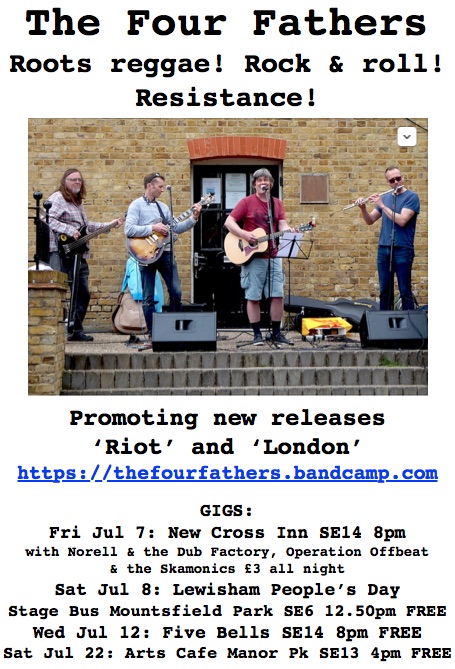 Over the month of July, my band The Four Fathers have four gigs in south east London, and we hope that, if you’re around, you’ll come and see us — and even if you’re not around, we hope that you’ll check out our music, and even buy a download or two!
In the last few months, we’ve been releasing songs from our forthcoming second album, How Much Is A Life Worth? — Close Guantánamo, which I wrote for the Close Guantánamo campaign, and with a new verse dealing with the menace posed by Donald Trump, Dreamers, a song about friendship and parenthood, which I wrote for a friend’s 50th birthday, and, most recently, two of our hardest-hitting political songs, Riot, which warns politicians about what to expect if the poorer members of society are relentlessly exploited and treated with contempt, and London, a love song to the city that has been my home for the last 32 years, in which I reflect with sorrow and anger on how the UK capital’s wildness and its relentless and persistent state of dissent in the 80s and 90s has been tamed — or bludgeoned — by greed over the last 20 years, and how, sadly, the recent disaster at Grenfell Tower in west London is the most distressing outcome of this institutional disdain for the poor.
Other key songs we play live include our anthemic anti-austerity song, Fighting Injustice, our cover of Bob Dylan’s Masters of War (from our debut album, Love and War), the folk song Rebel Soldier that I put to a reggae tune in Brixton in the 1980s, and other songs not yet released — How Much Is A Life Worth?, about how white people perceive the value of their lives against those of (i) the victims of our wars, (ii) refugees and (iii) in the US, black people killed by the police, and Equal Rights and Justice For All, about the importance of habeas corpus. A recent addition is Stand Down Theresa, our updated version of the Beat’s classic protest song, Stand Down Margaret. A rough but energetic version of Stand Down Theresa is on video here. Read the rest of this entry »
Video: Andy Worthington’s Band The Four Fathers Play ‘Stand Down Theresa’, An Updated Version of The Beat’s ‘Stand Down Margaret’
 When I was growing up in late 70s Britain, one of the great political anthems of the time — when we were not short of protest music from, to name but a few artists, the Sex Pistols, the Clash and the Specials — was ‘Stand Down Margaret’ by The Beat, featured on their debut album, ‘I Just Can’t Stop It,’ which was released in 1980. Paired with Prince Buster’s ‘Whine and Grine,’ ‘Stand Down Margaret’ primarily featured a polite but wonderfully poetic and insistent message, asking Margaret Thatcher, who became Prime Minister the year before, to resign. As the song stated:
I see no joy, I see only sorrow
I see no chance of a bright new tomorrow
Stand down Margaret, stand down please
Stand down Margaret
Here’s Dave Wakeling of The Beat talking about the song in 2013 — and about Margaret Thatcher, about whom he said, “Most everything about Margaret Thatcher was pretend … a way for the privileged to secure themselves at the expense of everybody else.” And here’s fabulous footage of The Beat playing their “insurrectionary anthem” on children’s TV. Read the rest of this entry »










 Who's still at Guantánamo?
