Despite 9/11 Accused Being Mentally “Unfit To Stand Trial,” Biden Refuses Plea Deal That Would Provide Mental Health Care, As Required By International Law
Please support my work as a reader-funded journalist! I’m currently trying to raise $2500 (£2000) to support my writing and campaigning on Guantánamo and related issues over the next three months. If you can help, please click on the button below to donate via PayPal.
I wrote the following article for the “Close Guantánamo” website, which I established in January 2012, on the 10th anniversary of the opening of Guantánamo, with the US attorney Tom Wilner. Please join us — just an email address is required to be counted amongst those opposed to the ongoing existence of Guantánamo, and to receive updates of our activities by email.
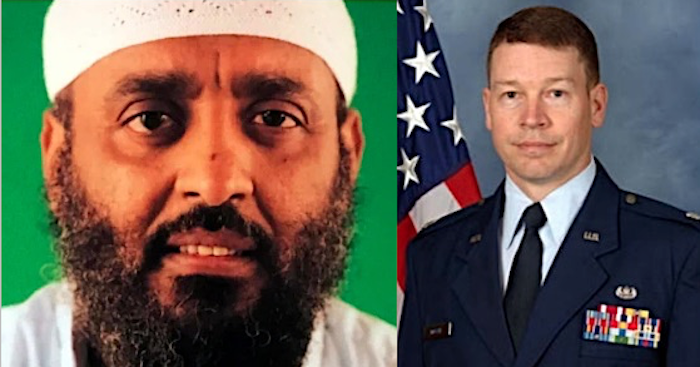
In startling news from Guantánamo four days ago, Air Force Col. Matthew McCall, the judge in the military commission case against the five men accused of involvement in the terrorist attacks of September 11, 2001, ruled that one of the men, Ramzi bin al-Shibh, is, as the Associated Press described it, “unfit for trial” after a medical panel found that “torture left him psychotic” — or “lastingly psychotic,” as the article’s opening line stated.
Bin al-Shibh, 51, a Yemeni, was 30 years old when he was seized in a house raid in Karachi, Pakistan on September 11, 2002, the first anniversary of the 9/11 attacks. He was subsequently held for four years in CIA “black sites” around the world — including Morocco, Poland, Romania and a “black site” that existed in Guantánamo in 2003-04 — before his final transfer to Guantánamo in September 2006, with 13 other “high-value detainees,” including the other four men accused of involvement in the 9/11 attacks.
After an abortive attempt, in 2008, to prosecute the five men in the military commissions under President Bush, and a subsequent commitment, in November 2009, to prosecute them in a federal court in New York, which was abandoned after a Republican backlash, the five were charged in a revived military commission system in May 2011.
Please Write to the Guantánamo Prisoners, to Let Them Know We Remember Them

Please support my work as a reader-funded journalist! I’m currently trying to raise $2500 (£2000) to support my writing and campaigning on Guantánamo and related issues over the next three months. If you can help, please click on the button below to donate via PayPal.
I wrote the following article for the “Close Guantánamo” website, which I established in January 2012, on the 10th anniversary of the opening of Guantánamo, with the US attorney Tom Wilner. Please join us — just an email address is required to be counted amongst those opposed to the ongoing existence of Guantánamo, and to receive updates of our activities by email.
It’s 13 years since two Muslim activist friends in the UK initiated a project to get people to write to the Guantánamo prisoners still held at that time — 186 in total — and I adopted it, and have been running it ever since; initially, once or twice a year, although more sporadically in recent years.
When I last posted a request for people to write to the men still held, just over a year into the Biden presidency, 39 men were still held at the prison. That number has now fallen to 30, but, after a flurry of releases earlier this year, a kind of dreadful deadly stasis has once more descended on Guantánamo.
Although 16 of the men still held have been unanimously approved for release by high-level government review processes — mostly via the Periodic Review Boards (PRBs), introduced in 2013 — no one can say when they might actually be freed. This is because the majority of them cannot be sent back to their home countries, as a result of bans imposed by Republicans every year in the annual National Defense Authorization Act (NDAA), meaning that third countries must be found that are prepared to offer them new homes.
After First Ever Guantánamo Visit, UN Rapporteur Finds Dehumanized, Traumatized Men Subjected to Cruel, Inhuman and Degrading Treatment That May Rise to the Level of Torture
Please support my work as a reader-funded journalist! I’m currently trying to raise $2500 (£2000) to support my writing and campaigning on Guantánamo and related issues over the next three months. If you can help, please click on the button below to donate via PayPal.
I wrote the following article for the “Close Guantánamo” website, which I established in January 2012, on the 10th anniversary of the opening of Guantánamo, with the US attorney Tom Wilner. Please join us — just an email address is required to be counted amongst those opposed to the ongoing existence of Guantánamo, and to receive updates of our activities by email.
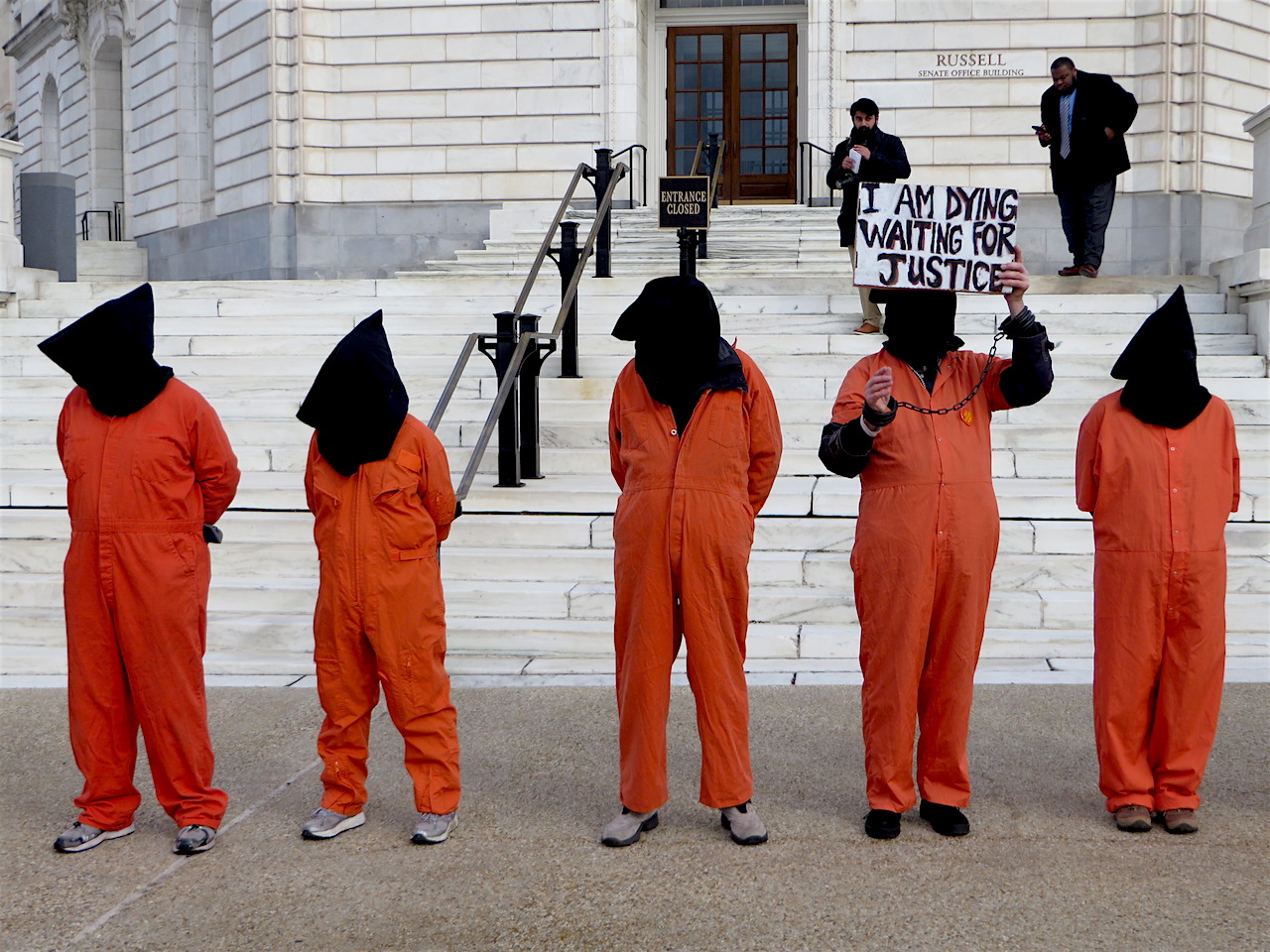
On Monday June 26, 7,837 days since the prison at Guantánamo Bay opened, and on the 25th anniversary of the establishment of the UN International Day in Support of Victims of Torture, the Special Procedures of the UN Human Rights Council (“independent human rights experts with mandates to report and advise on human rights from a thematic or country-specific perspective”) issued a devastatingly critical report about systemic, historic and ongoing human rights abuses at the prison, based on the first ever visit by a Special Rapporteur — Fionnuala Ní Aoláin, the Special Rapporteur on the Promotion and Protection of Human Rights and Fundamental Freedoms while Countering Terrorism, who visited the prison in February.
At the time of her visit, just 34 men were held at the prison (a number now reduced to 30), out of the 779 men and boys who have been held by the US military throughout the prison’s long history, and, as the Special Rapporteur admitted, she agreed with every “detainee or former detainee,” who, “[i]n every meeting she held” with them, told her, “with great regret,” that she had arrived “too late.”
However, it is crucial to understand that the lateness of the visit was not through a lack of effort on the part of the UN; rather, it was a result of a persistent lack of cooperation by the US authorities — part of a pattern of obstruction, secrecy and surveillance that prevented any UN visit because the authorities failed to comply with the Terms of Reference for Country Visits by Special Procedure Mandate Holders, which require “[c]onfidential and unsupervised contact with witnesses and other private persons, including persons deprived of their liberty.”
Shocking Statistics From Guantánamo: How Long Prisoners Approved for Release Have Been Waiting to Be Freed

Please support my work as a reader-funded journalist! I’m currently trying to raise $2500 (£2000) to support my writing and campaigning on Guantánamo and related issues over the next three months. If you can help, please click on the button below to donate via PayPal.
Last week, when Majid Khan was freed from Guantánamo, it had taken 337 days for the US government to secure his release after his terrorism-related military commission sentence ended, on March 1, 2022.
The US government worked hard to secure Majid Khan’s resettlement in Belize because it was legally required to do so, and also because officials in various branches of the government wanted to ensure the continuing viability of plea deals for Guantánamo prisoners accused of acts of terrorism.
In contrast, however, as the infographic above shows, 20 other men approved for release through high-level government review processes have, for the most part, been waiting far longer than the 337 days that Majid Khan had to wait for his freedom.
Video: Moazzam Begg, Anas Altikriti and I Discuss ‘Guantánamo: 21 Years On’ on Al Hiwar TV’s New Show, ‘The London Circle’
Please support my work as a reader-funded journalist! I’m currently trying to raise $2500 (£2000) to support my writing and campaigning on Guantánamo and related issues over the next three months. If you can help, please click on the button below to donate via PayPal.
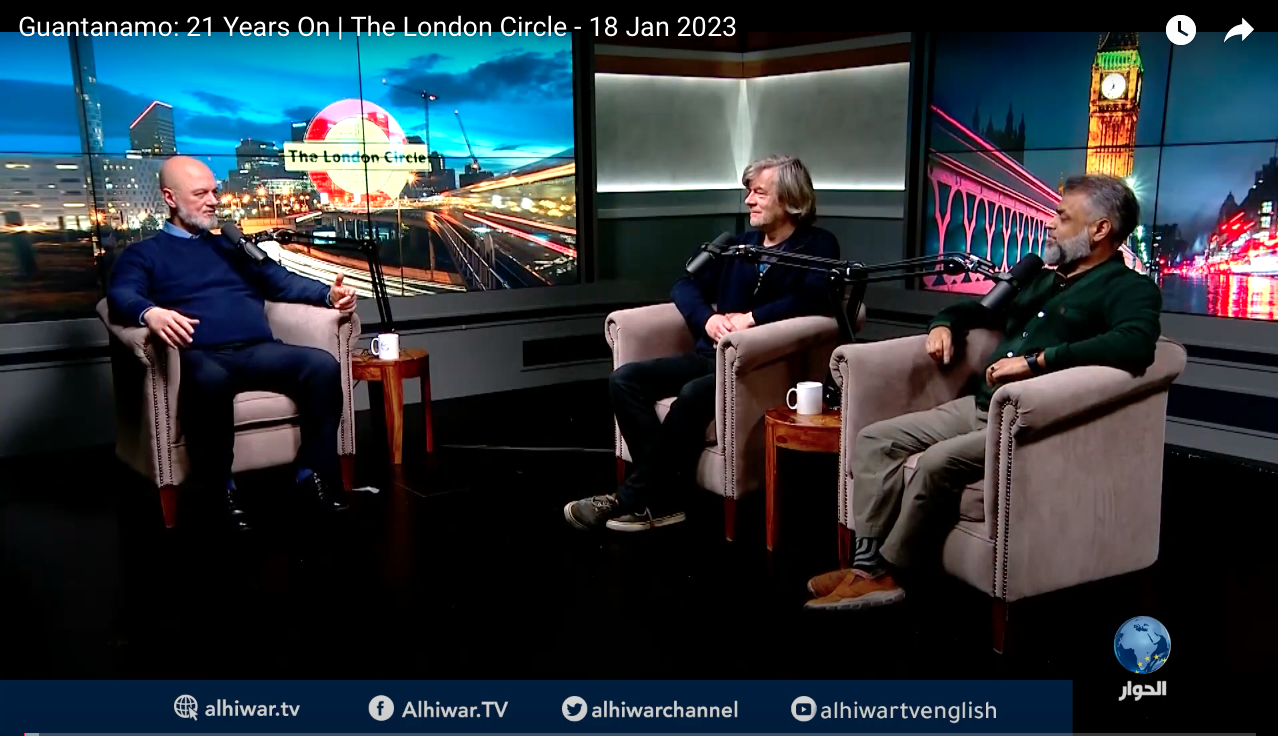
I’m delighted to promote ‘Guantánamo: 21 Years On’, the very first episode of a new English language show, ‘The London Circle’, broadcast by the Arabic news channel Al Hiwar TV, which reaches millions of viewers throughout the Arabic-speaking world.
For the opening show, I was invited to join a discussion with former Guantánamo prisoner Moazzam Begg, hosted by Anas Altikriti, the CEO and founder of the Cordoba Foundation, which was established in 2005 “to provide a strong voice of tolerance and reason in promoting dialogue and a rapprochement between Islam and the West.”
The one-hour discussion was envisaged by Anas as a free-wheeling conversation rather than the regimented question and answer format of most news discussions, and I thought it was very successful. The video is posted below, via YouTube, and I hope that you’ll have the time to watch it, and that you’ll share it if you find it useful.
Video: The Annual New America Panel Discussion About Guantánamo, Featuring Karen Greenberg, Tom Wilner and Myself
Please support my work as a reader-funded journalist! I’m currently trying to raise $2500 (£2000) to support my writing and campaigning on Guantánamo and related issues over the next three months. If you can help, please click on the button below to donate via PayPal.
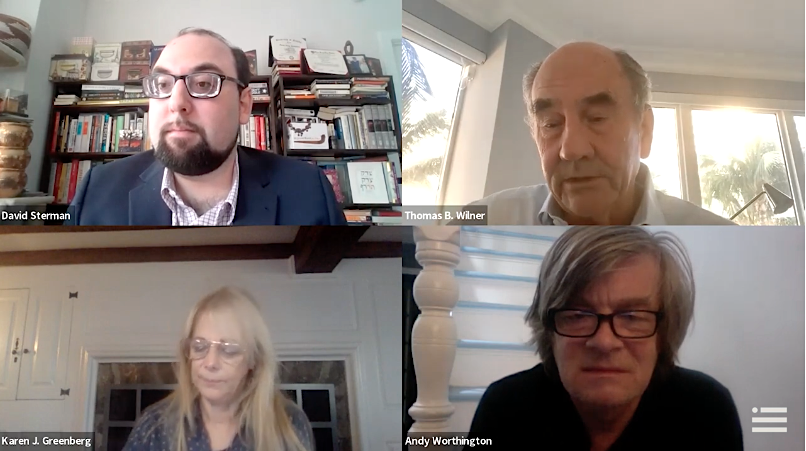
Almost every year since 2011, the New America think-tank in Washington, D.C. has generously hosted panel discussions about Guantánamo with the attorney Tom Wilner and I, at which we have been joined by a number of other guests.
At the time of that first event, Barack Obama was the president, and 173 men were still held. In 2012 we marked the 10th anniversary of the prison’s opening, also launching the Close Guantánamo campaign, returning every year thereafter, except for 2014, when Tom and I were both too dispirited to summon up any enthusiasm. The 2016 event coincided with a “Countdown to Close Guantánamo” campaign, launched by Andy and Roger Waters on Democracy Now!, to put pressure on Obama to finally fulfill his promise to get the prison closed, but, when Obama left office, 41 men were still held, who then had endure four years of hostility from a president who had no interest in releasing any of them.
Having moved the events online in 2021, because of Covid, Tom and I and our by now regular companion, Karen Greenberg, the Director of the Center on National Security at Fordham Law School, met again online a year ago to discuss Guantánamo on its 20th anniversary, when we were, I think it’s fair to say, caught been hope and pessimism, but this year, sadly, hope is losing that battle.
Over 150 Rights Groups, Including Close Guantánamo, Send A Letter to President Biden Urging Him to Shut the Prison on Its 21st Anniversary

Please support my work as a reader-funded journalist! I’m currently trying to raise $2500 (£2000) to support my writing and campaigning on Guantánamo and related issues over the next three months. If you can help, please click on the button below to donate via PayPal.
I wrote the following article for the “Close Guantánamo” website, which I established in January 2012, on the 10th anniversary of the opening of Guantánamo, with the US attorney Tom Wilner. Please join us — just an email address is required to be counted amongst those opposed to the ongoing existence of Guantánamo, and to receive updates of our activities by email.
On January 11, the 21st anniversary of the opening of the prison at Guantánamo Bay, over 150 rights groups, including the Center for Constitutional Rights, the Center for Victims of Torture, the ACLU, and groups closely associated with Guantánamo activism over the years — Close Guantánamo, Witness Against Torture, and the World Can’t Wait, for example — sent a letter to President Biden urging him to finally bring an end to the monstrous injustice of the prison by closing it once and for all.
I’m pleased that the letter at least attracted a brief flurry of media interest — from Democracy Now! and The Intercept, for example — but I doubt that any of the organizations involved seriously believe that President Biden and his administration will suddenly find that their moral conscience has been awakened by the letter.
What is needed from the Biden administration is hard work and diplomacy, particularly to secure the freedom of the 20 men still held who have been approved for release, but are still languishing at Guantánamo as though they had never even been approved for release in the first place, because their approval for release came solely through administrative reviews, which have no legal weight, and nothing, apparently, can compel the administration to overcome their inertia, and to act with decency to secure the prompt release of these men.
Free The Guantánamo 20: Events Marking the 21st Anniversary of the Opening of the Prison

Please support my work as a reader-funded journalist! I’m currently trying to raise $2500 (£2000) to support my writing and campaigning on Guantánamo and related issues over the next three months. If you can help, please click on the button below to donate via PayPal.
I wrote the following article for the “Close Guantánamo” website, which I established in January 2012, on the 10th anniversary of the opening of Guantánamo, with the US attorney Tom Wilner. Please join us — just an email address is required to be counted amongst those opposed to the ongoing existence of Guantánamo, and to receive updates of our activities by email.
With a heavy heart, the small but dedicated group of human rights activists from across the United States and around the world who, on a daily basis, are appalled by the continued existence of the fundamentally lawless prison at Guantánamo Bay are preparing to mark the 21st anniversary of its opening this Wednesday, Jan. 11.
This anniversary I’ll be in London (not the US as I was every Jan. 11 from 2011 to 2020), but I’m hoping that I’ll still be able to make waves, along with my American friends and colleagues, and this year I’m particularly focusing on the 20 men, out of the 35 still held — who have been approved for release, but are still held.
Photos of these 20 men are in the composite image at the top of this article, which I made a few days ago, and when I posted it on Facebook, I explained, “16 of these men have been approved for release since President Biden took office, while three others were approved for release in 2010, but are still held, and one other man was approved for release in the dying days of the Trump presidency.”
Two Radio Shows: I Discuss Guantánamo and Julian Assange on TNT Radio and Parallax Views

Please support my work as a reader-funded journalist! I’m currently trying to raise $2500 (£2000) to support my writing and campaigning on Guantánamo and related issues over the next three months. If you can help, please click on the button below to donate via PayPal.
This week I was delighted to take part in two interviews, to discuss the prison at Guantánamo Bay, as the 21st anniversary of its opening approaches, and the ongoing plight of Julian Assange, still held in Belmarsh maximum-security prison in London, as he continues to challenge his proposed extradition to the US to face espionage charges relating to WikiLeaks’ publication of classified US documents leaked by Chelsea Manning.
On Monday, I spoke with Jason Olbourne on TNT Radio, based in Australia, in an interview that started 21 minutes into the 55-minute show. The interview is available here, and after a great introduction, in which Jason enthused about my photo-journalism project ‘The State of London’, and the music of The Four Fathers (asking if people have suggested that I sound like David Byrne), we spoke about Guantánamo, with Jason asking me to run through the story of how I first got involved with Guantánamo, in 2006, and how I worked out who was held there, and how very few of them had any meaningful involvement with Al-Qaeda or other terrorist groups.
Jason suggested that people might be held at Guantánamo in future, but was, I hope, persuaded by my explanation that Guantánamo is such a disaster area, legally, that no one with any sense would consider sending anyone there in future. I explained how the majority of the men held there were insignificant, but were tortured or otherwise abused in an effort to extract information from them, because of mistaken presumptions that they were hiding actionable intelligence — presumptions that wouldn’t have been so easy to make if the US authorities had not done away with any kind of screening process when they were first seized, and which led to Guantánamo becoming a place where the authorities’ actions resembled the witch hunts of centuries past.
Radio: I Discuss Guantánamo, Saifullah Paracha and the Plight of the Men Approved for Release on WSLR 96.5 in Florida

Please support my work as a reader-funded journalist! I’m currently trying to raise $2500 (£2000) to support my writing and campaigning on Guantánamo and related issues over the next three months. If you can help, please click on the button below to donate via PayPal.
Many thanks to Bob Connors and Tom Walker of WSLR 96.5, a progressive community radio station in Sarasota, Florida, for having me on their show, “The Peace & Justice Report,” on Wednesday. As the hosts explain, the show “covers local, state, national and international social justice issues,” featuring “a wide variety of guests whose views are underrepresented in the mainstream media,” including “peace activists who are devoting their lives to creating a world free from war, violence and environmental destruction.”
I’ve spoken to Bob and Tom before — in 2018, 2019 and last year —and it was great to talk to them again, not only because they are such welcoming hosts, but also because far too few radio shows in the US — or around the world — devote any time at all to the ongoing injustice of Guantánamo.
Our 22-minute interview is embedded below, and I hope you have time to listen to it, and that you’ll share it if you find it useful.












 Who's still at Guantánamo?
