Editorials Call for the Closure of Guantánamo in the New York Times, Washington Post and Guardian
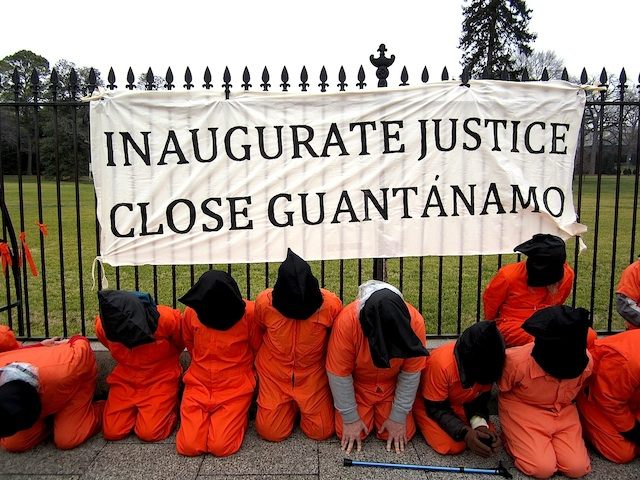 As the prison-wide hunger strike in Guantánamo continues (sign the petition calling for its closure here!), nearly three months since the majority of the 166 prisoners still held began refusing food, it is abundantly clear that, after several years in which, frankly, almost everyone had forgotten about Guantánamo or had given up on it, the prison — and the remaining 166 prisoners — are now back in the news and showing no signs of being as easily dismissed as they were three years ago, when everyone went silent after President Obama’s promise to close the prison within a year fizzled out dismally.
The need to exert concerted pressure on the Obama administration is more important than ever, because, until the prisoners appealed to the world by putting their lives on the line, President Obama had been content to abandon them, and had been encouraged to do so by Congress, where lawmakers had blocked all his attempts to close the prison, and had ended up imposing restrictions, in the National Defense Authorization Acts passed at the end of 2011 and 2012, that made it almost impossible to release any prisoners.
In the last week, the editors of the New York Times, the Washington Post and the Guardian have all published powerful editorials calling for the closure of Guantánamo, which I’m cross-posting below. The first, on April 26, was the New York Times editorial, which delivered crushing words to President Bush as he sought to reclaim his legacy with the opening of the George W. Bush Presidential Library and Museum about his prison which “should never have been opened,” and which “became the embodiment of his dangerous expansion of executive power and the lawless detentions, secret prisons and torture that went along with them.” Read the rest of this entry »
Guantánamo Authorities Respond to Hunger Strike with Violence; Red Cross Complains
 I wrote the following article for the “Close Guantánamo” website, which I established in January 2012 with US attorney Tom Wilner. Please join us — just an email address is required to be counted amongst those opposed to the ongoing existence of Guantánamo, and to receive updates of our activities by email.
In response to the prison-wide hunger strike at Guantánamo, the authorities last weekend stormed into Camp 6, the block where the majority of the prisoners are held, and hauled most of the prisoners off to solitary confinement.
The authorities attempted to justify their actions — but failed to understand that the men who are endangering their lives by embarking on a hunger strike are doing so not to upset the authorities for no reason, or to challenge their authority needlessly, but because they despair of ever being released.
Even though 86 of the 166 men still held were cleared for release by an inter-agency Guantánamo Review Task Force established by President Obama in 2009, the US government has turned its back on them. Although two-thirds of the cleared prisoners are Yemenis, President Obama issued a blanket ban on releasing any Yemenis after the failed underwear bomb plot on Christmas Day 2009 (perpetrated by a Nigerian man recruited in Yemen).
Congress has also raised obstacles preventing the release of prisoners, and the court of appeals in Washington D.C. — the D.C. Circuit Court — has also issued rulings preventing the release of prisoners for reasons that have much more to do with ideology and paranoia than with the facts.
The men are effectively stranded at Guantánamo, and will die there unless action is taken immediately by President Obama to bring this intolerable situation to an end. Read the rest of this entry »
A Voice from Guantánamo: Samir Moqbel, a Hunger Striker Brutally Force-Fed Every Day
 With the prison-wide hunger strike at Guantánamo now in its third month, it is encouraging that so much of the mainstream media is paying close attention to the story, maintaining pressure on the Obama administration to do something about it — most obviously by securing the release of the 86 men (out of 166 in total), who were cleared for release by an inter-agency Guantánamo Review Task Force that President Obama established when he took office in 2009, just after he had issued his executive order promising to close the prison within a year.
Despite that promise, the men have actually been abandoned by all three branches of the US government. President Obama bears huge responsibility, for having imposed a blanket ban, three years ago, on releasing any cleared Yemenis, in the wake of a failed bomb plot that originated in Yemen, and Congress has also imposed almost insurmountable restrictions on the release of prisoners.
The hunger strike seems to have pricked the conscience of the mainstream media, who, for the most part, had lost interest in Guantánamo and the men abandoned by President Obama and used as pawns in a cynical political game by Congress, and I’m relieved that this is the case, because I believe that only sustained pressure — both domestic and international — can persuade President Obama and lawmakers to wake up to the horrors of their indifference and their cynicism. Read the rest of this entry »
United Nations and New York Times Call for Closure of Guantánamo and End to Indefinite Detention
 I wrote the following article for the “Close Guantánamo” website, which I established in January 2012 with US attorney Tom Wilner. Please join us — just an email address is required to be counted amongst those opposed to the ongoing existence of Guantánamo, and to receive updates of our activities by email.
The ongoing hunger strike at Guantánamo is now in its third month, and shows no sign of coming to an end. As stories have emerged from the prisoners, via their lawyers, we have learned that it was inspired by deteriorating conditions at the prison, and by the prisoners’ despair at ever being released.
Their despair, sadly, is understandable.
Although 86 of the remaining 166 prisoners were cleared for release at least three years ago by an inter-agency Guantánamo Review Task Force established by President Obama, they are still held because of cynical Congressional obstruction, and weakness on the part of President Obama — in particular through his failure to close the prison, as he promised when he took office, and because of a ban he imposed in January 2010 on releasing any cleared Yemenis, who make up two-thirds of the cleared prisoners, which he issued in the wake of a failed bomb plot involving a Nigerian man recruited in Yemen. Read the rest of this entry »
On Guantánamo, the New York Times Abdicates Responsibility
 I wrote the following article for the “Close Guantánamo” website, which I established in January with US attorney Tom Wilner. Please join us — just an email address is required to be counted amongst those opposed to the ongoing existence of Guantánamo, and to receive updates of our activities by email.
This week, in its “Room for Debate” series, the New York Times invited six people to debate the question, “Time to End Military Tribunals?” and also to comment on whether, in his second term, President Obama should “finally close Guantánamo.”
On the one, hand, of course, there were some powerful arguments made for President Obama to drop the military commissions — especially after the recent ruling by the D.C. Circuit Court, quashing one of the only convictions in the system’s troubled history, that of Salim Hamdan — and finally fulfill his failed promise to close Guantánamo, and it was important to have these arguments made in the pages of the Times.
In “A Failed Experiment,” Andrea Prasow of Human Rights Watch stated bluntly, “The Guantánamo experiment has failed,” and added, “Those implicated in serious crimes should be prosecuted, but in time-tested judicial systems. If the president is serious about closing Guantánamo, he needs to work with Congress to lift the restrictions on transferring detainees. If Congress refuses, Obama should use his veto”– included in last year’s National Defense Authorization Act, which Tom Wilner wrote about here. Read the rest of this entry »
WikiLeaks and the Lawyers: Justice Department Finally Allows Attorneys to See Leaked Guantánamo Files, But Not to Download, Save or Print Them
 In the US government’s farcical world of overclassification, four reporters were banned from Guantánamo last year for reporting the name of a witness in the trial by Military Commission of the Canadian citizen and former child prisoner Omar Khadr, even though his name had been widely reported in the media, and was available online.
That was the Defense Department’s doing, but the whole story of WikiLeaks and its exposure of classified US documents — whether it is the Collateral Murder video, the Afghan and Iraqi war logs, the diplomatic cables, or the Detainee Assessment Briefs from Guantánamo — is one of overclassification across every government department, in which material that should not necessarily be secret was, until it was leaked, jealously guarded by a government that behaves as though it was not elected by the people, and is not answerable to them.
The treasure trove of documents released to WikiLeaks also came about because, after the pre-9/11 failures of the intelligence agencies to communicate with one another, the creation of a vast database accessible by, literally, millions of government employees, was designed to facilitate the sharing of useful information. This was in spite of the fact that it should also have been obvious that, with so many people having access to it, it was only a matter of time before someone concerned with transparency and justice — allegedly Pfc. Bradley Manning, imprisoned for leaking the documents since last May — would take advantage of the 21st century whistleblowing opportunities made available by WikiLeaks to let the world know what it was missing. Read the rest of this entry »
Supreme Court Fails to Tackle Torture – in the Past or in the Future
 Since the dying days of the Bush administration, when the Supreme Court savaged the indifference of the executive branch and of Congress towards the cruel mess they had created at Guantánamo, by ensuring that the prisoners had constitutionally guaranteed habeas corpus rights, it has, sadly, all been downhill when it comes to judicial oversight of the national security state. Moreover, in two recent decisions, the Supreme Court has shown indifference to torture, either in the past or in the future.
In the three years since that landmark case, Boumediene v. Bush, the prisoners’ initial success in the District Court in Washington DC., where they won 38 of the first 52 cases, has been abruptly halted, as right-wing judges in the D.C. Circuit Court, led by Senior Judge A. Raymond Randolph, have pushed back, insisting that little evidence is required to continue holding men indefinitely, even if, as in most cases, they were nothing more than insignificant foot soldiers for the Taliban, rather than international terrorists.
In response to this repeated hurling down of gauntlets by Judge Randolph, who is notorious for approving every piece of Guantánamo-related legislation that was subsequently overturned by the Supreme Court, there has been no repeat of Boumediene. In the last few months, lawyers for the prisoners have tried to undermine Judge Randolph and his colleagues on numerous fronts. Eight Guantánamo cases have made their way to the Supreme Court, as SCOTUSblog reported back in December, but all have failed. Read the rest of this entry »
Free John Walker Lindh, Scapegoat of the “War on Terror”
 With the death of Osama bin Laden, there is now an opportunity for a huge peace dividend — an end to the occupation of Afghanistan, and an opportunity to close Guantánamo — which will probably not happen, even though it should, because of powerful vested interests. These include the lawmakers intent on using bin Laden’s death as an excuse to further ramp up the “War on Terror” by revising the Authorization for Use of Military Force, the founding document of the phoney war, and to claim, in spite of all the evidence, that George W. Bush’s torture program was a good idea and helped to track down bin Laden (which it didn’t), and that Guantánamo was useful for producing reliable intelligence (which it wasn’t).
I tackled all of these dangerous lies and distortions in my articles, With Osama bin Laden’s Death, the Time for US Vengeance Is Over, Osama bin Laden’s Death, and the Unjustifiable Defense of Torture and Guantánamo and No End to the “War on Terror,” No End to Guantánamo, but although I also implied that it was ridiculous to continue holding people at Guantánamo whose only crime seems to have been that they saw Osama bin Laden from afar while attending a training camp in Afghanistan, what I didn’t reflect on directly were specific victims of the hysteria of the “War on Terror.”
Clearly, this process includes dressing up soldiers at Guantánamo as terrorists to placate those who believe that being strong means being both brutal and stupid, but, as the lawyer Frank Lindh explained in an op-ed in the New York Times last week, it also includes his son, John Walker Lindh, forever tarred as “the American Taliban,” who was one of the first scapegoats of the “War on Terror.” Read the rest of this entry »
New York Times Attempts to Stifle Torture Debate It Helped Spark in the Wake of Osama bin Laden’s Death
 On Thursday, the New York Times, having played a major part in creating a buzz in the United States about the role that torture and the existence of Guantánamo played in locating Osama bin Laden, with an article on Tuesday entitled, “Bin Laden Raid Revives Debate on Value of Torture,” resolutely stepped back from the result of suggesting that there were even grounds for a “debate” — given that the use of torture is illegal (as well as morally corrosive and unreliable) — by publishing an excellent editorial decisively condemning the “immoral and illegal behavior” of torture apologists after 9/11, including Berkeley law professor John Yoo, who, as a lawyer in the Justice Department’s Office of Legal Counsel in 2002, “twisted the Constitution and the Geneva Conventions into an unrecognizable mess to excuse torture” in what will forever be known as the “torture memos.”
The Times also recognized torture as “immoral and illegal and counterproductive,” and stated that, although torture may produce some useful information — amongst all the lies that, for example, plague the military assessments of Guantánamo prisoners that were recently released by WikiLeaks — “most experienced interrogators think that the same information, or better, can be obtained through legal and humane means.”
I would prefer that the last line had read “experienced interrogators have absolutely no doubt that the same information, or better, can be obtained through legal and humane means,” and I would also have preferred the Times‘ editors not to have claimed that the use of torture has led to America’s “inability to hold credible trials for very bad men” — presumably a reference to Khalid Sheikh Mohammed and his alleged co-conspirators in the preparation and execution of the 9/11 attacks — when the truth is that Attorney General Eric Holder was convinced that a federal court trial could proceed, but was prevented from doing so for nakedly political reasons. Read the rest of this entry »
Scaremongers Fail to Undermine WikiLeaks’ Guantánamo Revelations
 For regular readers of this site, the release, by Wikileaks, of classified military documents relating to almost all of the 779 prisoners held at Guantánamo will not have yielded any great surprises.
Since May 2007, I have been writing articles on a regular basis dealing exclusively with the horrors of Guantánamo and the Bush administration’s torture program, explaining how few of the prisoners held at Guantánamo had any involvement with terrorism, how many innocent men and boys were seized by mistake or sold to US forces for bounty payments by the military’s Afghan and Pakistani allies, and how the “War on Terror” initiated by the Bush administration was an abomination.
This was because Bush’s “war” — essentially maintained by the Obama administration — involved confusing terrorists with soldiers, and attempting to do away with the Geneva Conventions and the UN Convention Against Torture, as well as other traditions more specifically associated with the United States — the Constitution and the separation of powers, for example, sidelined by an executive branch that sought unfettered executive power. Read the rest of this entry »












 Who's still at Guantánamo?
