“It’s a Disgrace”: Guantánamo Expert Andy Worthington Interviewed for Truthout
 Below, I’m pleased to cross-post an interview conducted by phone with the journalist Brad Jacobson during my recent visit to the US to campaign for the closure of Guantánamo on the 10th anniversary of the opening of the Bush administration’s brutal and lawless “war on terror” prison. The interview was conducted while I was in Washington D.C., and afterwards I was pleased to direct Brad to Truthout as a prospective publisher, and delighted that Truthout decided to run with it. It was published on Sunday, and I’ll let it speak for itself, after noting that I have made a few editorial changes, and have inserted some additional links as well.
Brad was a knowledgeable interviewer, and clearly interested in the horrors of America’s post-9/11 journey to the “dark side,” and the surreal situation we now find ourselves in, when a Democratic President, who campaigned largely on a promise to clear up the Bush administration’s mess, and to close Guantánamo, has largely failed to do so, and,perversely, has ended up normalizing much of what, under George W. Bush, had come to be regarded as a national shame.
Guantánamo Ten Years Later: “It’s a Disgrace,” Says Expert Andy Worthington
Interview by Brad Jacobson, Truthout, February 12, 2012
On January 12, the tenth anniversary of the notorious military prison in Guantanamo Bay, Truthout interviewed investigative journalist and Guantánamo expert Andy Worthington. Author of The Guantánamo Files and co-director of the film “Outside the Law: Stories from Guantánamo,” Worthington has spent the last six years painstakingly working to keep alive in the public consciousness the human faces and personal contexts of the 779 people imprisoned within the facility. Read the rest of this entry »
Video: Close Guantánamo: End Ten Years of Injustice — Andy Worthington and Jason Leopold in Discussion in San Francisco
 During my ten-day US tour last month to mark the 10th anniversary of the opening of the “war on terror” prison at Guantánamo, all the events I took part in, and the TV and radio interviews I undertook, were worthwhile, enjoyable, and an opportunity to provide important information and to urge those opposed to the ongoing existence of Guantánamo to keep campaigning for its closure.
This is not an easy task, given President Obama’s failures, cynical Congressional opposition, and the obstruction of right-wing judges in the D.C. Circuit Court — and it is compounded by a recent poll showing that a majority of Americans are apparently content for Guantánamo to remain open — but the 10th anniversary provided an opportunity to launch a new campaigning website, “Close Guantánamo” with the attorney Tom Wilner (and supporters can sign up here), and also to hook up with many other friends.
One of these is Jason Leopold, the lead investigative reporter for Truthout, who is a colleague and a friend with whom I spent some time in the fall of 2010, during “Berkeley Says No to Torture” Week, and in the third of the four cities on my recent visit — San Francisco — Jason and I took part in an hour-long conversation, at UC Hastings Law School on January 13, which was one of the most satisfying of all my engagements, as Jason and I work well together, and had enough time to cover all the issues that need discussing, on this baleful anniversary when all three branches of the US government have failed to close Guantánamo, and too few people seem to care. Read the rest of this entry »
Three UK Protests to Mark the 10th Anniversary of Shaker Aamer’s Arrival at Guantánamo
 February 14 marks the 10th anniversary of the arrival at Guantánamo of Shaker Aamer, who is now the last British resident in the prison, but was once one of 15 British citizens and residents held at Guantánamo. Shaker’s story is one that I have told and retold over the years, including in the documentary film, “Outside the Law: Stories from Guantánamo,” which I co-directed with Polly Nash, and it is distressing, for his British wife, and his four British children (the youngest of whom has never seen his father, because he was born after his capture) to have to endure another anniversary without Shaker, an eloquent man of great compassion, who has spent ten years demanding that he and his fellow prisoners be treated as human beings, and not as “enemy combatants” without rights, which is what they essentially remain, despite some general improvement in their living conditions under President Obama.
Throughout this period in which I have been studying Shaker’s story (for the last six years), it has been clear that there was no good reason for Shaker Aamer to be held. He was told in spring 2007 that he had been cleared for release by the Bush administration, and in August 2007 Gordon Brown, taking over from Tony Blair as Prime Minister, requested his return along with the other British residents.
Nevertheless, he was not freed, and with a new President in the US and a new government in the UK it was not initially known what his status was as the 10th anniversary of the opening of Guantánamo approached. However, two recent discoveries have ensured that, on the 10th anniversary of Shaker’s arrival at Guantánamo, there are no obstacles to his immediate release, however much representatives of the US or UK governments may pretend otherwise. Read the rest of this entry »
How the National Defense Authorization Act Allows the President to Release Prisoners from Guantánamo
 While I was in the US two weeks ago, for the 10th anniversary of the opening of the “war on terror” prison at Guantánamo Bay, there was great deal of understandable outrage amongst activists — both those on the left, and libertarians — because of outrageous provisions in the National Defense Authorization Act of 2012 (PDF), which was passed by the Senate on December 15, and was signed into law by President Obama on December 31.
I discussed these provisions in a number of articles — most recently in an article entitled, “A Tired Obsession with Military Detention Plagues American Politics” — in which I wrote about the shameful provisions requiring the mandatory military custody, without charge or trial, of anyone allegedly associated with al-Qaeda, and also wrote about the provisions preventing the release of prisoners from Guantánamo, which have stopped anyone being released in the last year.
In addressing concerns about the NDAA, I made a point of stressing that, although it is important that criticism should continue to be directed at lawmakers for subverting the entire basis of America’s foundation as a country based on the rule of law with their military detention provisions (for which they should all be hounded out of office), and although it is also of significance that the restrictions on releasing Guantánamo prisoners are based on fearmongering for nakedly political reasons, two other details should not be overlooked. Read the rest of this entry »
Video: “Guantánamo Forever?” – Jim Moran, Andy Worthington, Morris Davis and Tom Wilner at the New America Foundation, January 10, 2012
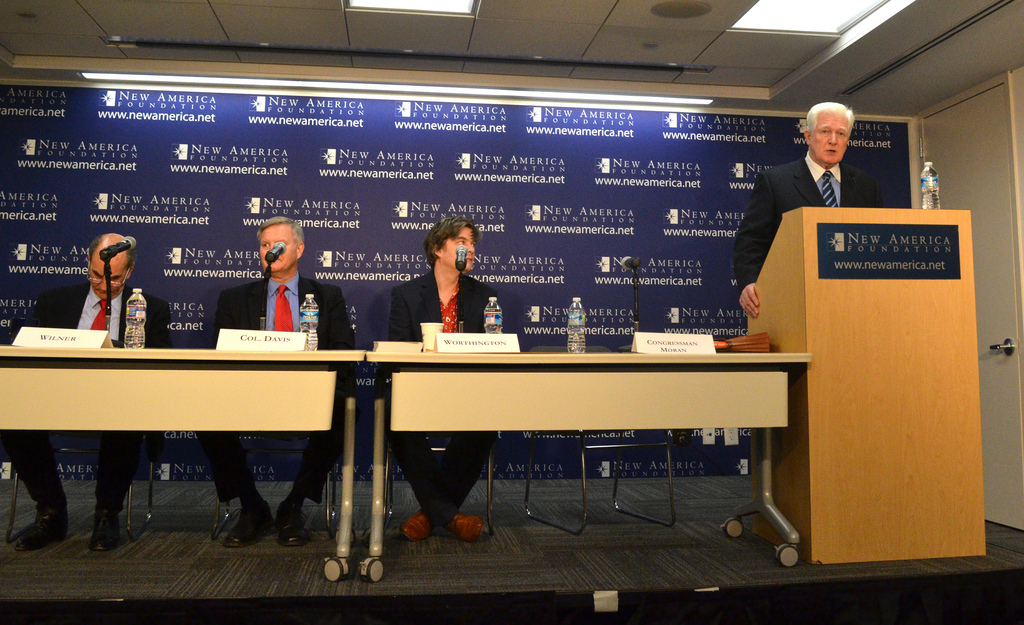 See the entire event on C-SPAN here (and also via YouTube, embedded below).
On the 10th anniversary of the opening of the Bush administration’s prison at Guantánamo Bay, Cuba, which belonged to George W. Bush for seven of those ten years, but has belonged to Barack Obama for the last three, there is no reason for anyone with a heart, a conscience or a respect for America and the rule of law to be cheerful.
On Tuesday lunchtime, however, as part of my ongoing US tour, when I met up, at the New America Foundation in Washington D.C. with Tom Wilner, Counsel of Record in the Guantánamo prisoners’ habeas corpus cases in the Supreme Court in 2004 and 2008, and Col. Morris Davis, the former chief prosecutor of the Military Commissions at Guantánamo, who resigned in 2007 in protest at the use of torture, Col. Davis found it impossible not to crack a joke about it. “We must stop meeting like this,” he said, referring to the fact that, exactly a year ago, he and Tom and I were on a panel discussing Guantánamo on the 9th anniversary of its opening. Read the rest of this entry »
Andy Worthington Reports on the New York Dates of His “Close Guantánamo” Tour on the 10th Anniversary of the Prison’s Opening
 After nearly four days in New York as part of my US tour to mark the 10th anniversary of the opening of Guantánamo, I’ve just taken a bus with Debra Sweet, the national director of the campaigning group The World Can’t Wait, who arranged my visit, heading down to Washington D.C. to take part in a number of events. Tomorrow lunchtime (Tuesday January 10, at 11.45), I’m taking part in a panel discussion at the New America Foundation, “Ten Years of Guantánamo: Will It Ever Close?” — with Col. Morris Davis, the former chief prosecutor for the Military Commissions at Guantánamo, who resigned in 2007, in protest at the planned use of evidence obtained through the use of torture, and is now the executive director of the Crimes of War Project, and Tom Wilner, Counsel of Record for the Guantánamo prisoners in their cases before the Supreme Court in 2004 and 2008. We will also be welcoming a special guest, Congressman Jim Moran, whose presence, in a Presidential election year, at an event that dares to mention Guantánamo is greatly appreciated.
At 5.30 pm, Tom Wilner and I will be at Busboys and Poets (at 5th and K) showing a new cut of the documentary film, “Outside the Law: Stories from Guantánamo” (which I co-directed with filmmaker Polly Nash), featuring new commentary by Tom, and, on Wednesday January 11 (the actual anniversary), I’ll begin, at 10 am, by attending an event at the National Press Club, at 529 14th St. NW, on the 13th Floor in the unironically entitled First Amendment Room.
Organized by the Center for Constitutional Rights, “Obama’s Prison: Guantánamo Turns 10” is an event to “discuss issues ranging from National Defense Authorization Act (NDAA) provisions that prohibit the transfer of detainees unanimously cleared for release by the CIA,FBI, NSC, and Defense Department, to the continued lack of transparency and accountability for US torture practices.” The event features Stephen Olesky, co-lead counsel in Boumediene v. Bush, Col. Morris Davis, Retired Adm. Gen. John Hutson, Vince Warren, CCR’s Executive Director, and Baher Azmy, CCR’s Legal Director. Read the rest of this entry »
A Tired Obsession with Military Detention Plagues American Politics
 Before the terrorist attacks on September 11, 2001, there were only two ways of holding prisoners — either they were prisoners of war, protected by the Geneva Conventions, or they were criminal suspects, to be charged and subjected to federal court trials.
That all changed when the Bush administration threw out the Geneva Conventions, equated the Taliban with al-Qaeda, and decided to hold both soldiers and terror suspects as “illegal enemy combatants,” who could be imprisoned indefinitely without charge or trial, and with no rights whatsoever.
The Bush administration’s legal black hole lasted for two and a half years at Guantánamo, until, in Rasul v. Bush in June 2004, the Supreme Court took the unprecedented step of granting habeas corpus rights to prisoners seized in wartime, recognizing — and being appalled by — the fact that the administration had created a system of arbitrary, indefinite detention, and that there was no way out for anyone who, like many of the prisoners, said that they had been seized by mistake. Read the rest of this entry »
Beyond Guantánamo, New York Times Examines How Federal Prisons Deal with Terrorists
 As the debate over the dreadful detainee provisions in the National Defense Authorization Act has demonstrated, when lawmakers, unprovoked, have unilaterally decided that what America needs is mandatory military custody for terror suspects (with the intention of holding people for life without charge or trial), something has gone horribly wrong, and a rational perspective on the success of federal court trials in prosecuting terror suspects has been shamefully discarded.
Above all, this is a sign of how lawmakers — Democrats as well as Republicans — have politicized terrorism, in their obsession with regarding terrorists not as criminals, but as “warriors” in a “war on terror” which they do not wish to end, despite the killing of Osama bin Laden this year, and despite the almost total eradication of al-Qaeda as an entity in Afghanistan and Pakistan.
In this absurd climate, lawmakers are shunning federal court trials for terror suspects, even though they have a successful track record, and even though, by any objective measure, that success has been purchased at a distinctly dubious cost — including a lamentable history of entrapment since 9/11, and the fact that the rules regarding material support for terrorism are so broadly drawn that prisoners are receiving punitive sentences for almost nothing. Read the rest of this entry »
Terrorists as Warriors: The Fatal Confusion at the Heart of the “War on Terror”
 Last week, when the Senate voted, by 93 votes to 7, to pass the latest National Defense Authorization Act (PDF), they passed legislation that not only approved a budget of $662 billion in military spending for the next fiscal year, but also demanded mandatory military custody for all terror suspects seized in future.
The military custody provisions were conceived, in a secretive manner, by the Senate Armed Services Committee, which also updated previous provisions preventing the closure of Guantánamo. This was achieved through two measures: banning the use of funds to purchase or adapt any other prison to hold the 82 prisoners that the Obama administration has said it wants to hold (for trial or indefinite detention), and imposing conditions on the transfer of any of the other 89 prisoners that the administration does not want to hold.
These designations were made through the careful deliberations of the interagency Guantánamo Review Task Force established by President Obama, which included career officials and lawyers not only from various government departments, but also from the intelligence agencies. However, while critics on the left and the right have long criticized any plan to move prisoners from Guantánamo to the US mainland, Congressional restrictions on releasing prisoners have become progressively more onerous over the last two years, since lawmakers first voted to prevent Guantánamo prisoners from being brought to the US mainland for any reason, except to face a trial. Read the rest of this entry »
Deranged Senate Votes for Military Detention of All Terror Suspects and a Permanent Guantánamo
 Yesterday the shameful dinosaurs of the Senate — hopelessly out of touch with reality, for the most part, and haunted by specters of their own making — approved, by 93 votes to 7, the passage of the National Defense Authorization Act (PDF), which contains a number of astonishingly alarming provisions — Sections 1031 and 1032, designed to make mandatory the indefinite military detention of terror suspects until the end of hostilities in a “war on terror” that seems to have no end (if they are identified as a member of al-Qaeda or an alleged affiliate, or have planned or carried out an attack on the United States), ending a long and entirely appropriate tradition of trying terror suspects in federal court for their alleged crimes, and Sections 1033 and 1034, which seek to prevent the closure of Guantánamo by imposing onerous restrictions on the release of prisoners, and banning the use of funds to purchase an alternative prison anywhere else. I have previously remarked on these depressing developments in articles in July and October, as they have had a horribly long period of gestation, in which no one with a grip on reality — and admiration for the law — has been able to wipe them out.
The four sections are connected, as cheerleaders for the mandatory military detention of terror suspects want them to be sent to Guantánamo, and have done, if I recall correctly, at least since Umar Farouk Abdulmutallab, the failed Christmas plane bomber in 2009, was arrested, read his Miranda rights, and interrogated by the FBI. Recently, Abdulmutallab, who told his interrogators all they wanted to know without being held in military custody — and, for that matter, without being tortured, which is what the hardcore cheerleaders for military detention also want — was tried and convicted in a federal court.
Hundreds of other terror suspects have been successfully prosecuted in federal court, throughout the Bush years, and under Obama, but supporters of military custody like to forget this, as it conflicts with their notions, held since the aftermath of 9/11 and the Bush administration’s horrendous flight from the law, that terrorists are warriors. Underpinning it all is the Authorization for Use of Military Force (AUMF), the founding document of the “war on terror,” passed the week after the 9/11 attacks. This authorizes the President to pursue anyone, anywhere who he thinks was involved in the 9/11 attacks, and it is a dreadfully open-ended excuse for endless war whose repeal I have long encouraged, but which some lawmakers have been itching to renew, even after the death of Osama bin Laden, and the obvious incentives for the winding-down of the ruinous, decade-long “war on terror.” Read the rest of this entry »












 Who's still at Guantánamo?
