Sad Confirmation that Second Ex-Guantánamo Prisoner Resettled in Senegal Has Been Forcibly Returned to Libya, Where His Life Is At Risk
 Please support my work as a reader-funded journalist! I’m currently trying to raise $2500 (£2000) to support my writing and campaigning on Guantánamo and related issues over the next three months of the Trump administration.
Two weeks ago, I reported the terrible news that two former Guantánamo prisoners, both Libyans, who had been given humanitarian asylum in Senegal two years ago, were about to be sent back to Libya by the Senegalese government. The two men, Omar Khalifa Mohammed Abu Bakr (aka Omar Mohammed Khalifh) and Salem Gherebi (aka Ghereby), had been approved for release by high-level US government review processes, but they had been resettled in Senegal because it was unsafe for them to be returned to Libya. In negotiations between the US State Department and the Senegalese government, the understanding was that their resettlement would not involve any efforts to repatriate them.
My initial information about the men’s dire situation came from the Intercept, and from discussions with the former prisoner Omar Deghayes, also Libyan, who I got to know well during the filming and touring of ‘Outside the Law: Stories from Guantánamo,’ the documentary film I co-directed with Polly Nash, which was released in 2009.
I continued to liaise with Omar Deghayes, and on April 5 the New York Times got involved, noting that Salem Gherebi had “apparently consented to repatriation,” and it would seem that he did so because he was desperate to be reunited with his wife and children, and was disappointed that they “had not been permitted to stay with him in Senegal,” and also believed he had connections that would protect him on his return. Read the rest of this entry »
After Powerful Screening of ‘Outside the Law: Stories from Guantánamo’ at Westminster University, I’m Available for Further Events
 Please support my work as a reader-funded journalist! I’m currently trying to raise $2500 (£2000) to support my writing and campaigning on Guantánamo and related issues over the next three months of the Trump administration.
On Friday, I was delighted to attend a screening of ‘Outside the Law: Stories from Guantánamo’, the 2009 documentary film I co-directed with Polly Nash, at the University of Westminster, followed by a lively Q&A session with a packed room full of very engaged students.
My thanks to Sam Raphael, Senior Lecturer in Politics and International Relations, for arranging the event. Sam, with Ruth Blakeley, set up The Rendition Project, described on his university page as “an ESRC-funded project which works with NGOs and human rights investigators to uncover and understand human rights violations in the ‘War on Terror.’” Sam’s page also explains that the project “provides an unparalleled picture of the CIA’s torture programme, and has been described by the Guardian as ‘a groundbreaking research project which sheds unprecedented light on one of the most controversial secret operations of recent years.’”
Sam and I have worked together before, most recently last November at ‘Enshrined Injustice: Guantánamo, Torture and the Military Commissions’, a panel discussion at the University of Westminster, which I spoke at, and which Sam moderated, and which also featured Alka Pradhan, Human Rights Counsel at the Guantánamo Bay Military Commissions, and Carla Ferstmann, the director of REDRESS. My report about that and other Guantánamo-related events in London at that time was entitled Parliament and the People: Two Days of London Events About Guantánamo, Torture and the Military Commissions. Read the rest of this entry »
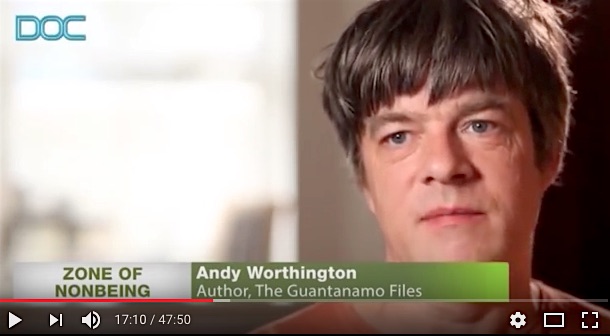
Video: “Zone of Non-Being: Guantánamo,” Featuring Andy Worthington, Omar Deghayes, Clive Stafford Smith, Michael Ratner
 Please support my work! I’m currently trying to raise $2500 (£2000) to support my writing and campaigning on Guantánamo and related issues over the next three months of the Trump administration.
Several years ago (actually, way back in December 2012), I was interviewed at my home for a documentary produced by the Islamic Human Rights Commission, which was directed by the filmmaker Turab Shah. For some reason, I never heard about the film being completed (I think its initial screening was in January 2014, when I was in the US), but after Donald Trump became president of the United States, I received an email from the IHRC stating that they were screening the film, which prompted me to look it up, and to discover that it had been put online in July 2014.
The film features a fascinating array of contributors, including myself, former prisoners including Omar Deghayes, Moazzam Begg and Martin Mubanga, Clive Stafford Smith, the founder of Reprieve, the late Michael Ratner, the founder of the Center for Constitutional Rights, the author and academic Arun Kundnani, Ramon Grosfoguel, Associate Professor of Ethnic Studies at the University of California, Berkeley, the journalist Victoria Brittain, the writer Amrit Wilson, and Massoud Shadjareh of the ICRC.
The ICRC described the film as follows: Read the rest of this entry »
Seven Ex-Guantánamo Prisoners Unite in London to Call for Prison’s Closure on Jan. 11; Shaker Aamer Photographed With Inflatable Figure of Himself Outside US Embassy
 Monday January 11 is the 14th anniversary of the opening of the US prison at Guantánamo Bay, and, as over a dozen rights groups hold a protest outside the White House, calling for President Obama to close Guantánamo in his last year in office, seven former Guantánamo prisoners from the UK will gather outside the US Embassy to also demand the closure of the prison.
The seven former prisoners are Shaker Aamer, Moazzam Begg, Ruhal Ahmad, Asif Iqbal, Shafiq Rasul, Bisher al-Rawi and Tarek Dergoul.
Ruhal Ahmad, Asif Iqbal and Shafiq Rasul (the Tipton Three) and Tarek Dergoul were released in 2004, Moazzam Begg was released in 2005, Bisher al-Rawi in 2007, and, after extraordinary campaigning from activists, MPs and the media, Shaker Aamer was released on October 30, 2015, eight years after he was first told that the US no longer wanted to hold him.
As the co-founder and co-director of the We Stand With Shaker campaign (with Joanne Macinnes), I will be taking part in the protest outside the White House, as part of a short tour to coincide with the 14th anniversary of the opening of Guantánamo, and I have brought with from the UK the giant inflatable figure of Shaker Aamer that was the centerpiece of the campaign. The photo above is of Shaker outside the US Embassy on January 7, when Joanne MacInnes and I met up with him to take the photo with campaign photographer Stefano Massimo. Read the rest of this entry »
Charges Against Moazzam Begg Dropped; Why Was He Ever Held in the First Place?
This morning, at the Old Bailey, the Crown Prosecution Service dropped all charges against Moazzam Begg, the former Guantánamo prisoner, who had been arrested in February on the basis of an alleged involvement in terrorism relating to visits he had made to Syria in 2012.
As I explained in an article at the time, “The Suspicious Arrest of Former Guantánamo Prisoner Moazzam Begg,” and in a radio interview with the US reporter Andrea Sears, it was impossible to believe that Begg, one of the most scrutinised Muslims in the UK, would have engaged in any activities that could be construed as terrorism.
He had indeed visited Syria, but had been in search of information relating to the US torture program that the Syrian government undertook on America’s behalf from 2002 onwards. Moreover, after his first visit in the summer of 2012, and before his second and last visit in December, the UK security services had interviewed him and had not attempted to prevent him from underraking his second visit. Read the rest of this entry »
Radio: Andy Worthington Discusses the Arrest of Former Guantánamo Prisoner Moazzam Begg with Andrea Sears
 Yesterday evening, in my article, “The Suspicious Arrest of Former Guantánamo Prisoner Moazzam Begg,” I mentioned how I had just been interviewed by the journalist Andrea Sears in New York. I spoke to Andrea about the arrest of Moazzam Begg, discussing and expanding upon my interpretation of the story as later published in my article.
The show, 11 minutes in length, is here (or via the Left Voices website here), and I hope you have time to listen to it, and to share it if you find it useful. As I explained, “it’s implausible to me that a man so well known and obviously under scrutiny … is going to become mixed up in anything that could be construed legitimately as terrorism, because that would make him such an obvious target of the British government.”
I also spoke about how profoundly alarming it is that Theresa May, the British home secretary, has taken upon herself the power to strip British citizens of their citizenship — and in some cases then letting the US know where these people are so that they can be killed in drone strikes — if she suspects that they are somehow involved in terrorism, even though this involves no due process or objective scrutiny, and even though, as I also pointed out, both the British and American governments have an extremely poor record when it comes to identifying people who are genuinely involved in terrorism, as opposed to, say, humanitarian aid or missionary work, as is evident from the cases of numerous men held at Guantánamo. Read the rest of this entry »
The Suspicious Arrest of Former Guantánamo Prisoner Moazzam Begg
 I received the news yesterday that former Guantánamo prisoner Moazzam Begg had been arrested when I was sent an email from Juliet Spare, a journalist working for the Voice of Russia, asking me for a short interview by phone. Once alerted to it, I checked out the coverage (mainly, at that point, the BBC), and spoke to her for a show that was broadcast yesterday, but is not available online, explaining how, to me, it made no sense that, with three other people, he had been “detained on suspicion of attending a terrorist training camp and facilitating terrorism overseas,” as the BBC put it, for a number of reasons.
First and foremost, while Moazzam was held by the US, from January 2002 to January 2005, there was never any credible evidence that he was involved with terrorism in any way, and this is an analysis that I endorse from my reading of his autobiography, Enemy Combatant, and from my own knowledge of Moazzam, based on meeting him on several occasions over the years at events involving Guantánamo.
Secondly, Moazzam must be one of the most scrutinised Muslims in the UK, so — even without the proviso that he has no track record of being a terrorist sympathiser — it seems ridiculous to me that he would get involved with anything that could be construed as terrorism, as it would obviously cause him trouble back in the UK. Moazzam has, on a few occasions since his passport was first returned to him after Guantánamo, spoken to me about his annoyance at being permanently harassed when he left or returned to the UK, but, while this was clearly irritating — and a form of harassment — it also meant that he was aware that he was permanently under scrutiny. Read the rest of this entry »
War Crimes Tribunal in Malaysia Finds Bush, Cheney, Rumsfeld Guilty of Torture in Guantánamo and Iraq
 Last November, a war crimes tribunal established in Malaysia “found George Bush and Tony Blair guilty of ‘crimes against peace’ and other war crimes for their 2003 aggressive attack on Iraq, as well as fabricating pretexts used to justify the attack,” as Glenn Greenwald explained at the time. The seven-member Kuala Lumpur War Crimes Tribunal, established in 2007 by Mahathir bin Mohamad, the Prime Minister of Malaysia from 1981 to 2003, “has no formal enforcement power,” as Greenwald also explained, “but was modeled after a 1967 tribunal in Sweden and Denmark that found the US guilty of a war of aggression in Vietnam, and, even more so, after the US-led Nuremberg Tribunal held after World War II.”
The tribunal “ruled that Bush and Blair’s name should be entered in a register of war criminals, urged that they be recognized as such under the Rome Statute, and also petitioned the International Criminal Court “to proceed with binding charges.” Though symbolic, the purpose was hugely important, as a Malaysian lawyer explained at the time, saying, “For these people who have been immune from prosecution, we want to put them on trial in this forum to prove that they committed war crimes.” In other words, as Greenwald stated, “because their own nations refuse to hold them accountable and can use their power to prevent international bodies from doing so, the tribunal wanted at least formal legal recognition of these war crimes to be recorded and the evidence of their guilt assembled.”
Greenwald also noted, “That’s the same reason a separate panel of this tribunal will hold hearings later this year on charges of torture” against senior US officials, and last week this second tribunal convened, hearing from three witnesses — former Guantánamo prisoner Moazzam Begg, and Abbas Abid and Jameela Abbas, both victims of US torture in Iraq, as well as receiving written submissions from other victims. Read the rest of this entry »
To Mark 10 Years of Guantánamo, Stern Magazine Profiles Five Former Prisoners
 Last week, when I cross-posted an article written for the 10th anniversary of the opening of Guantánamo by my friend Todd Pierce, I also noted that when I visited the US in January to campaign for the closure of Guantánamo Bay, I was so busy that I did not have time to cross-post other articles of interest that were published at the time, and added, “In the hope of keeping alive some of that spirit of awareness about the ongoing injustice of Guantánamo that flickered briefly to life around the anniversary, I’m planning to cross-post some of these articles.”
After starting with Todd’s article, I’m now moving on to a detailed article that was published in Germany’s Stern Magazine — available here as a PDF, and helpfully translated into English for Cageprisoners, via Google Translate, in a translation that I have tidied up.
The article features interviews with five former prisoners — Sami al-Laithi (aka el-Leithi), an Egyptian; Omar Deghayes, a British resident; Mohammed el-Gharani, a Chadian and former child prisoner; Mullah Abdul Salam Zaeef, an Afghan and a former Taliban ambassador; and Abu Bakker Qassim, a Uighur (a Muslim from China’s Xinjiang province) released from Guantánamo to Albania. The stories of all of these men have been reported before, but fresh eyes and ears are also ways useful to continue to expose the horrific history of Guantánamo, and its ongoing injustices, and the Stern article also featured a collection of powerful photos, as well as quotes from other prisoners — David Hicks (from Australia), Murat Kurnaz (from Germany) and Moazzam Begg (from the UK). Read the rest of this entry »
Moazzam Begg, Andy Worthington and Polly Nash Attend Screening of “Outside the Law: Stories from Guantánamo” at the European Parliament, Brussels, January 24, 2012
 On Tuesday January 24, at 7 pm, there will be a special screening of the acclaimed documentary film “Outside the Law: Stories from Guantánamo” (co-directed by Polly Nash and Andy Worthington) at the European Parliament in Brussels. The screening will take place in the main European Parliament building, the Altiero Spinelli Building, Rue Wiertz, in Room ASP – 3G2, on the 3rd floor, and Moazzam Begg, former Guantánamo prisoner, and the director of the NGO Cageprisoners, will be joining Andy Worthington and Polly Nash for the screening, and for the Q&A session afterwards.
The screening has been arranged by Jean Lambert (UK Green MEP), with the support of Sarah Ludford (UK Liberal Democrat MEP) and Ana Gomes (Portuguese Socialist MEP), and the purpose of the screening is to raise awareness of the continued existence of Guantánamo, and its mockery of universal notions of fairness and justice, ten years after the prison opened, on January 11, 2002. Given President Obama’s very public failure to close the prison as promised, it is essential that other countries step forward to take cleared prisoners who cannot be safely repatriated, and one of the main purposes of the screening and the visit of Moazzam Begg and Andy Worthington is to encourage EU countries to re-engage with the process of resettling prisoners that was so successful in 2009 and 2010.
The screening is free, but anyone who wishes to attend needs to contact Rachel Sheppard, the Parliamentary Assistant to Jean Lambert MEP. If those wishing to attend do not already have an access badge for the European Parliament, they need to provide their full name, date of birth, nationality, passport number or ID card and number and also specify the type of document (passport, ID card) so that access badges can be arranged. Without an access badge, those wishing to attend the screening will not be allowed. Read the rest of this entry »











 Who's still at Guantánamo?
