Andy Worthington Discusses Guantánamo, the Hunger Strike and Shaker Aamer in Westminster, Birmingham and Tooting
 Please sign the e-petition calling for the British government to secure the return to the UK from Guantánamo of Shaker Aamer, the last British resident in the prison, who has been cleared for release since 2007. 100,000 signatures are needed by April 20.
With a huge hunger strike taking place at Guantánamo, the prison is on the mainstream media’s radar more than it has been for many, many months, if not years — and, in the UK, it is also time for there to be a renewed focus on the case of Shaker Aamer, the last British resident in the prison.
Despite being cleared for release under President Bush and President Obama, Shaker is still held, even though he is the one prisoner, out of 86 prisoners cleared for release but still held, who could — and should — be released immediately. Congress has raised obstacles to the release of prisoners to any country that can be regarded as dangerous, but few, if any lawmakers would dare to argue that Britain fits that category.
In the UK, the ongoing detention of Shaker Aamer continues to appal those who have been campaigning for his release for many years — and the British government’s persistent claims that they are doing all they can to secure his return do not sound convincing. Last year, Shaker’s family launched an e-petition asking the British government to explain how, as America’s closest ally in the “war on terror,” it cannot secure Shaker’s return to the UK, to his British wife and four children, and there is now just one month to go for campaigners to try and ensure that the petition gets 100,000 signatures so that it is eligible for a Parliamentary debate. Please note that only British citizens and residents can sign it, although there is no lower age limit, so all family members can sign. Anyone anywhere in the world can sign the international petition here. Read the rest of this entry »
More Photos from “Born in Lewisham,” the Protest to Save Lewisham Hospital, March 16, 2013


More Photos from “Born in Lewisham,” the Protest to Save Lewisham Hospital, March 16, 2013, a set on Flickr.
On Saturday, another high-profile event took place in the campaign to “Save Lewisham Hospital” from destruction by senior NHS managers and the government, with an event entitled, “Born in Lewisham,” in which campaigners showed their support for the hospital with a gathering outside the entrance on Lewisham High Street, and a rally afterwards in Ladywell Fields, with speakers, music and stalls.
The particular focus of the event was on people born in Lewisham Hospital, who were encouraged to show their support for the hospital by having their photos taken for a photo gallery (forthcoming on the Save Lewisham Hospital website) and carrying home-made placards or wearing T-shirts with personalised messages. Some of those photos are featured in this photo set, and the previous one which I posted on Saturday. Read the rest of this entry »
Born in Lewisham: Photos of the Protest to Save Lewisham Hospital, March 16, 2013


Born in Lewisham: The Protest to Save Lewisham Hospital, March 16, 2013, a set on Flickr.
On March 16, 2013, the Save Lewisham Hospital campaign organised a protest and publicity event, entitled, “Born in Lewisham,” outside the endangered hospital — serving a population of 270,000 people — on Lewisham High Street.
The campaign was established in October 2012, when Matthew Kershaw, an NHS Special Administrator appointed to deal with the financial problems of a neighbouring trust, the South London Healthcare Trust (based in Greenwich, Bexley and Bromley), recommended that Lewisham Hospital — which is not part of the SLHT and has no financial problems — should merge with one of the SLHT’s hospitals, the Queen Elizabeth in Woolwich, and should have its A&E Department closed and other frontline services — including maternity — severely downgraded. In Lewisham, this would mean tens of thousands of emergencies having to be dealt with elsewhere, as well as 90 percent of Lewisham’s mothers having to give birth outside the borough. Read the rest of this entry »
While Tyrants Sleep: Photos of Canary Wharf at Night


While Tyrants Sleep: Canary Wharf at Night, a set on Flickr.
On November 14, 2012, as I explained in my previous photo set, “Curious Insomnia: A Journey through Deptford and Millwall to Canary Wharf at Night,” I decided, at 1am, to cycle from my home in Brockley, in south east London, down through Deptford and Greenwich, and through the Greenwich Foot Tunnel to the Isle of Dogs, where I cycled through Millwall, via the former docks and South Quay Plaza (and the DLR station) to Canary Wharf, the multi-towered financial centre and underground shopping complex that has been sucking the lifeblood out of the rest of London since it overcame its early wobbles under Margaret Thatcher and John Major, and became a magnet for dodgy unregulated bankers and obsessive materialists during the reign of Tony Blair.
It is, in fact, a place which, as Owen Hatherley explained in an excellent article for the Guardian last year (which I also drew on here), is responsible for “the most spectacular expression of London’s transformation into a city with levels of inequality that previous generations liked to think they’d fought a war to eliminate.” Read the rest of this entry »
Curious Insomnia: Photos of a Journey through Deptford and Millwall to Canary Wharf at Night


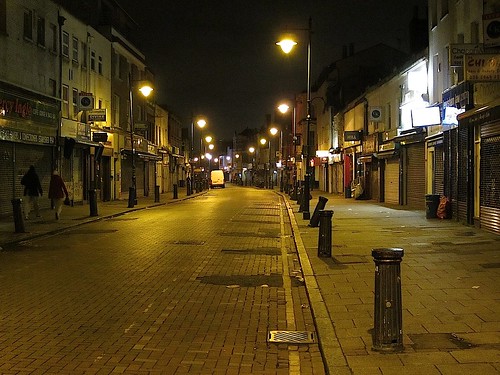


Curious Insomnia: A Journey through Deptford and Millwall to Canary Wharf at Night, a set on Flickr.
At 1 am on November 14, 2012, I decided to take a late night bike ride to Canary Wharf, the modern mutant offspring of the City of London. The City is an ancient lawless zone, but it is now rivalled by the lawlessness of the Docklands project initiated under Margaret Thatcher, which expanded hugely under Tony Blair.
Canary Wharf, which I first photographed here, fascinates and repels me. Its towers, with their horribly ostentatious show of wealth, and their disdain for even vaguely concealing how much money can be made through devious behaviour that ought to be illegal — and in many cases is — are visible from almost everywhere, and are particularly dominant from all over south east London, where I live. However, while the buildings are, in some ways, architecturally impressive, that is not all that calls out across the miles when One Canada Square and its phallic companions are glimpsed from afar. The wealth they display is also meant to intimidate and/or dazzle those mere mortals — the majority of us, in other words — who earn in a lifetime what well-paid bankers take home in a year.
I’ll be analysing Canary Wharf further in the article following this one, which features the photos I took in the heart of Canary Wharf. In contrast, this set features the start of my journey, through Deptford and Greenwich, including Deptford High Street, which stands in total contrast to the wealth and rarefied shopping malls of Canary Wharf (which I photographed here). I then cycled through the Greenwich Foot Tunnel, and took photos in Millwall, and also of Millwall Inner Dock, South Quay DLR station and the mainly residential developments around them, including the Pan Peninsula towers, luxury high-rises that deliberately scorn the ordinary humans below, with their promotional material celebrating those who “inhabit a private universe.”
For now, I hope you enjoy this photo set, the 84th in my ongoing project to photograph the whole of London by bike, which I began last May. The photos from the heart of Canary Wharf will follow soon.
 Andy Worthington is the author of The Guantánamo Files: The Stories of the 774 Detainees in America’s Illegal Prison (published by Pluto Press, distributed by Macmillan in the US, and available from Amazon — click on the following for the US and the UK) and of two other books: Stonehenge: Celebration and Subversion and The Battle of the Beanfield. To receive new articles in your inbox, please subscribe to my RSS feed — and I can also be found on Facebook, Twitter, Flickr (my photos) and YouTube. Also see my definitive Guantánamo prisoner list, updated in April 2012, “The Complete Guantánamo Files,” a 70-part, million-word series drawing on files released by WikiLeaks in April 2011, and details about the documentary film, “Outside the Law: Stories from Guantánamo” (co-directed by Polly Nash and Andy Worthington, and available on DVD here — or here for the US). Also see my definitive Guantánamo habeas list and the chronological list of all my articles, and please also consider joining the new “Close Guantánamo” campaign, and, if you appreciate my work, feel free to make a donation.
Night Lights: Photos of a Journey from Camberwell to New Cross at Night


Night Lights: Camberwell to New Cross at Night, a set on Flickr.
This photo set is the 83rd in my ongoing project to photograph the whole of London by bike, which I began last May, and after my recent publication of a series of photo sets from last July, featuring a journey through the East End to Stratford and the Olympic Park, on the eve of the Olympic Games, I thought it was time to return to the present — and also to publish some photos taken at night. For the previous photos, see here, here, here and here — and here for my journey around the perimeter of the Olympic Park.
As a result, I’m posting here a set of 15 photos I took at night a few days ago, during a journey from Camberwell to my home in Brockley, in south east London, after collecting my son from an art class organised by Southwark’s schools and the South London Gallery, and then escorting him to Denmark Hill station, to catch a train home. A month ago, in a set entitled, “Mostly Camberwell, At Night,” I published photos from a variation on this journey — from Brockley to Camberwell and back — although on that occasion I travelled back home through East Dulwich, and it was raining. On Tuesday, when it was dry, I cycled through Peckham instead, taking in a few council estates on the way — in Camberwell, Peckham and New Cross. Read the rest of this entry »
Photos of Poplar Dock, Canary Wharf and Greenwich on the Eve of the Olympics


Poplar Dock, Canary Wharf and Greenwich on the Eve of the Olympics, a set on Flickr.
This photo set is the 82nd in my ongoing project to photograph the whole of London by bike, which I began last May, and is the last of five sets taken on July 25 last year, a wonderful sunny day two days before the Olympic Games began, when I cycled east from Whitechapel along the A11 — Mile End Road, which becomes Bow Road and crosses the A12 on the way to the Olympic Park along Stratford High Street. I then cycled around the perimeter of the Olympic Park, up to Leyton on the eastern side, then along the A12 at the north, and then back south via Hackney Wick and Old Ford on the east, then through Bow, Bromley-by-Bow, Poplar and the Isle of Dogs, stopping in on Greenwich before returning home to Brockley.
The first two sets recording this journey were “Adventures in History: The Mile End Road,” and “From Mile End to Bow and Stratford on a Summer’s Day,” canned the third set — “The Olympics Minus One Day: Photos from the Frontline in Stratford” (and see here too) — was published last July, to capture some of the Olympic fervour at the time — even though I was extremely cynical about the outrageous and unaudited cost of the Olympics and the hideous patriotism milked by the government to deflect attention from its own evil heart, and even though I almost always prefer the fruits of cooperation to the chest-thumping Darwinism of competitive sport. Read the rest of this entry »
East End Odyssey: Photos of a Journey from Leyton to Poplar


East End Odyssey: A Journey from Leyton to Poplar, a set on Flickr.
This photo set is the 81st in my ongoing project to photograph the whole of London by bike, which I began last May, and is the third of four sets which either precede or follow on from a set I published last July, entitled, “The Olympics Minus One Day: Photos from the Frontline in Stratford” (and see here too), in which I cycled east from Whitechapel along the A11 — Mile End Road, which becomes Bow Road and crosses the A12 on the way to the Olympic Park along Stratford High Street. In the Olympics set I published in July, I then cycled up to Leyton, along the A12 at the north of the Olympic Park, and then back south via Hackney Wick, Old Ford, Poplar and the Isle of Dogs, stopping in on Greenwich before returning home to Brockley.
The previous two sets, “Adventures in History: The Mile End Road,” and “From Mile End to Bow and Stratford on a Summer’s Day,” covered the first part of this journey, right up to my first glimpse of the Olympic Park from the Bow Flyover. This set largely picks up where the Olympics set left off, although it includes a few photos not specifically related to the Olympics, which I took in Leyton and Hackney Wick and Old Ford, while making my way around the perimeter of the Olympic Park. Read the rest of this entry »
Photos: From Mile End to Bow and Stratford on a Summer’s Day


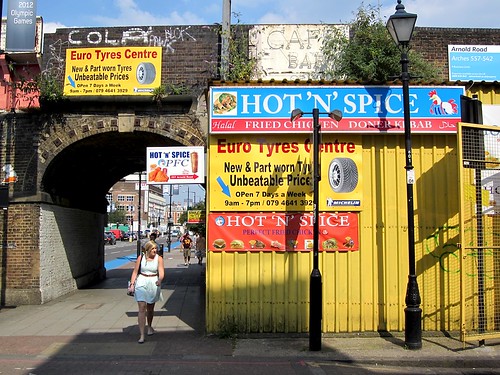


From Mile End to Bow and Stratford on a Summer’s Day, a set on Flickr.
This photo set, the 80th in my ongoing project to photograph the whole of London by bike, which I began last May, is the second of three that precedes and follows on from a set I published last July, entitled, “The Olympics Minus One Day: Photos from the Frontline in Stratford” (and see here too), in which I cycled east from Whitechapel along the A11 — Mile End Road, which becomes Bow Road and crosses the A12 on the way to the Olympic Park along Stratford High Street. In the Olympics set I published in July, I then cycled up to Leyton, along the A12 at the north of the Olympic Park, and then back south via Hackney Wick, Old Ford, Poplar and the Isle of Dogs, stopping in on Greenwich before returning home to Brockley.
Following the previous set, “Adventures in History: The Mile End Road,” in which I passed various historical landmarks on the way to Queen Mary, University of London and the Regent’s Canal, this set begins at the “green bridge” that crossed Mile End Road, and then traces my journey along Bow Road, past the derelict St. Clement’s Hospital, and other landmarks, to Bow Church, marooned on a traffic island, and the Bow Flyover, which vaults over the A12, where bikes were exempt from the Olympic traffic ban, and I had great views, from a highway that is never normally empty in the daytime, of the Olympic Park, the Lea Navigation (the River Lea), the A12 and the northern reaches of Bow and Stratford. Read the rest of this entry »
Adventures in History: Photos of the Mile End Road


Adventures in History: The Mile End Road, a set on Flickr.
This is the 79th photo set in my ongoing project to photograph the whole of London by bike, which I began last May. I currently have around 8,000 photos to publish, to add to the 1,500 or so I have already published, so it would be fair to say that it’s a project that is slightly out of control, in which it has proven far easier to get out and about taking photos, than it is to upload them.
Part of this is because I insist on spending time researching the places I photograph, so that my record of London is not just photographic, but a text-based historical record as well. However, it is also because, from the beginning of the project, I have been responding to the long years I spent indoors, writing on a daily basis about Guantánamo, followed by my illness two years ago, with an insatiable desire to be outdoors, on a bike, as much as possible. Read the rest of this entry »










 Who's still at Guantánamo?
