Celebrating 2,500 Days Since I First Started Photographing London’s 120 Postcodes for ‘The State of London’

Check out all the photos to date here.
Please support my work as a reader-funded investigative journalist, commentator and activist. If you can help, please click on the button below to donate via PayPal.
Today is the eighth anniversary of an event that triggered the creation of my photo-journalism project ‘The State of London’, and last Friday marked a milestone worth remarking on in the history of that project: 2,500 days since May 11, 2012, the first day I began cycling around London taking photos on a daily basis for the project that initially had no name, but that I soon called ‘The State of London.’
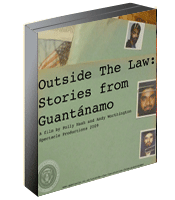
The eighth anniversary, today, is of when I was hospitalised following two months of serious agony as two of my toes turned black, but GPs and consultants failed to work out what was wrong with me for quite some time — only eventually working out that a blood clot had cut off the circulation to my toes — and also failed to prescribe me adequate painkillers. After I returned from a trip to Poland at the start of February 2011, for a short tour showing the film I co-directed, ‘Outside the Law: Stories from Guantánamo,’ until I was hospitalised on March 18, I was rarely able to sleep for more than five minutes at a time; almost as soon as I fell asleep, I awoke in agony. There was, I thought, something ironic about someone who campaigned for the rights of people suffering all manner of torments in US custody — including sleep deprivation — also ending up suffering from sleep deprivation, although in my case it was caused by my own body waging war on me.
After two days in Lewisham Hospital, where I was finally given morphine to take me beyond the pain, my wife figured out that they didn’t really know what to do with me, and so pushed for me to be transferred somewhere that they might have a clue. That somewhere was St. Thomas’s Hospital, opposite the Houses of Parliament, where I spent the next nine days, as consultants worked out that attaching me for five afternoons to a drip that pushed what felt like cement into my arteries might open up the blood supply to my toes, thereby saving them.
Violent and Unforgivable: The Destruction of the Old Tidemill Wildlife Garden in Deptford
 Please support my work as a reader-funded investigative journalist, commentator and activist. If you can help, please click on the button below to donate via PayPal.
Today is my birthday, and I find myself in a reflective place, looking, at one side, on death and destruction, and, on the other, at life and love and solidarity.
Perhaps this is appropriate at the age of 56, when I am neither young nor truly old — and, believe me, I reflect on aging, and mortality, and what it means, with some regularity, as my restless brain refuses to settle, endlessly asking questions and seeking new perspectives and insights into the human condition. But that is not why I’m in this reflective place today.
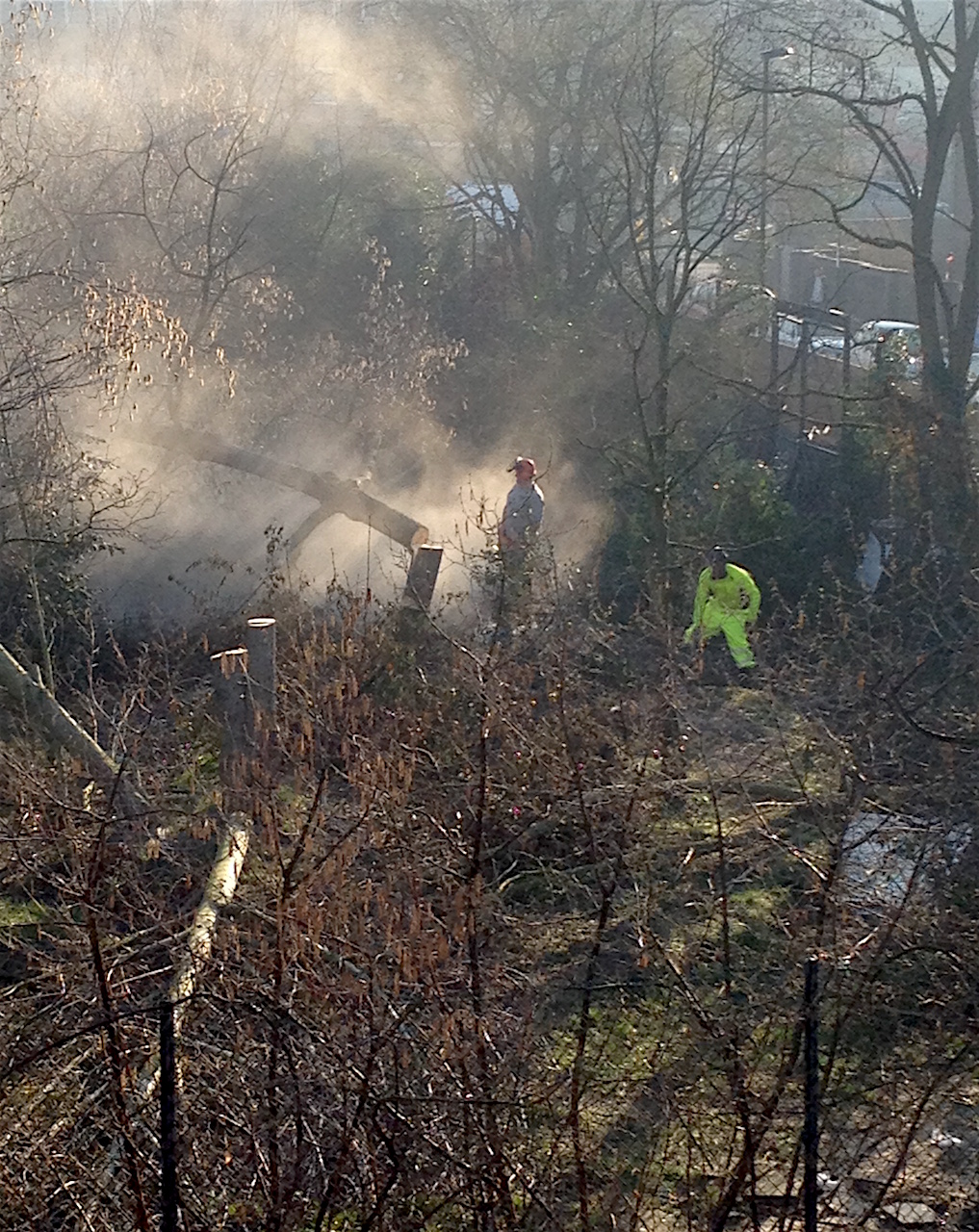
Yesterday, in the hallucinatory light and heat of one of the hottest February days in London’s history, I stood on a small triangle of grass by the horrendously polluted Deptford Church Street in south east London, and watched as a small group of tree-killers, SDL Solutions, brought in from Gloucestershire, tore down almost all the trees in a beautiful community garden, the Old Tidemill Garden, whose tree canopy, which would imminently have returned as spring arrives, had, over 20 years, become an increasingly efficient absorber of that horrendous pollution. Read the rest of this entry »
Nikita Woolfe and I Discuss ‘Concrete Soldiers UK’, the Housing Crisis and the ‘Inspire2Resist’ Handbook on Dissident Island Radio

Please support my work as a reader-funded investigative journalist, commentator and activist. If you can help, please click on the button below to donate via PayPal.
Last week I was delighted to be invited, with the filmmaker Nikita Woolfe, to discuss ‘Concrete Soldiers UK’, the documentary film Niki directed, and which I narrate — and, specifically, the ‘Inspire2Resist’ handbook Niki has put together, with a bit of help from me — on Dissident Island Radio, which describes itself as “a radical internet radio show broadcasting on the first and third Friday of every month from the London Action Resource Centre”, a wonderful community space in Whitechapel.
The show is here as an MP3 (and here on the website), and our section is from 27:30 to 46:00, with our reflections on resistance to the ‘regeneration’ industry, and the many forms it takes, including some mention of the ongoing resistance to ‘regeneration’ in Deptford, via the Save Reginald Save Tidemill campaign that I’m part of (and see the archive here and here). Our host, Patrick, had done his research, and the interview was exactly the kind of detailed discussion that rarely makes it into the mainstream media.
In discussing who the handbook is for, I stressed that anyone living in social housing is under threat, as councils, housing associations and housing developers continue to work towards destroying secure and genuinely affordable social housing, either through estate demolitions, or through other ongoing efforts to price people out of their homes — like the new rental regime introduced by Sadiq Khan, which I wrote about here. Read the rest of this entry »
‘Concrete Soldiers UK’: Screening of the Housing Documentary I Narrate at the Rio Cinema in Dalston, Tuesday February 26
 Please support my work as a reader-funded investigative journalist, commentator and activist. If you can help, please click on the button below to donate via PayPal.
Tuesday February 26, at the Rio Cinema in Dalston, will be the first screening of 2019 for ‘Concrete Soldiers UK’, the documentary film about the housing crisis, directed by Nikita Woolfe, which I narrate. I’m very pleased to note that, recently, ‘Concrete Soldiers UK’ was awarded ‘Best Documentary Film’ in the European Cinematography Awards for 2018. You can also now watch it via Amazon Prime.
The Facebook event page for the screening on February 26 is here, the listing on the Rio’s website is here, and if you’d like to attend for a reduced rate of £5, quote “£5 Tuesday Deal” when you get to the box office (it can’t be used to book online).
Focusing on the struggles against the cynical estate ‘regeneration’ industry, using examples in south London — the Aylesbury Estate in Southwark and Central Hill and Cressingham Gardens in Lambeth — the film demonstrates the scale of the problems faced by those living on estates, which councils want to knock down in deals with private developers and dubious housing associations. Crucially, however, the film also offers hope to campaigners, suggesting that people power can triumph. Read the rest of this entry »
As Lewisham Council Spend £1m Guarding the Old Tidemill Wildlife Garden from the People of Deptford, Who Will Be Their Tree-Killers?
 Please support my work as a reader-funded investigative journalist, commentator and activist. If you can help, please click on the button below to donate via PayPal.
A week last Friday, the Save Reginald Save Tidemill campaign — which I’m part of, and which is trying to save a community garden and a block of council flats in Deptford, in south east London from the wrecking ball of the cynical ‘regeneration’ industry — received some unwelcome, but not entirely unexpected news.
In the High Court, the court of appeals upheld an earlier decision not to accept a judicial review of the ‘regeneration’ plans, which centred on issues relating to the right to light of tenants in a block of flats next to the proposed building site.
In a statement for the Save Reginald Save Tidemill campaign, I responded by saying, “This is a disappointment, of course, but it doesn’t affect the campaign against the proposed destruction of the Old Tidemill Wildlife Garden and Reginald House. We continue to insist that the garden is too important as a barrier to pollution, and as a communal green space, to be destroyed, and that there is no acceptable reason for a structurally sound block of council flats to be knocked down for new housing that purports to be ‘social housing’ but will actually be at ‘London Affordable Rent’, which, in Lewisham, is 63% higher than social rents.” Read the rest of this entry »
Radio: My Interview About Guantánamo with Chris Cook, Plus Dahr Jamail on Our Planetary Environmental Catastrophe
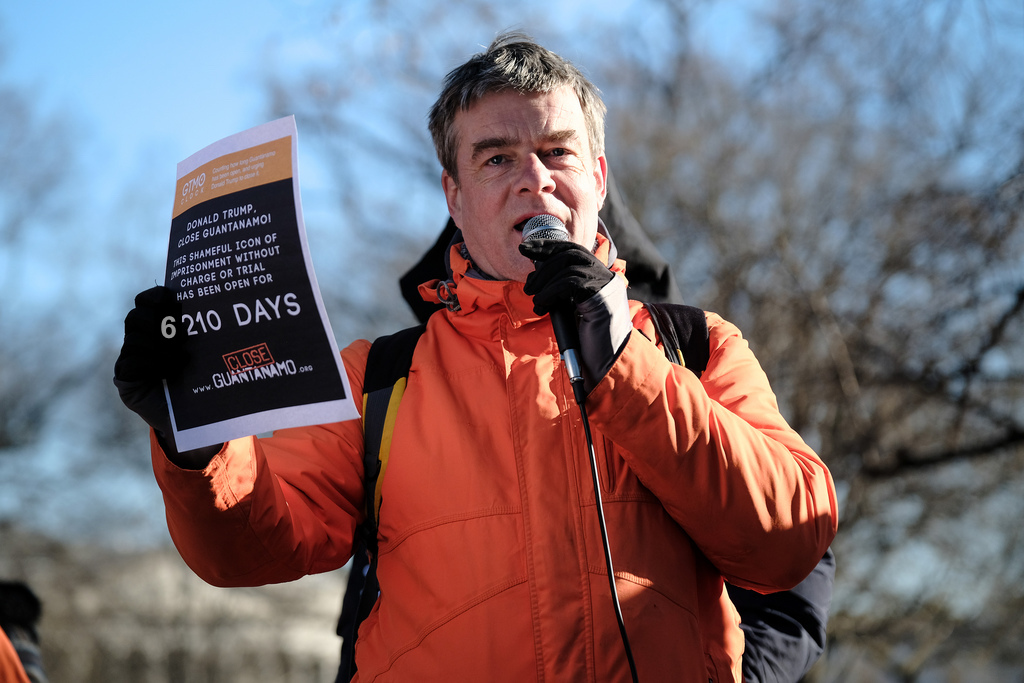
It’s nearly three weeks since the 17th anniversary of the opening of the prison at Guantánamo Bay, and the flurry of media activity that accompanied that somber occasion — although, as is typical, with little or no interest from the mainstream US media — has now largely faded away.
In an effort to keep interest in Guantánamo alive, I will continue to write about it as much as possible this year, to campaign for its closure, and to speak about the need for it to be closed to anyone who shows an interest.
One such person is Chris Cook, in Victoria, in British Columbia, Canada, who has interviewed me on numerous occasions after my annual US visits to call for the closure of Guantánamo on the anniversary of its opening (see our interviews in 2011, 2014, 2015, 2016 and 2017).
Read the rest of this entry »Celebrating 600 Days of My Photo-Journalism Project ‘The State of London’, as 2018 Ends
Please support my work as a reader-funded journalist, photographer and activist. If you can help, please click on the button below to donate via PayPal.
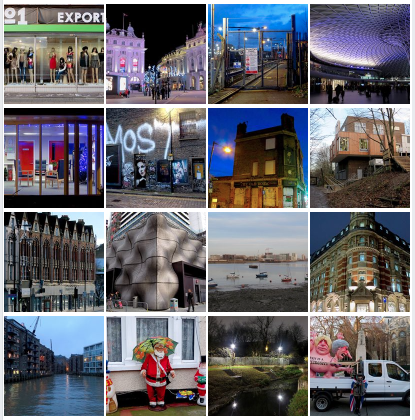
Over six and a half years ago — in fact, 2,426 days ago, on May 11, 2012 — I embarked on a project that provided me with a new creative outlet, and that would, in many ways, re-define my life. With a point-and-shoot digital camera in my pocket, given to me by my wife for Christmas at the end of 2011, I started a photo-journalism project that, in time, I gave a name that I think has a powerful resonance — ‘The State of London’, and that I soon conceived of as a personal photo-journalistic record of the fabric of the city, in which I intended to visit and take photos in all 120 of its postcodes (those beginning SE, E, N, NW, W, SW, EC and WC), as well as in some of the outlying boroughs.
Five years after I started the project, on May 11, 2017, with tens of thousands of photos sitting on my computer (and, yes, on a separate hard drive), and with a skeletal website lying dormant because of my inability to find time to populate it with images and stories, I decided instead to start posting a photo a day on Facebook — and later on Twitter. Today marks 600 days since that project began, and I’m delighted that I now have over a thousand followers on Facebook.
See all the photos here!
On that first day, as I cycled from my home in Brockley, in south east London, down through Deptford and Greenwich, looking at everything with a photo-journalist’s eye, I had no real concept of quite how big London is, and how immense a project would be that involved visiting and taking photos in all 120 of its postcodes. It took me until September 2014 to visit all 120 postcodes — and although I’ve managed to post photos from the majority of these postcodes in the last 600 days it’s only fair of me to admit that there are some areas of London that I’ve still only visited once or twice — although, ever enthusiastic for journeys to far-flung corners of the capital where I can still get lost, as I used to do wherever I went in the early days, I hope to remedy that in 2019! Read the rest of this entry »
Lewisham Council Narrowly Avoids Defeat of Its Tidemill Plans by the Constituency Labour Party
 Please support my work as a reader-funded investigative journalist, commentator and activist. If you can help, please click on the button below to donate via PayPal.
On December 18, Lewisham Council narrowly avoided a humiliating defeat regarding its bitterly contested plans for the Tidemill development site in Deptford, when the Constituency Labour Party General Committee almost passed a powerful motion tabled by member Bill Jefferies. The final vote was 24:24 with the Chair casting the vote that lost it.
Bill Jefferies’ ‘Motion on the Tidemill Gardens Security Operation’ called on Lewisham Council to immediately take four actions in relation to the Tidemill development site:
1) To put a halt on the Tidemill scheme while new plans are developed that meet the needs of residents and people in need of council housing
2) To honour its commitment to ballot council house residents affected by the Tidemill scheme
3) To immediately sever all links with County Enforcement
4) To end the occupation by bailiffs of the Tidemill site now
The Tidemill site consists of the old Tidemill primary school, which closed in 2012, the 16 council flats of Reginald House, which the council wants to destroy, and the Old Tidemill Wildlife Garden, formerly part of the school, which the council also wants to destroy. Read the rest of this entry »
It’s Human Rights Day – and Day One of My Quarterly Fundraiser, In Which I’m Trying to Raise $2500 (£2000) to Support My Guantánamo Work
 Please click on the ‘Donate’ button below to make a donation towards the $2,500 (£2,000) I’m trying to raise to support my work on Guantánamo over the next three months of the Trump administration.
Dear friends and supporters,
Every three months I ask you, if you can, to make a donation to support my ongoing work as an independent journalist, activist and commentator, working to try and secure the closure of the prison at Guantánamo Bay.
Today seems to be a particularly appropriate time to launch my latest fundraiser, as it is Human Rights Day, marking the adoption of the Universal Declaration of Human Rights by the General Assembly of the United Nations. That was exactly 70 years ago, on December 10, 1948, when, in response to the horrors of the Second World War, “representatives with different legal and cultural backgrounds from all regions of the world” created the UDHR “as a common standard of achievements for all peoples and all nations”, which set out, for the first time, “fundamental human rights to be universally protected”, as the UN explains on its website.
Human rights are central to the problems of Guantánamo — a place intended to be beyond the each of the US courts, where men and boys seized in the “war on terror” that the US declared in response to the terrorist attacks of September 11, 2001 were imprisoned without any rights whatsoever, held neither as criminal suspects, to be charged and tried, or as prisoners of war, and subjected to torture an other forms of abuse, contravening Article 5 of the UDHR — “No one shall be subjected to torture or to cruel, inhuman or degrading treatment or punishment” — as well as Articles 9 and 10: “No one shall be subjected to arbitrary arrest, detention or exile” and “Everyone is entitled in full equality to a fair and public hearing by an independent and impartial tribunal, in the determination of his rights and obligations and of any criminal charge against him.” Read the rest of this entry »
Tidemill Solidarity Gig: Come and Celebrate the Resistance at the Birds Nest This Sunday, Dec. 9
 Please support my work as a reader-funded investigative journalist, commentator and activist. If you can help, please click on the button below to donate via PayPal.
It’s now five weeks since the violent eviction of the Old Tidemill Wildlife Garden in Deptford, a wonderful community space and precious environmental asset that was violently evicted by bailiffs from the brutal County Enforcement company, who were hired by Lewisham Council. To show our continued resistance to the council’s plans to destroy the garden — and to celebrate our fighting spirit and our creativity — I’ve organised a gig this Sunday (Facebook page here) at the Birds Nest, the legendary live music pub just across the road, featuring musicians who played at events in the garden, or who were involved in the occupation.
Three prominent campaigners with the Save Reginald Save Tidemill campaign — Heather, Harriet and I — are represented by our bands Ukadelix, the Commie Faggots and the Four Fathers, and many other members of these bands were also involved in events in the garden. I remember one wonderful evening around the fire with Michelle and Angie from Ukadelix, Archie from the Commie Faggots and Richard from The Four Fathers, when, with Angie playing some wonderful basslines, we adopted ‘Love Train’ as the occupation’s anthem. Also present that night — and on many other occasions — was Flaky Jake, accordionist and troubadour, who, I hope, will also be able to make it on Sunday.
Also representing the occupation is Roll Rizz, who brought peace and love to the garden from north London, with his anarcho-tribal punk band Flak (or Flak Punks), and two singer-songwriters who have both written songs about Tidemill, which they’ll be performing — Gordon Robertson and Mark Sampson. And the evening will kick off with Brian Wilkes, visiting from Eastbourne, who played his first ever public set at a previous Tidemill benefit gig at the Birds Nest on September 16. Read the rest of this entry »











 Who's still at Guantánamo?
