“More Horrific Than Abu Ghraib and Guantánamo”: The Unsalvageable Depravity of Israel’s Prisons for Palestinians

Please click on either of the ‘Donate’ or ‘Buy’ buttons below (via PayPal or Stripe) to make a donation towards the $2,500 (£2,000) I’m trying to raise to support my work as a reader-funded investigative journalist, commentator and activist over the next three months. To get links to all my work in your inbox, please also consider taking out a free or paid subscription to my new Substack newsletter.
On June 19, 2024, Khaled Mahajneh, a Palestinian citizen of Israel, became the first lawyer to visit a notorious detention facility for Palestinians from the Gaza Strip, located inside the Sde Teiman military base in the Negev Desert, one of several detention facilities established after October 7, 2023 to hold Palestinians seized in Gaza.
Speaking to +972 Magazine a week after his visit, Mahanjeh drew a pertinent comparison with the treatment of Muslim prisoners in the US’s post-9/11 “war on terror”, but concluded that Israel’s behavior was even worse.
“The situation there is more horrific than anything we’ve heard about Abu Ghraib and Guantánamo”, he said, adding, “I have been visiting political and security detainees and prisoners in Israeli jails for years, including since October 7. I know that the conditions of detention have become much harsher, and that the prisoners are abused on a daily basis. But Sde Teiman was unlike anything I’ve seen or heard before.”
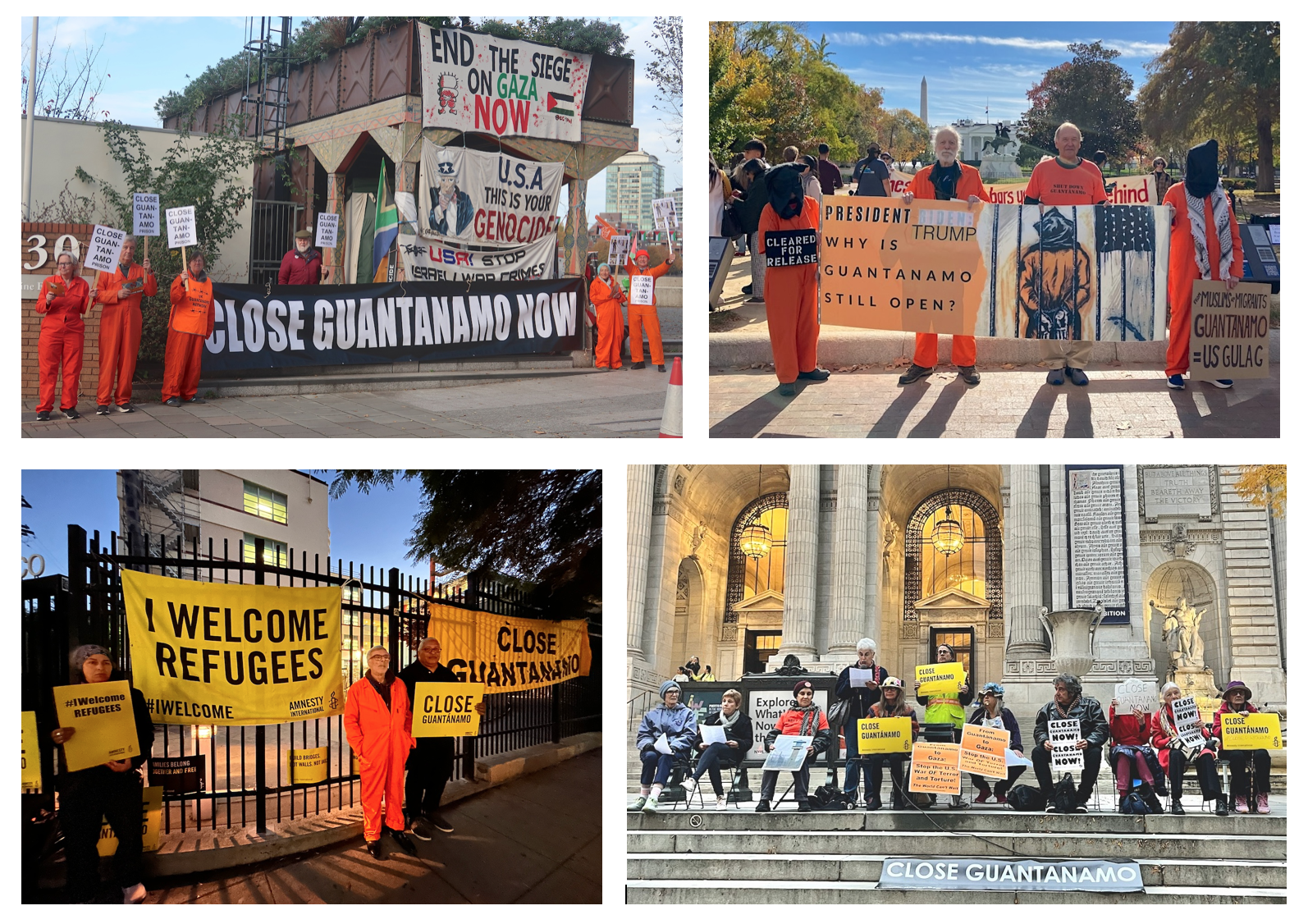
Photos and Report: The 34th Monthly Global Close Guantánamo Vigils on Nov. 5, Also Marking 8,700 Days of the Prison’s Existence
Please click on either of the ‘Donate’ or ‘Buy’ buttons below (via PayPal or Stripe) to make a donation towards the $2,500 (£2,000) I’m trying to raise to support my work on Guantánamo and on other related topics over the next three months. To get links to all my work in your inbox, please also consider taking out a free or paid subscription to my new Substack newsletter.
On Wednesday November 5, campaigners calling for the closure of the “war on terror” prison at Guantánamo Bay — and an end to its more recent use to hold migrants seized in Donald Trump’s disturbing “war on migrants” — gathered at significant locations across the US and globally for the 34th successive monthly coordinated Close Guantánamo vigils.
The “First Wednesday” vigils took place in Washington, D.C., London, New York, Brussels, Portland, Detroit and Los Angeles — with San Francisco following on November 6, and Cobleskill, NY on November 8 — and former prisoner Mansoor Adayfi also sending a photo from an exhibition of Guantánamo prisoners’ art in Giessen, in Germany.
As ever, the vigils involved committed campaigners from various Amnesty International groups, Close Guantánamo, the UK Guantánamo Network, Veterans for Peace, Witness Against Torture, the World Can’t Wait, the Peacemakers of Schoharie County, and various activist groups in New York City, with support from numerous other organizations, and I’m immensely grateful to our small but dedicated family of global activists for their dedication to shining a light on an enduring injustice that, shamefully, has largely been swallowed up in amnesia and inertia.
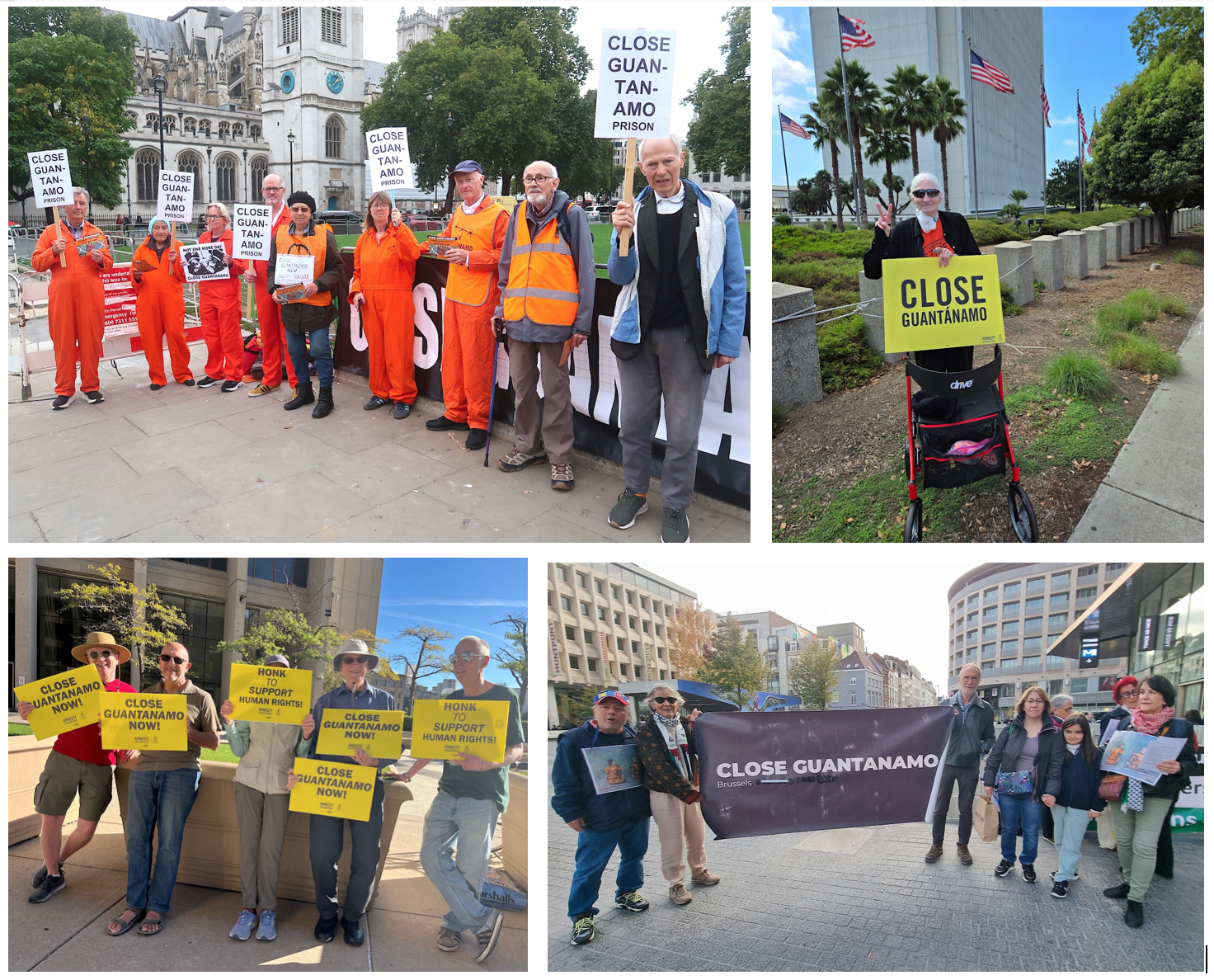
Photos and Report: The 33rd Monthly Close Guantánamo Vigils Across the US and Around the World
Please click on either of the ‘Donate’ or ‘Buy’ buttons below (via PayPal or Stripe) to make a donation towards the $2,500 (£2,000) I’m trying to raise to support my work on Guantánamo and on other related topics over the next three months. To get links to all my work in your inbox, please also consider taking out a free or paid subscription to my new Substack newsletter.
Last Wednesday, October 1, the world’s most dedicated campaigners for the closure of the “war on terror” prison at Guantánamo Bay gathered, at significant locations across the US and globally, for the 33rd successive monthly coordinated Close Guantánamo vigils — in Washington, D.C., London, New York, San Francisco, Brussels, Mexico City, Portland, Detroit, Los Angeles and Belgrade — with campaigners in Irvine, CA holding an indoor vigil, and with the redoubtable progressive outpost of Cobleskill, NY following on Saturday October 4.
The monthly “First Wednesday” vigils involve campaigners from various Amnesty International groups, Close Guantánamo, the UK Guantánamo Network, Witness Against Torture, the World Can’t Wait, the Peacemakers of Schoharie County, and various activist groups in New York City, with support from numerous other organizations.
As ever, I’m immensely proud of our little global family of activists, all of whom recognize the significance of the enduring injustice of Guantánamo, and its baleful influence on brutal and unjust detention policies from Israel to El Salvador and, more recently, the US mainland, via the expansion of fundamentally lawless detention facilities run by ICE (Immigration and Customs Enforcement) as part of the malignant “war on migrants” that Donald Trump launched when he took office in January.
Guantánamo Artists Speak: Moath Al-Alwi and Khalid Qassim, Freed in January

Please click on either of the ‘Donate’ buttons below (via PayPal or Stripe) to make a donation towards the $2,500 (£2,000) I’m trying to raise to support my work on Guantánamo and on other related topics over the next three months. To get links to all my work in your inbox, please also consider taking out a free or paid subscription to my new Substack newsletter.
I wrote the following article for the “Close Guantánamo” website, which I established in January 2012, on the 10th anniversary of the opening of Guantánamo, with the US attorney Tom Wilner. Please join us — just an email address is required to be counted amongst those opposed to the ongoing existence of Guantánamo, and to receive updates of our activities by email.
It’s two weeks since Spencer Ackerman published an article on his Forever Wars website by former Guantánamo prisoner Mansoor Adayfi, featuring the first ever interviews with two of his friends, the artists Moath Al-Alwi and Khalid Qassim, who were finally freed from Guantánamo in January this year, and resettled in Oman, after being held for nearly 23 years without charge or trial.
I’m cross-posting it below, following my own introduction, in the hope that it will reach some readers who never saw the original posting.
I’ve long followed the story of these two men, including Moath having his habeas corpus petition turned down via some inadequate legal reasoning in 2009, and both men taking part in various hunger strikes, including the prison-wide hunger strike in 2013. This, and the global outrage that greeted it, finally persuaded President Obama to overcome his inertia, prompted by obstacles raised by Republicans to try to prevent him releasing prisoners, which meant that almost no prisoners were freed for two and a half years before the mass hunger strike began in February 2013.
It wasn’t until November 2017, however, that I became aware of the talents of both men as artists, when “Ode to the Sea: Art from Guantánamo,” an exhibition of artwork by eight prisoners — some released, and some still held — took place at John Jay College of Criminal Justice in New York, which I was fortunate to attend in January 2018, and which I wrote about here.
Profound Alarm at Trump’s Deportation of Migrants to Third Countries Without Protections Against Torture or Even Death

Please click on either of the ‘Donate’ buttons below (via PayPal or Stripe) to make a donation towards the $2,500 (£2,000) I’m trying to raise to support my work on Guantánamo and on other related topics over the next three months. To get links to all my work in your inbox, please also consider taking out a free or paid subscription to my new Substack newsletter.
On the campaign trail on October 27, 2024, just days before November’s Presidential Election, Donald Trump promised, “On Day One, I will launch the largest deportation program in American history to get the criminals out.”
Trump’s target, to follow the logic of his promise, were those amongst the eleven million undocumented migrants in the US, according to estimates published by the Office of Homeland Security Statistics in April 2024, who had been convicted of crimes, which was a fraction of the total (just 4%).
According to Patrick J. Lechleitner, the acting director of ICE (Immigration and Customs Enforcement), in a letter to Congress on September 25, 2024, the total number of noncitizens with criminal convictions was, at the time, 435,719, although it’s important to note that a breakdown of the crimes committed demonstrated a wide spectrum from the most minor of offences through to much more significant crimes.
As Trump Holds 72 Migrants at Guantánamo From 26 Countries Including the UK, What Is His Long-Term Plan?

Please click on either of the ‘Donate’ buttons below (via PayPal or Stripe) to make a donation towards the $2,500 (£2,000) I’m trying to raise to support my work on Guantánamo and on other related topics over the next three months. To get links to all my work in your inbox, please also consider taking out a free or paid subscription to my new Substack newsletter.
In a shocking development reported two days ago by CBS News, the Department of Homeland Security has revealed that it is currently holding 72 migrants at Guantánamo from 26 countries.
At least one of these migrants is a UK national, while the other countries whose nationals are held are Brazil, China, Colombia, the Dominican Republic, El Salvador, Ethiopia, Guatemala, Haiti, Honduras, India, Jamaica, Kenya, Liberia, the Marshall Islands, Micronesia, Myanmar, Nicaragua, Nigeria, Peru, Romania, Russia, Somalia, St. Kitts-Nevis, Venezuela and Vietnam.
A month ago, shockwaves reverberated around the world when, as I discussed here, Politico reported that the Trump administration was planning to send at least 9,000 migrants to Guantánamo from a variety of countries, including 800 from Europe.
Photos and Report: Global Vigils for Guantánamo’s Closure on July 2, 2025 and the Growing Threat of the Gitmoization of the US

Please click on either of the ‘Donate’ buttons below (via PayPal or Stripe) to make a donation towards the $2,500 (£2,000) I’m trying to raise to support my work on Guantánamo and on other related topics over the next three months. To get links to all my work in your inbox, please also consider taking out a free or paid subscription to my new Substack newsletter.
On Wednesday July 2, the latest “First Wednesday” global vigils for the closure of the prison at Guantánamo Bay took place — four in the US, three in Europe, and one in Mexico City. An additional US vigil took place on Saturday July 5.
Please see the photos below, and read on for my analysis of the importance of the vigils, not only for the men still held, but also to highlight how, since Donald Trump came back to the White House, it has become increasingly apparent that the core injustice of Guantánamo — holding men indefinitely without charge or trial, and without providing any evidence for doing so — is being shamefully and cynically repurposed to justify detentions in the “war on migrants” that he declared when he took office in January.

Did a Leak Stop Trump From Sending 9,000 Migrants to Guantánamo, Including 800 Europeans?

Please click on either of the ‘Donate’ buttons below (via PayPal or Stripe) to make a donation towards the $2,500 (£2,000) I’m trying to raise to support my work on Guantánamo and on other related topics over the next three months. To get links to all my work in your inbox, please also consider taking out a free or paid subscription to my new Substack newsletter.
Yesterday, marking UN Torture Day, I posted my latest article on Close Guantánamo, which I’m cross-posting here, with reflections on torture past and present at the prison, Donald Trump’s shameful and lawless decision to co-opt Guantánamo for his deeply racist “war on migrants” — and the latest news involving Haitian migrants. I also publicized a recent letter to Kristi Noem and Pete Hegseth calling for the closure of Guantánamo by Rep. Rashida Tlaib and 14 of her Congressional colleagues, which was, in particular, prompted by alarming reports two weeks ago that the Trump administration was intending to send 9,000 new migrants to Guantanamo, including 800 Europeans. The story was decried as “fake news” by the White House, but I suggested that it was in fact a plan, and that it was leaked by officials within the administration to get it dropped, which seems to have quietly happened after numerous foreign governments expressed outrage about the proposals.
Yesterday, June 26, was the UN International Day in Support of Victims of Torture, first marked in 1998 to commemorate the historic day in 1987 when the UN Convention Against Torture and Other Cruel, Inhuman or Degrading Treatment or Punishment came into effect, and also to mark the historic day in 1945 when the United Nations Charter, the founding document of the UN, was signed in San Francisco by 50 countries.
Despite the best intentions of those who worked assiduously to create the Torture Convention over many decades, many of its signatories have — either openly or covertly — failed to fulfill their obligations to prevent the use of torture.
Particularly prominent amongst the violators of the Torture Convention is the United States, which, following the terrorist attacks of September 11, 2001, outsourced torture to a number of notorious right-abusing regimes in the Middle East, and also implemented a covert global torture program via a number of CIA “black site” torture prisons scattered around the world. I covered much of this story as the lead writer of a UN report about secret detention in 2010, and the CIA’s role was scrutinized and condemned in a torture report undertaken by the Senate Intelligence Committee, whose 500-page unclassified summary was published in December 2014.
Seeking Your Support in My 20th Year as an Independent Truth-Telling Human Rights Journalist

Please click on either of the ‘Donate’ buttons below (via PayPal or Stripe) to make a donation towards the $2,500 (£2,000) I’m trying to raise to support my work on Guantánamo and on other related topics over the next three months.
2025 marks the 20th year of my full-time work as a tenacious independent journalist and activist focused on issues of dehumanization, militarism, prisons, social justice and the many overlapping evils of 21st century capitalism.
Relentlessly focused on endless war and the ever-increasing extraction and use of fossil fuels, 21st century capitalism threatens our very existence on this miraculous planet, and yet its supporters, in governments, in business and in the mainstream media have conspired to hide, minimize or discredit the truth through distractions, distortions and, increasingly, direct suppression.
The main focus of my work since 2006 has been the US prison at Guantánamo Bay, where, for over 23 years, the US has, outrageously, been holding men either indefinitely without charge or trial, or, in a handful of cases, facing charges in a broken trial system, the military commissions. My focus on Guantánamo began with 14 months of relentless research and writing, for my book The Guantánamo Files, and has continued ever since with over 2,600 articles about Guantánamo that I have written and published here on my website. Since 2012, I’ve also been running the Close Guantánamo website, and I continue to spearhead monthly global vigils for Guantánamo’s closure, and a photo campaign every 100 days.
The Alarming Kafkaesque Basis of Trump’s “War on Migrants”

Please support my work as a reader-funded journalist! I’m currently trying to raise $2500 (£2000) to support my writing and campaigning on Guantánamo and related issues over the next three months. If you can help, please click on the button below to donate via PayPal. To get links to all my work in your inbox, please also consider taking out a free or paid subscription to my new Substack newsletter.
NOTE: On June 18, I was interviewed by Chris Cook for his weekly, hour-long Gorilla Radio show about this article. You can find the show here, and I’m in the second half, after Dan Kovalik talking about Israel’s war on Iran in the first half.
* * * * *
On June 4, in a memorable, 69-page memorandum opinion, Judge James Boasberg, the Chief Judge of the District Court in Washington, D.C., began a ruling relating to Venezuelan migrants deported by the Trump administration to a mega-prison for alleged terrorists in El Salvador by quoting from Franz Kafka’s “The Trial,” in which the protagonist, Josef K., “awakens to encounter two strange men outside his room,” and “realizes that he is under arrest.” However, “When he asks the strangers why, he receives no answer. ‘We weren’t sent to tell you that,’ one says. ‘Proceedings are under way and you’ll learn everything in due course.’”
As Judge Boasberg added, “Bewildered by these men and distressed by their message, K. tries to comfort himself that he lives in ‘a state governed by law,’ one where ‘all statutes [are] in force.’ He therefore demands again, ‘How can I be under arrest? And in this manner?’ ‘Now there you go again,’ the guard replies. ‘We don’t answer such questions.’ Undeterred, K. offers his ‘papers’ and demands their arrest warrant. ‘Good heavens!’ the man scolds. ‘There’s been no mistake.’ ‘[O]ur department,’ he assures K., is only ‘attracted by guilt’; it ‘doesn’t seek [it] out . . . That’s the Law.’ ‘I don’t know that law,’ K. responds. ‘You’ll feel it eventually,’ the guard says.”
As Judge Boasberg proceeded to explain, “Such was the situation into which Frengel Reyes Mota, Andry Jose Hernandez Romero, and scores of other Venezuelan noncitizens say they were plunged on March 15, 2025. In the early morning hours, Venezuelans held by the Department of Homeland Security at El Valle Detention Facility in Texas were awakened from their cells, taken to a separate room, shackled, and informed that they were being transferred. To where? That they were not told. When asked, some guards reportedly laughed and said that they did not know; others told the detainees, incorrectly, that they were being transferred to another immigration facility or to Mexico or Venezuela.”











 Who's still at Guantánamo?

