Gaza As a Death Camp, After 1,000 Days of Genocide
Please click on either of the ‘Donate’ or ‘Buy’ buttons below (via PayPal or Stripe) to make a donation towards the $2,500 (£2,000) I’m trying to raise to support my work as a reader-funded investigative journalist, commentator and activist over the next three months. To get links to all my work in your inbox, please also consider taking out a free or paid subscription to my new Substack newsletter.
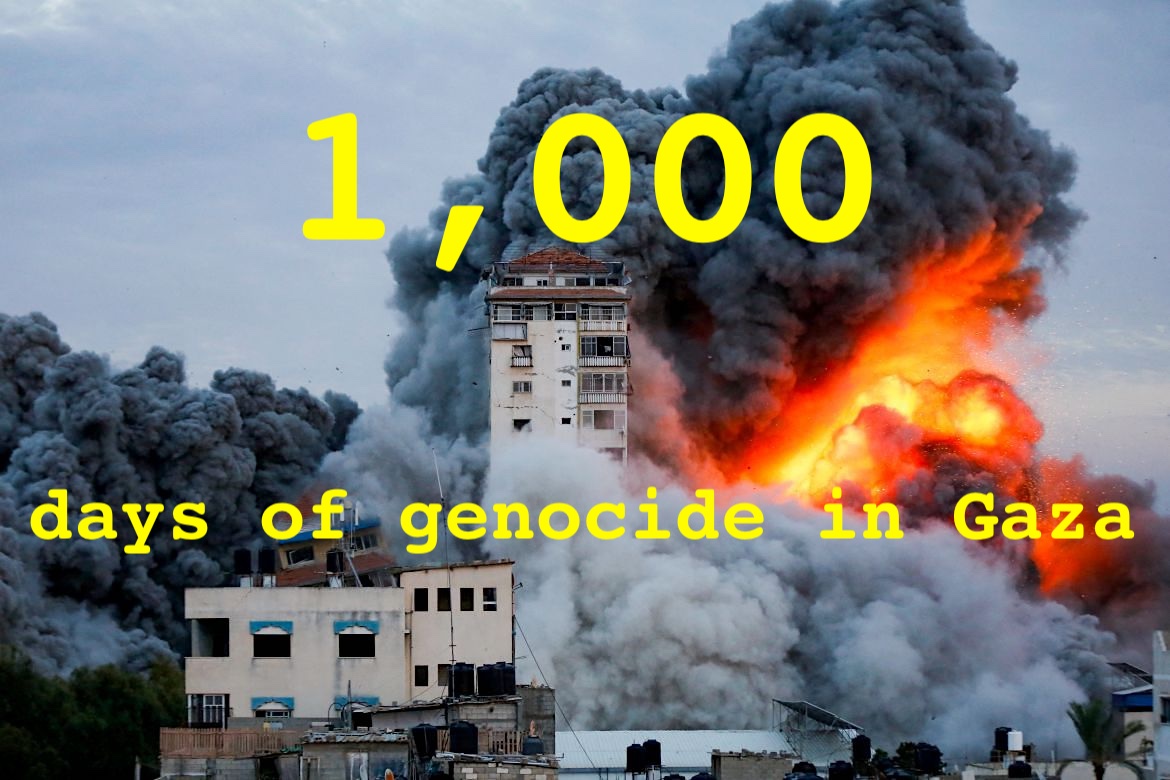
Today marks 1,000 days of Israel’s genocide in the Gaza Strip, in which, at the most conservative estimate, almost a quarter of a million people have been killed or wounded. On June 29, Gaza’s shattered Health Ministry reported that the death toll stood at 73,058, and the numbers of those injured stood at 173,488, many of them gravely so.
These figures are devastating enough, as they constitute a death toll of 73 people every single day over the last 33 months, but they are, without any doubt, a serious undercount. The real death toll is at least double that figure, and maybe more, as I establish in my notes at the end of this article.
In addition, as was revealed last August, an official Israeli military intelligence database, keeping tabs on how many suspected militants had been killed in Gaza, revealed that, according the military’s own figures, only 17% of those killed in Gaza were assessed as having been militants: in other words, 83% were civilians, a figure that, as I discussed in my analysis at the time, could actually be as high as 95%.
Israel, the US, the UK and Germany Have Destroyed Human Rights

Please click on either of the ‘Donate’ or ‘Buy’ buttons below (via PayPal or Stripe) to make a donation towards the $2,500 (£2,000) I’m trying to raise to support my work as a reader-funded investigative journalist, commentator and activist over the next three months. To get links to all my work in your inbox, please also consider taking out a free or paid subscription to my new Substack newsletter.
Yesterday, December 10, was Human Rights Day, marking the anniversary of the proclamation and adoption by the United Nations, on December 10, 1948, of the Universal Declaration of Human Rights, a hugely commendable and aspirational template for a better world, in which, to quote from its Preamble, “the equal and inalienable rights of all members of the human family” were recognized as “the foundation of freedom, justice and peace in the world.”
Translated into 577 languages, from Abkhaz to Zulu, the UDHR is, as the UN explains, “the most translated document in the world”, and is “generally agreed to be the foundation of international human rights law”, having “inspired a rich body of legally binding international human rights treaties.”
These include, as I discussed in an article year ago, entitled, Is Hope Still Alive on the Anniversaries of the Genocide and Torture Conventions, and the Universal Declaration of Human Rights?, the Convention against Torture and Other Cruel, Inhuman or Degrading Treatment or Punishment (more generally known as the Torture Convention), which was adopted by the UN General Assembly on December 10, 1984, the 36th anniversary of the UDHR, expanding on Article 5 of the Declaration, which states, unequivocally, “No one shall be subjected to torture or to cruel, inhuman or degrading treatment or punishment.”
The Slow But Significant Erosion of Israel’s Genocidal Impunity in the West
Please click on either of the ‘Donate’ buttons below (via PayPal or Stripe) to make a donation towards the $2,500 (£2,000) I’m trying to raise to support my work as a reader-funded investigative journalist, commentator and activist over the next three months. To get links to all my work in your inbox, please also consider taking out a free or paid subscription to my new Substack newsletter.
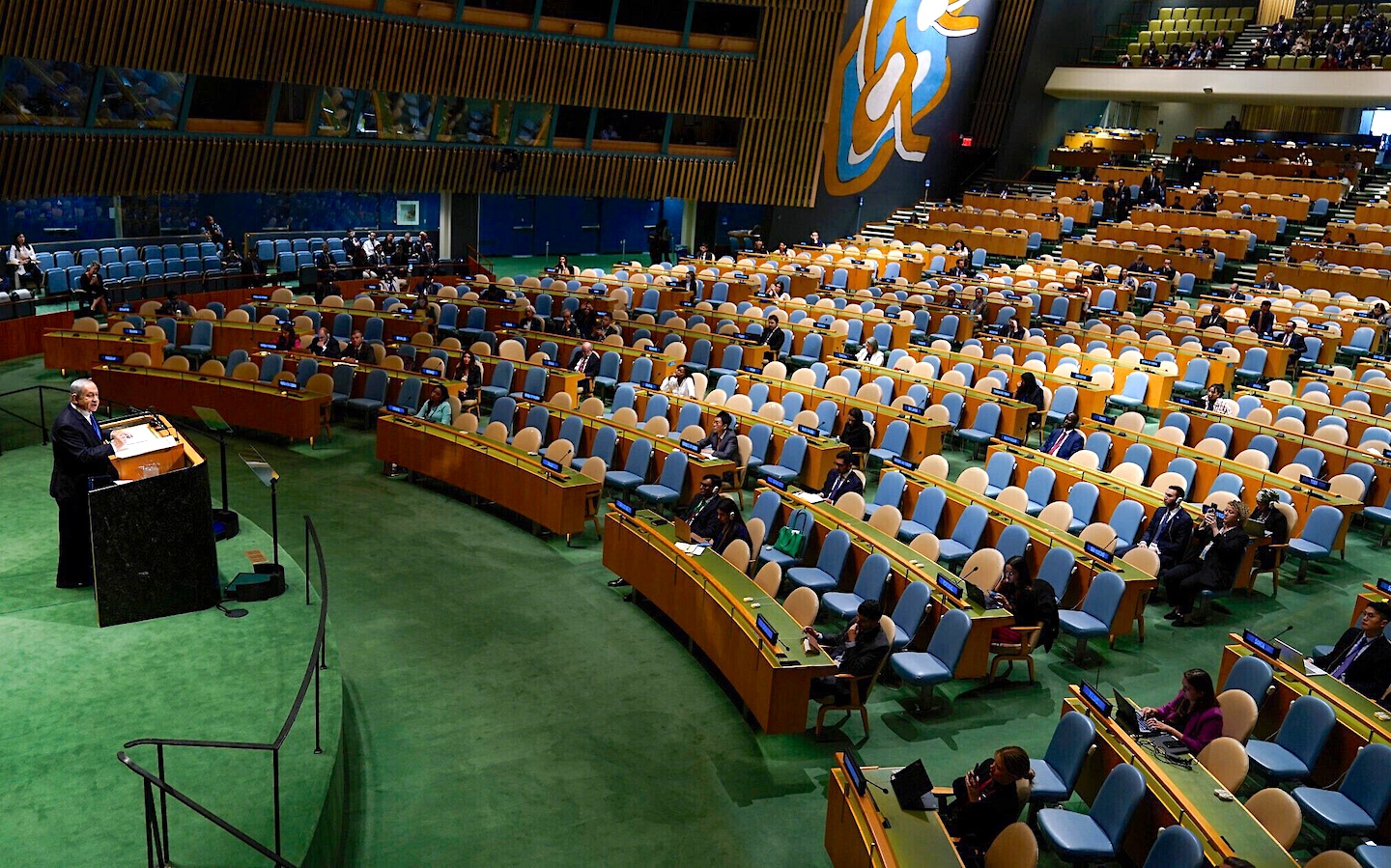
As the second anniversary looms — in just nine days’ time — of the attacks on southern Israel by Hamas and other militants on October 7, 2023 and the start of Israel’s sickeningly disproportionate and still ongoing genocidal response, it seems increasingly unlikely that the occasion will be marked by even the tiniest fraction of the outpouring of collective support that was on display two years ago, when world leaders queued up to declare that Israel had an open-ended and irresponsibly undefined “right to defend itself.”
By now, the outright lies that fuelled approval for Israel’s genocide — lies about 40 beheaded babies and mass rapes — have been thoroughly debunked, and the scale of Israel’s revenge has been so horrific that none of its supporters can credibly ignore the blunt truth that, in response to the 1,195 people killed on October 7, 2023 (including an untold number killed by Israel itself under the Hannibal Directive), Israel has routinely been killing the same number of Palestinians every few weeks for the last 100 weeks (at least 60,000, officially, but almost certainly many times more), and that, despite their protestations to the contrary, the vast majority of those killed have been blameless civilians, amongst them at least 20,000 children, as I discussed in my recent article, Gaza Horror: IDF Admits 83% of Those Killed Were Civilians, But the True Total May Be 95%.
Israel has so carefully cultivated support in western governments and in the mainstream media — and has so flagrantly ignored UN resolutions without punishment for decades — that it thought it could exterminate the Palestinians, in response to October 7, and get away with it, seeking to hide the extent of its dehumanizing genocidal intent through its usual combination of lies, threats, distortions and self-pity, and also seeking to hide the appalling truth that its true purpose was to destroy the whole of Gaza to make it unliveable, while killing as many people as possible in the vain hope that those who somehow managed to survive would subject themselves to what was euphemistically described as “voluntary migration.”
UN Report Confirms Genocide in Gaza, But the World Still Shrugs, Even As Israel Erases Gaza City
Please click on either of the ‘Donate’ buttons below (via PayPal or Stripe) to make a donation towards the $2,500 (£2,000) I’m trying to raise to support my work as a reader-funded investigative journalist, commentator and activist over the next three months. To get links to all my work in your inbox, please also consider taking out a free or paid subscription to my new Substack newsletter.
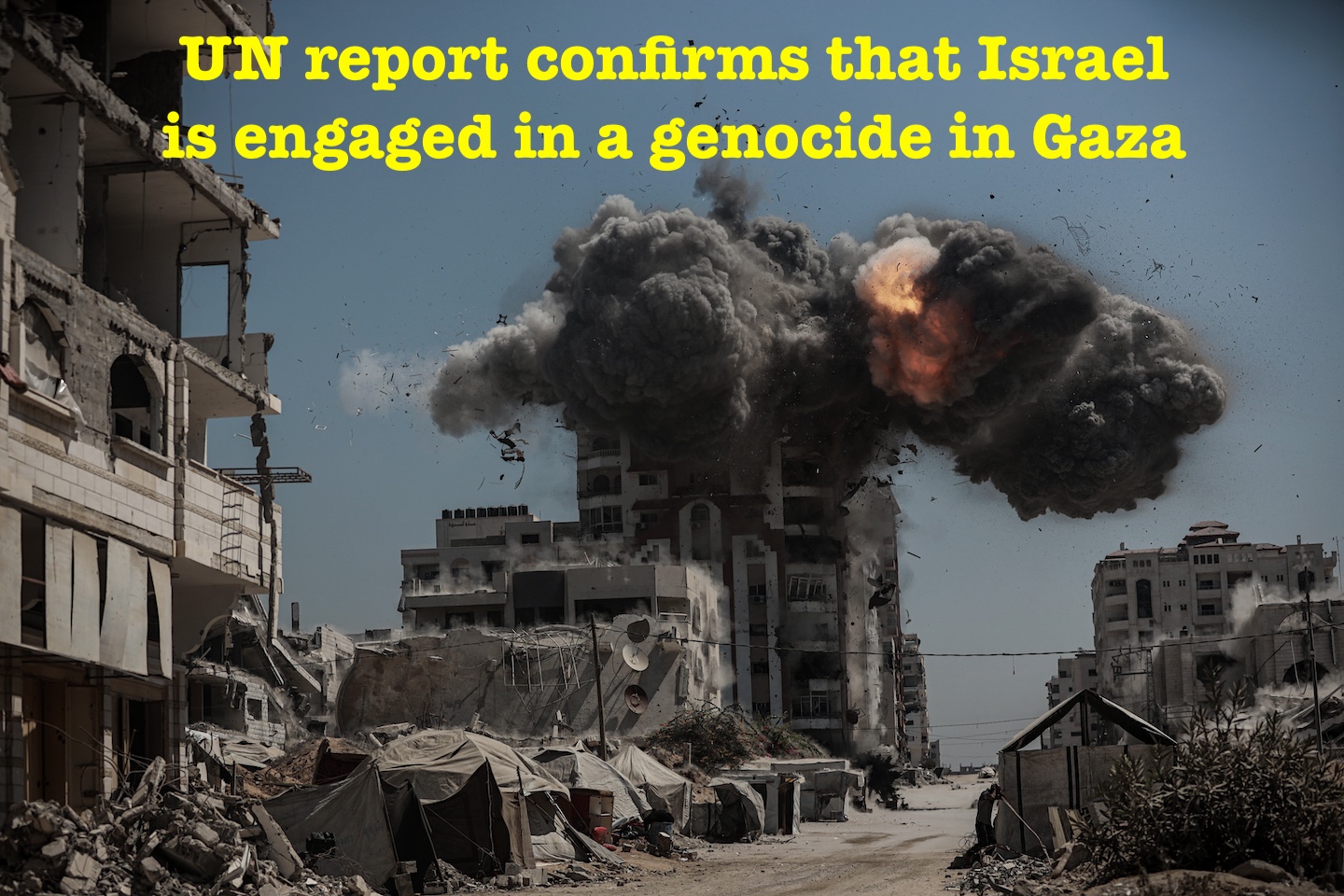
Four days ago, ripples of concern briefly surfaced in the global media, as a UN Commission of Inquiry — the Independent International Commission of Inquiry on the occupied Palestinian territory, including East Jerusalem, and Israel — issued a devastating 72-page report establishing, definitively, that the State of Israel is engaged in a genocide of the Palestinian people in the Gaza Strip, and has been throughout the whole of the last 23 months.
The Commission of Inquiry — chaired by Navi Pillay, who, over the last 30 years has served as a judge on the International Criminal Tribunal dealing with the Rwanda genocide, and at the International Criminal Court, and who was also, from 2008 to 2014, the UN High Commissioner for Human Rights — was established in May 2021 by the UN Human Rights Council to investigate violations of international humanitarian law in the territories illegally occupied by Israel since 1967, and its latest report follows on from other devastating reports over the last year.
One of these was in October last year, focusing on Israel’s exterminatory “war” on Gaza’s hospitals, and its extraordinarily brutal treatment of Palestinians in its prisons, which I wrote about in detail in two articles at the time — UN Report Confirms Israel Guilty of War Crimes and “Extermination” in Attacks on Gaza’s Hospitals and UN Report Condemns Unparalleled Violence, Including Torture, Rape and Murder, in Israel’s Unaccountable Prisons for Palestinians.
Is Hope Still Alive on the Anniversaries of the Genocide and Torture Conventions, and the Universal Declaration of Human Rights?

Please support my work as a reader-funded investigative journalist, commentator and activist. If you can help, please click on the button below to donate via PayPal. Please also consider taking out a free or paid subscription to my new Substack newsletter.
For anyone concerned with human rights and international humanitarian law, two dates in 1948 — December 9 and December 10 — are of crucial importance, as these are the dates when the recently-formed United Nations, via its General Assembly, idealistically and optimistically adopted, on December 9, the Convention on the Prevention and Punishment of the Crime of Genocide (the Genocide Convention), and, the day after, adopted and proclaimed the Universal Declaration of Human Rights (UDHR), which established, for the first time, fundamental human rights to be universally protected, and which, as the UN explains, “inspired, and paved the way for, the adoption of more than seventy human rights treaties.” Ever since, December 10 — today — has been known and celebrated as Human Rights Day, while December 9 is marked as the International Day of Commemoration and Dignity of the Victims of the Crime of Genocide and of the Prevention of this Crime.
One of those subsequent treaties is the Convention against Torture and Other Cruel, Inhuman or Degrading Treatment or Punishment (the Torture Convention), which, after decades of wrangling, was finally adopted by the General Assembly on December 10, 1984, the 36th anniversary of the UDHR, expanding on Article 5 of the Declaration, which states, unequivocally, “No one shall be subjected to torture or to cruel, inhuman or degrading treatment or punishment.”
The Genocide Convention, and the long quest for accountability
The Genocide Convention, drawing on the work of the Polish Jewish lawyer Raphael Lemkin, who first coined the term during the Second World War, defines genocide as “any of the following acts committed with intent to destroy, in whole or in part, a national, ethnical, racial or religious group” — “killing members of the group”, “causing serious bodily or mental harm to members of the group”, “deliberately inflicting on the group conditions of life calculated to bring about its physical destruction in whole or in part”, “imposing measures intended to prevent births within the group”, and “forcibly transferring children of the group to another group.”
Israel’s Collective Genocidal Sickness, the West’s Complicity, and the Messianic Colonialism Behind It All

Please support my work as a reader-funded investigative journalist, commentator and activist. If you can help, please click on the button below to donate via PayPal.
If your son or daughter was murdered, and you responded, in your grief, by suggesting that 2.3 million people should be murdered in retaliation, and if, moreover, you had the means to fulfil your vengeful fantasies, mental health experts would be alarmed, and would seek an urgent intervention.
This, however, is what happened not just to individuals, but, collectively, to almost the whole of Israeli society after the deadly attacks by Hamas and other militants on October 7 last year, in which, according to official Israeli figures, 1,068 Israeli citizens and 71 foreign citizens were killed, and 251 others were taken back to the Gaza Strip as hostages.
That is a significant number of people, and no excuse can be made for it — although strenuous efforts to claim that it occurred in a vacuum, as if through the exercise of pure evil for its own sake, fail, crucially, to recognize that it happened as the result of a multi-generational conflict between a colonial oppressor (the State of Israel) and an oppressed and occupied people (the Palestinians) that has been ongoing for 76 years, and that has involved, over the years, and before the latest horrors, the murder of tens of thousands of Palestinians, in numbers that dwarf the number of Israelis killed over that same period.
An Extraordinary Day for International Justice: ICC Issues Arrest Warrants for Benjamin Netanyahu and Yoav Gallant for War Crimes and Crimes Against Humanity

Please support my work as a reader-funded investigative journalist, commentator and activist. If you can help, please click on the button below to donate via PayPal.
In what will forever be remembered as an extraordinary day for international justice, the International Criminal Court (ICC) today issued arrest warrants, for war crimes and crimes against humanity, for Benjamin Netanyahu, Israel’s prime minster, and Yoav Gallant, who, until recently, was the defense minister in Netanyahu’s coalition government.
In its press release, the Court stated that it had “issued warrants of arrest for two individuals, Mr. Benjamin Netanyahu and Mr. Yoav Gallant, for crimes against humanity and war crimes committed from at least 8 October 2023 until at least 20 May 2024, the day the Prosecution filed the applications for warrants of arrest.”
The announcement in May, by Karim Khan KC, the chief prosecutor of the ICC, that arrest warrants would be sought for Netanyahu and Gallant, as well as for three Hamas leaders (two of whom have subsequently been murdered by Israel), was greeted at the time with huge enthusiasm, and a great sense of relief, by those who had been calling, since 2015, for the ICC to hold Israel accountable for its long history of grave crimes against the Palestinians.
Gaza: The Normalization of Genocide Through the Complete Complicity of the West and Its Colonization by Israel

Please support my work as a reader-funded investigative journalist, commentator and activist. If you can help, please click on the button below to donate via PayPal.
For a year and three weeks, all decent people around the world have been shocked and disturbed, to an extent unprecedented in our lifetimes, by the intensity of the genocidal fury unleashed by the State of Israel on the 2.3 million Palestinians living in the Gaza Strip, the Chicago-sized “reservation”, into which they were squeezed in 1948, as the nascent Israeli state, in a blood-soaked orgy of extraordinary violence, seized most of what had, for centuries, been Palestinian land.
For a year and three weeks, we have had to watch, powerlessly, as Israel has revisited the messianic genocidal intent that it first unleashed in an unfettered manner 76 years ago, when it erased Palestinian cities, towns and villages, murdering 15,000 civilians and expelling 750,000 others, based on an absurd historical and pseudo-religious claim to the land, dating back 2,000 years. Contextualizing this absurdity, some commentators have pointed out that Israel’s actions are the equivalent to the Italians laying claim to England because it was conquered by their ancestors — the Romans — 2,000 years ago.
This violent supremacism has underpinned the actions of the State of Israel ever since. Throughout the long years from 1948, Israel has refused to ever seriously consider that it should share this contested land with those who called it home. Those expelled — to refugee camps in neighbouring countries — were forbidden the right to return (despite that being a demand agreed upon by the United Nations from the very beginning), those in Israel had to struggle for years to even establish their right to exist as second-class citizens, while those in Gaza and the West Bank have been persistently targeted for marginalization, division, isolation and persistent depredation. Israel claims, risibly, to be “the only democracy in the Middle East”, whereas the objective reality is that it is a violent European settler colonial project enforcing a repulsive system of apartheid.
Where Will It End? The Limitless Depravity of the Renewed Assault on Northern Gaza

Please support my work as a reader-funded investigative journalist, commentator and activist. If you can help, please click on the button below to donate via PayPal.
A “genocide within a genocide” is taking place in northern Gaza, where Israel has specifically prevented any food, water, fuel or medical supplies entering since October 1, and where Israeli forces are involved in massacre after massacre, bombing and blowing up residential buildings and killing entire families, attacking and decommissioning the last three remaining partly-functioning hospitals, and picking off and killing anyone who dares to leave their homes via armed drones and snipers.
This is the manifestation of the “Generals’ Plan”, a diabolical initiative proposed by retired general Giora Eiland, which advocated for the enforced evacuation of the remaining 400,000 residents of northern Gaza — those unwilling or unable to obey previous evacuation orders — followed, after a week, by starvation and the execution of everyone who remains as a “terrorist.”
That plan was horrendous enough — especially because there is no legal basis whatsoever for regarding civilians who can’t or won’t leave a designated military area as “terrorists” — but its manifestation is even more horrific.
With Yahya Sinwar’s Death, Israel’s Genocidal Aims Are Exposed More Than Ever Before

Please support my work as a reader-funded investigative journalist, commentator and activist. If you can help, please click on the button below to donate via PayPal.
With the death of Yahya Sinwar, Israel’s mendacity and its genocidal intent stand exposed like never before.
Sinwar, the 62-year old leader of Hamas, who never abandoned his homeland, had been portrayed by Israel as hiding deep underground, surrounded by hostages, but in the end that was just another lie, to add to the mountains of lies that Israel has pumped out over the last year. In the end, Sinwar was killed in a chance military encounter in Rafah, not hiding out at all, but engaged in combat with the enemy — in military uniform, and with an AK-47.
His death was the opposite of the humiliation meted out by the US to Saddam Hussein or Moammar Gaddafi, when they were finally seized after the illegal invasions of Iraq and Libya. Nothing could be more inspiring for a resistance movement than for their leader to be killed in active combat, having refused to hide, or to be cowed by the enemy.











 Who's still at Guantánamo?
