Why We Must All Rise Up Against the Genocidal White Supremacists of Zionist Israel and the West

Please support my work as a reader-funded investigative journalist, commentator and activist. If you can help, please click on the button below to donate via PayPal.
Since Israel launched its genocide against the Palestinians of Gaza over three months ago, astute commentators in the west have noted that the masks of feigned decency have fallen from the faces of our leaders, revealing them to be, fundamentally, the same genocidal, racist supporters of colonial settler violence that their predecessors were in those long centuries when they pillaged the world, killing and enslaving native populations, and, when met with resistance, often engaging in genocide.
The speed with which the masks fell has, genuinely, been shocking to watch, even though historically, of course, the countries of the west have indulged Israel, as the last great European settler colonial project, since the Balfour Declaration of 1917, in which Britain’s foreign secretary, Arthur Balfour, pledged to establish “a national home for the Jewish people” in Palestine (which British was administering as a Mandate after the First World War and the collapse of the Ottoman Empire), and the blood-soaked creation of the State of Israel in 1948, when around 15,000 Palestinians were killed, and around 750,000 Palestinians were forcibly evicted from their homes in what is known to Palestinians as the Nakba (“catastrophe”).
According to British records, 376,415 Jewish immigrants, mostly from Europe, arrived in Palestine between 1920 and 1946, and, even though most of these Jews had avoided the Holocaust, and even though the armed groups who fought to establish the Israeli state did so through terrorism, not only against the Palestinians, but also against the British, the post-war western consensus on Israel was that it must be indulged, to assuage the guilt the European powers felt over the Holocaust as well as their well-chronicled oppression of Jewish people over many centuries.
Radio: I Discuss Israel’s Genocide in Gaza and Guantánamo’s 22nd Anniversary with Misty Winston on TNT Radio

Please support my work as a reader-funded journalist! I’m currently trying to raise $2500 (£2000) to support my writing and campaigning on Guantánamo and related issues over the next three months. If you can help, please click on the button below to donate via PayPal.
On Tuesday, I was delighted to talk to the US radio host Misty Winston, on the Australian-based online radio station TNT Radio, about Israel’s ongoing genocide in Gaza, and the imminent 22nd anniversary of the opening of the prison at Guantánamo Bay. The interview is available here on video, and I’ve also embedded it below, and the audio only version is available here.
Misty and I have spoken many times before, and our interview began 18 minutes into the one-hour show, after Misty spoke about the significance of the Jeffrey Epstein case, and her colleague Adam Clark spoke about the struggle against censorship — and for free speech — in the US election year.
Misty and I began by discussing Israel’s genocidal assault on Gaza, with Misty thanking me for acknowledging, very early on in what Al Jazeera accurately calls “Israel’s War on Gaza”, but most western media disgracefully describe as the “Israeli-Hamas War”, that, after years of remaining silent on Israel’s crimes over the last 75 years, because I feared its impact on my Guantánamo work, I could no longer remain silent as what is very evidently a genocide began to unfold. Misty also thanked me for my writing, in which I’ve been covering the unforgivable lawlessness of Israel’s three-month assault, via my articles here, here, here, here, here, here, here, here and here.
Ten Weeks of Genocide in Gaza: 25,000 Palestinians Killed, A Land in Ruins, And Still No Sign of a Ceasefire

Please support my work as a reader-funded investigative journalist, commentator and activist. If you can help, please click on the button below to donate via PayPal.
In my nearly 61 years on this earth, I’ve never felt as sick as I do now, watching in real time, as I have for the last ten weeks, a genocide taking place in the Gaza Strip, where 2.3 million Palestinians, trapped in an “open-air prison”, as they have been since 2007, with no means of escape, are being killed at a scale that is unprecedented in the history of warfare in my lifetime, while western leaders offer largely unconditional support — and weapons — and Israel continues to portray itself as the victim.
As of December 14, the death toll had reached 24,711, according to the Geneva-based Euro-Med Human Rights Monitor, which takes its figures from the health ministry in Gaza, and adds those missing and presumed dead under the rubble of destroyed buildings.
Of the dead — killed for the most part as a result of Israel’s relentless bombing of residential areas — 9,643 were children and babies, 5,109 were women, and 93%, according to Euro-Med Human Rights Monitor, were civilians.
The death toll is so colossal, and so relentless, that, on average, 365 people have been killed every day, including 140 children and babies; that’s six children every hour, or one every ten minutes over a period of more than two months; in other words, in response to the deadly attacks by Hamas militants on October 7, in which around 1,200 people were killed (and even disregarding the as yet unknown numbers killed by the Israelis themselves), Israel has been killing a comparative number of Palestinians twice a week for the last ten weeks.
Genocide Continues in Gaza, Exposing The Unending Depravity of Israel, and the Ongoing Criminal Complicity of the West

Please support my work as a reader-funded investigative journalist, commentator and activist. If you can help, please click on the button below to donate via PayPal.
For 47 days, from October 8 until November 23, the State of Israel relentlessly bombed the 2.3 million trapped civilians of the Gaza Strip — held in “an open air prison” since 2007, when Israel imposed a total blockade on its inhabitants — with such ferocity that 20,031 people were killed, including 8,176 children and 4,112 women, according to the Geneva-based NGO Euro-Med Human Rights Monitor. The NGO also noted that over 36,350 people had been injured — many gravely so — and that 1.7 million people, almost three-quarters of the entire population, had been displaced, as nearly a quarter of a million homes were completely or partially destroyed.
To give some necessary perspective to those statistics, what it meant was that, for 47 days, Israel was killing 174 children every day — seven children every hour, or one every eight and a half minutes. To understand quite how grotesque and unprecedented the killing of children on this scale is, on November 7 Al Jazeera analyzed the death rates of children in other major conflicts of the 21st century — in Afghanistan, Iraq, Syria, Ukraine and Yemen — establishing that the death rate of children in those conflicts was between 0.6 and three children per day.
This was carpet bombing on an industrial scale, using some of the heaviest and deadliest bombs ever invented by the depraved individuals who work in the arms industry, many of which were supplied by the US, and yet, despite international experts almost immediately recognizing that this was the collective punishment of an entire civilian population, in response to attacks by Hamas militants on October 7, in which, according to initial reports, 1,400 Israelis had been killed (a figure most recently revised down to 1,200), western leaders were united in their uncritical support for Israel’s unqualified “right to defend itself.”
Where Is The Outrage About Israel’s Profoundly Illegal ‘War on Hospitals’ in Gaza?

Please support my work as a reader-funded investigative journalist, commentator and activist. If you can help, please click on the button below to donate via PayPal.
Where is the outrage from western leaders, and the western mainstream media, about Israel’s ‘war on hospitals’ in Gaza?
Today, we hear that staff and patients at Al-Shifa Hospital, Gaza’s largest hospital, which was invaded by Israeli soldiers three days ago, have been ordered to evacuate, on foot, to the south of Gaza, even though that is impossible for the seriously ill and for the 35 premature babies who are still alive, after their incubators stopped working days ago because the hospital ran out of fuel.
Four of these babies have died in the last few days, but the rest are tenaciously clinging on to life, although Al-Jazeera noted that another five are now “severely ill.” Yesterday, doctors at the hospital reported that everyone in the intensive care unit had died as a result of the fuel ban.
Most of those in the hospital — nearly all of the many hundreds of patients and their families, most of the medical staff, and thousands of internally displaced people whose homes were destroyed in Israel bombing raids, and who have been sheltering in the hospital’s grounds — were made to leave the hospital this morning, with numerous witnesses, including Dr. Adnan Al Barsh, Al-Shifa’s Head of Orthopedics, explaining that they were “forced to leave at gunpoint.”
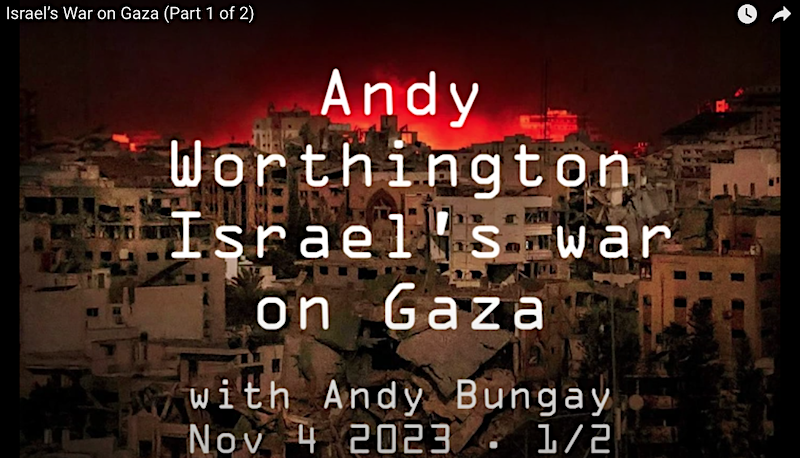
Radio: I Discuss Israel’s War on Gaza with Andy Bungay of Riverside Radio
Please support my work as a reader-funded investigative journalist, commentator and activist. If you can help, please click on the button below to donate via PayPal.
I’m pleased to post below an interview about Israel’s war on Gaza that I undertook two weeks ago with Andy Bungay of Riverside Radio, a community radio station in Wandsworth, which was previously included in a podcast here.
I hope you have time to listen to it, and that you’ll find it interesting. Anyone who knows my work will know that, when it comes to Guantánamo, which I’ve been writing about and speaking about for 17 years, I can talk about it eloquently at any time of the day or night, but this interview was the first time that I’d spoken publicly about Israel and Palestine. I have subsequently discussed it with Chris Cook on his Gorilla Radio show in Victoria, Canada, and I’m more than willing to discuss it in future with anyone who is interested in my perspective.
In my interview with Andy, I discussed my revulsion at Israel’s actions in Gaza, where, as of November 14, 11,320 people have been killed, including 4,650 children and 3,145 women, suggesting that it amounts to a genocide, a conclusion reinforced by several assessments, in the last few weeks, by experts in genocide.
The Siege of Gaza and Israel’s Premeditated Murder of Premature Palestinian Babies

Please support my work as a reader-funded investigative journalist, commentator and activist. If you can help, please click on the button below to donate via PayPal.
For several days now, I’ve been haunted by a photo posted by doctors in Al-Shifa Hospital in Gaza City — the largest hospital in the Gaza Strip — of premature babies huddled together as doctors and medical staff attempt to keep them alive.
The babies were previously being kept alive in incubators, but as a result of Israel’s medieval-style “complete siege” of Gaza, imposed 38 long, blood-soaked days ago, on October 8, when Israel’s defense minister Yoav Gallant announced that there would be “no electricity, no food, no fuel, everything is closed”, adding, “We are fighting human animals and we will act accordingly”, the fuel required to power the generators to provide electricity to the hospital has run out.
The plight of these premature babies — the death sentence to which Israel has subjected them, unless the siege is lifted — is particularly poignant for me, because my own son, now a healthy 23-year old man, was also born prematurely, at 30 weeks.
Humanity’s Greatest Failure: Turning Genocide in Gaza into a Spectator Sport
Please support my work as a reader-funded investigative journalist, commentator and activist. If you can help, please click on the button below to donate via PayPal.
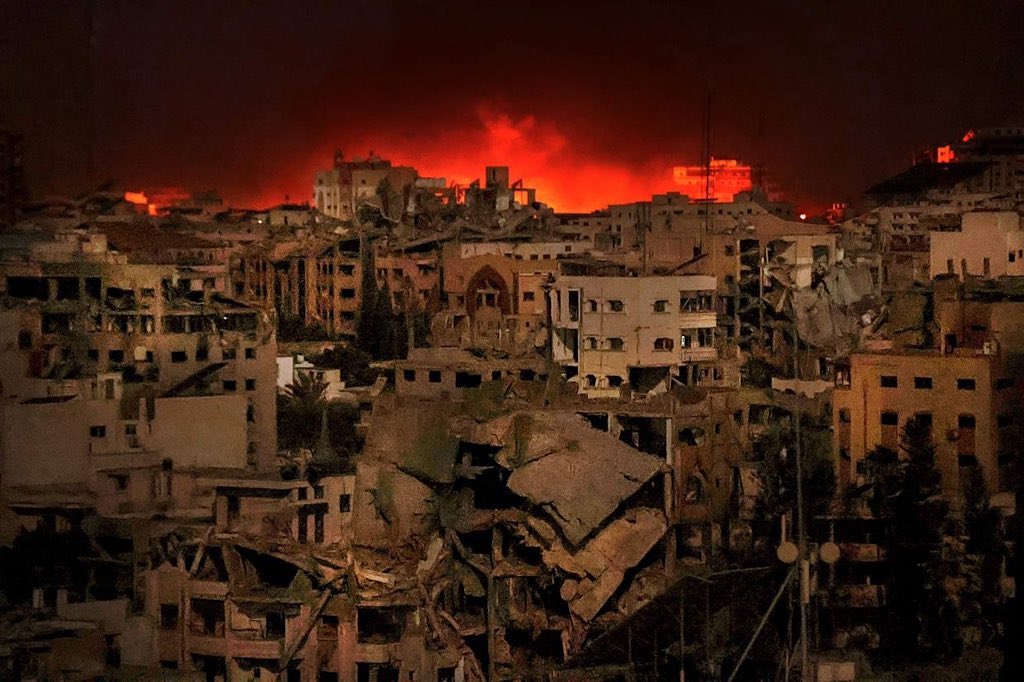
In Gaza, the world is watching a genocide play out in real time, like a vast public spectacle, or, to provide a more current analogy, like the most gruesome reality show.
Over the last month, as the State of Israel has relentlessly bombed the 2.3 million civilians trapped in the “open air prison” of the Gaza Strip, killing over 10,000 people, including over 4,000 children, the world has watched as, via its mainstream media, neighbourhood after neighbourhood has been destroyed and the dead bodies of children and adults are dragged out of the wreckage, with barely a whisper of official dissent.
Political leaders in the west openly support it, news readers talk blandly of those who have died, as though it was some sort of unfortunate but natural occurrence, generally refusing to acknowledge that they have actually been killed, and almost always refusing to name the perpetrators, while armchair genocide supporters, in significant numbers, cheer it on via social media.
Rarely reported are the additional uncomfortable truths that, although voices from within Gaza regularly state that “nowhere in Gaza is safe”, they are unable to leave, even if they wanted to, because Israel has controlled all entry to and exit from the Gaza Strip since 2007, and they are also subjected to a “complete siege”, as promised by the defence minister Yoav Gallant on October 8, whereby supplies of water, food, fuel and medical supplies have been cut off.
Genocide in Gaza: Death Toll Surpasses That of Srebrenica Massacre; 8,525 Palestinians Killed, Including 3,542 Children

Please support my work as a reader-funded investigative journalist, commentator and activist. If you can help, please click on the button below to donate via PayPal.
As you read this, the death toll in Gaza, since Israel began bombing its 2.3 million captive civilians on October 7, has surpassed the number of people killed in the Srebrenica Massacre, during the Bosnian War of 1992-95, when, in a 72-hour period between July 13 and July 15, 1995, 8,372 Muslim men and boys were murdered by Bosnian Serb and Serbian soldiers, in what the Guardian, in 2020, described as “the only massacre on European soil since the second world war to be ruled a genocide.”
As of yesterday, the Ministry of Health in Gaza reported that at least 8,525 Palestinians have been killed in Gaza since the Israeli military bombardment began 25 days ago — a rate of 340 deaths a day, or 14 every hour, or one every four minutes, meaning that, by the weekend, it can be expected to reach 10,000.
Shamefully, however, although human rights experts and experts in international humanitarian law are already talking openly about Israel’s actions in Gaza being a genocide, the silence from political leaders in the west, and the mostly complicit mainstream media, is profoundly shocking. What, when this all over — as it must be one day, one way or another — will they say in their defence?
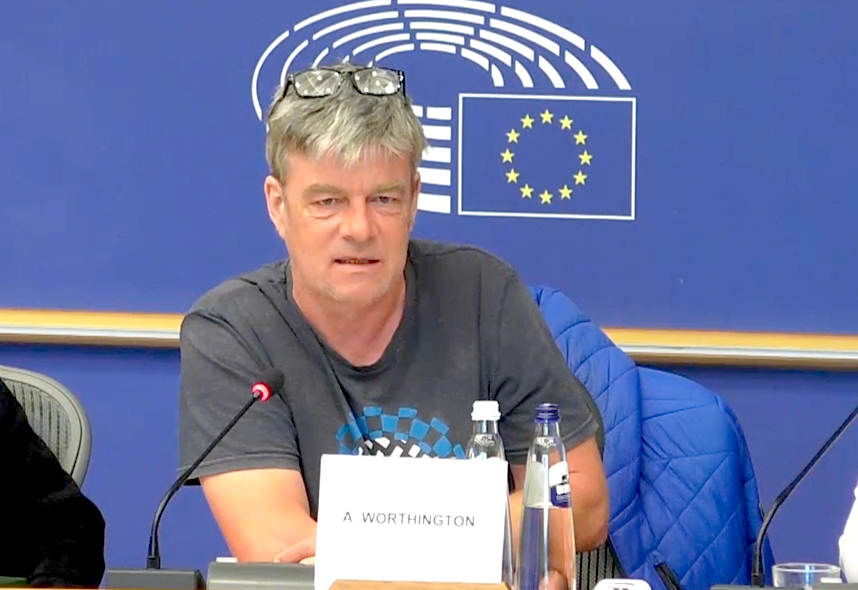
Video: My Impassioned Speech at the EU Parliament’s “Close Guantánamo!” Event on Sep. 28, 2023
Please support my work as a reader-funded journalist! I’m currently trying to raise $2500 (£2000) to support my writing and campaigning on Guantánamo and related issues over the next three months. If you can help, please click on the button below to donate via PayPal.
What a difference a month makes.
On September 28, I was in Brussels, taking part in “Close Guantánamo!”, a moving and powerful event in the European Parliament that I’d been working towards for six months with the indefatigable Irish independent MEPs Clare Daly and Mick Wallace, and former Guantánamo prisoner Mansoor Adayfi.
Over the course of three hours, a rapt audience heard a mixture of emotional, inspiring and legally compelling testimony about the evils of Guantánamo, the need to get the prison closed, and the urgent need to find new homes for at least 13 of the 30 men still held, who have been approved for release but cannot be repatriated. This is a pressing problem in need of a solution, with which, we all hoped, European countries might be able to help.
On October 1, I posted a detailed report about the event, also featuring the full three-hour video of it, at which the speakers, including Mansoor and myself, were two other former prisoners, Lakhdar Boumediene and Moazzam Begg, Fionnuala Ní Aoláin, the UN Special Rapporteur on the Promotion and Protection of Human Rights and Fundamental Freedoms while Countering Terrorism, who summarized her devastating report about historic and continuing abuses at Guantánamo, based on the first ever visit to Guantánamo by a UN Rapporteur, which she undertook in February, the lawyers Alka Pradhan and Beth Jacob, Valerie Lucznikowska of September 11th Families for Peaceful Tomorrows and James Yee, the former Muslim Chaplain at Guantánamo.
Afterwards, however, just as Clare and Mick were preparing to follow up, editing the event into smaller and more manageable podcasts and videos, and just as I was preparing to post a video of my speech, which Clare’s team had sent to me, the events of October 7 — when Hamas militants broke out of their “open air prison” in the Gaza Strip and went on a killing spree that left 1,400 people dead — threw all our plans into disarray, as it was immediately followed up by indiscriminate bombing raids of unprecedented ferocity on Gaza’s mercilessly trapped civilians, who, to compound their agonies, also had all their water, food, medical supplies and fuel supplies cut off.











 Who's still at Guantánamo?
