Hatred of Dissent: Reviewing Four Decades of Repressive Tory Laws on the 38th Anniversary of the Battle of the Beanfield

Please support my work as a reader-funded investigative journalist, commentator and activist. If you can help, please click on the button below to donate via PayPal.
38 years ago, on June 1, 1985, a convoy of vehicles carrying what the photographer Alan Lodge described as “a small, mild mannered bunch of people” — around 550 men, women and children, generally described at the time as New Age Travellers — was ambushed and “decommissioned” with extraordinary violence by around 1,400 police from six countries and the Ministry of Defence, in what has become known as the Battle the Beanfield — although, as I stated in my article marking this horrendous event last year, “‘battle’ suggests the presence of two more or less equal parties engaged in conflict, when what actually took place was a one-sided rout of heartbreaking brutality.”
The convoy was hoping to reach Stonehenge, to establish what would have been the 12th annual free festival in fields opposite the ancient temple on Salisbury Plain, which had grown, by 1984, into an anarchic settlement that welcomed tens of thousands of visitors throughout the whole of June. An injunction had been served, intended to prevent anyone from reaching Stonehenge, and from the summer before travellers, environmental protestors and festival-goers had been harassed and assaulted from Yorkshire to RAF Molesworth in Cambridgeshire, where a peace camp, echoing the famous Greenham Common Women’s Peace Camp, had been established to resist the planned introduction of a second US cruise missile base on UK soil until it was evicted in February 1985 in the largest peace-time action involving British troops, led by the then-defence secretary Michael Heseltine.
Undeterred, however, the convoy had set off for Stonehenge from Savernake Forest in Wiltshire on June 1, but soon met with trouble. After the police blocked the road seven miles from Stonehenge, and officers began smashing the windows of stationary vehicles and the occupants were ”dragged out screaming”, as Tony Thompson explained in an article for the Observer in 2005, the majority of the convoy sought to avoid the violence by driving into a nearby beanfield.
On the 37th Anniversary of the Battle of the Beanfield, Gypsies and Travellers Face an Unprecedented Threat From This Vile and Bigoted Government

Please support my work as a reader-funded investigative journalist, commentator and activist. If you can help, please click on the button below to donate via PayPal.
37 years ago today, a event took place that has largely been shunted into the margins of modern British history, even though it remains a particularly chilling example of the state suppressing manifestations of dissent, and of ways of life that didn’t conform to a narrow interpretation of the ‘normal’ and the ‘acceptable’ in a manner reminiscent of the ways in which totalitarian authoritarian regimes deal with those regarded as an undesirable underclass.
That event is known as the Battle of the Beanfield, although ‘battle’ suggests the presence of two more or less equal parties engaged in conflict, when what actually took place was a one-sided rout of heartbreaking brutality, as 1,400 police, drawn from six counties and the MoD, violently assaulted and ‘decommissioned’ a convoy of vehicles, carrying 400 to 500 men, women and children, who were en route to Stonehenge to establish what would have been the 12th annual Stonehenge Free Festival.

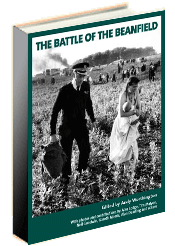
For detailed accounts of the Beanfield and the wider free festival and travellers’ movements, my books The Battle of the Beanfield and Stonehenge: Celebration and Subversion are both still in print, and can be ordered from me by clicking on the links.
The suppression of the festival — an alternative town that established itself every year in the fields opposite Stonehenge for the whole of June, and that, at its peak, in 1984, drew in tens of thousands of people from across the UK — was the justification used by the government of Margaret Thatcher to defend the single biggest peacetime assault on civilians in recent history, but it disguised other, even darker motives than the suppression of people’s collective assertion of a right to gather freely to listen to music and to practice alternative ways of living.










 Who's still at Guantánamo?
