I Pledge My Allegiance to the Struggle for Survival Against Catastrophic Climate Change

Please support my work as a reader-funded investigative journalist, commentator and activist. If you can help, please click on the button below to donate via PayPal.
It’s several weeks now since Extinction Rebellion (XR) occupied four sites in central London — Parliament Square, Waterloo Bridge, Oxford Circus and Marble Arch — bringing traffic largely to a halt and noticeably reducing pollution, and raising climate change as an urgent matter more persuasively than at any other time that I can recall.
In the first of three demands, they — we — urged politicians and the media to “Tell the Truth” — no more lies or spin or denial. Tell the truth about the environmental disaster we face. When XR formally launched at the end of October, the timing was right: the UN Intergovernmental Panel on Climate Change (IPCC) had just published a landmark report, in which, as the Guardian described it, “The world’s leading climate scientists have warned there is only a dozen years for global warming to be kept to a maximum of 1.5C, beyond which even half a degree will significantly worsen the risks of drought, floods, extreme heat and poverty for hundreds of millions of people.” The authors of the report added that “urgent and unprecedented changes are needed to reach the target”, which they called “affordable and feasible although it lies at the most ambitious end of the [2015] Paris agreement pledge to keep temperatures between 1.5C and 2C.”
The same week that Extinction Rebellion shut down much of central London, the BBC broadcast ‘Climate Change: The Facts’, an unambiguous documentary by David Attenborough, more hard-hitting than anything he has ever done before, which made clear to millions of people the scale of the environmental catastrophe that we’re facing.
Lewisham Council Still Mired in Controversy Six Months After the Violent Eviction of the Old Tidemill Wildlife Garden in Deptford
Please support my work as a reader-funded investigative journalist, commentator and activist. If you can help, please click on the button below to donate via PayPal.
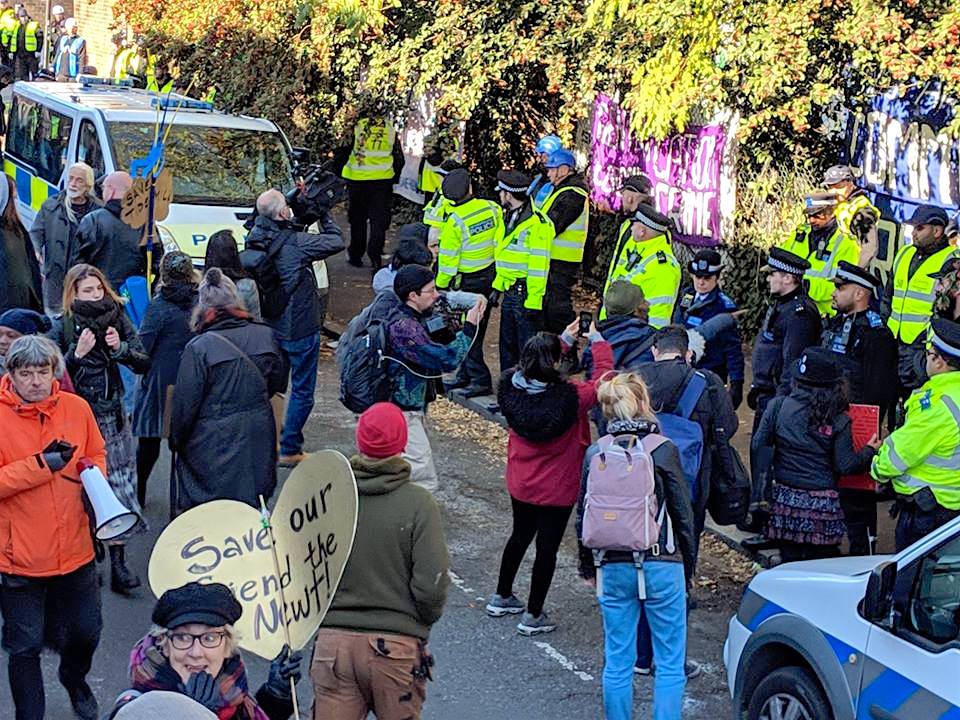
Exactly six months ago, the Old Tidemill Wildlife Garden in Deptford, a beautiful community space and environmental asset, which had been occupied for two months by members of the local community (the Save Reginald Save Tidemill campaign) to prevent its destruction by Lewisham Council for a housing scheme, was violently evicted by bailiffs working for the notoriously aggressive — and, historically, union-busting — company County Enforcement.
The garden was part of the old Tidemill primary school, which closed in 2012 and moved to a new site nearby, and the council’s plans are to hand over the site to the housing association Peabody to build new housing for sale on the old school site, and housing for rent or shared ownership where the garden stood, and where Reginald House, a block of 16 council flats, still stands.
The garden, sadly, was completely destroyed two months ago, by SDL Services, a tree services company from Gloucestershire — in the same week that the council, with no sense of shame or irony, declared a climate emergency! — but building work has still not begun, and campaigners are still calling for the scheme to be scrapped, and for a new plan to be created with the local community, which reinstates the garden and saves Reginald House.
Extinction Rebellion’s Urgent Environmental Protest Breaks New Ground While Drawing on the Occupy, Anti-Globalisation and Road Protest Movements

Please support my work as a reader-funded investigative journalist, commentator and activist. If you can help, please click on the button below to donate via PayPal.
Well, this is getting interesting. On Monday, when the environmental protest group Extinction Rebellion began its occupation of five sites in central London — Parliament Square, Waterloo Bridge, Oxford Circus, Piccadilly Circus and Marble Arch — I wasn’t sure that the ongoing intention of crashing the system through mass arrests, and waking people up to the need for change by disrupting their lives was going to work.
I’d taken an interest when Extinction Rebellion started in October — although I was still largely preoccupied by the occupation (and subsequent eviction) of the Old Tidemill Wildlife Garden in Deptford — but I’d ended up thinking that, although they had secured significant media coverage, which was very helpful, and their ‘branding’ was extremely striking, this wasn’t going to be enough.
I was somewhat heartened when, in related actions, school kids — inspired by the 16-year-old Swedish activist Greta Thunberg — got involved in climate strikes, and I hope we’ll be seeing a lot more on that front, but on Monday I couldn’t see how Extinction Rebellion’s latest coordinated protests were going to work. The police seemed, for the most part, to be trying not to give the protestors what they wanted — mass arrests — and although the crowds I encountered at Parliament Square and Oxford Circus reminded me of aspects of social movements of the past — Reclaim the Streets and the road protest movement from the ’90s, the anti-globalisation movement of the late ’90s and early 2000s, and 2011’s Occupy movement — I couldn’t see how the movement was going to be able to take the next step, and to build the momentum necessary for significant change.
Broken Britain: UN Rightly Condemns Eight Years of Tory Austerity, But the Labour Party Is No Saviour; Try Extinction Rebellion Instead
 Please support my work as a reader-funded investigative journalist, commentator and activist. If you can help, please click on the button below to donate via PayPal.
Britain, is, not to put too fine a point on it, screwed — and also deeply divided. Philip Alston, an Australian-born human rights lawyer, and the UN’s rapporteur on extreme poverty and human rights, has highlighted both these problems in his newly-issued report on the impact of eight years of savage austerity policies by the Tory government.
Alston pulls no punches. After spending two weeks travelling the length and breadth of the UK, and meeting people at the sharp end of austerity, as well as meeting government ministers, Alston notes how, in “the world’s fifth largest economy”, it “seems patently unjust and contrary to British values that so many people are living in poverty. This is obvious to anyone who opens their eyes to see the immense growth in foodbanks and the queues waiting outside them, the people sleeping rough in the streets, the growth of homelessness, the sense of deep despair that leads even the Government to appoint a Minister for suicide prevention and civil society to report in depth on unheard of levels of loneliness and isolation.”
Alston also explains how, during his visit, “I have talked with people who depend on food banks and charities for their next meal, who are sleeping on friends’ couches because they are homeless and don’t have a safe place for their children to sleep, who have sold sex for money or shelter, children who are growing up in poverty unsure of their future, young people who feel gangs are the only way out of destitution, and people with disabilities who are being told they need to go back to work or lose support, against their doctor’s orders.” Read the rest of this entry »











 Who's still at Guantánamo?
