Celebrating One Year of My Photo Project ‘The State of London’; Now For An Exhibition and a Book!
 Please support my work as a reader-funded investigative journalist, photographer, commentator and activist.
Exactly one year ago, I began posting a photo a day on a Facebook page I had just established — ‘The State of London’ — from my archive of tens of thousands of photos taken of London, in all 120 of the capital’s postcodes, as well as some of the outlying boroughs, that I had built up over the previous five years.
I haven’t advertised ‘The State of London’ via Facebook, which some people suggest is a good way of getting supporters, but I’ve steadily built up a following over the last year of people who like my photo-journalistic take on the capital — photos, often accompanied by short essays, of the good, the bad and the ugly of London in the second decade of this tumultuous century. Someone more objective than me can probably analyse my taste, but I know that I’m bewitched by the light and the changing seasons, that I love catching photos on those outings when I get caught in storms or showers or torrential rain, that I love the river and its tributaries, and London’s canals, that I love the capital’s hills, its park, its trees, and that I also see almost everything with a political eye.
On my endless, restless journeys, I see everything that is happening with the built environment, but when I started in 2012, in the year of the Olympic hype, in which big money was savagely reshaping the Lea valley, I was appalled by the jingoism and empty patriotism, but I didn’t fully comprehend how, in the years that followed, the broken capitalist model that had almost killed itself through 2008’s self-inflicted global economic crash would end up working out that the only way left to guarantee huge and unjustifiable profits for the lazy rich was for the UK establishment, and those who aspire to it, to cannibalistically feed off its own people, through housing. Read the rest of this entry »
Britain’s Broken Democracy: Tories Become UKIP, Media Ignores Labour Gains, Labour Continues Estate Demolitions
 Please support my work as a reader-funded investigative journalist, commentator and activist.
What a generally dispiriting occasion Thursday’s council elections were. On housing, which is the most pressing issue in the lives of over half the population, there was almost no acknowledgement, from either of the main parties, that we are in the midst of an unprecedented crisis of affordability and of security of tenure. Labour councils, even those that are actively engaged in demolishing council estates and replacing them with new developments with private developers, from which local people will largely be excluded, were largely undamaged at the polls, while the Tory heartlands generally held firm.
Pundits observed that UKIP were almost wiped out, with establishment commentators suggesting that this was some sort of triumph of common sense in merrie olde England, whereas the truth is that the post-Brexit Conservative Party under Theresa May has actually become UKIP, and, as a result, the truth is considerably more alarming than lazy pundits suggest. As for Labour, the mainstream media furiously tried to portray their modest gains, and their considerable overall majority of councils and councillors, as some sort of sign of failure, which it very obviously isn’t. Some independent analysts suggested, plausibly, that Remain voters sent a powerful message to the Tories, and to Labour under the hazy, instinctively Eurosceptic Jeremy Corbyn, that the EU was significant battleground in the elections, but in general the elections played out as a showdown between the two big dogs of English politics, Labour and the Tories, in which overall, there was little change, because, overall, little change is actually possible. In our wretched, complacent first-past-the-post system, very little is actually to play for, and while the damage this inflicts on a broad platform of viewpoints is always apparent in a general election, local elections somehow get far less scrutiny, even though their outcomes are often even more damaging for democracy.
In Lewisham, where I live, for example, 60% of those who voted cast their votes for the Labour Party, but Labour walked off with 100% of the council seats.
How is that supposed to be fair? Read the rest of this entry »
A Defence of Social Housing in a Resolutely Hostile Political Environment
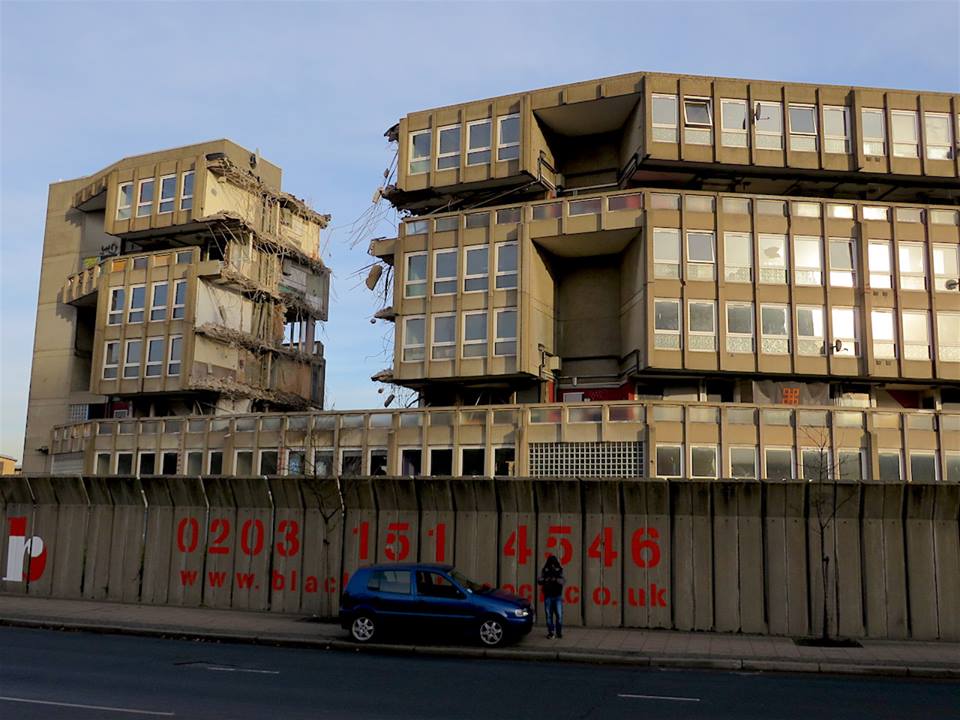 Please support my work as a reader-funded investigative journalist, commentator and activist.
Tomorrow, Londoners will go to the polls to vote in council elections in the capital’s 32 boroughs,and across the UK there will also be elections in 34 metropolitan boroughs, 67 district and borough councils and 17 unitary authorities.
Voting ought to be a simple matter. The Tories, under Theresa May, are spectacularly useless and, wherever possible, cruel. Engaged in an effort to implement Brexit that seems to be destroying them, they are also gasping from one scandal to another — the latest being the Windrush fiasco, initiated by Theresa May, who is, to be blunt, a racist, and this whole racist disaster demonstrates quite how unpleasant they are.
And yet, if you care about fairness and social justice — in the specific context of housing, the biggest issue facing Londoners today, as well as many, many other people around the country — then voting for the Labour Party is not, in general, to be recommended, leaving a giant hole where participation in the democratic process ought to be. Read the rest of this entry »
The 34 Estates Approved for Destruction By Sadiq Khan Despite Promising No More Demolitions Without Residents’ Ballots
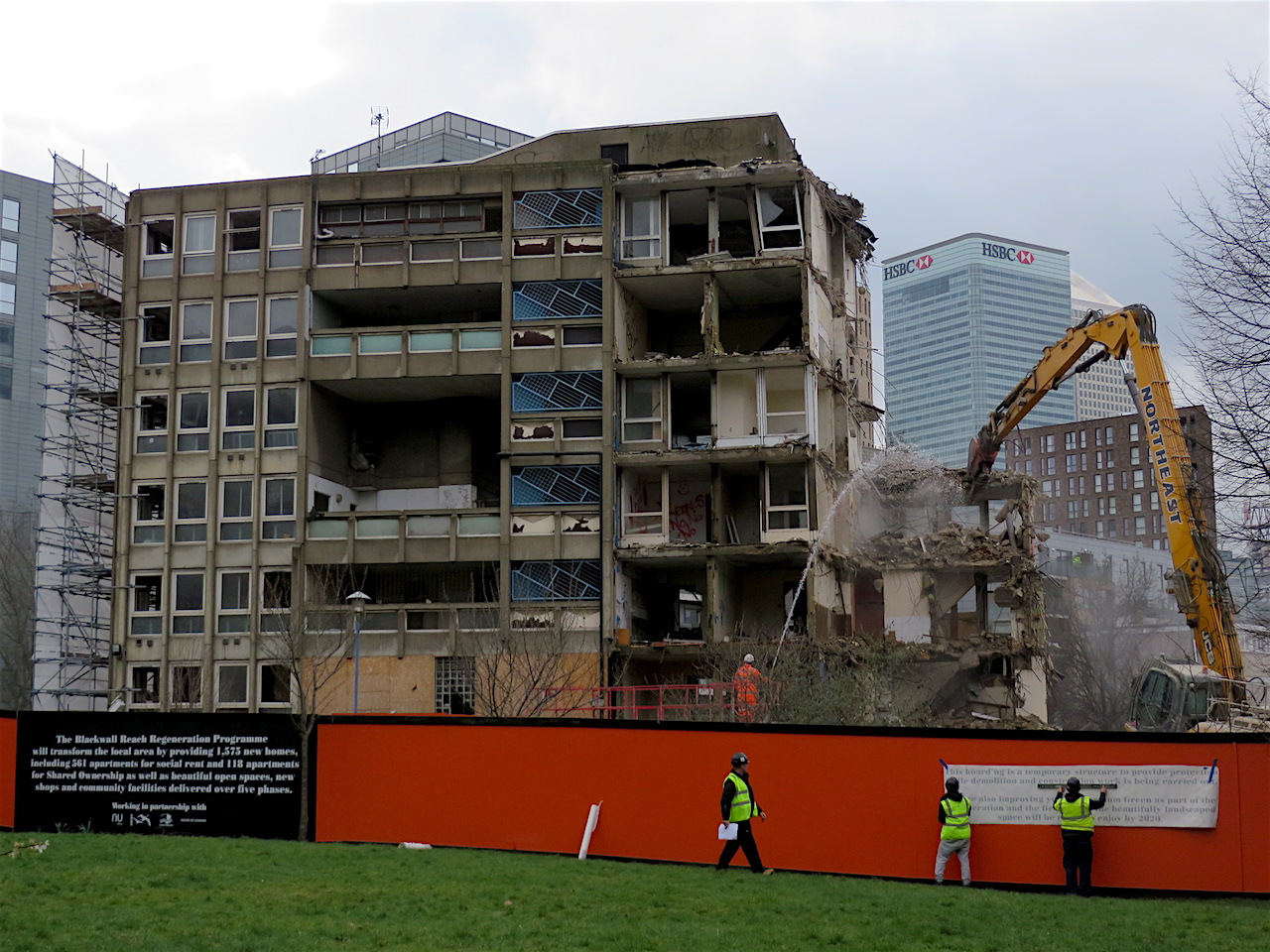 Please support my work as a reader-funded investigative journalist, commentator and activist.
Anyone paying any attention to the sordid story of council estate demolitions in London will know how hard it is to take politicians seriously — and especially Labour politicians — when it comes to telling the truth about their actions and their intentions.
Perfectly sound estates are deliberately run down, so that councils can then claim that it’s too expensive to refurbish them, and that the only option is to knock them down and build new ones — with their developer friends who are conveniently waiting in the wings.
In addition, a collection of further lies are also disseminated, which divert attention from the fundamental injustice of the alleged justification for demolitions — false claims that the new housing will be “affordable”, when it isn’t; that part-ownership deals are worthwhile, when they are not; and that building new properties with private developers will reduce council waiting lists, when it won’t. Read the rest of this entry »
Launching A Crowdfunder to Support a UK Tour of ‘Concrete Soldiers UK’, the New Documentary Film About the Threat to Social Housing, Which I Narrate
 Please support the crowdfunding campaign here!
Dear friends and supporters,
I’m writing to ask if you can help with a crowdfunding campaign I’ve just helped to launch, for a new documentary film, ‘Concrete Soldiers UK’, which I narrate. Directed by Nikita Woolfe, the film looks at council estates threatened with destruction in the UK, and the inspiring resistance of residents to the proposed destruction of their homes, and we’re hoping to raise the money required to take it around the country, and to produce a booklet compiling information about how to successfully resist estate destruction — and which pitfalls to avoid. If you can help out at all, it will be very greatly appreciated.
The crowdfunding page is embedded below:
My involvement with the film came about after I met Niki at an open meeting last June, called by ASH (Architects for Social Housing) to discuss the Grenfell Tower fire — and specifically, to examine what caused the fire, and what lessons can and must be learned from it. Niki was filming that meeting, which was later made available as a video, and afterwards she asked me to narrate ‘Concrete Soldiers UK’, which she had been working on for three years. Read the rest of this entry »
Nine Months After the Entirely Preventable Grenfell Tower Fire, UN Housing Rapporteur Says UK Government May Have Breached Residents’ Human Rights
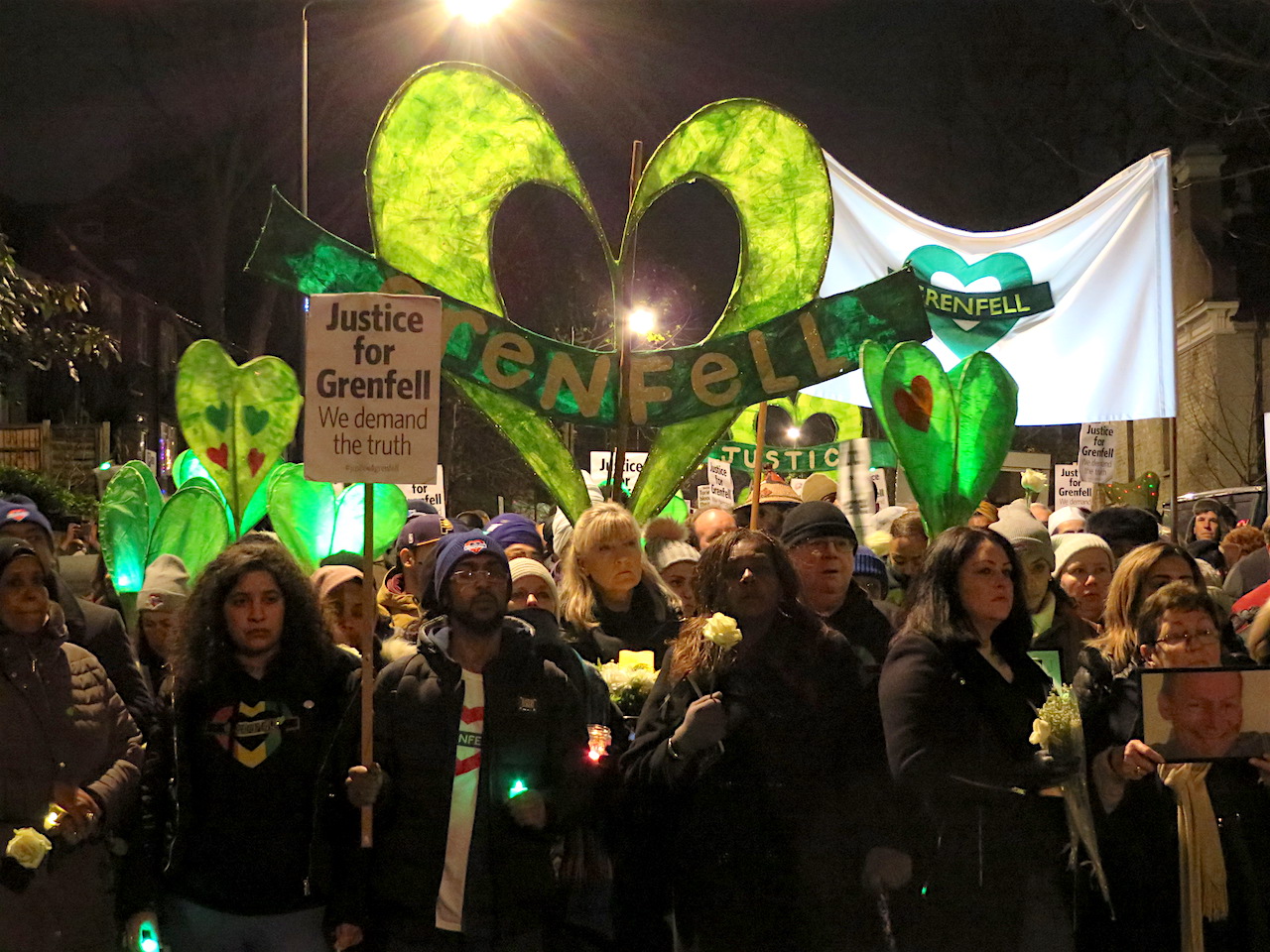 Please support my work as a reader-funded investigative journalist, commentator and activist.
Today, survivors of the Grenfell Tower Fire last June — and supporters from across London — are taking part in a Silent Walk that begins outside the offices of Kensington and Chelsea Council and ends by the blackened skeleton of the tower, where over 70 people died. The fire should never have happened, but did so because safety standards have been fatally eroded over many years by those responsible for the safety of tenants and leaseholders — central government, local government, management companies that have taken over the management of swathes of social housing, and contractors.
For me, the fire was the defining moment of 2017, and in summer I wrote a song about it, remembering those whose lives were “so needlessly lost”, and calling for ”those who only count the profit not the human cost” to be held accountable. Three members of my band The Four Fathers — myself, Richard Clare and Mark Quiney, accompanied by my son Tyler beatboxing — were recorded playing the song by a German film crew in autumn. We released it as a video in December, and I’m pleased to note that it currently has nearly 1,500 views on YouTube (posted below) and on Facebook. Please watch it, and share it if you like it. We hope to make a studio recording soon, and would be delighted to hear from anyone in the Grenfell community who would like to be involved, as we would love it to be used to help the survivors.
Over 1,200 Views for The Four Fathers’ ‘Grenfell’ Video, Remembering Those Whose Lives Were Lost, and Calling for Those Responsible to be Held Accountable
Last month, at a party of activists in Brooklyn, towards the end of my annual US visit to call for the closure of the prison at Guantánamo Bay on the anniversary of its opening (the 16th anniversary of its opening, on January 11), I played ‘Grenfell’, the song I wrote after an entirely preventable inferno consumed Grenfell Tower, a residential tower block in west London last June, killing 71 people.
I wasn’t sure how much the small audience of human rights activists knew about it — how much news of distant disasters spreads around the globe, despite the notion that technology has made us all inter-connected — but I realised when introducing it that it was, for me, the defining moment of 2017, and I’m sure my passionate rendition of it helped one small corner of Brooklyn to understand.
I wrote ‘Grenfell’ last summer, as my response to the disaster, and played it with my band The Four Fathers for the first time in September at a benefit gig for campaigners in Tottenham, as part of their opposition to the Haringey Development Vehicle (HDV), a deeply unpleasant proposal by Haringey Council to enter into a £2bn deal with the rapacious international property developers Lendlease (the destroyers of Southwark’s Heygate Estate), which would involve the council transferring all its social housing to the HDV, with the ensuing destruction of entire estates, and their replacement with new private housing, from which most of the existing tenants would almost certainly be excluded. Read the rest of this entry »
Following the Successful World Premiere of ‘Concrete Soldiers UK’ at the Cinema Museum, the Next Screening is at Deptford Cinema on Dec. 18
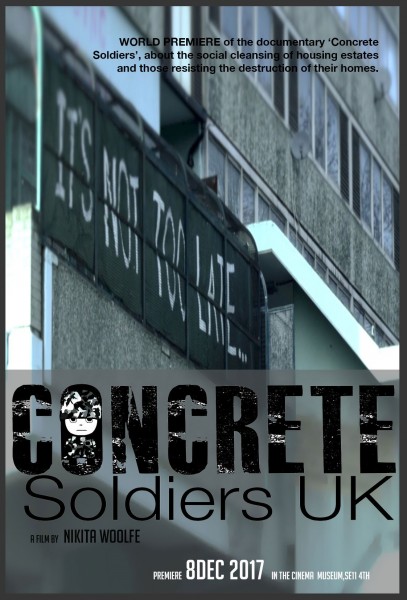 Last Friday a new and timely documentary film that I narrated, ‘Concrete Soldiers UK’, had its world premiere at the Cinema Museum in Kennington, London SE11, showing to a full house of over 150 people, with pre-screening performances from beatboxer Bellatrix and spoke word artist Potent Whisper. The film was directed by Nikita Woolfe, and is the result of three years’ work. As she says, “Three years ago I was looking at all the new developments in London and was surprised to see how much of the construction happened on old council estate land. I started wondering why the councils wanted to sell off their valuable assets and whether there were alternatives. That’s how ‘Concrete Soldiers UK’ began. Three years later and ‘Concrete Soldiers UK’ is not only answering my questions but it has also become a film about the fighting spirit that I encountered on the way.”
The next screening is at Deptford Cinema on Monday December 18, at 7.30pm, followed by a Q&A with me and with representatives of estates and community spaces threatened with destruction in the borough of Lewisham — Old Tidemill Garden and Reginald Road in Deptford, and Achilles Street in New Cross — under the ‘No Social Cleansing in Lewisham’ umbrella term that I came up with in October, and which has so far spawned a benefit gig and a Facebook page.
Niki and I are planning to take the film on the road next year — primarily around estates threatened with destruction in London, but also beyond, if we can secure funding for our time and our travel. We also hope it will be shown in cinemas, and if you can help at all with any of these proposals, do get in touch. You can email me here, or you can email Niki here or call her on 07413 138909. We’re currently setting up a fundraising page, so if you want to help with that, do let Niki know. Read the rest of this entry »
Just Two Days Until the World Premiere of ‘Concrete Soldiers UK’, About Community Resistance to the Destruction of Council Estates, Which I Narrate
Please support my work as a reader-funded investigative journalist, commentator and activist.
This Friday, December 8, it’s the world premiere of ‘Concrete Soldiers UK’ at the Cinema Museum, in Kennington, London SE11, and if you’re in London and care about social housing, I do urge you to come and watch it.
I’m the narrator of the film, but I came to it after all the hard work had been done — by the director, Nikita Woolfe, who spent three years working on it between other projects. It focuses on the destruction of council estates, and their replacement with new projects built by private developers, from which, crucially, existing tenants and leaseholders tend to be excluded, a form of social cleansing that is on the verge of becoming an epidemic in London.
Starved of funding by central government, councils have been working with private developers, who have no interest in renovating existing estates, as they know that there are huge profits to be made by demolishing estates instead and building new housing for private sale. To try to avoid claims of social cleansing, some of these new properties are marketed as “affordable”, but because “affordable” rents were set at 80% of market rents under Boris Johnson during his lamentable eight-year tenure as the Mayor of London, they are not actually affordable for most Londoners. Another scam is shared ownership, whereby, for many times more than they were paying previously in social rent, tenants get to nominally own a share of their property (say, 25%), but on what can only objectively be construed as a nominal basis, as it’s not something that can ever actually be sold unless the occupier can eventually afford to buy the entire property, which many can’t. In the meantime, as solicitor Giles Peaker explained in an article in 2013 looking at the case of a woman who had lost her part-owned home through rent arrears, “In practice … shared ownership is just a tenancy, with an expensive downpayment for an option to buy the whole property at a later date.” Read the rest of this entry »
No Social Cleansing in Lewisham: Please Join the New Campaign!
 Please visit and like the No Social Cleansing in Lewisham Facebook page!
And, if you can, please support my work as a reader-funded investigative journalist, commentator and activist.
Back in October, after being hit by a number of pieces of bad news regarding the state of social housing in Lewisham, I rather impetuously came up with a name for a campaign and a rallying cry — No Social Cleansing in Lewisham — and emailed Deptford’s legendary live venue, the Birds Nest, to ask if they would host a night of music, consciousness-raising and and solidarity, to which they said yes.
I had been encouraged to think that a gig in defence of social housing — essentially, not-for-profit rented housing, typically available for no more than a third of what unregulated private rents cost — was possible because, contrary to popular notions that politics has no place in music, which is assiduously promoted by the corporate media, my own band, The Four Fathers, refused the imperative to be bland and non-confrontational, and I had been meeting appropriate performers over the previous year — the acclaimed spoken word artist Potent Whisper, whose work is relentlessly political, the Commie Faggots, who play theatrical singalong political songs, and Asher Baker, a singer-songwriter and rapper from Southwark.
Potent Whisper and I had got to know each other online, and had then both played at a benefit for housing campaigners in Haringey in September, which was a particularly inspirational evening. I’d seen the Commie Faggots play at an open mic event in New Cross, and had then put on an event with them for the Telegraph Hill Festival, and Asher and I had met when we were both on the bill for an evening at the New Cross Inn. I then added people I met recently — the fabulous all-women Ukadelix, and local spoken word artist Agman Gora — and, with the last-minute addition of the Strawberry Thieves Socialist Choir, had a powerful evening of protest music lined up for a great night of conscious partying. Read the rest of this entry »










 Who's still at Guantánamo?
