Act Now or Face Extinction: My Birthday Present From the Intergovernmental Panel on Climate Change

Please support my work as a reader-funded investigative journalist, commentator and activist. If you can help, please click on the button below to donate via PayPal.
Today is my birthday.
59 years ago, in Salford Maternity Hospital, my mother brought me into this world during one of the coldest winters in modern history, believed to have been the coldest since the winter of 1739-40.
59 years on from my birth, as I reflect on all that has happened to me in the 21,550 days of my life — all my struggles, my achievements, my loves, my joys, my sorrows, and my persistent inability not to question what those in authority tell me — and as I also reflect on the political and cultural changes of these many decades, I am struck by how this is all in the past, and how the pulse of life itself, which inhabits a continuous present that so many of us struggle to accept, is now located in a world in which bleak winters, like that of 1962-63, will never happen again.
When we look at why that is, one abiding truth becomes clear. Life on earth is a chemical miracle, one that requires a fine balance between its various components to maintain an atmosphere in which life is abundant. We know of nowhere else in the universe where life teems as it does on earth, and yet, because of capitalist greed and hubris, and a dangerous disconnection from nature, we are undermining the miracle of life, changing the atmosphere, primarily through our use of fossil fuels, into one that that will make the world inhospitable.
2021 Review: Covid, Climate Change, Corrupt, Complicit Governments – and ‘Don’t Look Up’

Please support my work as a reader-funded investigative journalist, commentator and activist. If you can help, please click on the button below to donate via PayPal.
As 2022 begins, Covid-19 continues to dominate our lives. It’s now nearly two years since its arrival triggered levels of panic unprecedented in the lifetimes of most of us in the West — isolating people in their homes, shutting down offices, the hospitality and entertainment industries, and most retail outlets. After restrictions were eased over the summer of 2020 and into autumn, a second wave of the pandemic shut society down again for several long and gruelling months at the start of 2021, and, after another easing of restrictions, a third wave — of the Omicron variant — has once more derailed notions of a return to “normality.”
Thankfully, it looks as though this variant, although highly infectious, is far less deadly, although it will still put a strain on overstretched and exhausted health services. In the UK, however, another serious lockdown looks unlikely — not for medical reasons, but because Prime Minister Boris Johnson faces a backbench rebellion that will topple him from power if he once more imposes serious restrictions.
Throughout this period, a far bigger crisis — catastrophic climate change, caused by humanity’s obsession with fossil fuels — has generally been relegated to a secondary position in the considerations of politicians and the media. Activists did a great job of amplifying the concerns of largely ignored climate scientists in the years before Covid hit, but although there was a brief reawakening of interest in climate change in November, when the COP26 climate summit of world leaders took place in Glasgow, it passed as soon as the conference ended, and the Omicron variant took over.
Photos and Report: Extinction Rebellion’s Two Weeks of Timely and Urgent Actions Calling on Banks to End All Fossil Fuel Investments Now

Please support my work as a reader-funded investigative journalist, commentator and activist. If you can help, please click on the button below to donate via PayPal.
When faced with the gravest existential threat to humanity’s future in our lifetimes — no, it’s not Covid, it’s catastrophic climate change as a result of the actions of humanity — homo sapiens, for all our vaunted ability to think and to understand complex situations, have found ourselves unable or unwilling to deal with it.
Three responses have been dominant over the many decades that this unfolding crisis has been apparent: firstly, denial, propagated by the climate change deniers in the fossil fuel industry and amplified by corrupt media; secondly, a complete lack of interest from those parts of the population (around a third in total) who have become completely disengaged from politics; and thirdly, and belatedly, a recognition of the severity of the crisis, but an acceptance that slowly-awakening politicians making promises about change that will take place decades from now is the best that we can do.
A fourth group is trying to do something about it, through non-violent direct action, to try to raise awareness of the urgent severity of the crisis, and the need for major structural changes to the way humans consume the planet’s resources, unleashing alarming quantities of greenhouse gases — primarily, carbon dioxide and methane — that are causing the earth’s atmosphere to change from one that supports an abundance of life to one that threatens it via increasingly hostile weather conditions, rising tides, melting ice and dying oceans.
2021 is the Year of Catastrophic Climate Change, But Capitalism Doesn’t Care

Please support my work as a reader-funded investigative journalist, commentator and activist. If you can help, please click on the button below to donate via PayPal.
Since I first saw it on Twitter last week, I’ve been haunted by the photo above, showing holidaying diners by the sea, or by a lake, seemingly oblivious to the wildfires engulfing a forest on the hills behind. It may or may not be from Turkey, recently ravaged by uncontrollable wildfires. Or it may be, as one commentator suggested, from similar wildfires in Oregon four years ago. It may even be photoshopped, but in the year that wildfires have engulfed forests in country after country across the globe to an unprecedented degree, in yet another year of record-breaking heat in numerous locations, and in its juxtaposition of this disaster with the people blithely, self-obsessedly asserting their right to enjoy themselves, it vividly captures an uncomfortable truth about our collective inability, as human beings, to put aside the allure of self-gratification that is so engrained in so much of our culture, when faced with an existential threat that is largely of our own making.
In that sense, it is as profound as the photo, from 2017, of US golfers continuing their pointless game, in Washington State, while the world around them was consumed by flames, which prompted me to use the photo to accompany an article I wrote in May 2019, entitled, I Pledge My Allegiance to the Struggle for Survival Against Catastrophic Climate Change, inspired by the campaigning of Greta Thunberg and Extinction Rebellion, and by the the publication in 2018, by the UN Intergovernmental Panel on Climate Change, of a landmark report in which, as the Guardian described it. the world’s leading climate scientists warned there was “only a dozen years for global warming to be kept to a maximum of 1.5C, beyond which even half a degree will significantly worsen the risks of drought, floods, extreme heat and poverty for hundreds of millions of people.”
Unfortunately, while not being oblivious, or in denial, or still enslaved, like so many of my fellow human beings, by simply trying to survive in a harsh capitalist system that exploits so many for the benefit of the comparatively few, my fine words in 2019 haven’t translated into reality. I have continued to work towards the closure of the prison at Guantánamo Bay, to raise money to live on, to play music and to chronicle London in photographs on daily bike rides.
Rise Up! How Protest Movements Define the Limits of Covid Lockdowns, and the Perils of Covid Denial
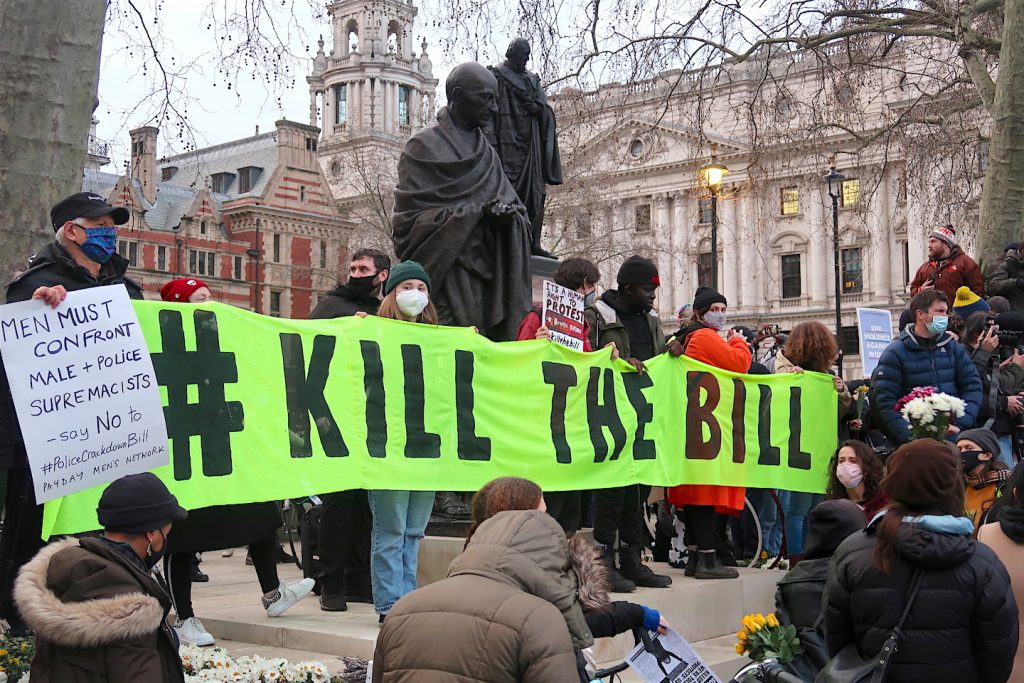
With the anniversary of the UK’s first Covid lockdown approaching, I look at how how the protest movements that have arisen over the last 12 months — about racist oppression, the safety of women and an attempted ban on protest itself — have spontaneously arisen when the logical limits of strict lockdowns have been reached. I also note how these movements stand in stark opposition to the protests of those engaged in Covid denial, who wilfully flout genuine public safety concerns through a toxic mix of dangerous conspiracy theories.
The devastatingly incompetent and corrupt government of Boris Johnson
Ever since the first Covid lockdown was declared in the UK, on March 23 last year, the British people have, for the most part, complied with the rules laid down by a government that was spectacularly ill-equipped to deal with a global pandemic, that has handled it with shattering incompetence, and that has also engaged in cronyism to an unprecedented extent.
Elected in December 2019 to ‘Get Brexit Done’ by just 29% of the registered electorate, Boris Johnson stacked his cabinet with inadequate, second-rate politicians whose only requirement for being chosen was that they were fanatically committed to Britain leaving the EU, an astonishingly misguided policy of national suicide that came out of David Cameron’s shameful capitulation to Euro-sceptics in his own party, and the threat posed by UKIP under Nigel Farage.
Photos: The People’s Climate March, London, September 21, 2014

See my photos of the People’s Climate March on Flickr here.
On September 21, 2014, all around the world, hundreds of thousands of people in 166 countries took part in over 2,800 events calling for urgent, coordinated action on climate change. The website for the New York City event — attended by an estimated 300,000 people — described it accurately as the “largest climate march in history.”
The trigger for the coordinated events around the world was the Climate Summit taking place at the United Nations headquarters in New York on Tuesday, where over 120 world leaders “will try to rally the political will for a new world-wide climate treaty by the end of 2015,” as the Wall Street Journal described it.
I attended the event in London, which involved around 40,000 people, a largely sunny day and a very friendly atmosphere, and took the photos available on Flickr. It was a powerful demonstration of widespread concern about the climate that is an important antidote to the cynical and well-funded climate change denial lobby, and the general indifference of politicians, who sometimes make positive noises about the environment, but are more generally in bed with the polluters — and, in addition, find themselves unable to tell the truth to their electorates: that we urgently need to make the environment a priority, and that doing so has to involve curbing our own destructive appetites. Read the rest of this entry »












 Who's still at Guantánamo?
