A Devastating Condemnation of Guantánamo’s Military Commissions by Palestinian-American Journalist P. Leila Barghouty
 Please support my work as a reader-funded journalist! I’m currently trying to raise $2500 (£2000) to support my writing and campaigning on Guantánamo and related issues over the next three months of the Trump administration.
I wrote the following article for the “Close Guantánamo” website, which I established in January 2012, on the 10th anniversary of the opening of Guantánamo, with the US attorney Tom Wilner. Please join us — just an email address is required to be counted amongst those opposed to the ongoing existence of Guantánamo, and to receive updates of our activities by email.
Six years and three months since Tom Wilner and I launched the Close Guantánamo campaign, we are becalmed in horribly unjust waters, with Donald Trump resolute that no one should leave the prison under any circumstances, and, as a result, 41 men held in what must appear to be a never-ending limbo, even though five of them were approved for release by high-level government review processes under President Obama, and another man, Ahmed al-Darbi, continues to be held despite being promised his release — to be re-imprisoned in Saudi Arabia — four years ago in a plea deal in his military commission trial.
Twenty-six other men are held indefinitely — and lawyers for some of them submitted a habeas corpus petition on their behalf on January 11, the 16th anniversary of the opening of the prison, on the basis that, as the New York-based Center for Constitutional Rights explained, “[Donald] Trump’s proclamation against releasing anyone from Guantánamo, regardless of their circumstances, which has borne out for the first full year of the Trump presidency, is arbitrary and unlawful and amounts to ‘perpetual detention for detention’s sake.’”
The other men still held — nine in total — have been through the military commission process, or are facing trials, and this latter category of Guantánamo prisoner came under the spotlight recently in an article written for a new website, The Outline, by P. Leila Barghouty, a journalist and filmmaker based in New York City, whose work has appeared on Al Arabiya, National Geographic, Slate, CNN, Vice News and Netflix. Read the rest of this entry »
16 Years Ago, the US Captured Abu Zubaydah, First Official Victim of the Post-9/11 Torture Program, Still Held at Guantánamo Without Charge or Trial
 Please support my work as a reader-funded journalist! I’m currently trying to raise $2500 (£2000) to support my writing and campaigning on Guantánamo and related issues over the next three months of the Trump administration.
I wrote the following article for the “Close Guantánamo” website, which I established in January 2012, on the 10th anniversary of the opening of Guantánamo, with the US attorney Tom Wilner. Please join us — just an email address is required to be counted amongst those opposed to the ongoing existence of Guantánamo, and to receive updates of our activities by email.
16 years ago, on March 28, 2002, an event took place that has had dreadful repercussions ever since, when Pakistani and American agents raided a house in Faisalabad, Pakistan and captured Abu Zubaydah (Zayn al-Abidin Muhammad Husayn), creating a torture program especially for him, which was then applied to dozens of other prisoners seized in the US’s brutal and pointless “war on terror.”
A Palestinian born in Saudi Arabia in 1971, Zubaydah had traveled to Afghanistan to join the mujahideen in the Afghan civil war (1989-1992) that followed the retreat of the Soviet Union after its ten-year occupation. In 1992, he was severely injured by an exploding mortar shell, suffering shrapnel wounds and severe memory loss. For over a year, he was also left unable to speak.
Although he eventually recovered sufficiently to become a logistician for Khalden, an independent training camp run by Ibn al-Shaykh al-Libi, which closed around 2000 when al-Libi refused to allow it to come under the control of Al-Qaeda, FBI agents who interviewed him after his capture had no doubt that the mortar damage had caused permanent damage. They also knew that he was a kind of travel agent for Khalden, and not number 3 in Al-Qaeda, as the CIA and the Bush administration mistakenly thought. (Al-Libi, meanwhile, tortured into telling lies that the US used to justify its illegal invasion of Iraq, was eventually returned to Libya, where Col. Gaddafi imprisoned him and later killed him). Read the rest of this entry »
The Torture Trail of Gina Haspel Makes Her Unsuitable to be Director of the CIA
 Please support my work as a reader-funded journalist! I’m currently trying to raise $2500 (£2000) to support my writing and campaigning on Guantánamo and related issues over the next three months of the Trump administration.
I wrote the following article for the “Close Guantánamo” website, which I established in January 2012, on the 10th anniversary of the opening of Guantánamo, with the US attorney Tom Wilner. Please join us — just an email address is required to be counted amongst those opposed to the ongoing existence of Guantánamo, and to receive updates of our activities by email.
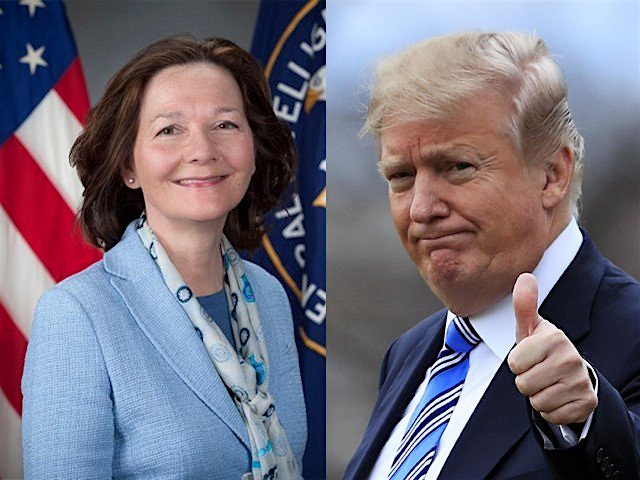
Last Tuesday, Donald Trump announced that Mike Pompeo, the current Director of the CIA, would become the new Secretary of State, replacing Rex Tillerson, while Gina Haspel, the current Deputy Director of the CIA, would be promoted to Director, “the first woman so chosen.”
There was nothing positive about this development. As usual, Trump, defying protocol and any notion of politeness, announced Tillerson’s sacking, and the new appointments, by tweet. Tillerson, formerly the CEO of ExxonMobil, had been an indifferent Secretary of State, but Pompeo is a poor choice to be the nation’s top diplomat — hawkish on Iran, and a supporter of the continuing existence of Guantánamo. Interestingly, the New Yorker noted that Tillerson was fired shortly after agreeing with the British government that Russia “appears” to have been responsible for the recent nerve-gas attack on a former Russian spy in Salisbury, in the UK. Pompeo, however, is not averse to criticizing Russia, in contrast to Trump himself, who, ignoring his advisers, on Tuesday congratulated Vladimir Putin on his recent election victory.
However, the bulk of the criticism after Trump’s announcement has, deservedly, been reserved for the promotion of Gina Haspel, who oversaw the last few months’ existence of the CIA’s first post-9/11 “black site” in Thailand, and later conspired to destroy videotapes of the torture that took place there. Unlike Mike Pompeo, who has taken a stance agains torture, there is no sign from Haspel that she recognizes the illegality of torture, and in Donald Trump, of course, she has a president who is an enthusiastic advocate for the use of torture. Read the rest of this entry »
UN Working Group on Arbitrary Detention Condemns US Treatment of Ammar Al-Baluchi at Guantánamo, Says All Prisoners Arbitrarily Detained
 Please support my work as a reader-funded journalist! I’m currently trying to raise $2500 (£2000) to support my writing and campaigning on Guantánamo and related issues over the next three months of the Trump administration.
I wrote the following article (as “U.N. Working Group on Arbitrary Detention Condemns U.S. Treatment of ‘High-Value Detainee’ Ammar Al-Baluchi at Guantánamo”) for the “Close Guantánamo” website, which I established in January 2012, on the 10th anniversary of the opening of Guantánamo, with the US attorney Tom Wilner. Please join us — just an email address is required to be counted amongst those opposed to the ongoing existence of Guantánamo, and to receive updates of our activities by email.
In a strongly-worded press release, the United Nations Working Group on Arbitrary Detention declared on Sunday evening their finding that “detention conditions at Guantánamo [and the] military commission procedures violate international law.”
The Working Group, which consists of “international legal experts mandated to investigate arbitrary deprivations of liberty,” issued its press release following the release last month of Opinion 89/2017, “a comprehensive condemnation of the United States’ continuing commission of torture and due process violations at Guantánamo Bay,” specifically focusing on the case of “high-value detainee” Ammar al Baluchi (aka Ali Abd al-Aziz Ali).
The press release explained that the Working Group’s Opinion “was issued in January 2018 following substantive briefings to the Working Group by the United States government and counsel for Mr. al Baluchi.” Alka Pradhan, civilian counsel for Mr. al Baluchi, declared, “This is a major public denunciation of the United States’ illegal prison and military commissions at Guantánamo Bay, and a specific call to change Mr. al Baluchi’s circumstances immediately.” Read the rest of this entry »
Guantánamo Lawyers Urge International Criminal Court to Investigate US Torture Program
 Please support my work as a reader-funded journalist! I’m currently trying to raise $2500 (£2000) to support my writing and campaigning on Guantánamo and related issues over the next three months of the Trump administration.
Ever since evidence first emerged of the US’s post-9/11 torture program — most conspicuously, via the photos of abuse in Abu Ghraib that were revealed in 2004, and the network of CIA “black sites” that were first revealed in the media in late 2005 — opponents of torture have sought to hold accountable those responsible for implementing torture in its various forms: in the CIA’s global network of “black sites,” in proxy prisons in other countries, in Afghanistan and Iraq, and at Guantánamo.
Their efforts have persistently been thwarted. President Obama, notoriously, used the “state secrets doctrine” to prevent torture victims from having their day in the US court system (check out the Jeppesen case in 2010, for example), and, earlier that year, after an internal Justice Department investigation into John Yoo and Jay Bybee, who wrote and approved the notorious “torture memos” of 2002 that purported to re-define torture so that it could be used by the CIA, concluded that they were guilty of “professional misconduct,” the Obama administration allowed a DoJ fixer to override that conclusion, deciding instead that they had merely exercised “poor judgment.”
In December 2014, an important step towards the truth came with the publication of the executive summary of the Senate Intelligence Committee’s report into the CIA’s post-9/11 detention program (the Senate torture report, as it is more colloquially known), which delivered a devastating verdict on the program, even if it was not empowered to hold anyone accountable. And last August, there was good news when James Mitchell and Bruce Jessen, former military psychologists who had developed the torture program for the CIA, settled out of court — for a significant, but undisclosed amount — with several survivors of the rendition and torture program, and the family of another man, Gul Rahman, who had died in Afghanistan. Read the rest of this entry »
Radio: My Discussion with Scott Horton About the Shameful Rehabilitation of George W. Bush, As I Recall His 2002 Memo Authorizing Torture
 Please support my work as a reader-funded journalist! I’m currently trying to raise $2500 (£2000) to support my writing and campaigning on Guantánamo and related issues over the next three months of the Trump administration.
Last week I was delighted to be invited to discuss Guantánamo, George W. Bush, torture and the “war on terror” by Scott Horton, the libertarian, Texan-based radio host, and the author of Fool’s Errand: Time to End the War in Afghanistan, in which, as Pentagon Papers whistleblower Daniel Ellsberg notes in a review, he “masterfully explains the tragedy of America’s longest war and makes the case for immediate withdrawal.”
Scott and I have been talking several times a year — and sometime more frequently — since September 2007, when we first spoke about the case of US “enemy combatant” Jose Padilla, tortured on the US mainland. Our interviews have generally been for 20-25 minutes, but for our latest interview the brakes were off, and we spoke for a whole hour.
The show is available here, or here as an MP3, and I wholeheartedly recommend it as a tour through the darkness of the “war on terror” declared by the Bush administration after the 9/11 attacks, as manifested in CIA “black sites,” in the CIA’s “extraordinary renditions” to torture prisons in other countries, in Guantánamo, and in the wars — and the accompanying lawless prisons — in Afghanistan and Iraq. We also looked at the sad failures of the Obama years — not only his failure to close Guantánamo, but how extrajudicial assassination by drones replaced the messy detention, rendition and torture program of the Bush years, but is no more legally or morally acceptable. Read the rest of this entry »
Exactly 16 Years Ago, George W. Bush Opened the Floodgates to Torture at Guantánamo
Please support my work as a reader-funded journalist! I’m currently trying to raise $2500 (£2000) to support my writing and campaigning on Guantánamo and related issues over the next three months of the Trump administration.
Since the terrible elevation of the grotesquely inadequate figure of Donald Trump to the position of President of the United States, there has been a bizarre propensity, on the part of those in the center and on the left of US political life, to seek to rehabilitate the previous Republican president, George W. Bush.
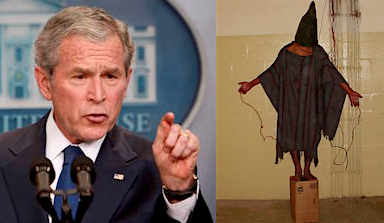
So let’s nip this in the bud, shall we? Because unless you’ve been away from the planet for the last 20 years, you must be aware that it was George W. Bush who initiated the US’s brutal and thoroughly counter-productive “war on terror” in the wake of the terrorist attacks of September 11, 2001, which involved authorizing the CIA to set up a secret detention and torture program, establishing a prison outside the law at Guantánamo Bay, Cuba, establishing deportation and surveillance programs within the US, invading one country (Afghanistan) in response to the attacks, where US troops remain to this day, despite having long ago ”snatched defeat from the jaws of victory,” as the author Anand Gopal once explained to me, and invading another country (Iraq) that had nothing to do with 9/11 or al-Qaeda, but which was nevertheless destroyed, along the way serving as the crucible for the creation of a newer threat, Daesh, or Islamic State, as it is more colloquial known in the West, a kind of turbo-charged reincarnation of al-Qaeda.
Today, February 7, is the 16th anniversary of one particularly sinister and misguided development in Bush’s “war on terror” — a memorandum, entitled, “Humane Treatment of Taliban and al Qaeda Detainees,” which was sent to just a handful of recipients including Vice President Dick Cheney, Secretary of Defense Donald Rumsfeld, Secretary of State Colin Powell, Attorney General John Ashcroft, CIA director George Tenet, and General Richard B. Myers, the Chairman of the Joint Chiefs of Staff. Read the rest of this entry »
Nils Melzer, UN Special Rapporteur on Torture, Accuses US of Still Using Torture at Guantánamo, Asks to Visit and Meet Prisoners Unsupervised
 Please support my work as a reader-funded journalist! I’m currently trying to raise $2500 (£2000) to support my writing and campaigning on Guantánamo and related issues over the next three months of the Trump administration.
I wrote the following article for the “Close Guantánamo” website, which I established in January 2012, on the 10th anniversary of the opening of Guantánamo, with the US attorney Tom Wilner. Please join us — just an email address is required to be counted amongst those opposed to the ongoing existence of Guantánamo, and to receive updates of our activities by email.
Last week, following Human Rights Day (on December 10), and the third anniversary of the publication of the executive summary of the Senate Intelligence Committee’s report into the CIA’s post-9/11 torture program (on December 9), the UN Special Rapporteur on torture, Nils Melzer, “appealed to the United States to end a pervasive policy of impunity for crimes of torture committed by US officials,” as a UN press release, issued on December 13, stated.
In a statement, Mr. Melzer, who was appointed by the UN Human Rights Council as the Special Rapporteur on torture and other cruel, inhuman or degrading treatment or punishment in November 2016, after previously working for the International Committee of the Red Cross and the Swiss government, made reference to the Senate torture report, noting how it “publicly acknowledged the systematic use of torture in US custody,” and stating, “To this day, however, the perpetrators and policymakers responsible for years of gruesome abuse have not been brought to justice, and the victims have received no compensation or rehabilitation.”
He added, “By failing to prosecute the crime of torture in CIA custody, the US is in clear violation of the Convention against Torture and is sending a dangerous message of complacency and impunity to officials in the US and around the world.” Read the rest of this entry »
Guantánamo, The Torture Report and Human Rights Day: America’s Unaddressed Legacy of Torture and Arbitrary Detention
 Please support my work as a reader-funded journalist! I’m currently trying to raise $2500 (£2000) to support my writing and campaigning on Guantánamo and related issues over the next three months of the Trump administration.
This time of year has always been a significant time for anyone concerned with human rights to reflect on what has or hasn’t been achieved in the last twelve months, and to make plans for the new year.
A crucial, and long established date is December 10, which the United Nations designated as Human Rights Day in 1950, on the second anniversary of the ratification by the UN of the Universal Declaration of Human Rights (UDHR), which, in a Facebook post on Human Rights Day, I described as “probably the most wonderful aspirational document in human history, born out of the soul-churning horrors of the Second World War.”
The UN, on its Human Rights Day page, says of the UDHR that it “sets out universal values and a common standard of achievement for all peoples and all nations. It establishes the equal dignity and worth of every person. Thanks to the Declaration, and States’ commitments to its principles, the dignity of millions has been uplifted and the foundation for a more just world has been laid. While its promise is yet to be fully realized, the very fact that it has stood the test of time is testament to the enduring universality of its perennial values of equality, justice and human dignity.”
Amongst the UDHR’s 30 articles are prohibitions on the use of torture and cruel, inhuman or degrading treatment or punishment, and arbitrary arrest, as well as the presumption of innocence and the right to a fair trial, all of which have long been of great significance to those like myself who have been writing about Guantánamo and working to get the prison closed. Read the rest of this entry »
Torture Accountability in Canada: After Payments to Three Men Tortured in Syria, Former Guantánamo Prisoner Djamel Ameziane Also Seeks Damages
 Please support my work as a reader-funded journalist! I’m currently trying to raise $2500 (£2000) to support my writing and campaigning on Guantánamo and related issues over the next three months of the Trump administration.
There was some very welcome news from Canada last week, when three Canadian citizens — Abdullah Almalki, Ahmad El Maati and Muayyed Nureddin — were paid $31.25 million (around $25m US dollars, or £18.7m) by the Canadian government as compensation for the government’s key role, via the spy agency CSIS (the Canadian Security Intelligence Service) and RCMP (the Royal Canadian Mounted Police), in arranging for them to be imprisoned and tortured in Syria between 2001 and 2003, when they were wrongly suspected of having some involvement with terrorism.
As the Toronto Star explained on October 26, “The payout was kept secret until this month and is part of a legal settlement that was first reported by the Star in February and announced by the Liberal government weeks later.”
The Star added, “The resolution and accompanying government apology put an end to a nine-year court battle for compensation that has been demanded since 2008,” when then-Supreme Court justice Frank Iacobucci concluded, in a report on their cases, that “Canadian agents labelled the men Islamic extremists and shared information with other countries without proper precautions about its unreliability.” Read the rest of this entry »











 Who's still at Guantánamo?
