On the 10th Anniversary of Yoo and Bybee’s “Torture Memos,” Col. Morris Davis Reminds Americans About Justice and the Law
 Exactly ten years ago, two memos written by John Yoo, a lawyer in the Justice Department’s Office of Legal Counsel, were signed by his immediate boss, Jay S. Bybee. In these two memos, Yoo, also a law professor at UC Berkeley, attempted to redefine torture so that it could be used on Abu Zubaydah, an alleged “high-value detainee” seized in the “war on terror,” even though the US is a signatory to the UN Convention Against Torture, which prohibits the use of torture under any circumstances.
These two memos, generally known as the Bybee memos, but forever known to anyone with a conscience as the “torture memos,” marked the start of an official torture program that will forever be a black mark on America’s reputation — as well as providing cover for torturers worldwide, and turning America into such a dubious and lawless nation that President Obama and his administration have shied away form holding any of their predecessors accountable for their actions, and have swallowed the Bush administration’s rhetoric about a “war on terror” to such an extent that, although torture has been officially repudiated, the administration has presided over a massive increase in the use of unmanned drones to assassinate those regarded as a threat, without any judicial process, and in countries with which the US is not at war, including US citizens.
In an article to follow soon, I will examine this anniversary more closely, but for now I wanted to make sure that I marked it in some manner, having been away at the WOMAD world music festival for most of the run-up to it, and I’m delighted to use the occasion to cross-post an op-ed from the Los Angeles Times written by Col. Morris Davis, the former chief prosecutor of the military commissions at Guantánamo, who resigned five years ago, when he was placed in a chain of command under William J. Haynes II, the Pentagon’s General Counsel, and one of the main drivers of the torture program. Read the rest of this entry »
Polish Senator’s Startling New Allegations About the CIA Torture Prison in Poland
 In the long quest for accountability for those who ordered, authorized or were complicit in the Bush administration’s torture program, every avenue has been shut down within the US by the Obama administration, the Justice Department and the courts, and the only hope lies elsewhere in the world, and specifically Poland, one of three European countries that hosted secret CIA prisons, where “high-value detainees” were subjected to torture.
Whereas the other two countries — Romania and Lithuania — have either refused to accept that a secret prison existed, or have opened and then prematurely shut an investigation, Poland has an ongoing official investigation, which began four years ago and shows no sign of being dismissed, even if numerous obstacles to justice have been erected along the way.
Last week, two US news outlets — the Los Angeles Times and ABC News — reported the latest claim by Senator Jozef Pinior, who, as ABC News explained, told the Polish newspaper Gazeta Wyborcza that prosecutors “have a document that shows a local contractor was asked to build a cage at Stare Kiekuty,” the Polish army base that was used by the CIA as its main prison for “high-value detainees” from December 2002 (when the previous prison in Thailand was closed down) until September 2003, when, for six months, the main “high-value detainees” were held in a secret prison within Guantánamo, before being transferred back to facilities in Europe and Morocco. 14 “high-value detainees” were eventually returned to Guantánamo, as military prisoners, in September 2006. Read the rest of this entry »
On 25th Anniversary of UN Convention Against Torture, Khalid Sheikh Mohammed’s Lawyers Submit Case to Rapporteur
 Exactly 25 years ago, on June 26, 1987, the UN Convention against Torture and Other Cruel, Inhuman or Degrading Treatment or Punishment came into force, and in December 1997, the UN General Assembly proclaimed June 26 the International Day in Support of Victims of Torture, “with a view to the total eradication of torture and the effective functioning of the Convention against Torture.”
As is painfully clear today, despite the support of 150 countries, the use of torture is still rife, and many of the countries that claim to adhere to the Convention have, in fact, shown a cynical — and in some cases blatant — disregard for its provisions.
One of those countries is, of course, the United States of America, which, under President George W. Bush, cynically attempted to redefine torture so that it could be used on “high-value detainees” seized in the “war on terror” in a network of secret prisons, and, moreover, withdrew the protections of the Geneva Conventions from the prisoners in Guantánamo, who were also tortured, and also tortured prisoners in Afghanistan and Iraq — most notoriously in Bagram, the “Dark Prison” and the “Salt Pit” in Afghanistan and Abu Ghraib in Iraq, although its use was also widespread at other locations in Iraq.
To date, no one — beyond a few low-level personnel who did not design the abusive detention and interrogation regime that was introduced after 9/11 — has been held accountable for these crimes, and in the meantime, numerous torture victims — including 13 of the 14 “high-value detainees” who were delivered to Guantánamo in September 2006 from secret torture prisons run by the CIA, where they had been held for up to four and a half years — remain imprisoned, with no indication, for most of them, of when, if ever, they will even receive a trial. Read the rest of this entry »
US Government Turns Down Request for Trial by Guantánamo Prisoner and CIA Torture Victim Abu Zubaydah
 Last week, lawyers for Abu Zubaydah, an alleged “high-value detainee” in the “war on terror,” who was held in secret CIA prisons for four and a half years until his transfer to Guantánamo in September 2006, submitted a letter to the Convening Authority for the military commissions at Guantánamo, Retired Vice Admiral Bruce MacDonald, asking for their client to be charged, after more than ten years in US custody. I followed up on this by writing an article pointing out that seven other “high-value detainees” held at Guantánamo — mostly since September 2006, but in two cases since 2007 and 2008 — have also not been charged, and asked, with regard to these eight men, “Are there any plans to try them? Or is the Obama administration happy for them to be held for the rest of their lives without charge or trial — a confirmation, if any were needed, that indefinite detention without charge or trial has, through Guantánamo, become normalized?”
Today, I had planned to publish the letter that Joe Margulies and the other lawyers for Abu Zubaydah wrote to Bruce MacDonald, which Marcy Wheeler made available on her website Empty Wheel, and I am proceeding with that plan, as the letter contains an important summary of the Bush administration’s disgraceful and illegal torture program, for which no one in authority has yet been held accountable, as well as summarizing the scandalous treatment of Abu Zubaydah, and how the claims about his significance have melted away with the passage of time. It also is an indictment of the Obama administration’s unwillingness to deal adequately with the toxic inheritance left by the Bush administration.
In addition, however, I am also publishing the response to the letter that Bruce MacDonald wrote on May 17, in which he pointed out that the decision on whether or not to prosecute lies with the Office of the Chief Prosecutor — and that therefore, by inference, it is a decision that also involves defense secretary Leon Panetta and President Obama as the Commander in Chief — and also pointed out that Abu Zubaydah can “challenge the legality of his detention by seeking a writ of habeas corpus.” Read the rest of this entry »
Why No Trials for Abu Zubaydah and Seven Other “High-Value Detainees” in Guantánamo?
 Two weeks ago, when Khalid Sheikh Mohammed and four other “high-value detainees” were arraigned at Guantánamo, in preparation for their forthcoming trial by military commission, they brought to eight the number of “high-value detainees” tried, put forward for trials or having agreed to a plea deal to avoid a trial and secure a reduced sentence.
In total, 16 “high-value detainees” have been sent to Guantánamo — 14 in September 2006, another in 2007 and another in 2008. One, Ahmed Khalfan Ghailani, was tried and convicted in federal court in New York in 2010, another, Majid Khan, accepted a plea deal in February this year, and Khalid Sheikh Mohammed and his four co-defendants join another prisoner, Abd al-Rahim al-Nashiri, in the slow-moving queue for military commission trials at Guantánamo.
But what of the other eight? Are there any plans to try them? Or is the Obama administration happy for them to be held for the rest of their lives without charge or trial — a confirmation, if any were needed, that indefinite detention without charge or trial has, through Guantánamo, become normalized? Read the rest of this entry »
War Crimes Tribunal in Malaysia Finds Bush, Cheney, Rumsfeld Guilty of Torture in Guantánamo and Iraq
 Last November, a war crimes tribunal established in Malaysia “found George Bush and Tony Blair guilty of ‘crimes against peace’ and other war crimes for their 2003 aggressive attack on Iraq, as well as fabricating pretexts used to justify the attack,” as Glenn Greenwald explained at the time. The seven-member Kuala Lumpur War Crimes Tribunal, established in 2007 by Mahathir bin Mohamad, the Prime Minister of Malaysia from 1981 to 2003, “has no formal enforcement power,” as Greenwald also explained, “but was modeled after a 1967 tribunal in Sweden and Denmark that found the US guilty of a war of aggression in Vietnam, and, even more so, after the US-led Nuremberg Tribunal held after World War II.”
The tribunal “ruled that Bush and Blair’s name should be entered in a register of war criminals, urged that they be recognized as such under the Rome Statute, and also petitioned the International Criminal Court “to proceed with binding charges.” Though symbolic, the purpose was hugely important, as a Malaysian lawyer explained at the time, saying, “For these people who have been immune from prosecution, we want to put them on trial in this forum to prove that they committed war crimes.” In other words, as Greenwald stated, “because their own nations refuse to hold them accountable and can use their power to prevent international bodies from doing so, the tribunal wanted at least formal legal recognition of these war crimes to be recorded and the evidence of their guilt assembled.”
Greenwald also noted, “That’s the same reason a separate panel of this tribunal will hold hearings later this year on charges of torture” against senior US officials, and last week this second tribunal convened, hearing from three witnesses — former Guantánamo prisoner Moazzam Begg, and Abbas Abid and Jameela Abbas, both victims of US torture in Iraq, as well as receiving written submissions from other victims. Read the rest of this entry »
Torture: The Bush Administration on Trial
 Law-abiding US citizens have been appalled that Jose Rodriguez, the director of the CIA’s National Clandestine Service until his retirement in 2007, was invited onto CBS’s “60 Minutes” program last weekend to promote his book Hard Measures: How Aggressive CIA Actions After 9/11 Saved American Lives, in which he defends the use of torture on “high-value detainees” captured in the Bush administration’s “war on terror,” even though that was — and is — illegal under US and international law.
Rodriguez joins an elite club of war criminals — including George W. Bush, Dick Cheney and Donald Rumsfeld — who, instead of being prosecuted for using torture, or authorizing its use, have, instead, been allowed to write books, go on book tours and appear on mainstream TV to attempt to justify their unjustifiable actions.
All claim to be protected by the “golden shield” offered by their inside man, John Yoo, part of a group of lawyers who aggressively pushed the lawlessness of the “war on terror.” Abusing his position as a lawyer in the Justice Department’s Office of Legal Counsel, whose mandate is to provide impartial legal advice to the executive branch, Yoo instead attempted to redefine torture and approved its use — including the use of waterboarding, an ancient torture technique and a form of controlled drowning — on an alleged “high-value detainee,” Abu Zubaydah, in two memos, dated August 1, 2002, that will forever be known as the “torture memos.” Read the rest of this entry »
How America Became A Torture Nation
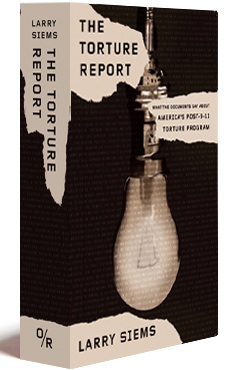 Since I began researching Guantánamo and the “war on terror” on a full-time basis over six years ago, my motive has been to pierce the lies told about the prisoners, falsely tarred as “the worst of the worst,” even though most of them were rounded up for money, or through poor intelligence, and to expose the horrors that ensue when a rogue government — saturated in vengeance and with a long-standing disdain for restraints on executive power — disregards domestic and international law, deliberately confusing a terrorist attack with a war, depriving prisoners seized in wartime of the rights of the Geneva Conventions, and introducing arbitrary detention and torture.
Torture has permeated every aspect of America’s “war on terror,” and I have researched and written about what is known of its use at Guantánamo, and in prisons in Afghanistan, through the stories of the men held there and the documents about them that have been publicly released. I have also undertaken research into prisoners held in other locations — in the proxy prisons in countries including Egypt, Jordan, Morocco and Syria, where the torturers of those regimes extracted information on behalf of the CIA, and in the “black sites” run by the CIA, in a disturbingly novel departure from its traditional modus operandi, in Thailand, Poland, Romania, Lithuania and Morocco.
My main contribution to the documentation of these prisoners is a section of a UN report published in 2010, the “Joint Study on Global Practices in Relation to Secret Detention in the Context of Countering Terrorism,” dealing with US secret detention policies after 9/11, on which I was the lead author. That report is available here as a PDF, and in June 2010 I cross-posted the chapter dealing with US secret detention in three parts on my website — see UN Secret Detention Report (Part One): The CIA’s “High-Value Detainee” Program and Secret Prisons, UN Secret Detention Report (Part Two): CIA Prisons in Afghanistan and Iraq and UN Secret Detention Report (Part Three): Proxy Detention, Other Countries’ Complicity, and Obama’s Record. Read the rest of this entry »
The Torture Trials at Guantánamo
 In the last few weeks, Guantánamo has been under the spotlight as, for the first time since President Obama took office, the military commission trial system — the government’s preferred method for trying terror suspects held in Guantánamo — has been readied for trying “high-value detainees”; those who, as well as being held in Guantánamo, were previously held in “black sites” run by the CIA, where the use of torture was widespread.
This has always been a problem for the government — under George W. Bush as well as under Obama — because the use of torture is not only illegal, but information derived through its use cannot be used in US courts. To get around the first inconvenience, President Bush’s lawyers arranged for torture to be redefined, and, to overcome the second, the Bush administration initially brought the military commissions out of retirement with the intention that the prohibition on torture could be ignored.
When the first incarnation of the commissions was felled by the Supreme Court in June 2006, and Congress then dutifully brought the trial system back to life a few months later, the use of information derived through torture was banned, although gray areas were acceptable at the discretion of the military judges. To get around this, the Bush administration tried, at one point, to send in “clean teams” of FBI agents and military interrogators to try and persuade those who had been tortured to repeat their tortured confessions voluntarily. Presumably, there was as little concern about the accuracy of the confessions as there was when the men were first being tortured, because, as any expert can confirm, torture is not a useful method for extracting reliable information, but is very good for producing false confessions. Read the rest of this entry »
US Training Manual Used As Basis for Bush’s Torture Program Is Released by Pentagon
 Over the last few years, my friends and colleagues Jason Leopold and Jeffrey Kaye have been doing some excellent work for Truthout exposing the Bush administration’s torture program, and human experimentation at Guantánamo, and last week they produced another excellent article for Truthout, examining the significance of a recently released US military training manual for the development of George W. Bush’s torture program.
The development of Bush’s torture program was triggered by the capture of the alleged “high-value detainee” Abu Zubaydah in Pakistan in March 2002, and formalized when John Yoo, a lawyer in the Justice Department’s Office of Legal Counsel, wrote two memos — the “torture memos” — signed by his boss, Jay Bybee, on August 1, 2002, which purported to redefine torture so that it could be used by the CIA, and approved the use of ten torture techniques on Abu Zubaydah, including waterboarding, an ancient torture technique and a form of controlled drowning.
As Jason and Jeff explain, the manual “was prepared by the Department of Defense’s (DOD) Joint Personnel Recovery Agency (JPRA) and used by instructors in the JPRA’s Survival Evasion Resistance Escape (SERE) courses to teach US military personnel how to withstand brutal interrogation techniques if captured by the enemy during wartime.” It has long been known that the Bush administration actively sought the advice of JPRA operatives — including James Mitchell and Bruce Jessen — who proposed reverse engineering the torture techniques taught in US military schools to enable captured personnel to resist torture if captured, and using them in real-life situations with captured “terror suspects.” Read the rest of this entry »











 Who's still at Guantánamo?
