Guantánamo Torture Victim Mohamedou Ould Slahi’s Harrowing Memoir to be Published in January 2015
 In January 2015, Mohamedou Ould Slahi, a prisoner at Guantánamo, will become the first prisoner still held to have his memoir published. Guantánamo Diary, which he wrote by hand as a 466-page manuscript, beginning in 2005, will be published in the US by Little, Brown and Company and in the UK by Canongate, and the date of publication is January 20, 2015. His lawyers tenaciously fought for seven years to have his diary declassified, and were ultimately successful, although parts of it remain classified. The publishers describe it as “not merely a vivid record of a miscarriage of justice, but a deeply personal memoir — terrifying, darkly humorous, and surprisingly gracious”, and “a document of immense historical importance”.
A Mauritanian, Mohamedou Ould Slahi is a cousin of Abu Hafs al-Mauritani (real name Mahfouz Ould al-Walid), a spiritual advisor to al-Qaeda, who disagreed with the 9/11 attacks, and he also briefly communicated with the 9/11 attackers while living in Germany. These connections led Col. Morris Davis, the former chief prosecutor of the military commissions at Guantánamo, to describe him as a “Forrest Gump” character, “in the sense that there were a lot of noteworthy events in the history of al-Qaida and terrorism, and there was Slahi, lurking somewhere in the background,” although, as Col. Davis stressed, in early 2007 “we had a big meeting with the CIA, the FBI, the Department of Defense, and the Department of Justice, and we got a briefing from the investigators who worked on the Slahi case, and their conclusion was there’s a lot of smoke and no fire.”
Ironically, Abu Hafs is now a free man, while Slahi is still held. Slahi handed himself in to the Mauritanian authorities on November 2001, and was then rendered to a secret torture prison in Jordan by the CIA, where he was interrogated for eight months until the Jordanians concluded that he was an innocent man. Nevertheless, the US then flew him to to Bagram in Afghanistan, and then on to Guantánamo, where “he was designated a ‘special project’ and subjected to isolation, beatings, sexual humiliation, death threats, and a mock kidnapping and rendition,” as his publishers explained — and as was mentioned in an article in the Guardian. Read the rest of this entry »
European Court of Human Rights Delivers Powerful Condemnation of US Torture Program and Poland’s Role Hosting a CIA “Black Site”
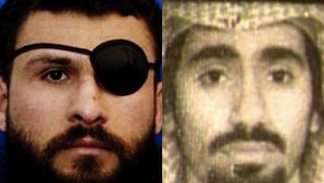 Last week there was some extremely important news for those of us who have spent many long years hoping to hold senior US officials — up to and including former President George W. Bush and former Vice President Dick Cheney — accountable for approving and implementing a torture program in the “war on terror,” when the European Court of Human Rights unanimously condemned the US for implementing a program of extraordinary rendition and torture, and condemned Poland for its involvement in the program by hosting a secret torture prison — a CIA “black site” — on its soil in 2002-03.
The rulings were delivered in the cases of two men, Abd al-Rahim al-Nashiri, a Saudi national accused of masterminding the attack on the USS Cole in 2000, and Abu Zubaydah (a Saudi-born Palestinian whose real name is Zayn al-Abidin Muhammad Husayn), mistakenly described as al-Qaeda’s number 3 after his capture in March 2002. In its report on the rulings, the New York Times provided a more appropriate description of Zubaydah as someone who is “believed to have overseen the operation of guesthouses in Pakistan,” who vetted recruits and “provided letters of recommendation allowing them to be accepted for training at a paramilitary camp in Afghanistan” — which, it should be noted, was not affiliated with al-Qaeda.
Both men are currently held at Guantánamo, where they have been since September 2006, but they were held for over four years in “black sites” where they were subjected to torture, including the site in Poland that the European Court of Human Rights highlighted in its rulings. Read the rest of this entry »
Please Read “Britain’s Latest Counter-Terrorism Disasters,” My New Article for Al-Jazeera About Diego Garcia, Babar Ahmad and Talha Ahsan
 Dear friends and supporters,
I’ve been away since last Wednesday, but I hope that you have time to read my latest article for Al-Jazeera, “Britain’s Latest Counter-Terrorism Disasters,” if you didn’t see it when it was published on the day of my departure (to the WOMAD festival in Wiltshire) and to like it, share it and tweet it if you find it of interest. It concerns two recent problems with the UK’s conduct in the “war on terror” — specifically, the latest embarrassment about British knowledge of what the US was doing with terror suspects on the UK’s Indian Ocean territory of Diego Garcia (a story that has been bubbling away for nearly 12 years), and the colossal waste of time and effort involved in the long UK detention without charge or trial of two British citizens, Babar Ahmad and Talha Ahsan (held for eight and six years), their extradition to the US in October 2012, their plea deals last December and their sentencing last week, which has led to an order for Talha Ahsan’s immediate release, and a sentence for Babar Ahmad that will probably see him freed in the UK in just over a year.
The US, of course, is severely to blame for both of these policy disasters — through its policy of extraordinary rendition and CIA “black sites” under the Bush administration, which the UK readily supported, and through the UK-US Extradition Act of 2003, which was used to extradite Talha Ahsan and Babar Ahmad, even though it is clearly not a well-functioning system, as the UK government conceded that the two men could not have been put on trial in the UK.
Back in 2008 and 2009, in particular, I wrote extensively about Britain’s revolting counter-terrorism policies in the wake of 9/11: about the high-level attempts to hide British complicity in the torture of Binyam Mohamed, a British resident held in Guantánamo, who had been tortured in Morocco; about the foreign nationals held without charge or trial in the UK, on the basis of secret evidence presented in closed sessions in a special national security court, and the others — including British nationals — held on control orders, a form of house arrest that also involved secret evidence and no trials; and, on occasion, about Diego Garcia (see here, and see my Guardian article here). Read the rest of this entry »
More Farcical Proceedings at the Military Commissions in Guantánamo
 I wrote the following article for the “Close Guantánamo” website, which I established in January 2012 with US attorney Tom Wilner. Please join us — just an email address is required to be counted amongst those opposed to the ongoing existence of Guantánamo, and to receive updates of our activities by email.
Last week I published “The 9/11 Trial at Guantánamo: The Dark Farce Continues,” the first of two articles providing updates about the military commissions at Guantánamo.
The commissions were established under President George W. Bush in November 2001, were ruled illegal by the Supreme Court in June 2006, revived by Congress in the fall of 2006, suspended by President Obama in January 2009, and revived again by Congress in the fall of 2009, but they have always struggled to establish any credibility, and should not have been revived by the Obama administration.
Last week’s article, as the title indicates, covered developments — or the lack of them — in pre-trial hearings for Khalid Sheikh Mohammed and four other men accused of involvement in the 9/11 attacks, who were held and tortured in CIA “black sites” for years before their arrival in Guantánamo in September 2006. Read the rest of this entry »
The 9/11 Trial at Guantánamo: The Dark Farce Continues
 I wrote the following article for the “Close Guantánamo” website, which I established in January 2012 with US attorney Tom Wilner. Please join us — just an email address is required to be counted amongst those opposed to the ongoing existence of Guantánamo, and to receive updates of our activities by email.
In two articles — this one and another to follow soon — I’ll be providing updates about the military commissions at Guantánamo, the system of trials that the Bush administration dragged from the US history books in November 2001 with the intention of trying, convicting and executing alleged terrorists without the safeguards provided in federal court trials, and without the normal prohibitions against the use of information derived through torture.
Notoriously, the first version of the commissions revived by the Bush administration collapsed in June 2006, when, in Hamdan v. Rumsfeld, the Supreme Court ruled that the commission system lacked “the power to proceed because its structures and procedures violate both the Uniform Code of Military Justice and the four Geneva Conventions signed in 1949.”
Nevertheless, Congress subsequently revived the commissions, in the fall of 2006, and, although President Obama briefly suspended them when he took office in 2009, they were revived by Congress for a second time in the fall of 2009. Read the rest of this entry »
The Chaotic History of Guantánamo’s Military Commissions
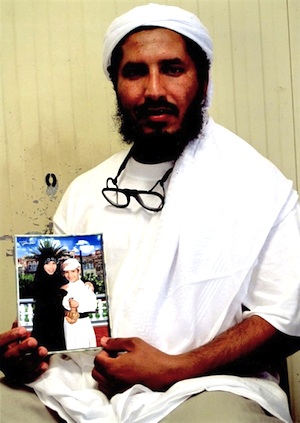
See the full list here of everyone charged in the military commissions at Guantánamo.
Recently, a friend asked me for information about all the Guantánamo prisoners who have been put forward for military commission trials at Guantánamo, and after undertaking a search online, I realized that I couldn’t find a single place listing all the prisoners who have been charged in the three versions of the commissions that have existed since 2001, or the total number of men charged.
As a result, I decided that it would be useful to do some research and to provide a list of all the men charged — a total of 30, it transpires — as well as providing some updates about the commissions, which I have been covering since 2006, but have not reported on since October. The full list of everyone charged in the military commissions is here, which I’ll be updating on a regular basis, and please read on for a brief history of the commissions and for my analysis of what has taken place in the last few months.
The commissions were dragged out of the history books by Dick Cheney on November 13, 2001, when a Military Order authorizing the creation of the commissions was stealthily issued with almost no oversight, as I explained in an article in June 2007, while the Washington Post was publishing a major series on Cheney by Barton Gellman (the author of Angler, a subsequent book about Cheney) and Jo Becker. Alarmingly, as I explained in that article, the order “stripped foreign terror suspects of access to any courts, authorized their indefinite imprisonment without charge, and also authorized the creation of ‘Military Commissions,’ before which they could be tried using secret evidence,” including evidence derived through the use of torture. Read the rest of this entry »
Radio: Andy Worthington Discusses the European Court of Human Rights’ Hearing About Poland’s CIA Torture Prison on Voice of Russia
On Monday and Tuesday, as I explained in a subsequent article, “an important step took place in the quest for those who ordered and undertook torture in the Bush administration’s ‘war on terror’ to be held accountable for their actions,” when a ground-breaking hearing took place in Strasbourg. For the first time since the start of the “war on terror” and the abuses that, in particular, took place between 2002 and 2006, the European Court of Human Rights listened to evidence about the role of the Polish authorities in the extraordinary rendition, secret detention and torture of two men currently held in the US prison at Guantánamo Bay, Cuba — Abu Zubaydah and Abd al-Rahim al-Nashiri.
Both men were held at a secret prison at Stare Kiejkuty in the northeast of the country, between December 2002, when they were moved from a previous CIA “black site” in Thailand, until October 2003, when they were moved for five months to “Strawberry Fields,” a secret facility in Guantánamo, until the Bush administration realized that the Supreme Court was about to grant the Guantánamo prisoners habeas corpus rights, thereby allowing lawyers to visit and to shatter the secrecy that was necessary for torture abuse to take place unchallenged. They were then shunted around other “black sites” in Romania, Lithuania and Morocco, until they were returned to Guantánamo in September 2006, with 12 other “high-value detainees” held in “black sites” for several years.
Writing about the hearing, Crofton Black, an investigator with Reprieve, one of the organizations representing Abu Zubaydah, stated that the court had “heard overwhelming and uncontested evidence that the CIA was running a secret torture prison on Polish soil, with the Polish government’s knowledge.” As I wrote in my article, “although I am prepared for disappointment, I certainly hope that the European Court of Human Rights will find that the Polish authorities acted unlawfully in hosting a CIA ‘black site’ on their territory.” Read the rest of this entry »
European Court of Human Rights Hears Evidence About CIA Torture Prison in Poland
On Monday and Tuesday, an important step took place in the quest for those who ordered and undertook torture in the Bush administration’s “war on terror” to be held accountable for their actions, when the European Court of Human Rights in Strasbourg held a hearing to examine the role of the Polish authorities in the extraordinary rendition, secret detention and torture of two men currently held in the US prison at Guantánamo Bay, Cuba — Abu Zubaydah and Abd al-Rahim al-Nashiri.
Both men are amongst the 14 “high-value detainees” who arrived at Guantánamo in September 2006 after years of incommunicado detention and torture in a variety of CIA “black sites,” one of which was in Poland, and as Interights, the International Centre for the Legal Protection of Human Rights, explained in a news release, “This historic court hearing [is] the first time a European country has been taken to court for allowing the CIA to run a torture site on its territory and comes after years of silence from the Polish government about the CIA’s prison there.”
The cases of these two men are enormously significant for everyone seeking accountability, as they are two of only three prisoners whom the US had admitted were subjected to waterboarding, the ancient torture technique that involves controlled drowning. With another “high-value detainee,” Ramzi bin al-Shibh, they were the only men held at a CIA “black site” in Thailand prior to their transfer to Poland in December 2002. In October 2003, they were moved to a secret “black site” within Guantánamo, identified as “Strawberry Fields,” and were then moved around a number of other CIA “black sites” in Romania, Lithuania and Morocco until their eventual return to Guantánamo in 2006. Read the rest of this entry »
Penny Lane: What We Learned This Week About Double Agents at Guantánamo
 On Tuesday, out of nowhere, the Associated Press ran a story about a secret prison at Guantánamo that attracted a huge amount of attention from the media around the world — more attention, in fact, than at any time since the prison-wide hunger strike earlier this year, which, surprisingly, managed to retain much of the media’s attention for several months.
That, however, was a current story, whereas the AP’s story dealt with a secret facility that apparently existed between 2003 and 2006, in a now overgrown clearing at the end of a dirt road behind a ridge near the administrative offices of the prison.
There, in eight small cottages, the CIA housed and trained a handful of prisoners they had persuaded to become double agents, according to Adam Goldman and Matt Apuzzo, who spoke to around ten current and former US officials for their story. All spoke anonymously “because they were not authorized to publicly discuss the secret program.”
Goldman and Apuzzo described the program as “a risky gamble,” because although the double agents might locate terrorist leaders for them, they might also turn against their employers. That, of course, is always a problem with double agents, although the AP was correct to note the stench of hypocrisy when it came to recruiting double agents at Guantánamo. “At the same time the government used the threat of terrorism to justify imprisoning people indefinitely,” Goldman and Apuzzo wrote, “it was releasing dangerous people from prison to work for the CIA.” Read the rest of this entry »
New Report Condemns Role of Doctors, Psychologists and Psychiatrists as Torturers in Bush’s “War on Terror”
 Unusually, there has been so much Guantánamo-related news lately that I haven’t had time to write about it all. A case in point is “Ethics Abandoned: Medical Professionalism and Detainee Abuse in the War on Terror” (also available here on Scribd), a 156-page report by the Task Force on Preserving Medical Professionalism in National Security Detention Centers, an independent panel of 19 military, ethics, medical, public health, and legal experts, who spent two years working on their report, with the support of the Institute on Medicine as a Profession and the Open Society Foundations.
The report was published on November 5, and, as a press release explained, the task force of experts “charged that US military and intelligence agencies directed doctors and psychologists working in US military detention centers to violate standard ethical principles and medical standards to avoid infliction of harm.”
The task force also concluded that, “since September 11, 2001, the Department of Defense (DoD) and CIA improperly demanded that US military and intelligence agency health professionals collaborate in intelligence gathering and security practices in a way that inflicted severe harm on detainees in US custody,” which included “designing, participating in, and enabling torture and cruel, inhumane and degrading treatment” of prisoners seized in the “war on terror.” Read the rest of this entry »












 Who's still at Guantánamo?
