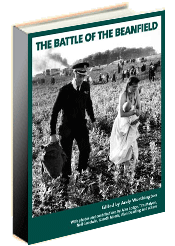
Never Trust the Tories: It’s 32 Years Today Since the Intolerable Brutality of the Battle of the Beanfield
 Please support my work as a reader-funded investigative journalist and commentator.
Today, June 1, the cultural nostalgia industry — a burgeoning movement that seeks safe havens in the past, where the reality of the here and now can be denied — is in overdrive, marking the 50th anniversary of the release of the Beatles’ LP, ‘Sergeant Pepper’s Lonely Hearts Club Band.’ Cue rhapsodic reflections on the meaning of “the summer of love,” and, presumably, very few people talking about how it’s not the Beatles’ best or more significant album, and, more importantly, “the summer of love” isn’t something to wheel out like a colourful aged relative.
If there is, at some level, a rainbow-hued joy to recollections of the time, this should reasonably be tempered with an awareness that the hippie movement was not just about fashion and flowers; it was also tied into the movement against the Vietnam War in America, to movements of resistance to the status quo (whether violent or non-violent), and to profound questions about culture, love, relationships, business and our place in the world that often led to conflicting and confused responses, in which irresponsibility played a part as well as idealism.
The rather more superficial aspect of the 60s — the fashion and flowers — led in turn to what I see as the most defining betrayal of the hope and desire for change that drove much of the agitation of the time: the sidelining of the commitment to political resistance — a largely communal affair — through the self-obsession of self-improvement: those millions of journeys to self-discovery that, absorbed and reinterpreted by the voracious mainstream of capitalism, have become nothing more than a vain sense of entitlement, typified by L’Oreal’s “Because You’re Worth It” tagline, but apparent everywhere, in the preening, pampering world of materialistic self-worth. Read the rest of this entry »
My Photos on Flickr: Bermondsey and the River Thames, June 2012
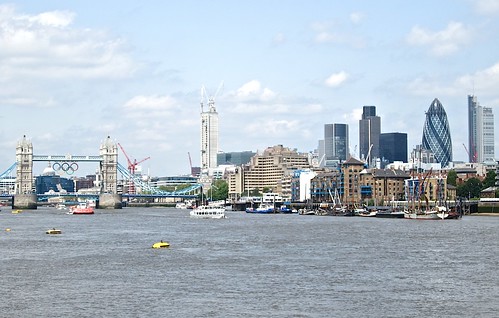


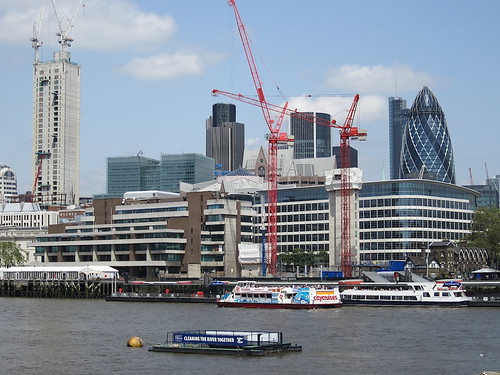
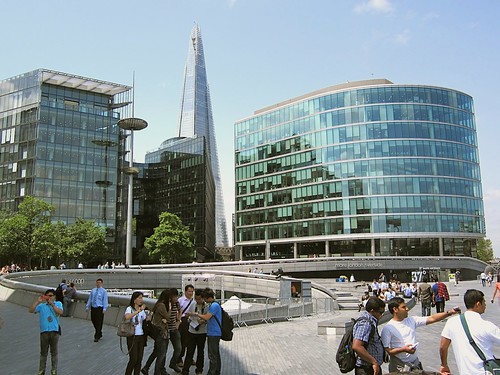


Bermondsey and the River Thames, June 2012, a set on Flickr.
This set of photos, recording elements of a journey I made by bike on June 28, 2012 from south east London to the West End and back, is the third set of photos of London that I’ve uploaded to my recently established Flickr account, based on my newly-discovered means of escape from the chains that tie me to my computer and my work as a freelance investigative journalist — cycling around London with a camera, recording whatever captures my attention: buildings old and new, the sky, the river, trees and parks, and street art.
I’m also drawn to signs of emptiness, untidiness and decay that stand in contrast to the shiny new corporate buildings and endless “luxury” housing developments that are still springing up as part of a rigged economy, and that stand in such marked contrast to the savage age of austerity to which London’s poorer citizens are being subjected. Read the rest of this entry »










 Who's still at Guantánamo?
