After First Ever Guantánamo Visit, UN Rapporteur Finds Dehumanized, Traumatized Men Subjected to Cruel, Inhuman and Degrading Treatment That May Rise to the Level of Torture
Please support my work as a reader-funded journalist! I’m currently trying to raise $2500 (£2000) to support my writing and campaigning on Guantánamo and related issues over the next three months. If you can help, please click on the button below to donate via PayPal.
I wrote the following article for the “Close Guantánamo” website, which I established in January 2012, on the 10th anniversary of the opening of Guantánamo, with the US attorney Tom Wilner. Please join us — just an email address is required to be counted amongst those opposed to the ongoing existence of Guantánamo, and to receive updates of our activities by email.
On Monday June 26, 7,837 days since the prison at Guantánamo Bay opened, and on the 25th anniversary of the establishment of the UN International Day in Support of Victims of Torture, the Special Procedures of the UN Human Rights Council (“independent human rights experts with mandates to report and advise on human rights from a thematic or country-specific perspective”) issued a devastatingly critical report about systemic, historic and ongoing human rights abuses at the prison, based on the first ever visit by a Special Rapporteur — Fionnuala Ní Aoláin, the Special Rapporteur on the Promotion and Protection of Human Rights and Fundamental Freedoms while Countering Terrorism, who visited the prison in February.
At the time of her visit, just 34 men were held at the prison (a number now reduced to 30), out of the 779 men and boys who have been held by the US military throughout the prison’s long history, and, as the Special Rapporteur admitted, she agreed with every “detainee or former detainee,” who, “[i]n every meeting she held” with them, told her, “with great regret,” that she had arrived “too late.”
However, it is crucial to understand that the lateness of the visit was not through a lack of effort on the part of the UN; rather, it was a result of a persistent lack of cooperation by the US authorities — part of a pattern of obstruction, secrecy and surveillance that prevented any UN visit because the authorities failed to comply with the Terms of Reference for Country Visits by Special Procedure Mandate Holders, which require “[c]onfidential and unsupervised contact with witnesses and other private persons, including persons deprived of their liberty.”
The Broken Old Men of Guantánamo

Please support my work as a reader-funded journalist! I’m currently trying to raise $2500 (£2000) to support my writing and campaigning on Guantánamo and related issues over the next three months. If you can help, please click on the button below to donate via PayPal.
I wrote the following article for the “Close Guantánamo” website, which I established in January 2012, on the 10th anniversary of the opening of Guantánamo, with the US attorney Tom Wilner. Please join us — just an email address is required to be counted amongst those opposed to the ongoing existence of Guantánamo, and to receive updates of our activities by email.
In recent months, an often-submerged story at Guantánamo — of aging torture victims with increasingly complex medical requirements, trapped in a broken justice system, and of the US government’s inability to care for them adequately — has surfaced though a number of reports that are finally shining a light on the darkest aspects of a malignant 21-year experiment that, throughout this whole time, has regularly trawled the darkest recesses of American depravity.
Over the years, those of us who have devoted our energies to getting the prison at Guantánamo Bay closed have tended to focus on getting prisoners never charged with a crime released, because, since the Bush years, when, largely without meeting much resistance, George W. Bush released two-thirds of the 779 men and boys rounded up so haphazardly in the years following the 9/11 attacks and the US-led invasion of Afghanistan, getting prisoners out of Guantánamo has increasingly resembled getting blood out of a stone.
Apart from a brief period from 2008 to 2010, when the law finally reached Guantánamo through habeas corpus (before cynical appeals court judges took it away again), getting out of Guantánamo has involved overcoming government inertia (for several years under Obama) or open hostility (under Trump), repeated administrative review processes characterized by extreme caution regarding prisoners never charged with a crime, and against whom the supposed evidence is, to say the least, flimsy (which led to over 60 men being accurately described by the media as “forever prisoners”), and many dozens of cases in which, when finally approved for release because of this fundamental lack of evidence, the men in question have had to wait (often for years) for new homes to be found for them in third countries.
My Reflections on Guantánamo and the 21st Anniversary of the 9/11 Attacks and a Video of My Interview on Salaamedia in South Africa

Please support my work as a reader-funded journalist! I’m currently trying to raise $2500 (£2000) to support my writing and campaigning on Guantánamo and related issues over the next three months. If you can help, please click on the button below to donate via PayPal.
Today marks the 21st anniversary of the terrorist attacks on September 11, 2001, when nearly 3,000 people lost their lives in coordinated terrorist attacks on the twin towers of the World Trade Center in New York, and the Pentagon in Washington, D.C.
Sadly, it also marks the launch, in response, of a global ”war on terror” by the administration of George W. Bush that led to the invasion and occupation of Afghanistan, a 20-year endeavor that ended in humiliation last year when the US withdrew from Afghanistan, handing the country back to the Taliban; the illegal occupation of Iraq; the shredding of the Geneva Conventions in both countries; the establishment of a global, extrajudicial program of kidnapping, torture and indefinite imprisonment without charge or trial that, between 2002 and 2006, involved the CIA establishing and running numerous “black sites” (torture prisons) around the world; and the creation of a prison at Guantánamo Bay, in Cuba, where 779 men (and boys) have been held by the US military since it opened on January 11, 2002.
Since 2006, I have assiduously chronicled the monstrous injustices of Guantánamo, sought to expose and tell the stories of the prisoners held there — most of whom had nothing whatsoever to do with international terrorism — and campaigned for the prison’s closure, and two days ago, to mark the 21st anniversary of the 9/11 attacks, I was delighted to be interviewed by Inayat Wadee, of Salaamedia in South Africa, about the anniversary, and about the shameful ongoing existence of Guantánamo, where 36 men are still held.
Video: I Discuss 9/11, Guantánamo and the Significance of the US Defeat in Afghanistan on Salaamedia in South Africa

Please support my work as a reader-funded journalist! I’m currently trying to raise $2500 (£2000) to support my writing and campaigning on Guantánamo and related issues over the next three months. If you can help, please click on the button below to donate via PayPal.
On Wednesday, I was pleased to take part in a discussion — “Reflections on 9/11: The Impact on Afghanistan and the Muslim World” — on Salaamedia in South Africa, with whom I have spoken many times, including this time last year, when I took part in a discussion with former Guantánamo prisoner Moazzam Begg, about Guantánamo, torture and the US’s endless wars.
This year, with the 20th anniversary of 9/11 and the US withdrawal from Afghanistan dominating the news, the former involved four commentators responding to questions from the host Inayet Wadee — myself, the political commentator and foreign policy adviser Sami Hamdi, the academic Ibrahim Moiz, and, rather less successfully, Taji Mustafa from the fundamentalist group Hizb ut-Tahrir Britain.
Please feel free to watch it all if it sounds like it will be of interest, but if you’d like to hear me discussing the lawless prison system established by the US after 9/11, at Guantánamo, at Bagram and other locations in Afghanistan, and in the system of “black sites” established as torture prisons around the world by the CIA, who also rendered other prisoners to proxy torture prisons in other rights-abusing countries, that begins around seven minutes in, and lasts for about six and a half minutes.
On the 20th Anniversary of the 9/11 Attacks, the US Needs to Close Guantánamo and Bring to an End the Broken Military Commission Trials

Please support my work as a reader-funded journalist! I’m currently trying to raise $2500 (£2000) to support my writing and campaigning on Guantánamo and related issues over the next three months. If you can help, please click on the button below to donate via PayPal.
I wrote the following article for the “Close Guantánamo” website, which I established in January 2012, on the 10th anniversary of the opening of Guantánamo, with the US attorney Tom Wilner. Please join us — just an email address is required to be counted amongst those opposed to the ongoing existence of Guantánamo, and to receive updates of our activities by email.
On the 20th anniversary of the terrorist attacks of September 11, 2001, the United States’ response to those attacks, both militarily and in terms of the law, couldn’t, in all honesty, have ended up more broken, unjust and embarrassing.
Having invaded Afghanistan a month after the attacks, the last US troops withdrew last month, effectively conceding defeat to the Taliban, whose overthrow had been one of the two justifications for the invasion, the other being the destruction of Al-Qaeda, the organization allegedly responsible for the attacks.
In fact, the Taliban were quite swiftly defeated after the US-led invasion, but, instead of withdrawing, US forces stayed on, blundering around the country, largely unable to identify allies from enemies, and definitively losing “heart and minds” through repeated bombing raids, often based on poor intelligence, that killed an enormous number of Afghan civilians, and through imprisoning many thousands of Afghans in lawless and often brutal conditions at Bagram and Guantánamo.
Video: Moazzam Begg and I Discuss Guantánamo, Torture and Endless War on the 19th Anniversary of 9/11 on Salaamedia

Please support my work as a reader-funded journalist! I’m currently trying to raise $2500 (£2000) to support my writing and campaigning on Guantánamo and related issues over the next three months of the Trump administration. If you can help, please click on the button below to donate via PayPal.
On Friday, the 19th anniversary of the terrorist attacks of September 11, 2001, I was delighted to be asked to take part in a discussion, “Unpacking 9/11 19 Years Later,” broadcast on Salaamedia in South Africa, along with former Guantánamo prisoner Moazzam Begg, now the outreach director of CAGE (formerly Cageprisoners).
The show was hosted by Inayat Wadee, who used to interview me regularly about Guantánamo for Radio Islam International, also based in South Africa, although we had lost touch in recent years, probably because Guantánamo — and the fate of the 40 men still held — has so largely slipped off the radar under Donald Trump, rather sadly confirming the truth of the motto, “out of sight, out of mind.”
Trump has largely ignored Guantánamo, sealing it shut, and refusing to even contemplate releasing the five men unanimously approved for release by high-level US government review processes that he inherited from President Obama, or the limbo of the 26 other men who are not amongst the nine facing (or having faced) trials, and in response most people have behaved as though they have forgotten that Guantánamo ever existed.
9/11 at 19: Endless Wars, Guantánamo and 37 Million People Displaced

Please support my work as a reader-funded journalist! I’m currently trying to raise $2500 (£2000) to support my writing and campaigning on Guantánamo and related issues over the next three months of the Trump administration. If you can help, please click on the button below to donate via PayPal.
It’s 19 years today since the terrorist attacks of September 11, 2001 on the US mainland, in New York City and Washington, D.C., and I’m shocked to discover that one-third of my life has elapsed since the attacks took place. I was 38 years old when 9/11 happened, and now I’m 57. Even more shocking is the realization that my son, who is 20 now, was just one year old at the time.
On the morning of 9/11, my partner, Dot, called me to urgently come and watch the TV after the first plane had hit, and together we watched as the second plane hit. I remember thinking that it was blowback for American imperialism, and worrying how George W. Bush and his administration would react, but I had no idea what was to come. Instead, I got on with my life. Our baby son had been very ill, so I proposed marriage to his mother as a positive event to unite us, on Boxing Day 2001, just 16 days before the prison at Guantánamo opened, when the Marines were preparing the cages of Camp X-Ray.
We got married in July 2002, just before the “torture memos” prepared by John Yoo and signed by Jay S. Bybee were issued (in secret, of course), and in September I began work on what would be my first book, Stonehenge: Celebration and Subversion, a counter-cultural history of Stonehenge that was published in June 2004, after the first British prisoners had been released (and whose accounts massively piqued my curiosity about just what was going on at Guantánamo), and just before the Supreme Court’s ruling in Rasul v Bush, establishing that the prisoners had habeas corpus rights.
18 Years After 9/11, the Endless Injustice of Guantánamo is Driving Prisoners to Suicidal Despair

Please support my work as a reader-funded journalist! I’m currently trying to raise $2500 (£2000) to support my writing and campaigning on Guantánamo and related issues over the next three months of the Trump administration. If you can help, please click on the button below to donate via PayPal.
I wrote the following article for the “Close Guantánamo” website, which I established in January 2012, on the 10th anniversary of the opening of Guantánamo, with the US attorney Tom Wilner. Please join us — just an email address is required to be counted amongst those opposed to the ongoing existence of Guantánamo, and to receive updates of our activities by email.
18 years ago, on September 11, 2001, the world changed irrevocably, when terrorists, using hijacked passenger planes, attacked the US mainland, killing nearly 3,000 people. In response, the administration of George W. Bush launched a brutal, global “war on terror,” invading Afghanistan to destroy Al-Qaeda and to topple the Taliban government, and embarking on a program of kidnapping (“extraordinary rendition”), torture and the indefinite detention without charge or trial of alleged “terror suspects.”
18 years later, the war in AfghanIstan drags on, the battle for “hearts and minds” having long been lost, a second occupied country — Iraq — illegally invaded on the basis of lies, and of false evidence obtained through torture, remains broken, having subsequently served as an incubator for Al-Qaeda’s savage offshoot, Daesh (or Islamic State), and the program of indefinite detention without charge or trial continues in the prison established four months after the 9/11 attacks, at Guantánamo Bay on the US naval base in Cuba.
Torture, we are told, is no longer US policy and the CIA no longer runs “black sites” — although torture remains permissible in Appendix M of the Army Field Manual, and no one can quite be sure what the US gets up to in its many covert actions around the world.
Radio: I Discuss London’s Housing Crisis, the Tidemill Occupation and Guantánamo on Wandsworth Radio, Plus the World Premiere of ‘Grenfell’ by The Four Fathers
 Please support my work as a reader-funded investigative journalist, commentator and activist.
Last Saturday, I was on community radio station Wandsworth Radio for two hours, taking part in a freewheeling, wide-ranging political discussion with host Andy Bungay and regular monthly co-host Colin Crilly.
The show is here, and below I’ve broken it down into various topics, if you’re interested in navigating to various discussions.
From 9:00 to 15:00 we discussed the occupation of the Old Tidemill Wildlife Garden in Deptford, which I’m involved in, and which I’ve written about here and here, the latter linking to my article for Novara Media, The Battle for Deptford and Beyond.
From there, from 15:00 to 23:20, we moved on to discussing ‘Concrete Soldiers UK’, the documentary film about the destruction of council estates, and residents’ resistance to the destruction of their homes, which I narrate, and we also discussed the Grenfell Tower fire, and the important work of ASH (Architects for Social Housing), including their post-Grenfell public meeting, ‘The Truth About Grenfell Tower’, which was where I met Nikita Woolfe, the director of ‘Concrete Soldiers UK’, and we also discussed the extent of post-Grenfell cladding issues, and how the government has still failed to address them adequately. Read the rest of this entry »
The Bitter Legacy of 9/11, on its 17th Anniversary: Endless War, Guantánamo, Brexit, Trump and the Paranoid Security State
 Please support my work as a reader-funded journalist! I’m currently trying to raise $2500 (£2000) to support my writing and campaigning on Guantánamo and related issues over the next three months of the Trump administration.
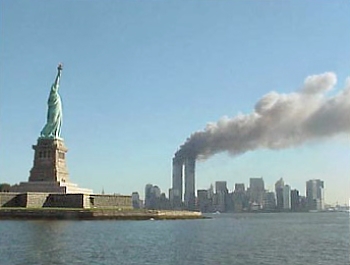
17 years ago today, on September 11, 2001, the world changed forever. In the wake of the terrorist attacks that killed nearly 3,000 people, a US-led coalition invaded Afghanistan, decimating al-Qaeda and toppling the Taliban, but staying on to lose hearts and minds in an apparently unending occupation in which we are still mired.
Within three months, Tony Blair was imprisoning foreign-born “terror suspects” without charge or trial in the UK, and exactly four months after the attacks, the Bush administration opened Guantánamo, its showcase prison for what happens when a vengeful nation led by belligerent ideologues historically fixated with the exercise of unfettered executive power and disdain for domestic and international laws and treaties rounds people up without competent battlefield reviews, instigates torture and embraces indefinite imprisonment without charge or trial on an industrial scale.
Two and a half years after 9/11, the Bush administration’s ideological “crazies,” aided and abetted by Tony Blair, compounded the Afghan quagmire by invading Iraq on the basis of lies, endorsing regime change over the rights of sovereign nations not to be invaded without good reason, and confirming 9/11 as the conduit for endless war — a dream for the military-industrial complex’s bureaucrats and arms manufacturers, and the growing mercenary armies of the west, but a disaster for everyone else. Read the rest of this entry »











 Who's still at Guantánamo?
