Archive for May, 2015
“Petty and Nasty”: Guantánamo Commander Bans Lawyers From Bringing Food to Share with Prisoners
 I wrote the following article for the “Close Guantánamo” website, which I established in January 2012 with US attorney Tom Wilner. Please join us — just an email address is required to be counted amongst those opposed to the ongoing existence of Guantánamo, and to receive updates of our activities by email.
In the latest news from Guantánamo, the prison’s military commander, Rear Adm. Kyle Cozad, has issued a memorandum banning lawyers for the prisoners from bringing food to meetings with their clients. The memorandum, entitled, “Modification to Rules Regarding Detainee Legal and Periodic Review Board Meetings,” states, “Food of any kind, other than that provided by guard force personnel for Detainee consumption, is prohibited within meeting spaces.”
That innocuous sounding ban is, nevertheless, a huge blow to many lawyers and prisoners. Since lawyers were first allowed to visit prisoners ten years ago, and to represent them, after the Supreme Court granted them habeas corpus rights in Rasul v. Bush in June 2004, it has been an opportunity for bonding between lawyers and prisoners, and an opportunity for the prisoners to receive something from the outside world, in a place where, initially, they were completely cut off from the outside world, and where, even now, over six years after Barack Obama became president, they are still more isolated than any other prisoners held by the US — unable, for example, to meet with any family members, even if their relatives could afford to fly there, and, in almost all cases, held without charge or trial in defiance of international norms.
As veteran Guantánamo reporter Carol Rosenberg explained in an article for the Miami Herald, “the custom of eating with a captive across a meeting table at Camp Echo — with the prisoner shackled by an ankle to the floor — took on cultural and symbolic significance almost from the start when lawyers brought burgers and breakfast sandwiches from the base McDonald’s to prison meetings in 2005.” Read the rest of this entry »
The Scandal of Demonising the Unemployed When There Aren’t Enough Jobs
 Last week, I received a comment on one of my articles from April 2013, The Tories’ Cruelty Is Laid Bare as Multiple Welfare Cuts Bite, from a reader — Rick — who, through no fault of his own, has found himself unemployed in a society that has been encouraged to regard anyone without a job as deserving of contempt, even though there are nowhere near enough job vacancies for everyone without a job — roughly one job vacancy for every three unemployed people if you take the government’s statistics at face value (and the statistics, it should be noted, hide an unknown number of people who have given up on trying to get a job and are supported by their partners).
The Tories claim to have created two million jobs since 2010, but those figures don’t stand up to scrutiny: there have been 500,000 job cuts in the public sector, average earnings have fallen by 5.7% in real terms, and far too many of those new jobs are on zero hours contracts, where people never know from one week to another whether they’ll be employed, and are rarely paid enough to live on, or are part-time jobs that also fail to provide a living wage.
The way this cruel and deeply cynical government has manipulated the public about the unemployed is just one example of the profoundly negative campaigning they have been encouraged to indulge in by their Australian PR guru, Lynton Crosby, and, to be frank, by the darkness in their own hearts. Read the rest of this entry »
Clive Stafford Smith Confirms That Shaker Aamer Could Be Released from Guantánamo in June
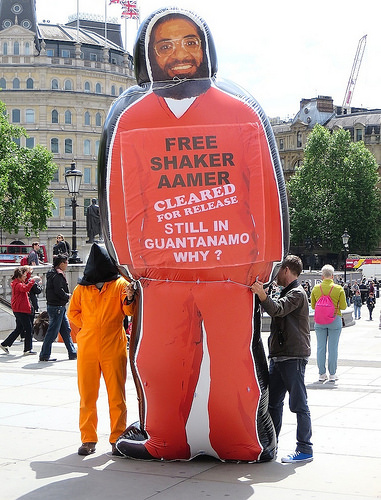 Back in April, the Washington Post suggested that ten prisoners were in line to be freed from Guantánamo in June, and that Shaker Aamer, the last British resident in the prison, “may be resettled as early as this summer.” A Saudi national, Shaker was granted indefinite leave to remain in the UK, where his wife, a British national, and his four children live, including his youngest son, born on the day he arrived at Guantánamo in February 2002.
The suggestion that he might be released soon gave hope to his supporters, who have been campaigning for years for his release — and, more generally, for those who are appalled that anyone should be held in Guantánamo year after year without charge or trial, and after twice being approved for release by high-level US government review processes, in 2007 and 2009, as is the case with Shaker, a vocal critic of the US “war on terror,” who has always fought for the prisoners’ rights throughout his 13 years in US custody.
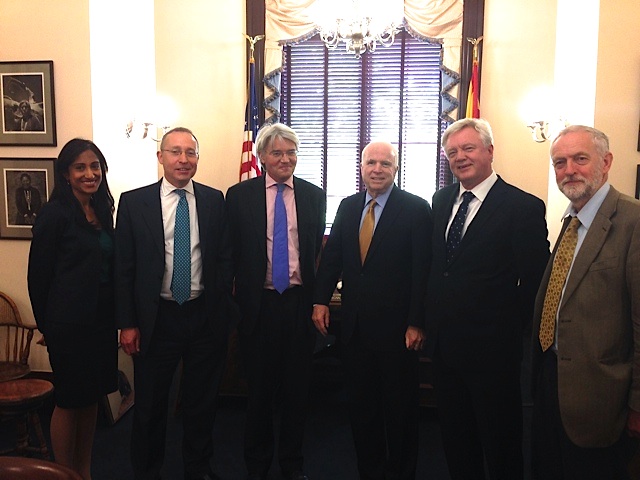
The suggestion that he might be released soon also gave impetus to the delegation of MPs that visited Washington, D.C. last week, meeting Senators including John McCain and Dianne Feinstein, and stressing the urgent need for a timetable for Shaker’s release — see, for example, the strong words of Andrew Mitchell MP, as reported in the Daily Mail just two days ago. Read the rest of this entry »
Incommunicado Forever: The Colossal Injustice of Torture Victim Abu Zubaydah’s Ongoing Imprisonment Without Charge or Trial at Guantánamo
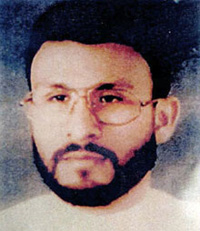 It’s been some time since I wrote about Abu Zubaydah (Zayn al-Abidin Muhammad Husayn), one of 14 “high-value detainees” transferred from secret CIA prisons to Guantánamo in September 2006, beyond discussions of his important case against the Polish government, where he was held in a secret CIA torture prison in 2002 and 2003. This led to a ruling in his favor in the European Court of Human Rights last July, and a decision in February this year to award him — and another Guantánamo prisoner and torture victim, Abd al-Rahim al-Nashiri — $262,000 in damages, for which, just last week, a deadline for payment was set for May 16, even though, as the Guardian noted, “neither Polish officials nor the US embassy in Warsaw would say where the money is going or how it was being used.”
I wrote extensively about Abu Zubaydah from 2008 to 2010, when there was generally little interest in his case, and I have also followed his attempts to seek justice in Poland since the investigation by a prosecutor began in 2010, leading to his recognition as a “victim” in January 2011, just before I visited Poland for a brief tour of the film I co-directed, “Outside the Law: Stories from Guantánamo,” with the former Guantánamo prisoner Moazzam Begg.
I have continued to follow Abu Zubaydah’s story in the years since, as other developments took place — when Jason Leopold, then at Al-Jazeera America, got hold of his diaries, which the US authorities had refused to release, and last December, when the executive summary of the Senate Intelligence Committee’s report into the CIA’s torture program was released, and one of Abu Zubaydah’s lawyers, Helen Duffy, wrote an article for the Guardian, entitled, “The CIA tortured Abu Zubaydah, my client. Now charge him or let him go.” This followed the revelations in the report that, if he survived his torture, his interrogators wanted assurances that he would “remain in isolation and incommunicado for the remainder of his life,” and senior officials stated that he “will never be placed in a situation where he has any significant contact with others and/or has the opportunity to be released.” Read the rest of this entry »
Former Guantánamo Prisoner Asim Al-Khalaqi Dies in Kazakhstan, Four Months After Being Freed
 Vice News broke the news on Thursday that Asim Thabit Abdullah al-Khalaqi, a Yemeni, and a former prisoner at Guantánamo, died in Kazakhstan, just over four months since he was freed, after spending 13 years in US custody without charge or trial.
The 46- or 47-year old, identified in Guantánamo as ISN 152, was one of five men freed on December 31, 2014, 13 years and one day after his capture, on December 30, 2001, in Pakistan. Three weeks later, he was flown to Guantánamo, less than two weeks after the prison opened.
As I explained in an article in 2012, entitled, “Guantánamo Scandal: The 40 Prisoners Still Held But Cleared for Release At Least Five Years Ago,” al-Khalaqi was approved for release under President Bush, as well as by President Obama’s high-level, inter-agency Guantánamo Review Task Force in 2009: Read the rest of this entry »
MPs Visit US to Discuss the Release of Shaker Aamer from Guantánamo with John McCain and Dianne Feinstein
 On Tuesday, in an open letter to President Obama and defense secretary Ashton Carter that I drafted, 13 rights groups, including Close Guantánamo and We Stand With Shaker, as well as Amnesty international USA, the Center for Constitutional Rights, Reprieve and others, called for the release of 57 men from Guantánamo (out of the 122 men still in the prison), who are still held despite being approved for release, the majority for over five years.
One of the 57 is Shaker Aamer, the last British resident in Guantánamo, and one of the reasons I initiated the letter was to coincide with a visit to Washington, D.C. by a delegation of British MPs, from the Shaker Aamer Parliamentary Group, which was established last November, and, in March, secured the support of the government for the following motion — “That this House calls on the US Government to release Shaker Aamer from his imprisonment in Guantánamo Bay and to allow him to return to his family in the UK.”
The MPs who flew to the US for meetings to try to secure Shaker’s release are the Labour MPs Jeremy Corbyn (a longtime colleague of the Shaker Aamer Parliamentary Group’s chair, John McDonnell) and Shadow Justice Minister Andy Slaughter, and the Conservative MPs David Davis (a former Shadow Home Secretary) and Andrew Mitchell (a former Chief Whip and former International Development Secretary). Read the rest of this entry »
Rights Groups Send An Open Letter to President Obama and Ashton Carter: Free the 57 Guantánamo Prisoners Approved for Release
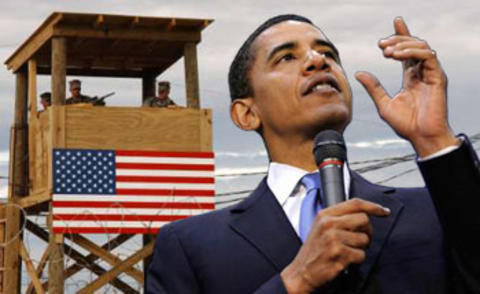 Below is an open letter that has just been made available by 13 human rights organizations and lawyers’ groups calling for immediate action by President Obama and defense secretary Ashton Carter to secure the release of the 57 men still held at Guantánamo (out of the 122 men still held) who have been cleared for release — or approved for transfer, in the administration’s careful words. The signatories also call on the administration to try or release the other men, and to move towards the eventual closure of the prison, as President Obama first promised when he took office in January 2009.
The spur for the letter, which I initiated on behalf of Close Guantánamo and We Stand With Shaker, is the second anniversary of President Obama’s promise to resume releasing prisoners from Guantánamo, after Congress raised legislative obstacles, which he made in a major speech on national security issues on May 23, 2013.
Also of great relevance is the arrival in Washington, D.C. today of a British Parliamentary delegation calling for the release and return to the UK of one of the 57, Shaker Aamer, the last British resident in the prison. The four MPs involved are the Conservative MPs David Davis and Andrew Mitchell, and the Labour MPs Andy Slaughter and Jeremy Corbyn, who are part of the cross-party Shaker Aamer Parliamentary Group, and they will be meeting administration officials and Senators to try to secure a timeline for Shaker Aamer’s release. Read the rest of this entry »
Retired Justice John Paul Stevens Calls for Compensation for the 57 Cleared Guantánamo Prisoners Still Held
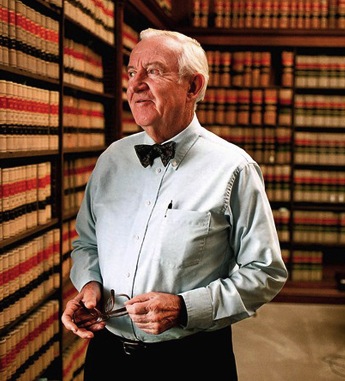 Last week, as three prominent Democratic Senators — Patrick Leahy, Dianne Feinstein and Dick Durbin — wrote to President Obama urging him to take urgent action to release the 57 men still held at Guantánamo who have been approved for release by high-level governmental review boards, and who, for the most part, have been waiting over five years to be freed, Justice John Paul Stevens, a Supreme Court Justice from 1975 until his retirement in 2010, made a speech at which he not only urged the release of these men, but also suggested that some of them may be due compensation for their long and ultimately unjustifiable ordeal. The 57 men make up almost half of the total of 122 men still held, and include, prominently, Shaker Aamer, the last British resident in the prison.
This is not, of course, the first time that former Justice Stevens, who is now 95 years old, has dealt with Guantánamo. When he retired, SCOTUSblog — the official Supreme Court blog — ran a series of articles about him, and in one of these articles, “Justice Stevens, Guantánamo, and the Rule of Law,” Daniel A. Farber, a law professor at Berkeley who clerked for him in 1976, explained the importance of his role in the 2004, 2006 and 2008 Supreme Court rulings that granted the prisoners habeas corpus rights (Rasul v. Bush in June 2004 and Boumediene v. Bush in June 2008, which I wrote about here), and that dealt with the legality — or rather the lack of it — of the military commission trial system at Guantánamo (Hamdan v. Rumsfeld in 2006).
Justice Stevens wrote the majority opinion in Rasul v. Bush, in which, almost two and a half years after Guantánamo opened, and after a long journey through the lower courts, the Supreme Court “held that the habeas statute covered Guantánamo,” and turned down the Bush administration’s argument that the prison was on foreign soil. Although Congress then passed legislation that purported to block the prisoners’ habeas rights, the ruling allowed lawyers to take on prisoners as clients, and to visit the prison, breaking through the veil of secrecy that had allowed torture and other forms of abuse to proceed unchecked. Read the rest of this entry »
Canadian Supreme Court Rules That Omar Khadr Was A Juvenile Prisoner, Not An Adult
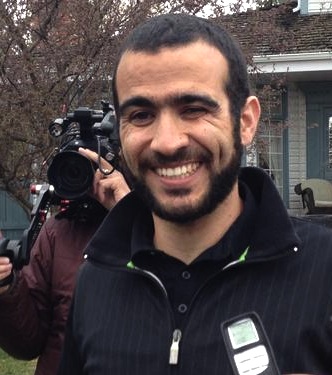 How much money will the Canadian government spend in its futile effort to demonize Omar Khadr? A week after the former child prisoner — now 28 years old — was freed on bail after nearly 13 years behind bars (ten years in Guantánamo, and the rest in Canada), winning over numerous Canadians with his humility as he spoke in public for the first time, the Canadian government, which had unsuccessfully argued that releasing him on bail would damage its relations with the US, faced another humiliating court defeat, this time in Canada’s Supreme Court.
The government was claiming that Omar — just 15 years old when he was seized after a firefight in Afghanistan, where he had been taken by his father — had been sentenced as an adult, not a juvenile. The intention was that, if Omar is to be returned to prison if his appeal against his conviction in the US fails (which, it should be noted, seems unlikely), he would be returned to a federal prison. The ruling followed an appeals court ruling in Omar’s favor last July, which I wrote about here.
However, the Supreme Court ruled that Omar had been sentenced as a juvenile, and that, if he were to be returned to prison, it would therefore be to a “provincial reformatory,” as the Globe and Mail described it. Read the rest of this entry »
What Does It Say About the Tories That They Want to Scrap Human Rights Legislation?
 After last Thursday’s General Election, as the Tories entrench themselves in power, without even the need of Lib Dem stooges to prop them up, we hear that the Cabinet spent a whole minute thumping the table at their first meeting, demonstrating a gracelessness and arrogance that is typical of the bullies, sociopaths and misfits who make up the upper echelons of the party.
Through our broken electoral system, the Tories have convinced themselves they have a mandate for even more of the destruction to the British state than they undertook over the last five years, propped up by the Lib Dems, even though the 50.9% of the seats that they took came with the support of just 24.4% of those eligible to vote.
The Tories’ relentless war on the British state and the British people
Since 2010, the Tories have been waging a relentless war on the British state, and on anyone who is not wealthy, privatising anything that was not already privatised, and using taxpayers’ money to make publicly owned enterprises more attractive to private buyers (as with the sell-off of the Royal Mail, for example), and also using taxpayers to fund huge vanity projects like the Olympics. Read the rest of this entry »












 Who's still at Guantánamo?
