Archive for June, 2012
A Powerful Interview with Former Guantánamo Prisoner Lakhdar Boumediene
 Last Saturday, the New York Times published an article based on an interview with former Guantánamo prisoner Lakhdar Boumediene, an Algerian whose case, Boumediene v. Bush, was regarded at the time as one of the most significant legal victories in the whole of the Bush administration’s “war on terror,” reversing Congressional attempts to strip the prisoners of the habeas rights that the Supreme Court had first granted them in June 2004.
Lakhdar Boumediene went on to become one of 28 prisoners freed as a result of winning their habeas corpus petitions in the District Court in Washington D.C., although that impressive run of victories for the prisoners from October 2008 to July 2010 was abruptly stopped in the summer of 2010 by right-wing judges in the D.C. Circuit Court — the court of appeals — who have insisted, for nakedly political reasons, in rewriting the rules of detention to ensure that no prisoner can now secure a victory in court and be released through legal means.
As well as being a well-known name in legal circles, Lakhdar Boumediene was also noteworthy in Guantánamo, as one of six unfortunate Algerian men seized nowhere near the battlefields of Afghanistan, but kidnapped by US agents in Bosnia-Herzegovina and flown to Guantánamo in January 2002. The kidnapping took place after a disgraceful episode of US paranoia, in which he and the other men — who had all settled in Bosnia-Herzegovina after traveling there during the Bosnian War of 1992-95 — were imprisoned for three months by the Bosnian authorities at the request of the Bush administration. They were then kidnapped on Bosnian soil after their release had been ordered by a Bosnian court, because there was no evidence whatsoever that they were involved in terrorism, or had, as the US initially alleged, been involved in plotting to blow up the US embassy in Sarajevo. Read the rest of this entry »
Remember the Battle of the Beanfield: It’s the 27th Anniversary Today of Thatcher’s Brutal Suppression of Traveller Society
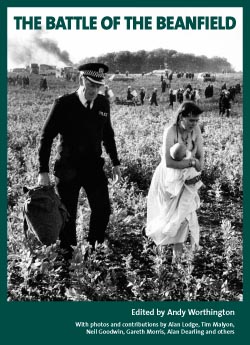 27 years ago, a convoy of vehicles driven by refugees from the chronic unemployment of Margaret Thatcher’s Britain — commonly described as new age travellers, but also including environmental and anti-nuclear activists and land reformers — was set upon by police from six counties and the MoD, en route to Stonehenge, to establish what would have been the 12th Stonehenge Free Festival, an anarchic annual event that drew tens of thousands of visitors every June.
Cornered in a field by the A303, the convoy members — including women and children — were eventually set upon by the police in a distressingly violent manner, albeit one that was typical of life under Thatcher, bearing remarkable similarities to the violence meted out to the miners at Orgreave, in South Yorkshire, the year before.
I was one of those visitors to the Stonehenge Free Festival in 1983 and 1984, and the freedom and anarchy I experienced there helped to shape my belief that there are many different ways to live, and that dissent is a vital part of any functioning democracy. However, in the year that followed the Battle of the Beanfield, laws were implemented to try to make sure that the right to gather freely — and in huge numbers — would never be able to happen again, although they were not immediately successful. The new age traveller culture was severely damaged, but dissent reemerged unexpectedly in the form of the acid house movement , or rave culture, and was followed by the road protest movement, and groups like Reclaim the Streets, which helped to fuel a worldwide anti-globalization movement by the late 1990s. Read the rest of this entry »












 Who's still at Guantánamo?
