Archive for December, 2010
Heroes and Villains in the Tuition Fees Vote
 In case anyone would like to send congratulations to MPs who bucked the party line in yesterday’s vote on raising tuition fees from £3,290 a year to £9,000 a year and withdrawing all funding from arts, humanities and social sciences — or something less complimentary to the Liberal Democrats responsible for securing the government’s victory — the following list may be useful. The vote was won by 323-302, so just 11 more dissenters were needed for the vote to have been lost.
The 21 Liberal Democrat MPs who voted against the rise in tuition fees
Annette Brooke (Dorset Mid & Poole North)
Sir Menzies Campbell (Fife North East), former Lib Dem leader
Michael Crockart (Edinburgh West)
Tim Farron (Westmorland & Lonsdale), Lib Dem party president
Andrew George (St Ives)
Mike Hancock (Portsmouth South)
Julian Huppert (Cambridge)
Charles Kennedy (Ross, Skye & Lochaber), former Lib Dem leader
John Leech (Manchester Withington)
Stephen Lloyd (Eastbourne)
Greg Mulholland (Leeds North West)
John Pugh (Southport)
Alan Reid (Argyll & Bute)
Dan Rogerson (Cornwall North)
Bob Russell (Colchester)
Adrian Sanders (Torbay)
Ian Swales (Redcar)
Mark Williams (Ceredigion)
Roger Williams (Brecon and Radnorshire)
Jenny Willott (Cardiff Central)
Simon Wright (Norwich South)
Particularly noteworthy are Michael Crockart and Jenny Willott, who both lost their jobs in the government as a result of putting principles above whatever it is that Nick Clegg and Vince Cable, in particular, regard as the acceptable realities of coalition politics.
Jenny Willott, who was Parliamentary Private Secretary to energy secretary Chris Huhne, wrote to the Lib Dem chief whip, Alistair Carmichael, explaining why she was resigning and voting against the government. “Whilst I support many aspects of the higher education proposals, including abolishing upfront fees for part-time students and the generous support for young people from less-privileged backgrounds,” she wrote, “I feel I can’t support the significant increase in the fee charged per year. As a result, I cannot support the overall package.” She continued, “It is with great sadness that I resign, as I fully support the coalition government and believe that the Liberal Democrats, with Nick in charge, are playing a crucial role in steering Britain towards a better future” (the last bit doesn’t ring true, somehow).
Earlier, Michael Crockart, the Parliamentary Private Secretary to Scotland Secretary Michael Moore, stated in his resignation letter, “I believe that access to higher education is a key enabler of social mobility and the best way to narrow the gap between the richest and poorest in society. I cannot therefore vote for a system which I believe puts barriers in the path of able students.”
The 27 Liberal Democrat MPs who voted for the rise in tuition fees
Ministers (15)
Danny Alexander (Inverness, Nairn, Badenoch and Strathspey), Chief Secretary to the Treasury
Norman Baker (Lewes), Parliamentary Under Secretary of State for the Department of Transport
Jeremy Browne (Taunton Deane), Minister of State for the Foreign and Commonwealth Office
Paul Burstow (Sutton & Cheam), Minister of State for the Department of Health
Vincent Cable (Twickenham), Secretary of State for Business, Innovation and Skills
Alistair Carmichael (Orkney & Shetland), Deputy Chief Whip to the House of Commons
Nick Clegg (Sheffield Hallam), Deputy Prime Minister
Edward Davey (Kingston & Surbiton), Parliamentary Under Secretary of State for the Department for Business, Innovation and Skills
Lynne Featherstone (Hornsey & Wood Green), Parliamentary Under Secretary of State (Minister for Equalities) for the Home Office
Nick Harvey (Devon North), Minister of State (Minister for the Armed Forces) for the Ministry of Defence
David Heath (Somerton & Frome), Parliamentary Secretary (Deputy Leader) to the Office of the Leader of the Commons
Michael Moore (Berwickshire, Roxburgh & Selkirk), Secretary of State for Scotland
Andrew Stunell (Hazel Grove), Parliamentary Under Secretary of State to the Department for Communities and Local Government
Sarah Teather (Brent Central), Minister of State for the Department for Education
Steve Webb (Thornbury and Yate), Minister of State to the Department for Work and Pensions
MPs (12)
Sir Alan Beith (Berwick-upon-Tweed)
Gordon Birtwistle (Burnley)
Tom Brake (Carshalton & Wallington)
Malcolm Bruce (Gordon)
Don Foster (Bath)
Stephen Gilbert (St Austell and Newquay)
Duncan Hames (Chippenham)
John Hemming (Birmingham Yardley)
Norman Lamb (Norfolk North)
David Laws (Yeovil)
Jo Swinson (Dunbartonshire East)
David Ward (Bradford East)
The 5 Liberal Democrat MPs who abstained
Lorely Burt (Solihull)
Simon Hughes (Bermondsey & Old Southwark), Lib Dem deputy leader
Tessa Munt (Wells)
John Thurso (Caithness, Sutherland & Easter Ross)
Stephen Williams (Bristol West)
And the 3 who were out of the country
Martin Horwood (Cheltenham)
Chris Huhne (Eastleigh), Secretary of State for Energy and Climate Change
Sir Robert Smith (Aberdeenshire West and Kincardine)
The Lib Dem teller, Mark Hunter (Cheadle) did not vote.
Of further interest:
The 6 Conservative MPs who voted against
David Davis (Haltemprice and Howden)
Philip Davies (Shipley)
Julian Lewis (New Forest East)
Jason McCartney (Colne Valley)
Andrew Percy (Brigg and Goole)
Mark Reckless (Rochester and Strood)
And the 2 Conservative MPs who abstained
Tracey Crouch (Chatham and Aylesford)
Lee Scott (Ilford North)
Of particular interest here is Lee Scott, the Parliamentary Private Secretary to the Transport Secretary, Philip Hammond, who resigned. He had initially signed a petition, circulated among MPs, promsing to vote against any increase in tuition fees, but he defended his decision on Tuesday, saying, “I think it is keeping to the pledge. I said I would not vote for higher fees and I’m not voting for higher fees.”
And finally, some comments from MPs:
Labour leader Ed Miliband: “I feel this is a bad day for families and young people up and down the country. I think it’s a bad day for democracy as well, because it doesn’t just damage trust in the Liberal Democrats that they broke their promises, frankly it damages trust in politics as a whole.”
Lib Dem deputy leader Simon Hughes: The “level of fee increase … may have a significant disincentive effect on youngsters going to university.”
Tory MP Julian Lewis: He said that if the government could not persuade the public about the increase, “it will be rejected. Even if you have a policy that you genuinely think is fair, if you cannot convince people that it is a fair policy, then it will fail. I would be deterred [by the fees rise]. I don’t want others to be.”
Lib Dem MP Greg Mulholland (who had tabled an amendment calling for the vote to be delayed): “Sometimes governments are wrong and sometimes you need the courage to say so and I am doing that today. I am voting against the government today because I simply cannot accept that fees of up to £9,000 are the fairest and most sustainable way of funding higher education.”
Shadow business secretary John Denham: “Even if they had just cut universities the way they are cutting other public services, students would be facing fees of no more than £4,000.”
Contact details for Liberal Democrat Ministers are here, and for MPs are here. Conservatives are here.
 Andy Worthington is the author of The Guantánamo Files: The Stories of the 774 Detainees in America’s Illegal Prison (published by Pluto Press, distributed by Macmillan in the US, and available from Amazon — click on the following for the US and the UK) and of two other books: Stonehenge: Celebration and Subversion and The Battle of the Beanfield. To receive new articles in your inbox, please subscribe to my RSS feed (and I can also be found on Facebook and Twitter). Also see my definitive Guantánamo prisoner list, updated in July 2010, details about the new documentary film, “Outside the Law: Stories from Guantánamo” (co-directed by Polly Nash and Andy Worthington, currently on tour in the UK, and available on DVD here), and my definitive Guantánamo habeas list, and, if you appreciate my work, feel free to make a donation.
Government Wins University Tuition Fees Vote, But So What? Remember the Poll Tax!
 After a heated debate in the House of Commons — and an even more heated protest outside the Houses of Parliament — the coalition government secured Parliamentary approval — by just 21 votes (323 to 302) — for savage cuts to the funding for university teaching, transferring the entire burden for arts, humanities and social sciences teaching onto students (which many people still do not realize), and raising fees from the current rate of £3,290 a year to as much as £9,000 a year.
Ever since the coalition government announced its plans, I have railed against this ideological destruction (under cover of the economic crisis triggered by bankers and corporate tax avoiders), in my articles, 50,000 Students Revolt: A Sign of Much Greater Anger to Come in Neo-Con Britain, Did You Miss This? 100 Percent Funding Cuts to Arts, Humanities and Social Sciences Courses at UK Universities, Cameron’s Britain: “Kettling” Children for Protesting Against Savage Cuts to University Funding and Biggest Student Protest on Thursday, as Parliament Votes on Tuition Fees.
Although I was unable to take part in the protest, as I had to attend a Q&A following a screening of the documentary “Outside the Law: Stories from Guantánamo” at UCL (the film I co-directed with Polly Nash), I promise that, like many, many other citizens, I will continue to regard this as a fundamental betrayal of young people — and of the principle that a caring State, rather than one based on a particularly callous and indifferent form of self-interest, recognizes that funding university education is good for society as a whole — and I pledge to remain involved in opposition to the implementation of these dangerous and fundamentally unfair plans.
I hope that the momentum of the protests is not lost after the vote, and that people will recall that the Poll Tax was also voted in by Parliament, but was subsequently withdrawn when the people of Britain refused to accept it, and rebelled in vast numbers. The last few weeks have seen the most extraordinary mobilization of schoolchildren, students, lecturers, other university staff, and concerned members of the public — some of whom received a subsidized university education, and who believe that society as a whole should prioritize university education, rather than turning it into an expensive lifestyle choice — and the temptation for determination to turn to despair must be resisted.
My feeling is that this growing movement of dissent will refuse to be quelled, driven, as it appears to be, by schoolchildren, for whom the goverment’s plans, their dubious concessions, and their mealy-mouthed attempts to justify tripling the cost of a degree as somehow “fair,” are completely unacceptable, and by students and other young people who are confronting the failures of the last 31 years of a rigged “free market,” now that the bubble has burst, and are realizing that, instead of making schoolchildren, students, the poor, the unemployed and the disabled pay for the deficit, we should first take aim at those whose greed caused the economic crisis in the first place, and those who, while still profiting enormously, are guilty of systematic tax evasion.
The gap between the rich and the poor in the UK is greater than at any time since the Second World War, and just last month the UN reported that the UK’s wealth gap is one of the highest in “the 30-plus countries that are members of the Organisation for Economic Cooperation and Development, a club for rich nations based in Paris.” Now that protestors have started to notice that the City has been given a free pass by the Tories and their descredited Lib Dem lackeys, and that promises to clamp down on corporate tax evasion are nothing more than soundbites, it shouldn’t be too hard for this new political movement — unaligned to any party — to maintain a focus on how to actually create a fairer society.
It is, I hope, just the start of a genuinely revolutionary time.
Andy Worthington is the author of The Guantánamo Files: The Stories of the 774 Detainees in America’s Illegal Prison (published by Pluto Press, distributed by Macmillan in the US, and available from Amazon — click on the following for the US and the UK) and of two other books: Stonehenge: Celebration and Subversion and The Battle of the Beanfield. To receive new articles in your inbox, please subscribe to my RSS feed (and I can also be found on Facebook and Twitter). Also see my definitive Guantánamo prisoner list, updated in July 2010, details about the new documentary film, “Outside the Law: Stories from Guantánamo” (co-directed by Polly Nash and Andy Worthington, currently on tour in the UK, and available on DVD here), and my definitive Guantánamo habeas list, and, if you appreciate my work, feel free to make a donation.
Anwar Al-Awlaqi: Judge Rules that President’s Decision to Assassinate US Citizens Abroad, Without Due Process or Explanation, is “Judicially Unreviewable”
 On Tuesday, in an extremely troubling ruling in the District Court in Washington D.C., Judge John D. Bates dismissed a lawsuit contesting what is described as President Obama’s “targeted killing” policy, but which is, in fact, a program to assassinate US citizens anywhere in the world, without explanation, and without the involvement of Congress or the judiciary.
The case concerns Anwar al-Awlaqi (aka al-Awlaki or al-Aulaqi), an American citizen living in Yemen, who “was placed on kill lists maintained by the CIA and the US military’s Joint Special Operations Command (JSOC) earlier this year,” as the Center for Constitutional Rights has explained. Al-Awlaki was also labeled as a “specially designated global terrorist” on July 16, even though, behind the rhetoric, doubts have been expressed about his significance, which make it obvious that there are profound problems in allowing the executive branch to have the unfettered power to decide when American citizens should be designated for assassination.
As Gregory Johnsen, a doctoral candidate in Near Eastern studies at Princeton University, who writes the blog Waq al-Waq, explained in an op-ed for the New York Times on November 19:
[N]o one should remain under the mistaken assumption that killing Mr. Awlaki will somehow make us safer. He is far from the terrorist kingpin that the West has made him out to be. In fact, he isn’t even the head of his own organization, Al-Qaeda in the Arabian Peninsula. That would be Nasir al-Wuhayshi, who was Osama bin Laden’s personal secretary for four years in Afghanistan … Mr. Awlaki isn’t the group’s top religious scholar (Adil al-Abab), its chief of military operations (Qassim al-Raymi), its bomb maker (Ibrahim Hassan Asiri) or even its leading ideologue … Rather, he is a midlevel religious functionary who happens to have American citizenship and speak English. This makes him a propaganda threat, but not one whose elimination would do anything to limit the reach of the Qaeda branch.
The lawsuit was submitted in August by the ACLU and CCR on behalf of Anwar al-Awlaqi’s father, Nasser al-Awlaqi, against President Obama, CIA Director Leon Panetta, and Defense Secretary Robert Gates, challenging their decision to authorize the “targeted killing” of Anwar Al-Awlaqi as a violation of the Constitution and international law.
Quite how Judge Bates reached his conclusion is beyond me. On technical grounds, it may well be that, as the ACLU explained, “the plaintiff did not have legal standing to challenge the targeting of his son,” but I fail to understand how Judge Bates also concluded “that there are circumstances in which the Executive’s unilateral decision to kill a US citizen overseas is ‘constitutionally committed to the political branches’ and judicially unreviewable.”
Over nine years after the 9/11 attacks that prompted the Bush adminstration to launch the “War on Terror” that is clearly alive and well in the United States, despite a change of administration, it appears that the merest mention of “war” and “the executive” in the same breath is enough to send otherwise sane and responsible judges scuttling to abdicate their responsibilities.
Judge Bates, to be sure, made a show of struggling with this particular problem — before giving up on it. Referring to his conclusion about executive power, he acknowledged “the somewhat unsettling nature of its conclusion” and, as the ACLU explained, he also
called the case “unique and extraordinary,” said it presented “[s]tark, and perplexing, questions” and found that the merits “present fundamental questions of separation of powers involving the proper role of the courts in our constitutional structure.” Ultimately, however, he dismissed the case on procedural grounds and found that “the serious issues regarding the merits of the alleged authorization of the targeted killing of a US citizen overseas must await another day.”
Unanswered, therefore, are the answers to three important questions posed by the ACLU and CCR:
Outside of the context of armed conflict, should it not be the case that the government can only carry out the “targeted killing” of an American citizen “as a last resort to address an imminent threat to life or physical safety”?
Why did the court not order the government to disclose the legal standard it uses to place US citizens on government kill lists?
and
“How is it that judicial approval is required when the United States decides to target a US citizen overseas for electronic surveillance, but that, according to defendants, judicial scrutiny is prohibited when the United States decides to target a US citizen overseas for death?”
After the ruling, CCR attorney Pardiss Kebriaei stated, “The court refused to hear a claim on behalf of a US citizen under threat of death by his own government that his personal constitutional rights have been violated — exactly what the court itself acknowledges it appears no court has ever done.” She added, “The court’s holding on the political question doctrine is indeed ‘unsettling.'”
In addition, Jameel Jaffer, Deputy Legal Director of the ACLU, said:
If the court’s ruling is correct, the government has unreviewable authority to carry out the targeted killing of any American, anywhere, whom the president deems to be a threat to the nation. It would be difficult to conceive of a proposition more inconsistent with the Constitution or more dangerous to American liberty. It’s worth remembering that the power that the court invests in the president today will be available not just in this case but in future cases, and not just to the current president but to every future president. It is a profound mistake to allow this unparalleled power to be exercised free from the checks and balances that apply in every other context. We continue to believe that the government’s power to use lethal force against American citizens should be subject to meaningful oversight by the courts.
This is not the end of the story, of course, as there will undoubtedly be an appeal. In the meantime, perhaps someone close to the administration might like to draw attention to the conclusion reached by Gregory Johnsen in hs recent op-ed:
[U]ntil the Obama administration put him on its hit list, [Anwar al-Awlaqi] had little standing in the Arab world. Now, however, Al-Qaeda in the Arabian Peninsula is taking advantage of this free advertising. No propaganda from the group had ever mentioned his name before it was reported in January that the United States had decided he could be legally assassinated. Shortly after, an article in the official Qaeda journal trumpeted that Mr. Awlaki had not been killed in December, as had been reported, in an air attack on a gathering in Shabwa Province.
So now that it has given Mr. Awlaki such a high profile, the administration is in a bind: if it ignores him, it will look powerless; if it succeeds in killing him, it will have manufactured a martyr. The best way out is to redouble its efforts to track down the real, more dangerous leaders of the Yemen group like Mr. Wuhayshi and Mr. Asiri, who likely made the bombs used in the [recent, foiled] parcel attacks and carried by Umar Farouk Abdulmutallab, the so-called Christmas Day bomber.
Mr. Awlaki’s name may be the only one Americans know, but that doesn’t make him the most dangerous threat to our security.
Moreover, when it comes to losing the propaganda war, someone close to the administration might also want to mention that it is nearly a year since, in the wake of the failed Christmas Day bombing, President Obama capitulated to Republican hysteria and announced a moratorium on the release of any more Yemenis from Guantánamo, even though the Guantánamo Review Task Force convened by President Obama had recommened that 29 of those held could be immediately released to Yemen — and that 30 more could be released if the security situation improved.
I have problems with the conditions attached to the release of those 30, but a more urgent problem is the fate of the 29 others recommended for immediate release. One of these men — Mohammed Hassan Odaini, a transparently innocent student seized by mistake — was freed last July after he won his habeas corpus petition, but the rest are still held, adding not to America’s security, but to a feeling of ill-will in Yemen, where people have, rightly, concluded that the entire population has been tarred as terrorist sympathzers, and where the cleared Yemenis can, in all honesty, only be regarded as political prisoners.
Andy Worthington is the author of The Guantánamo Files: The Stories of the 774 Detainees in America’s Illegal Prison (published by Pluto Press, distributed by Macmillan in the US, and available from Amazon — click on the following for the US and the UK) and of two other books: Stonehenge: Celebration and Subversion and The Battle of the Beanfield. To receive new articles in your inbox, please subscribe to my RSS feed (and I can also be found on Facebook and Twitter). Also see my definitive Guantánamo prisoner list, updated in July 2010, details about the new documentary film, “Outside the Law: Stories from Guantánamo” (co-directed by Polly Nash and Andy Worthington, currently on tour in the UK, and available on DVD here), and my definitive Guantánamo habeas list, and, if you appreciate my work, feel free to make a donation.
As published exclusively on Cageprisoners.
Andy Worthington Discusses Guantánamo and WikiLeaks on Antiwar Radio
 A few days ago, I spoke — for the 21st time — with the irrepressible Scott Horton for his show on Antiwar Radio, which is available here. Over the course of 18 minutes, we discussed why my contentiously entitled article, The Irrelevance of Wikileaks’ Guantánamo Revelations, was intended to provoke interest in the reasons why the main WikiLeaks revelations about Guantánamo — detailing the often shabby horse-trading with countries around the world, as the Obama administration sought third countries to take cleared prisoners who could not be repatriated because they faced the risk of torture — was only necessary because of the refusal of every part of the US government — the Obama administration, Congress and the courts — to give homes to any of these men on the US mainland.
We also spoke about the 58 Yemenis, cleared for release by President Obama’s Guantánamo Review Task Force, but still held, apparently forever, because of an unprincipled moratorium, preventing the release of any Yemenis, which President Obama issued last January after being subjected to ridiculous hysteria following the failed Christmas Day bomb plot by a hapless Nigerian recruited in Yemen.
We also spoke about how the proposed trials of 34 Guantánamo prisoners have ground to a halt, because the left hates the Military Commissions (with extremely good reason, as the recent show trial of Omar Khadr showed), and the right hates federal court trials for men they insist on regarding as “warriors,” even though terrorists are criminals, and federal court trials actually have a proven track record of convicting terrorists more successly than the blighted Commissions.
We also spoke about the relentless negative campaigning of the Republican Party, and its barking mad advocates of a worldview still dominated by Dick Cheney, and ran through some regular talking points of mine and Scott’s, including the significance of the Authorization for Use of Military Force, still used to justify holding men neither as prisoners of war or as criminal suspects; the important role played by White House Counsel Greg Craig in the early months of Obama’s Presidency, who provided principles and courage that have since been abandoned, and who lost his job as a result when Obama decided that doing nothing was easier than doing what was right; and the lies that Dick Cheney told when he was torturing “terror suspects” to get false confessions to justify the invasion of Iraq, while pretending that the CIA torture program was designed to prevent another terrorist attack on US soil.
This is how Scott described the show:
Andy Worthington, author of The Guantánamo Files, discusses the WikiLeaks-revealed US negotiations to offload Guantánamo inmates scheduled for release; why resettling wrongfully-imprisoned Guantánamo detainees in the US remains politically impossible; how Obama can’t — or won’t — stand up to Republicans who won’t countenance the possibility of closing Gitmo and holding terrorism trials in federal courts; and the large portion of Americans subscribing to Sarah Palin’s fact-free worldview.
I hope you enjoy the show, if you have 18 minutes to spare. It’s always good to talk with Scott, and I look forward to the next time.
Andy Worthington is the author of The Guantánamo Files: The Stories of the 774 Detainees in America’s Illegal Prison (published by Pluto Press, distributed by Macmillan in the US, and available from Amazon — click on the following for the US and the UK) and of two other books: Stonehenge: Celebration and Subversion and The Battle of the Beanfield. To receive new articles in your inbox, please subscribe to my RSS feed (and I can also be found on Facebook and Twitter). Also see my definitive Guantánamo prisoner list, updated in July 2010, details about the new documentary film, “Outside the Law: Stories from Guantánamo” (co-directed by Polly Nash and Andy Worthington, currently on tour in the UK, and available on DVD here), and my definitive Guantánamo habeas list, and, if you appreciate my work, feel free to make a donation.
WikiLeaks’ Revelations that Bush and Obama Put Pressure on Germany and Spain Not to Investigate US Torture
 In the relatively small number of US diplomatic cables released to date by WikiLeaks, from its cache of 251,287 documents, the most disturbing revelations concerning the “War on Terror” deal with the pressure that the Bush administration exerted on Germany in 2007, regarding the planned prosecution of thirteen CIA agents involved in the rendition and torture of Khaled El-Masri, a German citizen seized as a result of mistaken identity, and the pressure that the Obama administration exerted on the Spanish government in 2009, to derail a criminal investigation into the role played by six senior Bush administration lawyers in establishing the policies that governed the interrogation — and torture — of prisoners seized in the “War on Terror.”
Neither of these developments had been reported prior to the release of the cables by WikiLeaks, and they are therefore extremely significant in establishing how long Bush administration officials were involved in fending off torture investigations overseas, and how eagerly Obama administration officials took up this role.
Suppression of a torture inquiry in Germany
In the first cable, sent to Secretary of State Condoleezza Rice from Berlin on February 6, 2007, by John M. Koenig, the senior career diplomat at the US Embassy in Berlin, following discussions with Rolf Nikel, the deputy national security advisor for Germany, Koenig explained how he emphasized to Nikel that “issuance of international arrest warrants would have a negative impact on our bilateral relationship.” In addition, he “reminded Nikel of the repercussions to US-Italian bilateral relations in the wake of a similar move by Italian authorities last year” (in the case of Abu Omar, discussed below), and “pointed out that our intention was not to threaten Germany, but rather to urge that the German Government weigh carefully at every step of the way the implications for relations with the US.”
 What makes this thinly-veiled threat seem particularly harsh is the fact that El-Masri is the clearest case of mistaken identity in the whole of the “War on Terror.” Confused with another man of the same name who had liaised with the 9/11 kidnappers, he was seized in Macedonia as he tried to enter the country on a vacation on New Year’s Eve, 2002, and was then sent to the CIA’s notorious “Salt Pit” prison in Afghanistan, where he was “repeatedly beaten, drugged, and subjected to a strange food regime that he supposed was part of an experiment that his captors were performing on him” (as described by Scott Horton of Harper’s), until the CIA realized it had made a mistake, and reluctantly set him free, dropping him off in Albania and obliging him to make his own way home, and to try to put together the pieces of his shattered life.
Suppression of a torture inquiry in Spain
The second cable, dated April 17, 2009, and sent from Madrid, explained how US officials had manipulated Spanish officials to suppress an investigation into six former Bush administration lawyers — Attorney General Alberto Gonzales, David Addington, former chief of staff and legal adviser to Vice President Dick Cheney, William Haynes, the Pentagon’s former general counsel, Douglas Feith, former undersecretary of defense for policy, Jay Bybee, the former head of the Justice Department’s Office of Legal Counsel, and John Yoo, a former official in the Office of Legal Counsel — for “creating a legal framework that allegedly permitted torture.” A Spanish human rights group had filed the complaint the month before, contending that Spain had a duty to open an investigation under its “universal jurisdiction” law.
The cable reveals how US officials immediately began sounding out Spanish officials, and how, on April 15, an apparently unlikely figure for the Obama administration to embrace — Sen. Mel Martinez (R-Fla.), who had recently been chairman of the Republican Party — attended a meeting between the US embassy’s charge d’affaires and the acting Spanish foreign minister, Angel Lossada, at which the Americans, repeating the same threatening language used in Germany in 2007, “underscored that the prosecutions would not be understood or accepted in the US and would have an enormous impact on the bilateral relationship” between Spain and the United States.
As the cable decribed it, “Lossada responded that the [Spanish government] recognized all of the complications presented by universal jurisdiction, but that the independence of the judiciary and the process must be respected.” However, he added that the government “would use all appropriate legal tools in the matter,” and that, although “it did not have much margin to operate,” would advise the Spanish Attorney General, Cándido Conde-Pumpido, that “the official administration position was that the [government] was ‘not in accord with the National Court.'”
The next day, Attorney General Conde-Pumpido “publicly stated that prosecutors will ‘undoubtedly’ not support [the] criminal complaint,” adding that he would “not support the criminal complaint because it is ‘fraudulent,’ and has been filed as a political statement to attack past [US government] policies.” He added that, “if there is evidence of criminal activity by [US government] officials, then a case should be filed in the United States.” In the cable, officials at the US embassy in Madrid congratulated themselves for their successful involvement in the case, noting that “Conde Pumpido’s public announcement follows outreach to [Spanish government] officials to raise [the US government’s] deep concerns on the implications of this case.”
This was not quite the end of the story, as Conde-Pumpido had specifically taken aim at Investigating Judge Baltasar Garzón, “a world-renowned jurist,” who, as David Corn explained in an article for Mother Jones, “had initiated previous prosecutions of war crimes and had publicly said that former President George W. Bush ought to be tried for war crimes.” Garzón pressed ahead with the prosecution in September 2009, but when he ran into domestic problems, triggered by his enthusiasm for investigating war crimes committed under General Franco, the case was assigned to another judge, and the trail has since gone quiet. As David Corn explained, “The Obama administration essentially got what it wanted. The case of the Bush Six went away.”
Supression of torture inquiries in the US — and an unexpected conviction in Italy
As a result of these revelations, it is clear that the US government — under Bush and Obama — has been largely successful in preventing the prosecution of anyone involved in the horrendous human rights abuses initiated in the “War on Terror,” not just abroad, but also in the US. In the last year, fulfilling his “belief that we need to look forward as opposed to looking backwards,” which he expressed in January 2009, the week before he took office, President Obama has presided over the whitewash of a damning internal Justice Department report into John Yoo and Jay S. Bybee (who wrote and approved the notorious “torture memos” of August 2002, which attempted to redefine torture, so that it could be used by the CIA), and has cynically resorted to manipulating the little known and little used “state secrets” privilege to prevent the merest whisper of evidence regarding the torture of foreign prisoners to be discussed in a US court.
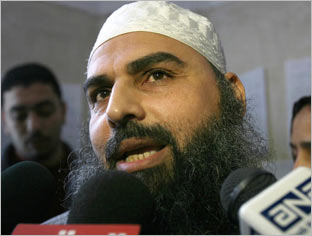 One unexpected exception to this global clampdown is Italy, where 22 CIA operatives and a US Air Force Colonel were convicted in absentia, in November 2009, for their part in the kidnapping, in broad daylight in a street in Milan on February 17, 2003 of the cleric Abu Omar, who was then rendered to Egypt, where he was subjected to horrific torture. The US government, of course, refused to allow these operatives to be extradited to Italy to face justice, but the ruling remains a permanent black mark against the Bush administration, which can never be washed away or concealed, and the entire sordid story has recently been covered, in extraordinary detail, by Steve Hendricks in his book, A Kidnapping in Milan: The CIA on Trial.
Trouble ahead in Spain, Germany, Macedonia, Lithuania, Poland and the UK
Moreover, it may be that, despite the success of the US efforts in Germany and Spain, further troubles lie ahead in both countries. In May 2010, Spain picked up where Germany left off regarding the prosecution of the thirteen CIA agents responsible for the torture of Khaled El-Masri, when prosecutors attached to the Audiencia Nacional in Madrid asked a judge to issue an order for the agents’ arrest, and, as Scott Horton also reported at the time, “A criminal proceeding relating to the kidnapping and torture of El-Masri is also underway in Germany.”
In addition, in 2009, as Amrit Singh of the Open Society Justice Initiative explained in a recent article on the Huffington Post, the OSJI filed an application on El-Masri’s behalf against the Macedonian government before the European Court of Human Rights. Singh continued:
In October 2010, the European Court communicated the case to the Macedonian government. This is a significant development, as only about ten percent of all cases brought before the European Court get communicated. Perhaps even more significant is the fact that the European Court has asked the Macedonian government a set of pointed questions, including whether agents of the Macedonian government detained El-Masri and subjected him to torture or cruel inhuman or degrading treatment; whether Macedonian government agents handed him over to a CIA rendition team; whether the Macedonian government was aware that El-Masri faced a real risk of being subjected to torture or cruel inhuman or degrading treatment if transferred to the Salt Pit; and whether Macedonia had conducted an effective official investigation of this case.
In addition, it is possible that further problems — which seem already to have gone beyond the reach of US diplomatic bullying — relate to investigations in Lithuania, Poland and the UK.
As Amnesty International noted in its recent report, “Open secret: Mounting evidence of Europe’s complicity in rendition and secret detention,” Lithuania, whose role as the host of a secret CIA prison in Europe — along with Poland and Romania — was most recently exposed in a United Nations report on secret detention, “has admitted that two secret prisons existed.” Significantly, “The prisons were visited in June 2010 by a delegation from the European Committee for the Prevention of Torture, the first visit by an independent monitoring body to a secret CIA prison in Europe,” and a criminal investigation is ongoing.
Although Romania continues to deny hosting a secret prison, it is implicated in documents issued by Poland’s Border Guard Office in July 2010, which, as I explained in an article at the time, provided, for the first time, “details of the number of prisoners transferred by the CIA to a secret prison in Poland between December 5, 2002 and September 22, 2003, and, in one case, the number of prisoners who were subsequently transferred to a secret CIA prison in Romania.” The revelations led immediately to claims that former Prime Minister Leszek Miller and former President Aleksander Kwasniewski “may face war crime charges for agreeing to host the facility,” and in September, as Amnesty described it, “the prosecutor’s office confirmed that it was investigating claims by Abd al-Rahim al-Nashiri [one of 14 “high-value detainees eventually transferred to Guantánamo, in September 2006], that he was held in secret in Poland.” Moreover, al-Nashiri “was granted ‘victim’ status in October 2010, the first time a rendition victim’s claims have been acknowledged in this context.”
 In the UK, British complicity in US torture has been acknowledged, through the deliberations of judges, since August 2008, when two high court judges, Lord Justice Thomas and Mr. Justice Lloyd Jones, found that the British government had been involved in “wrongdoing” in the case of Binyam Mohamed, a British resident who spent over two years being tortured in Pakistan, Morocco and the CIA’s “Dark Prison” in Kabul, before he was sent to Guantánamo. Mohamed was released in February 2009 — in the hope, shared by both the British and the American governments, that his release would shut down any further interest in his case — but in fact Lord Justice Thomas and Mr. Justice Lloyd Jones continued to fight against foreign secretary David Miliband’s refusal to allow them to release a summary of documents provided by the US, relating to Mohamed’s treatment by US agents in Pakistan.
Finally in February this year, 18 months after their initial ruling, the Court of Appeal ordered the documents to be released, and it was finally revealed that the summary described a range of techniques, which, in the judges’ opinion, “could readily be contended to be at the very least cruel, inhuman and degrading treatment by the United States authorities,” including “continuous sleep deprivation,” combined with “threats and inducements,” including the threat of “disappearing.” As the judges also explained, “the stress brought about by these deliberate tactics” was “causing him significant mental stress and suffering,” to the extent that he was being “kept under self-harm observation.”
Although a Metropolitan Police investigation was launched into Mohamed’s allegations, this investigation recently concluded with an announcement that there was insufficient evidence to prosecute the MI5 officer, known as Witness B, “for any criminal offence arising from the interview of Binyam Mohamed in Pakistan on 17 May 2002.”
However, the larger picture of British complicity in torture has refused to go away. Three weeks ago, the British government announced that it had reached a substantial financial settlement with 15 former Guantánamo prisoners — and with one man, Shaker Aamer, who is still held — to staunch the flow of dangerous documents being released as part of a civil claim for damages brought by a number of former prisoners. These had already revealed uncomfortable truths about the complicity in torture of former Prime Minister Tony Blair and former foreign secretary Jack Straw, and although David Cameron, the Prime Minister of the new coalition government, hopes to prevent any further damning revelations emerging, by announcing that a judicial inquiry into British complicity in torture will be held, directed by Sir Peter Gibson, who was previously responsible for overseeing the conduct of the security services, it is by no means certain that the inquiry will be able to halt further revelations, some of which may well involve the US.
It may be that further documents in WikiLeaks’ cache of diplomatic cables deal with the torture problems encountered in the UK since 2008, and with some of the other cases mentioned above, and it is also worth reflecting that, for the foreseeable future, diplomats may find it harder than before to exert pressure to suppress evidence of US torture, having suffered something of a hammer blow to their credibility through the documents released to date.
As a result, this is probably a good time for those in other countries who wish to hold the US government accountable for torture to press ahead with their claims and their cases, and if this is so, then on this point alone WikiLeaks’ disclosures will have been invaluable.
Andy Worthington is the author of The Guantánamo Files: The Stories of the 774 Detainees in America’s Illegal Prison (published by Pluto Press, distributed by Macmillan in the US, and available from Amazon — click on the following for the US and the UK) and of two other books: Stonehenge: Celebration and Subversion and The Battle of the Beanfield. To receive new articles in your inbox, please subscribe to my RSS feed (and I can also be found on Facebook and Twitter). Also see my definitive Guantánamo prisoner list, updated in July 2010, details about the new documentary film, “Outside the Law: Stories from Guantánamo” (co-directed by Polly Nash and Andy Worthington, currently on tour in the UK, and available on DVD here), and my definitive Guantánamo habeas list, and, if you appreciate my work, feel free to make a donation.
As published exclusively on the website of the Future of Freedom Foundation, as “Wikileaks: Suppressing the Investigation of Torture.” Cross-posted on The Public Record, The World Cant Wait and Uruknet. Also see the link on the website of the Center for Constitutional Rights.
Urge Your MP to Sign Caroline Lucas’ Early Day Motion Calling for the Return of Shaker Aamer and the Closure of Guantánamo
 With just five weeks to go before Guantánamo will have been open for nine years, and with Shaker Aamer, the last British resident in the prison, still held, the time is ripe for MPs to sign up to an Early Day Motion submitted by Caroline Lucas, Parliament’s only Green MP and a formidable campaigner for social justice, to put pressure on the government to secure Shaker Aamer’s return, and to help President Obama close the prison by accepting other cleared prisoners who cannot be safely repatriated. These men include Ahmed Belbacha, an Algerian, cleared since 2007, who lived and worked in the UK before he took an ill-timed holiday to Pakistan in 2001, and who is terrified of returning to his home country, which he fled because he had been threatened by Islamists while working for a state-owned oil company.
Accepting other cleared prisoners — and, in particular, Ahmed Belbacha — is something I have been advocating for a long time, as, despite being the Bush administration’s closest ally in the “War on Terror,” the UK has failed to join 16 other countries, throughout Europe and beyond, and including France, Germany, Ireland and Switzerland, who have given new homes to 37 cleared prisoners who could not be repatriated because they face the risk of torture in their home countries.
At the latest count, up to 33 of the 174 men remaining in Guantánamo fit into this category, and it would be a fine humanitarian gesture for the UK to take some of these men. It is also possible that some of the 58 cleared Yemenis who are currently prevented from returning home, because of a moratorium issued by President Obama in January this year, are also looking for a new home.
However, the most urgent thrust of Caroline Lucas’ EDM concerns Shaker Aamer, also cleared for release in 2007. For many years, his lawyers have been obliged to conclude that he is still held because of the extent of his knowledge about the darkest truths of Guantánamo, and abuses elsewhere in US custody in the “War on Terror.” Shaker learned about these abuses as the foremost advocate of the prisoners’ rights in Guantánamo, and, as a result, he was singled out for brutal treatment.
Since last month, however, when he was included in a financial settlement that the British government reached with 15 other Guantánamo prisoners (all of whom have been released), to stem the flow of dangerously revealing information about the complicity in torture of Tony Blair and Jack Straw as part of a civil claim for damages filed by a number of former prisoners, his continued detention makes no sense.
A Metropolitan Police investigation, triggered by a court case a year ago in which his allegations were first aired that British agents were present in the room when he was tortured in US custody in Afghanistan, cannot conclude without his presence, and without a conclusion to the investigation, David Cameron cannot launch the judicial inquiry into British complicity in torture abroad that he wants to initiate to “draw a line” under the whole sordid affair.
Please contact your MP (via Write ToThem, or via the UK Parliament website) to ask them to support Caroline Lucas’ EDM, which, at present has been signed by just 12 MPs: Caroline Lucas, the Tory MP Peter Bottomley, the Labour MPs Jeremy Corbyn, Martin Caton, John McDonnell, Marsha Singh and Michael Connarty, the Liberal Democrat MP Mike Hancock, the Plaid Cymru MPs Elfyn Llwyd and Jonathan Edwards, and the Social Democrat and Labour MPs Mark Durkan and Alasdair McDonnell.
The text of Caroline Lucas’ EDM (EDM 1093 — Guantánamo Bay) is as follows:
That this House:
– notes with regret that President Obama’s pledge to close the US Military Detention Centre at Guantánamo Bay by January 2010 is almost one year overdue and little closer to realisation;
– welcomes gestures by other European States to accommodate and receive innocent prisoners who have been cleared for release to help close the facility;
– notes with dismay that on 11 January 2011 the detention facility will have been open for nine years and that British resident Shaker Aamer has now been held there without charge or trial for almost the same length of time;
– urges the Government to step up its action to secure his release without further delay;
– and further notes the case of Ahmed Belbacha, previously resident in the UK and facing the imminent threat of forced return to his native Algeria where there are fears he will face abuse of his human rights;
– applauds the lead taken by countries such as Ireland, France, Spain, Germany and Bulgaria, who have accepted prisoners cleared for release from Guantánamo Bay by the US authorities on humanitarian grounds but who cannot return to their country of origin;
– and urges the Government to take similar measures to accept a number of such cleared prisoners.
Andy Worthington is the author of The Guantánamo Files: The Stories of the 774 Detainees in America’s Illegal Prison (published by Pluto Press, distributed by Macmillan in the US, and available from Amazon — click on the following for the US and the UK) and of two other books: Stonehenge: Celebration and Subversion and The Battle of the Beanfield. To receive new articles in your inbox, please subscribe to my RSS feed (and I can also be found on Facebook and Twitter). Also see my definitive Guantánamo prisoner list, updated in July 2010, details about the new documentary film, “Outside the Law: Stories from Guantánamo” (co-directed by Polly Nash and Andy Worthington, currently on tour in the UK, and available on DVD here), and my definitive Guantánamo habeas list, and, if you appreciate my work, feel free to make a donation.
As published exclusively on Cageprisoners.
“A Day for Shaker Aamer” on Saturday — and Postcards to Send to William Hague and to Shaker in Guantánamo
 I have been mentioning Saturday’s event, “A Day for Shaker Aamer,” for many weeks, in articles promoting screenings of “Outside the Law: Stories from Guantánamo,” the documentary I co-directed with Polly Nash, which is being shown on Saturday (Click on the image to enlarge the poster). However, with just four days to go I thought it was time to promote the event specifically. If you’re in London, or anywhere else in the UK and able to travel, then do come along to what promises to be an excellent day devoted to making such a big noise about Shaker’s ongoing and unacceptable detention that the government will have to take notice.
As I have explained on numerous occasions, the failure of the British government to secure Shaker’s return to the UK has been unacceptable since at least 2007, when he was cleared for release by a US military review board, and has been intolerable since, three weeks ago, the coalition government reached a financial settlement with 15 former Guantánamo prisoners, and also with Shaker, to bring to an end a civil claim for damages filed by a number of these men. As I explained in a recent article, this “threatened to wash away the last vestiges of credibility still retained by the government and the security services after disturbing revelations in the case of Binyam Mohamed — a British resident subjected to ‘extraordinary rendition’ and torture — emerged in the Court of Appeal in February.”
As I also explained:
In summer, the first of 500,000 classified documents were released by the court in connection with the civil claim, revealing shocking information about the involvement of Jack Straw and Tony Blair in actively depriving prisoners of their rights, and terrifying the government into making the financial settlement. Tacitly, of course, the settlement also serves as an admission of guilt on the part of the government and the security services, but although it provides some sort of closure for the 15 released prisoners, it still leaves Shaker in limbo.
Shaker needs to be returned immediately to agree his part of the settlement, and also so that an ongoing Metropolitan Police investigation into his claims that British agents were present when he was tortured in US custody in Afghanistan can be concluded. Without this, as David Cameron has conceded, the government’s alternative to the civil claim — a judicial inquiry into British complicity in torture, headed by Sir Peter Gibson — cannot even begin.
As a result, the only convincing explanation for why Shaker is not already back in the UK is that neither the US nor the UK governments can let go of their entrenched position, established over many years, in which Shaker’s release is something to be put off for as long as possible, because, as the foremost defender of the prisoners’ rights, involved in regular negotiations with the authorities and — it seems — subjected to horrendous abuse on the night that three other men died at Guantánamo in June 2006, his release will subject both governments to further scrutiny of their crimes.
With this intense scrutiny of Shaker’s case, there has never been a better time for concerned members of the public, fed up with the lies and prevarications on both sides of the Atlantic, to put pressure on the British government — and the Americans — to secure Shaker’s immediate return to the UK. A draft letter to foreign secretary William Hague is here, and readers can also send a letter to their MPs asking them to raise Shaker Aamer’s case with William Hague. A draft letter is here. Readers can also send a postcard to Daniel Fried, President Obama’s Special Envoy on Guantánamo, asking for Shaker Aamer’s release (although I would cut the section mentioning that the US government can, if it wishes, “charge him promptly and give him a fair trial”).
Saturday’s event, organized by the Save Shaker Aamer Campaign, based in Shaker’s home borough of Battersea, sponsored by Cageprisoners, Battersea and Wandsworth Trade Union Council and Labour CND, and supported by numerous other organizations, begins at 12 noon, with a rally and demonstration at Ponton Road, Nine Elms, London SW8, the site of the new US embassy. Speakers include:
Steve Bell, Stop the War Coalition
Chris Nineham, Stop the War Coalition
Nahella Ashraf, Chair, Manchester Stop the War Coalition
Shamiul Joarder, Friends of Al-Aqsa
Judith Orr, Editor, Socialist Review
Martin Linton, Shaker’s former MP, who campaigned for Shaker but lost his seat at the General Election
At 12.30, Shaker’s supporters will march to Battersea Arts Centre, Lavender Hill, London SW11, and at 2 pm there will be a Public Meeting, chaired by the journalist and playwright Victoria Brittain. Speakers include:
Moazzam Begg, former Guantánamo prisoner and director of Cageprisoners
Ken Livingstone, London Mayoral candidate and former Mayor
Gareth Peirce, human rights lawyer
Yvonne Ridley, journalist
Jeremy Corbyn, MP for Islington North
Anas Altikriti, President and founder, the Cordoba Foundation
Imam Suliman Gani, Tooting Islamic Centre
Lindsey German, Convenor, Stop the War Coalition
Weyman Bennett, Unite Against Fascism
Kate Hudson, Chair, CND
At 4.30 pm, there will be a screening of “Outside the Law: Stories from Guantánamo,” which features the stories of Shaker Aamer and former Guantánamo prisoners Omar Deghayes and Binyam Mohamed, followed by a Q&A session with Omar Deghayes and the film’s co-director, author and journalist Andy Worthington.
I do hope you can make it along on Saturday. For those who can’t — and for those interested in taking further action — I’d also like to wholehearedly recommend two new postcards by Maryam Hassan of the Justice for Aafia Campaign. The first is pre-printed with Shaker’s address at Guantánamo, and the second is pre-printed with the address of William Hague. These will be available at the event on Saturday, and Maryam emailed me to let me know that if any readers would like cards they can email her with their address and quantity required, and she will be happy to oblige.


And finally, here’s a video of Moazzam Begg talking about Shaker Aamer at a meeting of HHUGS (Helping Households Under Great Stress) in Birmingham on August 14, 2010:
And a video of an Iqra TV report recorded last Saturday, featuring Victoria Brittain, David Harrold of the London Guantánamo Campaign and Imam Suliman Gani [NO LONGER AVAILABLE].
Andy Worthington is the author of The Guantánamo Files: The Stories of the 774 Detainees in America’s Illegal Prison (published by Pluto Press, distributed by Macmillan in the US, and available from Amazon — click on the following for the US and the UK) and of two other books: Stonehenge: Celebration and Subversion and The Battle of the Beanfield. To receive new articles in your inbox, please subscribe to my RSS feed (and I can also be found on Facebook and Twitter). Also see my definitive Guantánamo prisoner list, updated in July 2010, details about the new documentary film, “Outside the Law: Stories from Guantánamo” (co-directed by Polly Nash and Andy Worthington, currently on tour in the UK, and available on DVD here), and my definitive Guantánamo habeas list, and, if you appreciate my work, feel free to make a donation.
Biggest Student Protest on Thursday, as Parliament Votes on Tuition Fees
 On Thursday, students, schoolchildren, university staff, concerned members of the public, and, hopefully, trade unionists (including members of the NUT) will lobby Parliament as MPs vote on the coalition government’s ruinous plans to slash university funding and to double or triple students’ fees, as well as plans to abolish the Education Maintenance Allowance, which provides crucial financial support to sixth-formers and other students from poor backgrounds.
Mass walkouts and protests are planned for Wednesday, and on Thursday, the National Campaign Against Fees and Cuts is encouraging protestors to gather at ULU at 12 noon, to march to Parliament. The main NUS/UCU protest begins at 3 pm by the Thames. As the UCU website explains, “Lobbyists will join protestors on Victoria Embankment for a rally from 3pm (see here for directions). After it gets dark, the protestors will hold up 9,000 Glo-sticks in a ‘candlelit’ vigil with the stunning Thames backdrop to symbolise the potential new annual level fee bill students could be hit with.”
I have written about the protests previously, in my articles 50,000 Students Revolt: A Sign of Much Greater Anger to Come in Neo-Con Britain, Did You Miss This? 100 Percent Funding Cuts to Arts, Humanities and Social Sciences Courses at UK Universities and Cameron’s Britain: “Kettling” Children for Protesting Against Savage Cuts to University Funding, and I encourage everyone who cares about higher education to take the afternoon off to support the protest.
As I have explained, these savage cuts, under cover of the “economic crisis,” are nothing less than an ideological assault on government funding for universities, transferring the entire cost of arts, humanities, and social sciences courses onto students, making Britain’s universities the most expensive publicly-funded universities in the world, and denying the importance of government funding for higher education as something that benefits society as a whole. They are also a dangerous experiment, risking a flight of talent abroad, a severe drop in applications from young people without rich parents, and, very possibly, the closure of numerous departments — and entire institutions — that have formed part of the British intellectual landscape for many years.
As the vote approaches, the Liberal Democrats — who promised to oppose any rise in tuition fees, and who are bearing the brunts of students’ anger — are in chaos. As the Observer reported on Sunday, Nick Clegg, the Deputy Prime Minister, is “bracing himself for a ‘train wreck’ which could see his MPs splitting four ways.”
After days of very public vacillations, in which business secretary Vince Cable “announced on Friday that he would vote yes on the increase in fees, then said [on Saturday] that he could abstain,” Clegg “clarified the leadership’s intentions in [the] Independent on Sunday when he confirmed senior ministers would support the rise.” As the Observer explained, senior ministers “will vote in favour of the increase on the grounds that Cable and Danny Alexander, the Lib Dem chief secretary to the treasury, fashioned the policy.”
However, other “ministers and some backbenchers will exercise their right under the coalition agreement to abstain,” and, crucially, “A significant group of backbenchers will vote against the rise. This is expected to include [Tim] Farron, [the party’s newly elected president, who refused to broker a deal with senior ministers over the weekend], Greg Mulholland, John Leech and the former leaders Sir Menzies Campbell and Charles Kennedy.”
As the Observer also explained, another option is that some of this group will “vote in favour of abandoning the vote if there is enough support to table an amendment to the government motion on Thursday.” An Early Day Motion, submitted by Mulholland (but, to date, signed only by Leech and the Green MP Caroline Lucas) “could be turned into an amendment” if MPs accept Mulholland’s argument: “that the proposed motion should not be moved, as the Government has failed to convince many people that its proposals will be fair and sustainable.
Mulholland’s EDM further “urges the Government to withdraw its proposed motion immediately and instead to undertake more public consultation on the issue of funding of higher education, including consultation with those future graduates and their families who did not contribute to the consultation over the Browne review [the review by the former BP CEO on which the government’s reforms are based]; and further considers that the Government should come forward with a full White Paper on reform in 2011 and should allow time in this process for consultation and for alternative proposals to be properly considered to ensure a fair and sustainable solution for higher education funding.”
This strikes me as an admirable motion, and interested readers should approach their MPs immediately to ask them to support it. With 57 Liberal Democrat MPs holding the balance of power (there are 305 Tory MPs, 253 Labour and 25 others likely to vote), it is particularly important to put pressure on other Lib Dem ministers and on any undecided backbenchers. Ministers can be found here, here, here and here, and a full list of MPs is here. They can be contacted via WriteToThem, or by phoning the House of Commons directly (or inserting your postcode and contacting them or phoning them through their websites) before Thursday.
Readers may also be interested in the following letter to MPs, drafted by the NUS, which can also be emailed to MPs via WriteToThem (or the other methods described above) or via the NUS website:
Dear [insert MP’s name here]
I am writing to you today to raise my grave concerns about the Government’s plans to bring a motion to Parliament to increase the level of the cap on student tuition fees on Thursday 9 December 2010. I would ask you to vote against this measure in the interests of students and their families.
The Government is, in effect, proposing a vote to triple fees before Christmas, a vote to make them ‘progressive’ after Christmas, and a vote on legislation to deliver value for money for those fees much further down the line. This process lacks proper scrutiny or democratic accountability and should be resisted by MPs and Lords of all parties.
I am deeply concerned that these proposals seek a near tripling of the cap on tuition fees to replace an 80 per cent cut in teaching funding for universities, including the removal of all public funding for subjects such as history, economics, english and politics. Suggestions that these proposals will improve quality and the student experience are not backed up by any guarantees or protections and these proposals would put our future and the world-class reputation of our universities at risk.
The proposals take an extremely risky approach to funding the higher education sector, with a rapid move to an unconstrained market of universities in which students pick up the bill for almost the whole cost of teaching. They ignore the probability that with much higher fee levels, prospective students — especially those from disadvantaged backgrounds — will change their behaviour and make judgements primarily on prices, costs, and debt.
The argument that these proposals are necessary or that there is no alternative is simply not accurate. There are a number of fully-costed models which I believe to be fairer, and more sustainable. But, fundamentally, it is clear that the depth and severity of what is being proposed is not in the least bit necessary.
There will be two votes on Thursday — one to raise the basic fee cap to £6,000, the other to allow for an additional higher fee cap at £9,000. Whatever your feelings about a rise in fees — which I must stress I oppose — there is no justification whatsoever for such an extreme rise in the fee cap as £9,000.
As every other OECD country is investing in its higher education, we stand alone with Romania in cutting back and failing to fund the high level skills we need for our future economy and society. The funding universities receive is not ‘dead weight’ but is a good, strong and stable investment that brings huge economic, as well as social and cultural, returns.
The argument that the proposals to increase the fee cap to £9,000 will actually save money and pay down the immediate public deficit is also in doubt. There is a great cost to the Government, who will have to borrow additional money to provide students with higher loans.
Indeed, The Higher Education Policy Institute’s verdict is that the proposals will increase public expenditure through this parliament and into the next. And the Office for Budget Responsibility’s updated November forecast shows that the impact of the Government’s plans to increase fees to £9,000 would add £13 billion to public sector net debt by 2015-16, even after the massive education funding cuts have been taken into account. As such, the argument that these measures are a necessary response to the need to reduce public spending simply does not add up.
The case has not been made to increase the tuition fee cap to £9,000 and it has not been made clear what students and their families would receive in return for huge increases in fees — and no protection mechanisms or access requirements have been properly proposed or discussed.
These proposals would force students and their families to pay more for less and I ask you to oppose them. As the vote is so soon, I would greatly appreciate it if you could let me know as soon as possible how you intend to vote.
Yours Sincerely
[insert name and address]
Andy Worthington is the author of The Guantánamo Files: The Stories of the 774 Detainees in America’s Illegal Prison (published by Pluto Press, distributed by Macmillan in the US, and available from Amazon — click on the following for the US and the UK) and of two other books: Stonehenge: Celebration and Subversion and The Battle of the Beanfield. To receive new articles in your inbox, please subscribe to my RSS feed (and I can also be found on Facebook and Twitter). Also see my definitive Guantánamo prisoner list, updated in July 2010, details about the new documentary film, “Outside the Law: Stories from Guantánamo” (co-directed by Polly Nash and Andy Worthington, currently on tour in the UK, and available on DVD here), and my definitive Guantánamo habeas list, and, if you appreciate my work, feel free to make a donation.
Andy Worthington, Asim Qureshi and Jason Leopold Discuss Guantánamo, Human Experimentation and the Global Reach of the “War on Terror” with Peter B. Collins
 My friend Peter B. Collins, a very experienced progressive radio host, who, in his own words, “is burdened with too many opinions,” and “follows news and politics to a degree that one friend calls ‘borderline obsessive,'” is putting together some excellent podcasts from the Bay Area, and it has been my great pleasure to have been interviewed by Peter on eight occasions since July 2009. Seven of these shows, generally an hour long, and mercifully free of ad breaks, can be heard here, here, here, here (with Sibel Edmonds as co-host, on Boiling Frogs), here, here and here.
For our ninth outing last week (Podcast 198, available here), Peter invited along my colleague, Asim Qureshi, the executive director of Cageprisoners, in particular to discuss his book Rules of the Game: Detention, Deportation, Disappearance, which is having an official launch event in London, at SOAS, on December 13, but also to discuss with both of us the latest news, via Wikileaks, about the international horse-trading regarding Guantánamo, and my analysis of why this was required in the first place (because of the Obama administration, Congress and the courts all agreeing that wrongly-imprisoned men must never be freed in the country responsible for their illegal detention).
We also discussed the latest news from the UK, regarding the financial settlement reached with former Guantánamo prisoners, why this was needed to staunch the flow of dangerous revelations of complicity in torture by Tony Blair and Jack Straw, and why the remaining British resident in Guantánamo, Shaker Aamer, must be released immediately. Following our segment, Peter spoke to another colleague of mine, Jason Leopold, about the explosive story he wrote for Truthout with the psychiatrist and blogger Jeffrey Kaye (another friend and colleague, I confess) about human experimentation at Guantánamo.
This is how Peter described the show:
The Guantánamo malignancy spreads: Journalist Andy Worthington returns, joined by Asim Qureshi of Cageprisoners; Jason Leopold of Truthout reports Gitmo prisoners were all given huge doses of unneeded drug with major side effects; Worthington is author of The Guantánamo Files and provides daily updates on his website, where you can find his detailed reports on the WikiLeaks cables related to Gitmo and placement of released prisoners. Asim Qureshi is Executive Director of Cageprisoners, the British nonprofit founded by former Guantanamo prisoners; he is the author of Rules of the Game: Detention, Deportation, Disappearance.
We talk about the WikiLeaks cables that show how Obama’s desire to close Gitmo and release the innocent men to anywhere-but-America has led to ugly dealmaking with a range of countries, big and small. Qureshi talks about his book, how other countries have copied US tactics on detention without trial and torture, including the use of police state tactics in England, Canada and other countries. Both guests comment on the British government’s agreement to compensate their ex-Gitmo prisoners, which (in a decent world) ought to pressure the US to honor its obligations to all prisoners who were or are released without being charged or convicted. And we talk about the December 11 event planned by Cageprisoners to draw attention to the case of Shaker Aamer, the last British detainee at Gitmo.
In segment 2 starting at 1:11:30 Jason Leopold reports on his investigation, with Dr. Jeff Kaye, into the practice of forcing all Gitmo prisoners, on arrival, to get a mega dose of mefloquine, which is intended for malaria and has major side effects, including psychoses. In this exclusive report, experts are quoted: the program is “medically indefensible” and “pharmacologic waterboarding”. And Leopold reports that our military has sharply limited use of this drug on our troops since 2007 — and PBC asks if this policy change is based on research conducted on humans at Gitmo.
If you have one hour and 50 minutes to spare, please listen to the show. Peter is one the best-informed radio hosts around, and his shows are always well-paced and extremely informative. Until the next time …!
Andy Worthington is the author of The Guantánamo Files: The Stories of the 774 Detainees in America’s Illegal Prison (published by Pluto Press, distributed by Macmillan in the US, and available from Amazon — click on the following for the US and the UK) and of two other books: Stonehenge: Celebration and Subversion and The Battle of the Beanfield. To receive new articles in your inbox, please subscribe to my RSS feed (and I can also be found on Facebook and Twitter). Also see my definitive Guantánamo prisoner list, updated in July 2010, details about the new documentary film, “Outside the Law: Stories from Guantánamo” (co-directed by Polly Nash and Andy Worthington, currently on tour in the UK, and available on DVD here), and my definitive Guantánamo habeas list, and, if you appreciate my work, feel free to make a donation.
Video: Andy Worthington Speaks at “Bring Aafia Siddiqui Home,” November 14, 2010
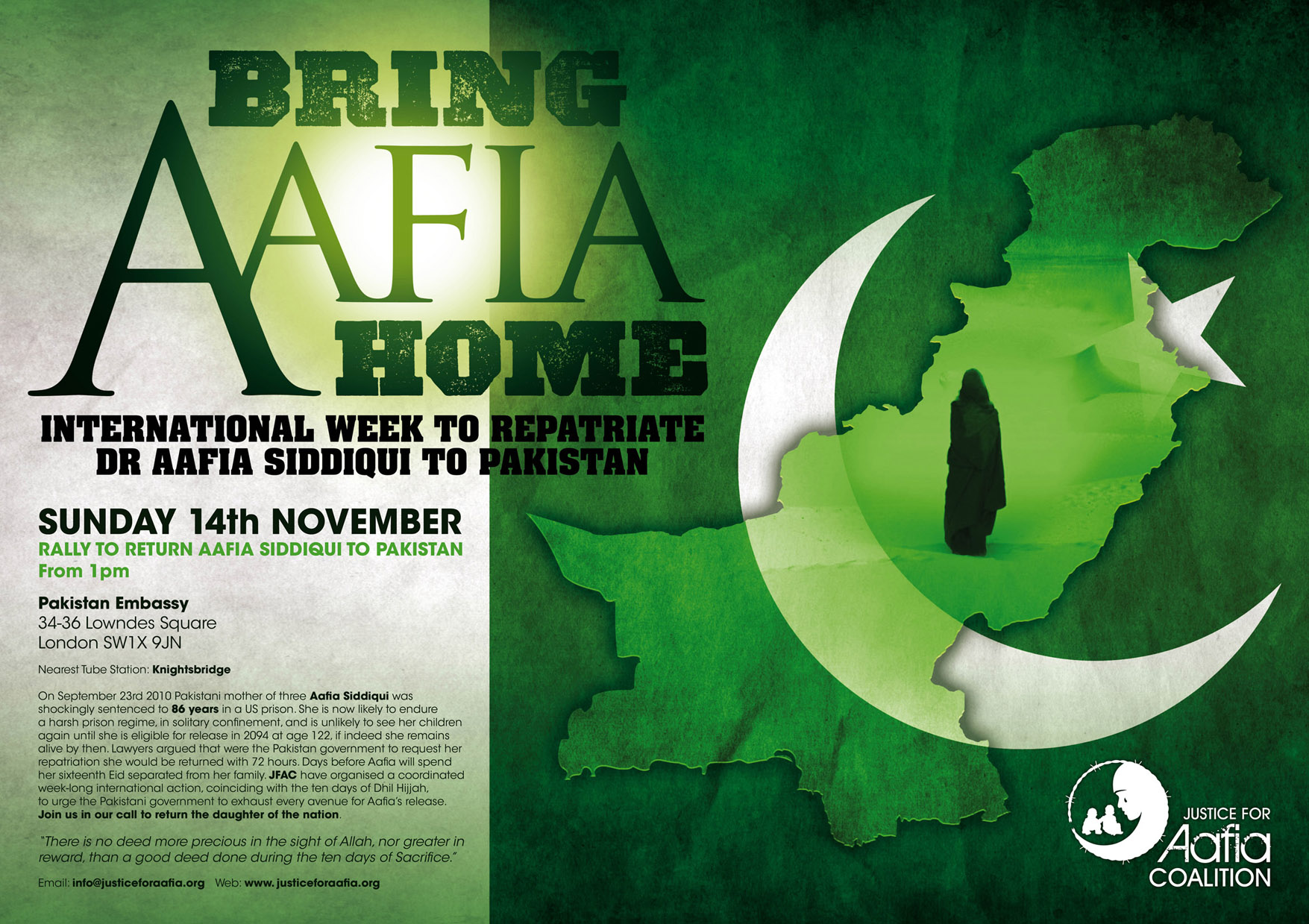 On November 14 — a very rainy Sunday in London — I was one of a number of speakers who gathered outside the Pakistani embassy for an event, “Bring Aafia Home,” which was organized by the Justice for Aafia Coalition, to urge the Pakistani government to do all it can to secure the return of Dr. Aafia Siddiqui to Pakistan, to rescue her from the 86-year prison sentence that this MIT-trained neouroscientist received in a New York court in September this year after what can only objectively be regarded as a rigged trial designed to consign her to oblivion in a US prison, and to permanently hide the evidence that she spent five years as a “ghost prisoner” in a secret prison — or secret prisons — run by the CIA.
A video of the short talk I gave at the event is below, via YouTube, and videos of other speakers from the day can be found on the Justice for Aafia Coalition’s YouTube channel. For further information, please check out the JFAC website, and my archive of articles here, and, in particular, my latest article about Aafia’s case, Wikileaks: Numerous Reasons to Dismiss US Claims that “Ghost Prisoner” Aafia Siddiqui Was Not Held in Bagram, which I wrote exclusively for JFAC, and which was originally published on the JFAC website.
And please — if this case moves you at all — send a card or letter to Aafia, to let her know that she has not been forgotten, and to ensure that those responsible for her — in a facility called the Federal Medical Center in Carswell, Texas, which has a terrible reputation for violence and abuse — know that the outside world is watching.
Andy Worthington is the author of The Guantánamo Files: The Stories of the 774 Detainees in America’s Illegal Prison (published by Pluto Press, distributed by Macmillan in the US, and available from Amazon — click on the following for the US and the UK) and of two other books: Stonehenge: Celebration and Subversion and The Battle of the Beanfield. To receive new articles in your inbox, please subscribe to my RSS feed (and I can also be found on Facebook and Twitter). Also see my definitive Guantánamo prisoner list, updated in July 2010, details about the new documentary film, “Outside the Law: Stories from Guantánamo” (co-directed by Polly Nash and Andy Worthington, currently on tour in the UK, and available on DVD here), and my definitive Guantánamo habeas list, and, if you appreciate my work, feel free to make a donation.











 Who's still at Guantánamo?
