Archive for November, 2008
Silence on war crimes as the US election campaign ends
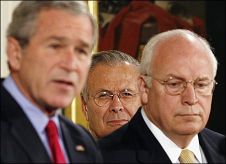 Last week, Bill Kovach, former Washington Bureau Chief of the New York Times and the founding chairman of the Committee of Concerned Journalists, blasted the US media for its failure to ask tough questions of both presidential candidates regarding their opinions of the Bush administration’s unprecedented adherence to the controversial “unitary executive theory” of government.
The theory, which became prominent in the Reagan administration, but has peppered US history, contends that, when he wishes, the president is entitled to act unilaterally, without interference from Congress or the judiciary. This is in direct contravention of the separation of powers on which the United States was founded, and critics have long contended that it is nothing less than an attempt by the executive to seize the dictatorial powers that the Constitution was designed to prevent.
Under the cover of the wartime powers granted in the wake of the 9/11 attacks, and with encouragement from lawyers including, in particular, Vice President Dick Cheney’s chief of staff (and former legal counsel) David Addington, President Bush has pursued the theory relentlessly, issuing a record number of “signing statements” to laws passed by Congress, designed to prevent the nation’s politicians from interfering in the executive’s quest for unchecked power.
He has also approved a number of secret memos, which, in conjunction with various “signing statements,” have authorized what numerous critics of the administration regard as war crimes. These include detaining prisoners seized in the “War on Terror” as “illegal enemy combatants” and holding them without charge or trial, dismissing the protections of the Geneva Conventions, redefining torture and approving its use by the US military and the CIA, and authorizing “extraordinary rendition” and the use of secret prisons.
As if to prove what he was saying, Bill Kovach’s speech to a meeting of international journalists in Washington D.C. went unreported in the US media (and I located it only on the website of a Jamaican newspaper). And yet in many ways Kovach could have gone further, and could also have asked why the presidential candidates themselves have been silent about the current administration’s crimes.
The answer, sadly, is that the executive’s thirst for unfettered executive power is not a priority for voters, even when it spills out of foreign wars and offshore prisons and onto the US mainland. Too many Americans, it seems, are unconcerned or unaware that the president can even hold US citizens and legal residents as “enemy combatants,” and can imprison them indefinitely on the US mainland without charge or trial, as the cases of Jose Padilla and Ali al-Marri reveal in horrific detail.
As a result, gross abuses of power in the name of the “War on Terror,” and the dictatorial theory that underpins them, have been ignored on the campaign trail. This is disturbing for a number of reasons, not least because it has deprived the campaign of former constitutional law professor Barack Obama’s eloquent and principled defense of the laws that have been shredded or sidelined by the Bush administration.
Over the past two years, Senator Obama has repeatedly declared his support for habeas corpus, a cornerstone of American law, inherited from the English, which prohibits arbitrary imprisonment and grants all prisoners the right to know why they are being held. He robustly defended habeas corpus while resisting the Military Commissions Act of 2006, a poisonous piece of legislation, which not only stripped the Guantánamo prisoners of their habeas rights, but also reinforced the president’s right to seize and detain indefinitely anyone he regarded as an “illegal enemy combatant,” and attempted to grant immunity to the President and his minions for any actions that might one day be regarded as war crimes.
Senator Obama has also stated that he will “reject torture without exception,” and last August delivered a stirring speech in which, touching on all the administration’s law-shredding excesses, he declared, “As President, I will close Guantánamo, reject the Military Commissions Act, and adhere to the Geneva Conventions. Our Constitution and our Uniform Code of Military Justice provide a framework for dealing with the terrorists … The separation of powers works. Our Constitution works. We will again set an example to the world that the law is not subject to the whims of stubborn rulers, and that justice is not arbitrary.”
In June this year, when the Supreme Court (which had granted the Guantánamo prisoners statutory habeas corpus rights in June 2004) rejected the habeas-stripping provisions of the Military Commissions Act and its predecessor, the Detainee Treatment Act of 2005, and ruled that the prisoners’ habeas corpus rights were constitutional, Senator Obama was swift to congratulate the justices, calling the ruling “an important step toward reestablishing our credibility as a nation committed to the rule of law, and rejecting a false choice between fighting terrorism and respecting habeas corpus.”
Since then, however, the Obama campaign has gone silent on executive power and the administration’s war crimes, and Senator Obama has only spoken out publicly on one occasion in September, in response to a ludicrous assertion by Sarah Palin, at the Republican conference, that “Al-Qaeda terrorists still plot to inflict catastrophic harm on America and he’s worried that someone won’t read them their rights.”
Senator Obama responded by telling supporters in Michigan that habeas corpus was “the foundation of Anglo-American law,” which “says very simply: If the government grabs you, then you have the right to at least ask, ‘Why was I grabbed?’ And say, ‘Maybe you’ve got the wrong person.’” He explained that it was an essential safeguard, “because we don’t always have the right person. We may think it’s Mohammed the terrorist, but it might be Mohammed the cab driver. You might think it’s Barack the bomb-thrower, but it might be Barack the guy running for president.” His conclusion drove the argument back to where it should have been, but it has sadly not been repeated since: “Don’t mock the Constitution. Don’t make fun of it. Don’t suggest that it’s not American to abide by what the founding fathers set up. It’s worked pretty well for over 200 years.”
Another reason for disappointment is that, by refusing to raise these issues, Senator Obama has allowed John McCain to comfortably maintain the Republicans’ “traditional” role as protectors of national security, without having the basis of that assumption challenged, and has also failed to exploit Senator McCain’s shameful hypocrisy, as he has drifted to the right to appeal to the Republican base.
Even before the campaign became all-consuming, Senator McCain (an outspoken opponent of torture, as the result of his own experiences in Vietnam) had a spotty record on the abuse of executive power — and even on the prevention of torture by US forces. Although he attempted to introduce a ban on torture by all US personnel in the Detainee Treatment Act, he allowed himself to be bullied by Dick Cheney into excluding the CIA from the act’s provisions, and the following year he willingly endorsed the Military Commissions Act.
This year, however, Senator McCain’s flight from his own convictions has accelerated alarmingly. In February, he conveniently shelved his lifelong opposition to torture by voting against a bill banning the use of torture by the CIA, and after the Supreme Court’s habeas ruling in June, he declared that it was “one of the worst decisions in the history of this country,” even though, in 2005, he had told NBC’s Meet the Press that the problem with Guantánamo was that the prisoners continued to be held without “any adjudication of their cases.”
However, the main reasons for being disappointed that the crimes of a rogue administration have barely been mentioned as the election approaches are these: firstly, that I can only wonder, in spite of Senator Obama’s fine words, whether the Democrats in general, who famously ruled impeachment “off the table” when they gained a political majority two years ago, would in fact be unwilling to cede power if it was theirs to wield; and secondly (and most significantly), because it allows those responsible for the long list of egregious crimes that have soiled America’s name to leave office unchallenged. Donald Rumsfeld may be long gone, and George W. Bush nothing more than a shadow, but in the Office of the Vice President, Dick Cheney and David Addington, the architects of this unprecedented assault on the Constitution, the Bill of Rights, the UN Convention Against Torture, the War Crimes Act and the Geneva Conventions have been allowed to maintain their homicidal delusions, nurtured through decades of support for executive overreach in the administrations of Richard Nixon, Ronald Reagan, and George H. W. Bush.
As law professor Scott Horton explained to the New Yorker’s Jane Mayer for an in-depth analysis of Addington in 2006, the mission of the Vice President’s closest adviser “and a small group of administration lawyers who share his views” has been to “overturn two centuries of jurisprudence defining the limits of the executive branch. They’ve made war a matter of dictatorial power.”
In conclusion, then, I can only note that it’s a sad indictment of a country’s state of mind when the ruling administration has been devoted to dictatorial powers and war crimes, but an election campaign comes and goes as though it had never happened.
Andy Worthington is the author of The Guantánamo Files: The Stories of the 774 Detainees in America’s Illegal Prison (published by Pluto Press/the University of Michigan Press).
A version of this article was published exclusively on the website of the Future of Freedom Foundation.
Note: The photo of President Bush, Vice President Cheney and former defense secretary Donald Rumsfeld is by Reuters/Kevin Lamarque.
Treachery at Guantánamo
 Andy Worthington, author of The Guantánamo Files, looks at the US authorities’ recent underhand attempts to return cleared prisoners from Guantánamo to regimes where they face the risk of torture, despite US court orders preventing their enforced repatriation.
For many of the prisoners at Guantánamo, the forthcoming US Presidential election holds little promise of change. Although both Barack Obama and John McCain have pledged to close Guantánamo, the problem for at least 50 of the 261 prisoners still held at the prison is not that the US government is unwilling to release them, but that there is nowhere for them to go.
These men are from countries including Algeria, China, Libya, Tunisia and Uzbekistan. Although they have been approved for release after multiple military review boards — some for at least three years — they cannot be repatriated because of international treaties preventing the return of foreign nationals to countries with poor human rights records, where they face the risk of torture. Attempts to find other countries willing to take them have also failed (with the exception of Albania, which accepted eight former prisoners in 2006), in part because, although they are approved for release, the government insists on maintaining that they are still “illegal enemy combatants.”
Generally ignored by the media, which focuses instead on the few prisoners chosen to face special “terror trials” (the Military Commissions), these men receive no special favors, in spite of their status, and are mostly held in conditions of strict solitary confinement for up to 23 hours a day.
Recently, however, some of these men have received extensive media coverage. Seventeen Uyghurs — Chinese Muslims who were sold to US forces after fleeing a settlement in Afghanistan where they had sought refuge from Chinese oppression — were allowed to present their case to a US court on October 7. The judge, Ricardo Urbina, ruled that their continued imprisonment was unconstitutional, and that, because no other country would take them, they should be rehoused in the United States.
This prompted a frantic appeal from the government, which is desperate not to accept responsibility for its mistakes by welcoming any former prisoners into the United States. The appeal was accepted, and arguments on both sides are scheduled to take place on November 24.
If the appeals court upholds Judge Urbina’s ruling, this might bring an end to some of the other prisoners’ extensive legal limbo, but in the meantime the silence surrounding their predicament masks a darker truth, which has only just come to light.
Since June 2007, the administration has been stealthily attempting to repatriate various North African prisoners, under the cover of “diplomatic assurances” with the governments of Algeria, Libya and Tunisia. These are supposed to guarantee that, if returned, the prisoners will be given “humane treatment,” but as various human rights organizations have reported, the “diplomatic assurances” are worthless.
After two Tunisians — Lotfi Lagha and Abdullah bin Omar — were repatriated last June, the “diplomatic assurance” with the government of Zine El Abidine Ben Ali melted away when the men faced show trials on trumped-up charges (extracted through the torture of other prisoners) and received jail sentences of three and seven years.
Fearing that other cleared prisoners would receive similar treatment, several lawyers sought help from the US courts to prevent their clients’ forcible return. A District Court blocked the return of a third Tunisian, Mohammed Abdul Rahman, and lawyers for at least two other prisoners petitioned to prevent their clients’ forced repatriation.
 One was Abdul Rauf al-Qassim, a Libyan with an Afghan wife and a daughter he has never seen, and another was Ahmed Belbacha (photo, left), an Algerian who had sought asylum in the UK in 1999. Belbacha, who was seized and sold by bounty hunters in Pakistan, had fled Algeria because he had been working for a government controlled oil company and had been threatened by militants, but the British government refused to accept his return to the UK because he was kidnapped while his asylum claim was still pending. Terrified of being returned to Algeria, he told his lawyers that he would rather stay in Guantánamo, even though his cell was “like a grave.”
For most of this year, it appeared that the lawyers’ attempts to prevent their clients’ return to torture had been successful, but last month, during a visit with Cori Crider, staff attorney at the London-based legal action charity Reprieve, Ahmed Belbacha explained that in July he had been taken aside by a group of US soldiers who had ordered him to sign papers approving his release from Guantánamo. Knowing that a court had put a stay on his repatriation, Belbacha refused, but his lawyers did not hear about it until Ms. Crider’s latest visit with him last month.
Although lawyers for other prisoners are not at liberty to speak about similar cases (because their cases are sealed before the US courts), it appears that this was not an isolated example. The only conclusion that can be drawn is a bleak one: in an attempt to clear out unwanted prisoners from Guantánamo — and also, no doubt, to prevent them from seeking asylum in the United States if Judge Urbina’s ruling stands — the authorities at Guantánamo are deliberately undermining rulings made in courts on the US mainland to prevent the forced repatriation of vulnerable prisoners.
This is shocking, of course, but it is unsurprising given that those who established Guantánamo have consistently expressed disdain for the law, and have sought nothing less than unfettered executive power.
Andy Worthington is the author of The Guantánamo Files: The Stories of the 774 Detainees in America’s Illegal Prison (published by Pluto Press/the University of Michigan Press).
As published exclusively in the Daily Star, Lebanon.
Guantánamo Uighurs: Sabin Willett’s letter to the Justice Department
 Today the Guardian runs a story about the Uighurs (or Uyghurs) in Guantánamo, the 17 Chinese Muslims whose fate is in the hands of a US appeals court. Uniquely, for prisoners held as “enemy combatants” in the Bush administration’s notorious offshore prison — where innocence has been banned as a concept, and the best that prisoners can hope for is that they one day regain their freedom as “no longer enemy combatants” — the case against the Uighurs (refugees from Chinese oppression, who were sold by bounty hunters after fleeing a settlement in Afghanistan) collapsed spectacularly in June, when judges in a US appeals court were finally allowed to review the case against one of the men, Huzaifa Parhat.
Denouncing the government’s “evidence” against Parhat for its resemblance to a nonsense poem by Lewis Carroll, the author of Alice’s Adventures in Wonderland, the court “held invalid” the decision by a military tribunal in Guantánamo that Parhat was an “enemy combatant,” and in the following months the government admitted that it would “serve no purpose” to continue trying to prove that Parhat was an “enemy combatant,” and then did the same for the other 16 Uighurs.
What followed was a spectacular example of American justice at its best. A month ago, in the District Court in Washington D.C., Judge Ricardo Urbina declared, “Because the Constitution prohibits indefinite detentions without cause, the continued detention is unlawful.” As no other country could be found that was prepared to accept the men, and the government long ago conceded that it would be unsafe to return them to China, Judge Urbina then ordered their release into the United States, to the care of communities in Washington D.C. and Tallahassee, Florida, who had prepared detailed plans for their resettlement.
As I wrote in a recent article, “The core of Judge Urbina’s ruling was his understanding that the Uighurs — to use those words dreaded by the administration — were innocent men, and had been imprisoned by mistake. Predictably, of course, the administration appealed, but all they had in their arsenal were recycled and thoroughly discredited claims that the Uighurs were ‘a danger to the public,’ who had ‘admitted receiving weapons training at a military training camp.’”
Despite having no case against the Uighurs, the government’s appeal will almost certainly hold up their release for years, as their lawyer, Sabin Willett, explained in what the Guardian described as “a blunt and angry letter” to the Justice Department. Even if the court rules in their favor, the government will appeal again, and the case could then go all the way to the Supreme Court. In the meantime, of course, the government’s last-minute slander of the men as “terrorists” will ensure that no other country will take them either. The Guardian explained that, according to the Justice Department, they “are linked to an organization that the state department has labeled to be a terrorist entity, and it is beside the point that the organization is not ‘a threat to us’ because the law excluding members of such groups does not require such proof.”
In the interests of presenting a viewpoint that is not just “blunt and angry,” but also brims with eloquent and barely concealed disdain for the bureaucrats responsible for replacing American values with arbitrary cruelty, I reproduce below the entire text of Sabin Willett’s letter to the Justice Department. If the appeal fails, it will, I believe, stand — on the eve of the Presidential elections — as one of the most damning indictments of the Bush administration’s lawless and brutal stupidity that you are ever likely to read.
Sabin Willett’s letter to the Justice Department
Our Uighur clients have now been at Guantanamo for about six and a half years. After years of stalling and staying and appellate gamesmanship, you pleaded no contest — they are not enemy combatants. You have never charged them with any crime. In October a federal judge said they must be freed. They were on freedom’s doorstep. The plane was at Gitmo. The stateside Lutheran Refugee services and the Uighur families and the Tallahassee clergy were ready to receive them. You blocked their release by getting an emergency stay from the Court of Appeals. Then by extending the stay. Since then we have done everything we can to try to win that release again and we have failed. And you have positioned this shrewdly. You know it will take many months to get a decision. If we win you will ask for en banc review. And if we win that you will appeal for Supreme Court review. So you know and I know what is happening here. This won’t be over in one month, or in six. It will be years.
And you know another thing. No other country is ever going to take them. Not ever. Not after some genius decided, in your overnight stay papers, for the first time ever, anywhere, to call these people “terrorists.” That the charge is false, that you have now backed away from it in your brief, that doesn’t matter. It will never happen now.
It was never going to happen anyway. [The] State [Department] has been trying to settle this for four years. China has blocked it everywhere. You know it will never happen. If you win your appeal these men will spend the rest of their lives as prisoners at Guantánamo.
So now I am on my way to Gitmo to tell them all of that on Monday.
And I asked for one simple thing of you. I said let me sit down with them together, as men, without them being chained to the floor. And the Defense Department said no.
So I said, let me meet them alone, as we always do. Let me meet them in the hut where we always meet. Station MPs outside that hut, as you always do. Just permit these men one shred of human dignity. Do not chain them to the floor.
And you said no.
Yesterday the court refused to intervene. But it doesn’t end there. Because this isn’t about courts or who wins a motion. This is really about just who in the hell you people are. What you see when you look in the mirror. Or who your clients are and what they see in the mirror. What kind of Americans treat innocent victims with this kind of reflexive, degrading cruelty? Americans don’t treat criminals this way in a federal prison. Americans are not supposed to treat enemy prisoners of war this way under the service field manuals, or the Geneva Conventions, if anyone paid attention to the field manuals or the Geneva Conventions any more. And these people aren’t criminals, and they aren’t the enemy and you say the department of defense will not comply even with its own service field manuals, or with any basic human decency, and carry on like a bunch of small-minded, panicked little people. As an American, I don’t understand that.
And that is what I am asking for you. I am asking you to request of the base commander that he look in the mirror. Tell him I will meet these men alone, one at a time, and I will sit in that hut, and he can station a whole platoon outside to make sure it is only one at a time, and I would like him to show these Uighurs the basic human respect of not having to be chained to the floor. That is my personal request of your client. As one American to another.
And if the base commander will not do that, not even that, then I would like him to meet me and look me in the eye and explain just what in the hell kind of American he is. Because I do not understand it. Whoever the narrow-chested bureaucrat may be who makes these legal decisions sitting in some political office in Washington, however small and un-American that execrable person may be, I am still willing to bet that the base commander is better than that.
I will be there Sunday night.
Andy Worthington is the author of The Guantánamo Files: The Stories of the 774 Detainees in America’s Illegal Prison (published by Pluto Press/the University of Michigan Press).
For a sequence of articles dealing with the Uighurs in Guantánamo, see: The Guantánamo whistleblower, a Libyan shopkeeper, some Chinese Muslims and a desperate government (July 2007), Guantánamo’s Uyghurs: Stranded in Albania (October 2007), Former Guantánamo detainee seeks asylum in Sweden (November 2007), A transcript of Sabin Willett’s speech in Stockholm (November 2007), Support for ex-Guantánamo detainee’s Swedish asylum claim (January 2008), A Chinese Muslim’s desperate plea from Guantánamo (March 2008), Former Guantánamo prisoner denied asylum in Sweden (June 2008), Six Years Late, Court Throws Out Guantánamo Case (June 2008), Guantánamo as Alice in Wonderland (July 2008), From Guantánamo to the United States: The Story of the Wrongly Imprisoned Uighurs (October 2008), Guantánamo Uyghurs’ resettlement prospects skewered by Justice Department lies (October 2008), A Pastor’s Plea for the Guantánamo Uyghurs (October 2008), Guantánamo: Justice Delayed or Justice Denied? (October 2008), Will Europe Take The Cleared Guantánamo Prisoners? (December 2008), A New Year Message to Barack Obama: Free the Guantánamo Uighurs (January 2009), Guantanamo’s refugees (February 2009), Bad News And Good News For The Guantánamo Uighurs (February 2009), and the stories in the additional chapters of The Guantánamo Files: Website Extras 1, Website Extras 6 and Website Extras 9.












 Who's still at Guantánamo?
