Archive for August, 2007
Update: House Democrats fail to act on Guantánamo, Iraq or domestic spying
Despite claims last week by House Representative John Murtha (D-Pa.) that he would put forward amendments to the administration’s colossal Defense Appropriations bill (see article here), the House of Representatives rolled over last night and passed the proposed legislation by 395 votes to 13, and Murtha, who had actually prepared the amendments to close Guantánamo within six months, and to require troops be fully trained and equipped before going to fight in Iraq, withdrew them, according to Theday.com, because he “fac[ed] the prospects of losing votes and inflaming partisan tensions.”
Highlighting the Democrats’ general spinelessness –- and also indicating how politicians of all hues are still swayed by the President’s bellicose, xenophobic paranoia –- the House also followed the lead established in the Senate on Friday, approving, by 227 votes to 183, the President’s plans to “expand the government’s abilities to eavesdrop without warrants on foreign suspects whose communications pass through the United States,” and thereby choosing hollow rhetoric –- Bush’s metronomic pronouncement that “Protecting America is our most solemn obligation” –- over more rational fears, expressed by many of the Democrats and also by civil liberties groups, that the bill “goes too far, possibly enabling the government to wiretap US residents communicating with overseas parties without adequate oversight from courts or Congress,” and that it is “not limited to terror suspects and could have wider applications.”
Dissenting Democrats at least won a few concessions in negotiations earlier in the week, insisting that any proposals for new wiretaps must be approved not just by the unraveling Attorney General Alberto Gonzales, but also by the director of national intelligence, but there was, overall, little enthusiasm for the concerns expressed by Representative Zoe Lofgren (D-Calif.), who said during the debate that preceded the vote, “This bill would grant the attorney general the ability to wiretap anybody, any place, any time without court review, without any checks and balances. I think this unwarranted, unprecedented measure would simply eviscerate the 4th Amendment,” which, as the Associated Press put it, “prohibits unreasonable searches and seizures.”
Any confrontation between Democrats and the administration will now have to wait until after the summer recess, when the President’s 2008 funding for Iraq and Afghanistan will come under scrutiny, and “surges” and “timetables for withdrawal” will once more be the subject of semi-inscrutable pronouncements with too many sub-clauses. I can hardly wait.
Andy Worthington is the author of The Guantánamo Files: The Stories of the 774 Detainees in America’s Illegal Prison (published by Pluto Press, distributed by Macmillan in the US, and available from Amazon — click on the following for the US and the UK). To receive new articles in your inbox, please subscribe to my RSS feed.
A combination of this article, and House Democrats take on Cheney over Guantánamo and Iraq, was published on CounterPunch (as “Why Do We Need the Democrats? House Democrats Fail to Restrain Bush on Guantánamo, Iraq or Domestic Spying”).
House Democrats take on Cheney over Guantánamo and Iraq
In an update from Congressional Quarterly, just two days after Vice President Dick Cheney shuffled out from under his rock to declare on CNN that he thought that proposals to close Guantánamo were a bad idea and that operational plans for Iraq were not the business of Congress, staff writer John Donnelly reports that “House Democrats plan to send members home for the August recess with fresh votes on legislation that would repudiate President Bush’s execution of the ‘global war on terror.’”
As part of measures to shave just $3.5 billion off the President’s insane request for $459.6 billion for Defense appropriations (that’s less than 1 percent of a figure so colossal that it matches the cumulative defense spending of the UK, France, Germany, Japan, China, Russia, Italy, Saudi Arabia, India, South Korea, Australia, Canada and Spain), the mildly emboldened Democrats indicated that they would put forward an amendment that would “require that US forces be fully trained and equipped before deploying to Iraq” (which rather begs the question of how shambolic the current process is), and another that “would close the Guantánamo prison in six months.”
On CNN, tilting at common sense and the increasing sway of public opinion, the advocate of the “Dark Side” in the “War on Terror” told Larry King that “we don’t get into the business of sharing operational plans –- we never have –- with the Congress.” He was speaking in defense of a former aide, Eric S. Edelman, currently an undersecretary of defense, who recently raised Democratic heckles when he replied to a request made by Senator Hillary Clinton for a briefing on withdrawal plans from Iraq by “accusing her of reinforcing ‘enemy propaganda that the United States will abandon its allies’ by discussing a timetable for withdrawal,” although he failed to indicate whether the “we” he was referring to was a royal “we” or was meant to indicate himself and the President.
Cheney also spoke out about Guantánamo, telling King, “I think you need to have someplace to hold those individuals who have been captured during the global war on terror. I’m thinking of people like Khalid Sheikh Mohammed,” and adding, for the benefit of those who have been on the moon for the last few years, “This is a man we captured in Pakistan. He’s the mastermind of 9/11.” Warming to his theme –- and refuting figures issued by the DoD’s Office for Detainee Affairs, showing that, at most, there are only 130 detainees that the administration wants to hold onto (80 to be tried before Military Commissions, and another 50 who are “too dangerous to risk release,” but not, bizarrely, dangerous enough to be charged with any crime) –- Cheney added, “There are hundreds of people like that, and if you closed Guantánamo, you’d have to find someplace else to put these folks.”
While Cheney’s opinion is backed by some of the House Representatives –- with Republican Conference Chairman Adam H. Putnam of Florida joining the NIMBYist tendency I highlighted here last week, and claiming that “any US town with a prison holding a terrorist would become a potential target for attack” –- Alcee L. Hastings, a Democratic Representative for Florida, and a member of the House Intelligence Committee, responded with a more measured view, pointing out that closing Guantánamo would be “an overdue way to restore the United States’ image overseas,” and explaining, “Pretty much everyone has agreed it has given America a black eye abroad.”
Let battle commence! Even a long-winded, bureaucratic battle –- one that would test the afflictions of an insomniac –- is probably better than nothing.
For more on Guantánamo, see my book The Guantánamo Files: The Stories of the 774 Detainees in America’s Illegal Prison (published by Pluto Press, distributed by Macmillan in the US, and available from Amazon — click on the following for the US and the UK). To receive new articles in your inbox, please subscribe to my RSS feed.
A combination of this article, and Update: House Democrats fail to act on Guantanamo, Iraq or domestic spying, was published on CounterPunch (as “Why Do We Need the Democrats? House Democrats Fail to Restrain Bush on Guantánamo, Iraq or Domestic Spying”).
Corine’s back: read “Guantánamo: the day after”
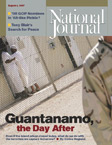 Corine Hegland, the National Journal reporter who, in February 2006, broke some of the first stories about dissenting military officers in Guantánamo’s kangaroo court tribunals (the Combatant Status Review Tribunals), is back with an edgy cover story that begins with former Center for Constitutional Rights lawyer Barbara Olshansky’s accidental side-trip to Ethiopia, during a visit to Africa, where she stumbled upon the new East African front in the Bush administration’s “War on Terror” –- the secret prisons for Somali jihadi suspects, ostensibly run by Africans but in fact controlled by the FBI, who seem, in the Horn of Africa at least, to have operatives prepared to assume the reviled post-9/11 methods of the too-visible CIA.
The story, which is very much alive and reprehensible, was then broken three days later by Human Rights Watch, and was partly the subject of an impressive documentary, Kidnapped to  Order (broadcast on Channel 4 in June), in which Ghost Plane author Stephen Grey reported on the “extraordinary rendition” program, traveling to Africa to interview former prisoners, who talked in detail about the rendition and imprisonment of men, women and children.
From there, Hegland takes a tour through Guantánamo’s history, via Olshansky’s part in Rasul v. Bush, the key case in June 2004 that pressured the Supreme Court to grant habeas rights to the detainees, but which has been the object of obfuscation, obstruction and vindictive contrariness by the administration ever since, ending up in the quagmire of suggestions and counter-suggestions that surround the prospective closing of Guantánamo. This takes in recent comments by Dick Cheney and Alberto Gonzales, discussions with lawyers, and an analysis of the ways in which indefinite detention without trial has been attempted in Canada, the UK and Israel.
The most optimistic passage –- in terms of motivating the American people to action, if not to deep political understanding –- is probably the one in which Senate Armed Services Committee Chairman Carl Levin, a Michigan Democrat and long-time opponent of Guantánamo, abandoned his attempts to persuade a blank-eyed audience at a public meeting of the evils of last fall’s Military Commissions Act -– which gave the President the power to detain people as enemy combatants “without access to any of the information which the government was relying on to make that determination, [so that] somebody could be there for three years, four years, or for life, without access to a judge, based on secret evidence” –- and instead responded to an audience member who raised his hand to say, “I’m a middle-school teacher who can no longer say the Bill of Rights is sacrosanct. What would you say in my place?” by “abandon[ing] his pitch for the bill and [giving] the group the pep talk it had traveled overnight to hear. ‘The only answer is, you fight back,’ he said. ‘You can stand in front of your class and say, get involved, fight back.’”
What’s sad about even this limited success, of course, is that Levin’s attempts to interest his compatriots in rewriting the administration’s sweeping definition of “enemy combatants” fell on deaf ears, and Hegland also uses Levin’s proposals to demonstrate the bewildering diversity of views about Guantánamo, noting that the White House threatened to veto the bill, saying that Levin’s provision would “interfere with the ‘effective conduct of the war on terror’ and with the president’s constitutional authority as the commander-in-chief,” and that even human rights groups “yawned at” his proposal, because they were “focused first on the restoration of habeas corpus, something that Levin also supports, and [worried] that adding substantive protections to the tribunals would sap the strength of their arguments for habeas.” Although she concludes the article by talking to Elisa Massimino, the Washington director of Human Rights First, who insists that, as with terror prosecutions before 9/11, successful prosecutions can be arranged within the existing criminal justice system, the article suggests, overall, that dark clouds hover over any prospect of any easy escape from the bleak and conflicted story of Guantánamo.
Perhaps the most memorable passage in the whole article is the one in which, reeling from her new discovery in east Africa, Barbara Olshansky declares, “It already is the day after Guantánamo. We haven’t gotten everyone out, obviously, but they’re just putting people in other prisons.”
Read the article. There’s more that I haven’t mentioned in this brief review, and it’s here if you missed it at the top.
For more on the abuse of human rights in the “War on Terror,” see my book The Guantánamo Files: The Stories of the 774 Detainees in America’s Illegal Prison (published by Pluto Press, distributed by Macmillan in the US, and available from Amazon — click on the following for the US and the UK). To receive new articles in your inbox, please subscribe to my RSS feed.
Saudi who suffered brain damage in Guantánamo gets married in Medina
The English-language Arabic daily newspaper Asharq al-Awsat recently ran an intriguing article, Life After Guantánamo, about a released Guantánamo detainee, Mishal al-Harbi, which I only came across because it was mentioned on John Burgess’ well-balanced Crossroads Arabia website.
Al-Harbi, who is now 27 years old, but who was only 21 when he was captured after a mass surrender by Taliban soldiers in the northern Afghan city of Kunduz in November 2001, was typical of many of the Guantánamo detainees. A low-level Taliban recruit, he admitted during his initial Combatant Status Review Tribunal at Guantánamo –- and his annual review a year later (the Administrative Review Board) –- that he went to Afghanistan to fight Shiites and not to fight Jews and Christians, as alleged. This suggests –- as with many other recruits –- that someone misled him while recruiting him in his homeland, as, with the exception of the Shia militias, the majority of the Northern Alliance –- the Tajiks and Uzbeks –- were Sunni Muslims like himself. Al-Harbi also admitted that he had received weapons training in Afghanistan, and had been on the Taliban front lines for three days, although he denied an allegation that he fought against US forces, and also denied an allegation that he drove a “rocket launcher mounted truck” in combat against the Northern Alliance, telling his tribunal that he drove a food supply vehicle instead.
After surrendering with several hundred other foreign fighters, al-Harbi survived a massacre at the Qala-i-Janghi fort in the northern city of Mazar-e-Sharif (discussed in detail in my book The Guantánamo Files), and arrived at Guantánamo on one of the first flights in January 2002, but it was what happened to him in Guantánamo that raised his profile above that of many other Taliban recruits. On 16 January 2003, during a particularly fraught time in the prison, when there was conflict between the detainees and some of the guards, who were abusing the Koran, al-Harbi suffered permanent mental and physical damage after his brain was deprived of oxygen for several minutes. According to the US authorities, he had attempted to hang himself, but according to a Washington Post report in March 2007 by Faiza Saleh Ambah, his brother claimed that his injuries were the result of a severe beating by some of the prison’s guards, and his family was “seeking not only financial compensation but also concrete answers from the US government –- either an admission that Mishal was injured by guards or proof that he tried to kill himself.”

Mishal al-Harbi (right), and his brother Fahd (photo by Faiza Saleh Ambah).
Quite what happened that night is unclear, but Faiza Saleh Ambah provided details which suggested that al-Harbi had indeed been set upon by guards. Hammad Ali, a released Sudanese detainee, recalled that his injuries took place shortly after he had been transferred to the isolation block India. He explained that one evening, after the guards had forcibly taken the Koran off another prisoner, prompting a half-hour protest by the detainees, who banged on their cell doors and shouted “Allah-u-Akbar” (God is great), riot guards entered the block, and, according to released Bahraini detainee Abdullah al-Noaimi, “started beating prisoners in their individual cells.” A short while later, al-Noaimi added, one of the guards shouted, “Turn on the lights!” and al-Harbi was carried out of his cell. He then spent three months in a coma, kept alive on an artificial respirator, and after he regained consciousness, according to records released by the Department of Defense, his weight dropped from 116 pounds (his weight on arrival, after six weeks of malnutrition in various Afghan prisons) to just 98 pounds (seven stone, or 44 kg).
For his part, however, al-Harbi was unsure of what happened on the night of 16 January 2003. As Faiza Saleh Ambah described it, “Sitting cross-legged on the carpet in the family guest room, his frayed black leather wheelchair to his left, Mishal said he remembers that after the desecration of the Koran, a guard entered his cell. ‘He was carrying a shield. He pushed me with it. I don’t remember anything else,’ he said, speaking with a heavy tongue.”
Although he recovered sufficiently to write letters to his family, and was helped by physical therapists, al-Harbi was not released from Guantánamo until July 2005, and is still “partially paralyzed” and confined to a wheelchair. Taking up his story after his return to Saudi Arabia, the Asharq al-Awsat profile, by Turki al-Saheil, focuses on the rehabilitation programs established by the Saudi government to “raise the [ex-detainees’] spirits and reintegrate them back into society.” Al-Saheil notes that al-Harbi, who “until recently had been receiving treatment at a hospital in Medina … required more time by reason of the incapacity he suffered while inside the US detention facility,” but adds that he “has managed to overcome his feelings of despair,” and, with the blessing of the Saudi Interior Ministry, married a Saudi woman last month, “whom he sees as the most beautiful thing in his life.”
While this is clearly a happy outcome for al-Harbi, who is being paid 3,000 Saudi Riyals a month [approximately $800] “as a means of assistance until he fully recovers,” al-Saheil’s article, like a previous article about released detainee Sa’ad al-Bidna, is rather vague about the constraints imposed on the released detainees in terms of surveillance and restrictions on their liberty, although there seems little doubt that the rehabilitation programs are principally designed to reintegrate the former detainees into society, through a form of “reprogramming,” in the case of the former jihadis, and then through more direct means –- including returning them to their former jobs –- in the cases of both the ex-Taliban recruits and the many men who were in Afghanistan as humanitarian aid workers or missionaries. Curiously, this latter category of ex-detainees is mentioned only in passing in the article, in the following rather blank sentence: “Facts show that a portion of those who returned from the Guantánamo facility were not involved in armed movements in areas of conflict.”
For those in the former category, al-Saheil explains that, after initial investigation, “The Interior Ministry’s philosophy in dealing with the Guantánamo returnees depends on several chief factors, the most important of which is reforming them intellectually,” a process which is “handled by a number of religious specialists who apply a program that is especially prepared for this purpose,” and adds that during this process the ministry also provides them with schooling, “the opportunity to live outside the prison,” and involvement in “different social programs.” As a result, we are told that “the ministry has not witnessed any negative signals from the citizens returning from the detention facility and whom it has recently released after completing the rehabilitation programs that seek to restore their psychological, social and religious well-being and reintegrate them back into society.”
Although this is not a full picture by any means, it remains to be seen whether any of the Saudi ex-detainees will ever be allowed to talk freely about their experiences, and whether the cause of Mishal al-Harbi’s injuries will ever be adequately explained. In the meantime, as two of the few English language reports to deal with the returned Saudi detainees, the articles by Faiza Saleh Ambah and Turki al-Saheil are some of the only glimpses we’re likely to be granted into the lives of the 72 Saudi detainees who have been released from Guantánamo.
Note: Throughout his detention, al-Harbi was referred to by the US authorities as Mishal Alhabiri.
Andy Worthington is the author of The Guantánamo Files: The Stories of the 774 Detainees in America’s Illegal Prison (published by Pluto Press, distributed by Macmillan in the US, and available from Amazon — click on the following for the US and the UK). To receive new articles in your inbox, please subscribe to my RSS feed.
Doing The Right Thing: Guantánamo Military Commission lawyers William Kuebler and Tom Fleener speak out
 In an excellent article for GQ, The Defense Will Not Rest, Sean Flynn profiles William Kuebler and Tom Fleener, military lawyers assigned to defend two alleged terrorists, Ghassan al-Sharbi and Ali Hamza al-Bahlul, in their Military Commissions at Guantánamo Bay. Robustly defending established laws, and delivering a devastating condemnation of the Commission process, Kuebler and Fleener lambast the administration for seeking results based on a preconceived notion of guilt (in much the same way that Stephen Abraham has complained about the tribunal process at Guantánamo), explain how their roles obliged them to be little more than puppets in illegal show trials, and describe the insoluble conflict between their military and legal obligations. Their complaints are many –- and I urge anyone reading this to read the whole article –- but the main issues are as follows:
Firstly, both al-Sharbi and al-Bahlul did not wish to be represented by lawyers, and neither Kuebler nor Fleener could find any justification for the administration’s insistence that they were not allowed to represent themselves. As Flynn notes, “The right to self-representation had been a codified tenet of American law for 217 years. Under established rules, whether a man can competently defend himself is irrelevant; he need only be competent to make the decision to represent himself.” Kuebler –- a navy lieutenant described by Flynn as “not a radical or a gadfly or even a liberal,” but rather as “a conservative Republican and devout Christian” –- believed that al-Sharbi was competent to make that decision. “Therefore,” Flynn continued, “Kuebler believed he had an ethical obligation to step aside. A lawyer can’t force himself upon an unwilling client, and no credible court would ever allow such a thing. To do so would be to replace a vigorous defender with a prop, an actor in a charade that only mimicked a proper trial.”
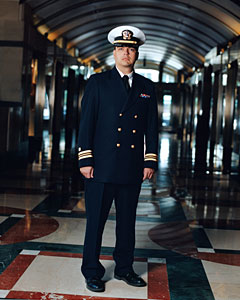
William Kuebler
Fleener faced a similar problem. A major in the army reserves, he had become interested in the Commissions after being briefed by friends in the Judge Advocate General’s Corps (JAG), and “was shocked by what he found: The rules really did require defendants to accept a pro bono military lawyer.” He told Flynn, “The concept of compelled representation has always bothered the crap out of me. You just don’t force lawyers on people. You don’t represent someone against his will. It’s never, ever, ever done.” Flynn then explained, “The reason it’s never done is that it undermines the concept of a fair trial. When a man’s life or liberty is at stake, he gets to decide who will speak for him. That’s the way American courts work, have always worked. To eliminate that right is to begin to transform a trial into a pageant. And the other commission regulations –- the use of secret evidence and third-hand hearsay, excluding defendants from parts of their own trials, charging them with invented crimes after they’d been interrogated in isolation for years –- only further that transformation.”
Fleener added, “I hated the fact, still hate the fact, that we were making up a trial system to convict people after we’d already decided they’re guilty. I hated that, as a country, we were doing that. I didn’t like the fact that we were violating the rule of law, and that what we were doing as a country was just … wrong.” Kuebler reached a similar conclusion. “It took me a while to figure out the system is rigged,” he told Flynn. “When it hit me how ridiculous and unjust and farcical this is? That was it. That was the moment I realized it was all a sham.”
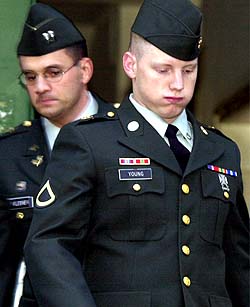
Tom Fleener (left)
The truth about the Commissions, as both men had realized, was that the administration needed to pursue the trials to provide a figleaf of justification for the whole malign Guantánamo experiment, given that, as Brigadier General Thomas Hemingway, the former legal adviser to the commissions, explained, it was “extremely unlikely” that any of the detainees could be convicted in a federal court or in a regular court-martial “because of the way we’ve collected evidence and other things,” to which Flynn added, “Even generously assuming no evidence has been obtained through abusive interrogations (which would almost certainly be barred from any criminal court), each defendant has been questioned for years without the benefit of counsel, which in itself would be considered impermissible.” As a result, the defense lawyers were obliged to take part in the Commissions because they had been designed by the administration “to appear to be fair. The rules required each defendant to be provided a JAG officer who would be bound by personal and professional honor to present as robust a defense as possible. It would all look very proper, but the outcome would be preordained, the defendant utterly doomed, because of all the other rules.”
Flynn continues: “The main problem with the commission system is that it would try men already considered guilty: Every defendant would have been ruled an enemy combatant, first by the mere fact of his detention, then by a separate board, a Combatant Status Review Tribunal –- and he would be charged with a crime only an enemy combatant could commit … The charge would only reinforce what had already been decided; the presumption of innocence would be completely reversed. The trial procedures were no better. Defendants wouldn’t see classified evidence against them, including anything that fell under the broad rubric of ‘sources and methods’ –- or, more simply, how statements were gathered and from whom. That obviously could include the benign, such as protecting the identity of an informant, yet it also clearly suggested that evidence derived from torture could be allowed while the actual torturing would be kept secret. If, for example, John Doe had been waterboarded until he claimed that Mike Smith was a terrorist, Mike Smith would know only that ‘a source’ had positively identified him, though not who or under what conditions. The accused also could be removed from his own trial whenever the presiding officer decided national security needed to be protected, and the rules tolerating hearsay testimony were so loose as to be meaningless. Any fifth-hand mumblings could be used against a man, and he would have no effective ability to challenge them.”
Both Kuebler and Fleener were appalled. Fleener told Flynn, “In practice the commissions dispense with two indispensable legal protections –- the presumption of innocence and the prevention of ex post facto application of criminal laws. What we’re saying is, ‘You are guilty of something –- we just don’t know exactly what. So we’ll gather as much incriminating evidence as we can, using methods that we aren’t going to talk about, and then we’ll make up a law that criminalizes the conduct.’”
“Over time,” Kuebler added, “we figured out we’re the linchpin in this process. They want to have these bizarre trials, they don’t want to let the defendant see secret evidence –- so the one thing they need is us. The government wanted this attorney-client thing to work. They really did. It’s an important part of the show.” “Only the government benefits if we do a bang-up job,” Fleener concluded. “The administration believes the commission process will ultimately justify the detentions. They know they can’t just hold people; they don’t want to take the political heat. So they rigged the rule of law. And because it’s rigged, the only thing that’s in play is the appearance … At the end of the day, that’s how these guys look at it: ‘If I’m going to get a life sentence –- or a death sentence –- I’d rather get one in this weird, disgusting system that everyone knows is a weird, disgusting system than have some military lawyer up there dancing and juicing it up and making it look like it’s not rigged.’”
In an even more critical passage, Flynn notes that “What happens to those two admitted jihadists is, frankly, less important than what happens to the American ideal,” and quotes Fleener once more: “It truly does affect all of us. It’s not because al-Bahlul wants to dispense with counsel that I’d leave my job and get involved in this mess. It’s that once you start putting on show trials, you can’t go back.” (emphasis added).
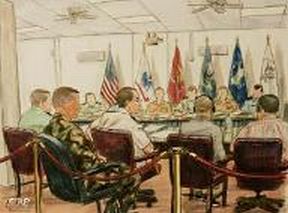
Ali Hamza al-Bahlul (2nd from right) during his aborted Military Commision in August 2004.
After a lively section analyzing the conflict of interest between their roles as representatives of the US military and as civilian lawyers who could have their licenses revoked if they insisted on representing a client who did not wish to be represented (their legal responsibilities won out), Flynn explains that, although still officially assigned to al-Sharbi and al-Bahlul, neither Kuebler nor Fleener “has had to do any actual lawyering” on their behalf since June 2006, when, in Hamdan v. Rumsfeld, the Supreme Court “threw out the military commission system, ruling that the president can’t unilaterally invent ways of trying people, even foreigners imprisoned outside US territory, without congressional approval.” Although the decision dismissed all the pending cases (including those of al-Sharbi and al-Bahlul), they could still be charged again, as the process was reinstated by Congress last October in the reviled Military Commissions Act.
As Flynn notes, acutely, this was “an astonishingly radical law,” which granted the president “the authority to declare anyone, captured anywhere, an enemy combatant who can be jailed indefinitely and without charge, precisely the sort of power against which the colonists fought the revolution,” and which also “explicitly stripped the right of habeas corpus from any foreign national designated an enemy combatant,” and “implicitly weakened the Article 3 protections of the Geneva Conventions by allowing the president to define ‘outrages upon personal dignity, in particular humiliating and degrading treatment,’ which the conventions prohibit.”
Shorn of their original cases (although Kuebler recently represented Omar Khadr in his aborted Military Commission), both Kuebler and Fleener have, nonetheless, maintained their opposition to the whole process, addressing law students, legal societies and public meetings throughout the US. “On an intellectual level,” Flynn writes, “it’s intriguing stuff, untangling the threads of international law and military procedure and constitutional reach,” but it means more than that to Fleener, who told Flynn, “All of that is fascinating. But what it does is take everyone away from the facts, which are: We lock up innocent people without access to courts, and we’ve tortured people. And when you’ve got a bunch of government lawyers sitting around trying to game torture, the first thing you’d hope would happen, especially as a lawyer, is that someone would step back and say, ‘Hey, we’re trying to game torture. This isn’t right.’ And no one did that. Not one of them.” “Instead,” as Flynn adds, “people who swore to uphold the American ideal, beginning with the president, deliberately subverted it. They established a system of detention and interrogation –- with the acquiescence of a compliant Congress and a fearful public –- that no American would tolerate if it were applied to our citizens anywhere else.”
The final, most damning words come from Fleener and Kuebler themselves. “I think more war crimes have been committed in the detention and interrogation and fake trials of people in Guantánamo than people in Guantánamo have committed,” Fleener said. “And I don’t think the question is whether they’ve tortured people.” After a moment, Kuebler, described by Flynn as “the more reserved of the two,” added, “I think things have been done to people that under any definition except this administration’s very narrow one would be torture.”
Note: See Marie Brenner’s Vanity Fair profile of JAG lawyer Charles Swift, lawyer for Salim Hamdan, and ABC Australia’s interview with Major Michael Mori, lawyer for David Hicks, for more on military lawyers critical of the entire Military Commission process.
For more on Guantánamo and the Military Commissions, see my book The Guantánamo Files: The Stories of the 774 Detainees in America’s Illegal Prison (published by Pluto Press, distributed by Macmillan in the US, and available from Amazon — click on the following for the US and the UK). To receive new articles in your inbox, please subscribe to my RSS feed.
Interview on Antiwar.com
On Wednesday I was interviewed by Scott Horton for Antiwar Radio, and the interview – loosely based on my CounterPunch article Gains and Losses at Guantánamo – is available here, or as an MP3 here.
I was also interviewed by Chuck Mertz for This Is Hell, on WNUR in Chicago, the week before (on July 21), and that show is here — and the MP3 is here.
For more on Guantánamo, see my book The Guantánamo Files: The Stories of the 774 Detainees in America’s Illegal Prison (published by Pluto Press, distributed by Macmillan in the US, and available from Amazon — click on the following for the US and the UK). To receive new articles in your inbox, please subscribe to my RSS feed.












 Who's still at Guantánamo?
