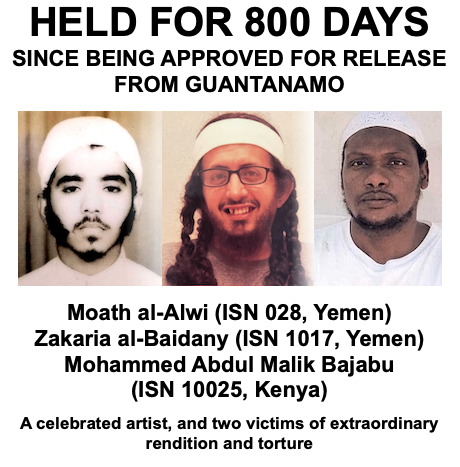
Held for 800 Days Since Being Approved for Release from Guantánamo: Moath Al-Alwi, Zakaria Al-Baidany and Mohammed Abdul Malik Bajabu
Please support my work as a reader-funded journalist! I’m currently trying to raise $2500 (£2000) to support my writing and campaigning on Guantánamo and related issues over the next three months. If you can help, please click on the button below to donate via PayPal.
This is the fifth in a new series of ten articles, alternately posted here and on the Close Guantánamo website, telling the stories of the 16 men still held at Guantánamo (out of 30 men in total), who have long been approved for release from the prison by high-level US government review processes, but have no idea of when, if ever, they will actually be freed. The first four articles are here, here, here and here.
Shamefully, these men are still held because the reviews were purely administrative, meaning that no legal mechanism exists to compel the US government to free them, if, as is apparent, senior officials are unwilling to prioritize their release.
To be fair, most of these men cannot be repatriated, because of US laws preventing the return of men from Guantánamo to countries including Yemen, where most of the men are from, but if senior officials — especially President Biden and Antony Blinken — cared enough, these men would already have been freed, and the suspicion, sadly, must be that they are failing to do anything because the they don’t want to upset the handful of Republican lawmakers who are fanatical in their support for Guantánamo’s continued existence, while they seek the GOP’s cooperation in funding military support for Israel and Ukraine.
Held for 5,150 Days Since Being Approved for Release from Guantánamo: Toffiq Al-Bihani and Two “Ghosts,” Ridah Al-Yazidi and Muieen Abd Al-Sattar

Please support my work as a reader-funded journalist! I’m currently trying to raise $2500 (£2000) to support my writing and campaigning on Guantánamo and related issues over the next three months. If you can help, please click on the button below to donate via PayPal.
Three weeks ago, I began a new Guantánamo project, telling the stories of the 16 men who have been approved for release from the prison, in an effort to humanize them, to remind the world of their existence, and to highlight the disgracefully long amount of time that they have been held since being approved for release.
I’m alternating publication of the articles here and on the Close Guantánamo website, tying them in to noteworthy dates relating to how long they have been held since the US authorities first decided that they no longer wanted to hold them. The first article focused on the case of Uthman Abd Al-Rahim Muhammad Uthman, a Yemeni who, on February 7, had been held for 1,000 days since being approved for release, and the second focused on Hani Saleh Rashid Abdullah, another Yemeni, who, on February 11, had been held for 1,200 days since being approved for release. For the fourth article, about Abdulsalam Al-Hela and Sharqawi Al-Hajj, see here.
The reason these men have been held for so long without being freed is, sadly, because the decisions taken to release them — via Periodic Review Boards, a parole-type review process established by President Obama in 2013 — were purely administrative, meaning that the US government has no legal obligation to free them, and they cannot, for example, appeal to a judge to order their release if, as has become sadly apparent, the government has failed to prioritize their release.
At Guantánamo, Accomplices in the 2002 Bali Bombings Reach A Plea Deal, May Be Released By 2029

Please support my work as a reader-funded journalist! I’m currently trying to raise $2500 (£2000) to support my writing and campaigning on Guantánamo and related issues over the next three months. If you can help, please click on the button below to donate via PayPal.
I wrote the following article for the “Close Guantánamo” website, which I established in January 2012, on the 10th anniversary of the opening of Guantánamo, with the US attorney Tom Wilner. Please join us — just an email address is required to be counted amongst those opposed to the ongoing existence of Guantánamo, and to receive updates of our activities by email.
Last month, two men that almost no one has heard of — despite them being held and tortured in CIA “black sites” for three years, and then held at Guantánamo for over 17 years — entered guilty pleas in their military commission trial at the war court on the grounds of the US military base in Cuba where the prison is located.
The two men are Mohammed Nazir Bin Lep, 47, and Mohammed Farik Bin Amin, 48, the only two Malaysians held at Guantánamo. Designated as “high-value detainees,” they were brought to Guantánamo in September 2006 with 12 other “high-value detainees,” who had also been held and tortured for years in CIA “black sites.”
However, like most of these 14 men, their stories are largely unknown to the majority of US citizens, and to the majority of those in the US who claim to be journalists, even though, if we were to attach a Bush administration-approved description to them, it would be that they were, allegedly, “the worst of the worst of the worst.”
Radio: I Discuss Guantánamo’s Discredited Torture Trials with Scott Horton
Please support my work as a reader-funded journalist! I’m currently trying to raise $2500 (£2000) to support my writing and campaigning on Guantánamo and related issues over the next three months. If you can help, please click on the button below to donate via PayPal.
Last week, hot on the heels of my interview about Guantánamo with Kevin Gosztola and Rania Khalek for their “Unauthorized Disclosure” podcast, I was delighted to speak again to Scott Horton, the indefatigable interviewer, author and libertarian, who I’ve been talking to on and off for the last 16 years. Scott works so hard that this was, astonishingly, his 5,935th interview!
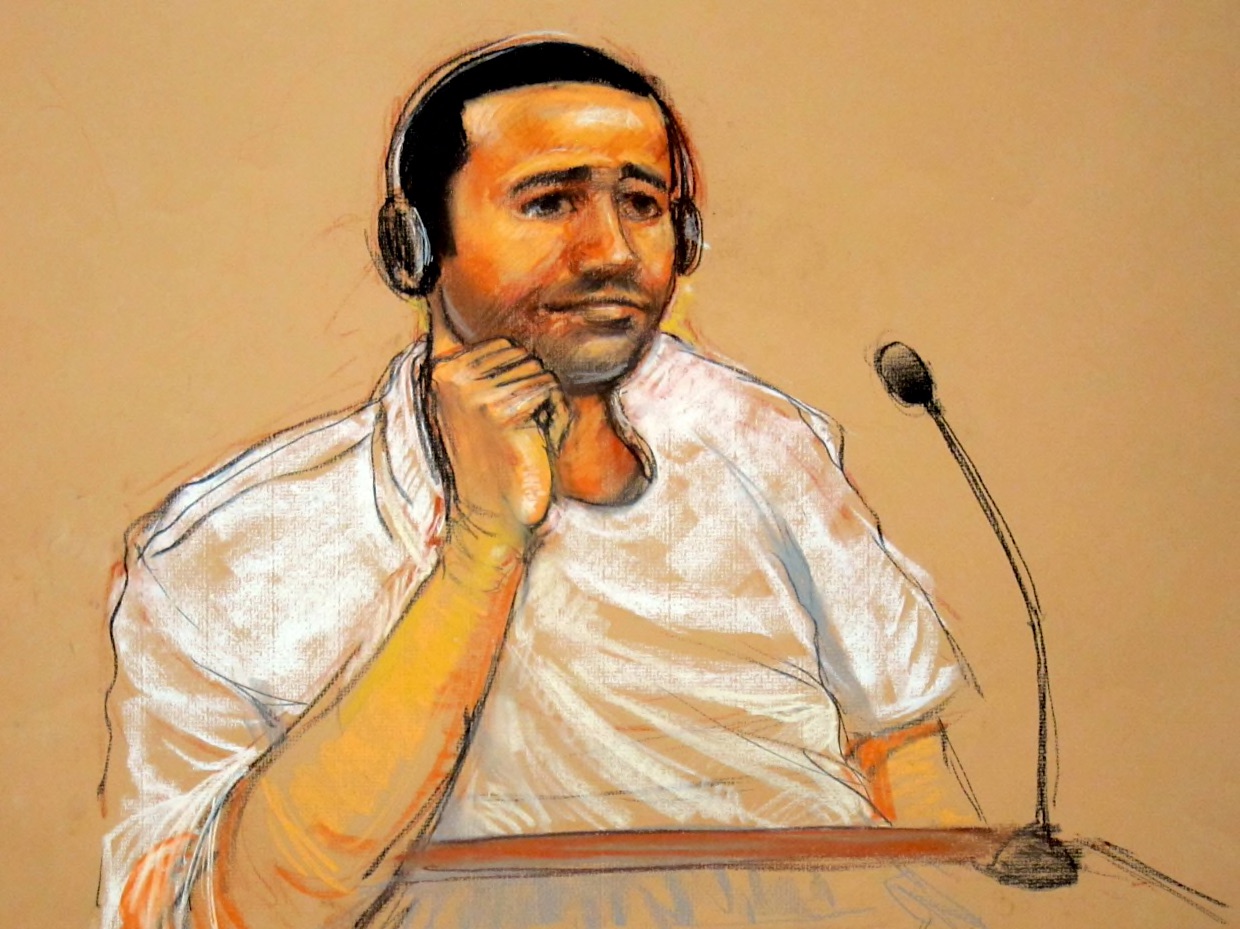
The focus of our half-hour interview was my recent article, Trial Judge Destroys Guantánamo’s Military Commissions, Rules That “Clean Team” Interrogations Cannot Undo the Effects of Torture, about the recent devastating ruling by Col. Lanny Acosta, the trial judge in the military commission pre-trial hearings (now in their 12th year) for Abd al-Rahim al-Nashiri, accused of being the mastermind of the bombing of the USS Cole in 2000, who was held and tortured in CIA “black sites” for nearly four years before his transfer to Guantánamo in September 2006.
Al-Nashiri had made self-incriminating statements under torture, but the government knew that these could not be used in court, and so, four months after his arrival, a so-called “clean team” of interrogators interviewed him non-coercively, apparently securing voluntary self-incriminating statements. It is these statements, however, that Col. Acosta has just ruled inadmissible, because, as he established, the regime of torture and confession in the “black sites” was so enduring that al-Nashiri had essentially been “conditioned” to believe that, if he didn’t tell his interrogators what they wanted to hear, he would inevitably be subjected to horrendous torture.
Video: I Discuss the Collapse of Guantánamo’s Military Commissions on “Unauthorized Disclosure” with Kevin Gosztola and Rania Khalek

Please support my work as a reader-funded journalist! I’m currently trying to raise $2500 (£2000) to support my writing and campaigning on Guantánamo and related issues over the next three months. If you can help, please click on the button below to donate via PayPal.
Many thanks to Kevin Gosztola of Shadowproof and The Dissenter for having me on his most recent “Unauthorized Disclosure” podcast with Rania Khalek to discuss the latest news regarding the prison at Guantánamo Bay.
The 40-minute podcast is entitled, “Nearly 8,000 Days of Injustice at Guantánamo Bay,” which is a helpful reminder of quite how long this wretched place has been open, and a reference to the photo campaign I’ve been running for many years now via the Close Guantánamo website (and its Gitmo Clock subsidiary, which counts in real time how long Guantánamo has been open), encouraging supporters to take photos with posters marking every 100 days of the prison’s existence.
The latest poster was for 7,900 days, on August 28, and you can see all the photos here, while the terrible milestone of 8,000 days takes place on December 6, and I hope you can take a photo with the 8,000 days poster and send it to Close Guantánamo.
Trial Judge Destroys Guantánamo’s Military Commissions, Rules That “Clean Team” Interrogations Cannot Undo the Effects of Torture

Please support my work as a reader-funded journalist! I’m currently trying to raise $2500 (£2000) to support my writing and campaigning on Guantánamo and related issues over the next three months. If you can help, please click on the button below to donate via PayPal.
I wrote the following article for the “Close Guantánamo” website, which I established in January 2012, on the 10th anniversary of the opening of Guantánamo, with the US attorney Tom Wilner. Please join us — just an email address is required to be counted amongst those opposed to the ongoing existence of Guantánamo, and to receive updates of our activities by email.
In an extraordinary 50-page ruling in Guantánamo’s military commissions, Col. Lanny J. Acosta Jr., the judge in the case of Abd al-Rahim al-Nashiri, a Saudi national of Yemeni descent, who is accused of masterminding the terrorist attack on the USS Cole in 2000, in which 17 US sailors died, has refused to allow prosecutors to use self-incriminating statements that al-Nashiri made to a so-called “clean team” of three agents from the FBI, the NCIS and the Air Force Office of Special Investigations on January 31 and February 1 and 2, 2007, five months after he was brought to Guantánamo, having spent nearly four years in CIA “black sites,” where he was subjected to horrendous torture.
At the heart of Col. Acosta’s measured and devastating opinion is an appalled recognition that the extent of al-Nashiri’s torture, and its location with a system designed to break him and to make him entirely dependent on the whims of his interrogators to prevent further torture, made it impossible for him to have delivered any kind of uncoerced self-incriminating statement to the “clean team” who interviewed him in 2007.
To establish this compelling conclusion, Col. Acosta painstakingly pieces together a narrative of al-Nashiri’s torture that tells this brutal story in more agonizing and forensic detail than any previous account has done, drawing largely on the accounts of al-Nashiri’s torture in the revelatory 500-page unclassified summary of the Senate Intelligence Committee’s report about the CIA torture program — technically, the Rendition, Detention, and Interrogation (RDI) program — which was released in December 2014, on the testimony of numerous experts called by the defense team in hearings between July 2022 and June 2023, and on the testimony of James Mitchell and Bruce Jessen, two staff psychologists from the US Air Force SERE school, who were recruited to direct the torture program on the ground.
“Forever Prisoner” Muhammad Rahim, the Last Afghan in Guantánamo, Eloquently Pleads For His Release
Please support my work as a reader-funded journalist! I’m currently trying to raise $2500 (£2000) to support my writing and campaigning on Guantánamo and related issues over the next three months. If you can help, please click on the button below to donate via PayPal.
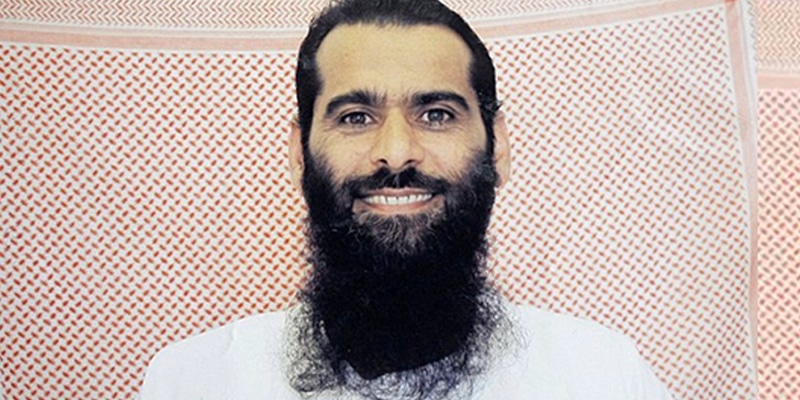
On August 15, completely unremarked on by the mainstream media, Muhammad Rahim, the last Afghan held at Guantánamo, issued a heartfelt and eloquent plea for a panel of military and intelligence officers to approve his release from the prison, where he has been held for over 15 years without charge or trial.
Rahim, who is 57 years old, and in poor health, made his plea at a Periodic Review Board hearing, a process described by the media, when they can be bothered to pay attention to it, as a type of parole hearing — disregarding the crucial aspect that distinguishes it from parole hearings in the federal prison system, where the men given an opportunity to ask for their freedom have been convicted of a crime in federal court, and have received a prison sentence as a result.
Established under President Obama, the Periodic Review Boards were created to review the cases of men regarded as “too dangerous to release,” but against whom insufficient evidence existed to put them on trial — men accurately described as “forever prisoners.” Since November 2013, 58 men have been approved for release by PRBs, with 20 of those decisions taking place since President Biden took office (although most of those 20 men, shamefully, have not yet been freed).
Searching for Justice at Guantánamo: The New Arab Podcast About Abd Al-Rahim Al-Nashiri, Featuring One of His Lawyers, Mansoor Adayfi and Me

Please support my work as a reader-funded journalist! I’m currently trying to raise $2500 (£2000) to support my writing and campaigning on Guantánamo and related issues over the next three months. If you can help, please click on the button below to donate via PayPal.
Many thanks to Nadine Talaat of The New Arab for interviewing me for a new podcast, “Searching for Justice at Guantánamo: Tainted evidence and the fight for accountability,” which you can listen to here.
The particular focus of the half-hour podcast is Abd al-Rahim al-Nashiri, a “high-value detainee,” who was held and tortured for nearly four years in CIA “black sites,” before ending up at Guantánamo in September 2006, where he has been held ever since.
Charged with terrorism-related offences in 2008, which were subsequently dropped, al-Nashiri was charged again in 2012, and has been caught up in pre-trial hearings ever since.
UN Condemns Arbitrary Detention of Guantánamo Prisoner and Torture Victim Abd Al-Rahim Al-Nashiri, and Calls for His Release

Please support my work as a reader-funded journalist! I’m currently trying to raise $2500 (£2000) to support my writing and campaigning on Guantánamo and related issues over the next three months. If you can help, please click on the button below to donate via PayPal.
I wrote the following article for the “Close Guantánamo” website, which I established in January 2012, on the 10th anniversary of the opening of Guantánamo, with the US attorney Tom Wilner. Please join us — just an email address is required to be counted amongst those opposed to the ongoing existence of Guantánamo, and to receive updates of our activities by email.
In a truly devastating opinion, the UN Working Group on Arbitrary Detention has condemned the government of the United States for the arbitrary detention, over the last 20 and a half years, of Abd Al-Rahim Al-Nashiri, a 58-year old Saudi national who was imprisoned and tortured in CIA “black sites” for nearly four years, and who has been held, since September 2006, in the prison at Guantánamo Bay, where he was brought with 13 other men described as “high-value detainees.” He is one of nine men facing charges in the prison’s largely dysfunctional military commission trial system, but, as the Working Group explained, although “pretrial hearings” in his case “began on 17 January 2012,” they “remain ongoing and no trial date has been set,” and, in a conclusion that must have unsettled the Biden administration, they called for his release.
Also implicated in his arbitrary detention are seven other countries — Afghanistan, Lithuania, Morocco, Poland, Romania and Thailand, where he was held in CIA “black sites,” and the United Arab Emirates, where he was first seized, without an arrest warrant, in October 2002, and interrogated for a month by Emirati intelligence operatives before being handed over to the CIA. The bulk of the Working Group’s condemnation of Al-Nashiri’s treatment is, however, focused on the US.
In recent months, the UN, which has always condemned the existence of Guantánamo and the human rights violations committed there, as well as in the CIA’s global network of “black sites,” has stepped up its criticism, issuing, via a number of UN experts, a resounding condemnation of life-threatening medical neglect in the case of Abd Al-Hadi Al-Iraqi, another “high-value detainee” (which I discussed here), and, also via the Working Group on Arbitrary Detention, an opinion in the case of Abu Zubaydah — the “high-value detainee” for whom the CIA’s post-9/11 torture program was developed, in the mistaken belief that the was a high-ranking member of Al-Qaeda — which was so hard-hitting that I described it as “the single most devastating condemnation by an international body that has ever been issued with regard to the US’s detention policies in the ‘war on terror,’ both in CIA ‘black sites’ and at Guantánamo.”
The Broken Old Men of Guantánamo

Please support my work as a reader-funded journalist! I’m currently trying to raise $2500 (£2000) to support my writing and campaigning on Guantánamo and related issues over the next three months. If you can help, please click on the button below to donate via PayPal.
I wrote the following article for the “Close Guantánamo” website, which I established in January 2012, on the 10th anniversary of the opening of Guantánamo, with the US attorney Tom Wilner. Please join us — just an email address is required to be counted amongst those opposed to the ongoing existence of Guantánamo, and to receive updates of our activities by email.
In recent months, an often-submerged story at Guantánamo — of aging torture victims with increasingly complex medical requirements, trapped in a broken justice system, and of the US government’s inability to care for them adequately — has surfaced though a number of reports that are finally shining a light on the darkest aspects of a malignant 21-year experiment that, throughout this whole time, has regularly trawled the darkest recesses of American depravity.
Over the years, those of us who have devoted our energies to getting the prison at Guantánamo Bay closed have tended to focus on getting prisoners never charged with a crime released, because, since the Bush years, when, largely without meeting much resistance, George W. Bush released two-thirds of the 779 men and boys rounded up so haphazardly in the years following the 9/11 attacks and the US-led invasion of Afghanistan, getting prisoners out of Guantánamo has increasingly resembled getting blood out of a stone.
Apart from a brief period from 2008 to 2010, when the law finally reached Guantánamo through habeas corpus (before cynical appeals court judges took it away again), getting out of Guantánamo has involved overcoming government inertia (for several years under Obama) or open hostility (under Trump), repeated administrative review processes characterized by extreme caution regarding prisoners never charged with a crime, and against whom the supposed evidence is, to say the least, flimsy (which led to over 60 men being accurately described by the media as “forever prisoners”), and many dozens of cases in which, when finally approved for release because of this fundamental lack of evidence, the men in question have had to wait (often for years) for new homes to be found for them in third countries.












 Who's still at Guantánamo?
