Gaza As a Death Camp, After 1,000 Days of Genocide
Please click on either of the ‘Donate’ or ‘Buy’ buttons below (via PayPal or Stripe) to make a donation towards the $2,500 (£2,000) I’m trying to raise to support my work as a reader-funded investigative journalist, commentator and activist over the next three months. To get links to all my work in your inbox, please also consider taking out a free or paid subscription to my new Substack newsletter.
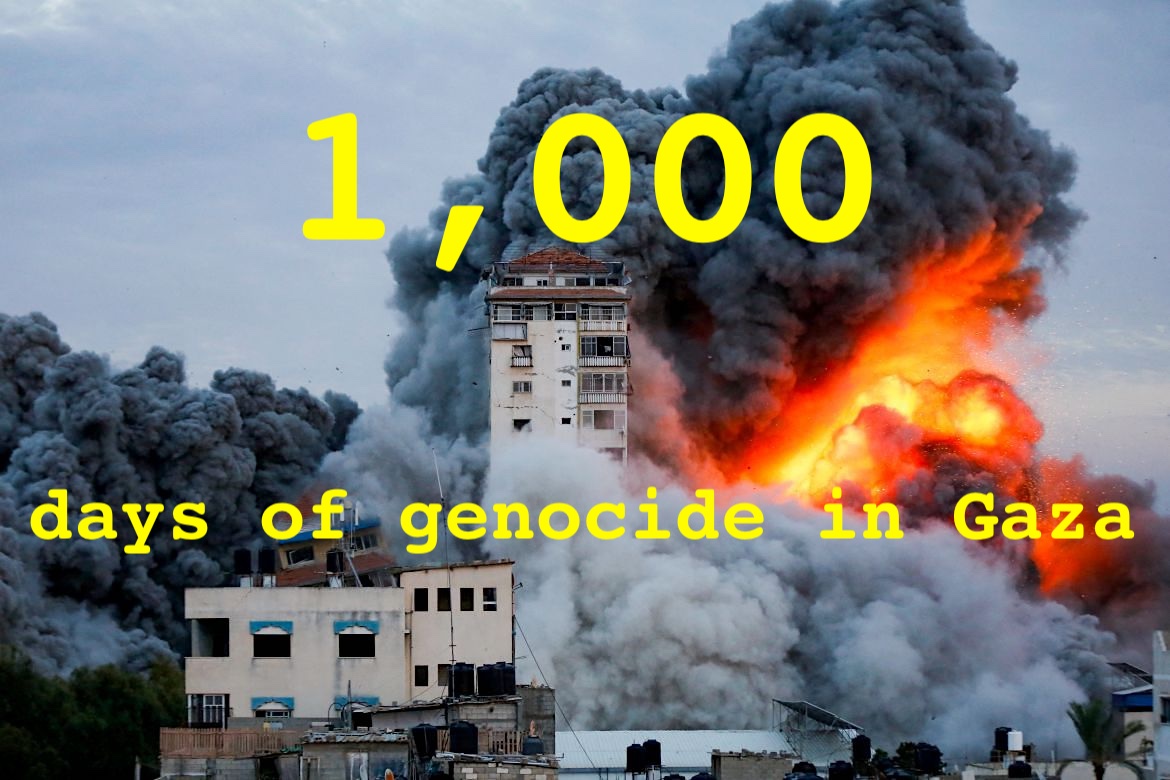
Today marks 1,000 days of Israel’s genocide in the Gaza Strip, in which, at the most conservative estimate, almost a quarter of a million people have been killed or wounded. On June 29, Gaza’s shattered Health Ministry reported that the death toll stood at 73,058, and the numbers of those injured stood at 173,488, many of them gravely so.
These figures are devastating enough, as they constitute a death toll of 73 people every single day over the last 33 months, but they are, without any doubt, a serious undercount. The real death toll is at least double that figure, and maybe more, as I establish in my notes at the end of this article.
In addition, as was revealed last August, an official Israeli military intelligence database, keeping tabs on how many suspected militants had been killed in Gaza, revealed that, according the military’s own figures, only 17% of those killed in Gaza were assessed as having been militants: in other words, 83% were civilians, a figure that, as I discussed in my analysis at the time, could actually be as high as 95%.
Genocide and Israel’s Defense Ministers: From “Human Animals” to “Terror Nests” and Endless Vengeance
Please click on either of the ‘Donate’ or ‘Buy’ buttons below (via PayPal or Stripe) to make a donation towards the $2,500 (£2,000) I’m trying to raise to support my work as a reader-funded investigative journalist, commentator and activist over the next three months. To get links to all my work in your inbox, please also consider taking out a free or paid subscription to my new Substack newsletter.
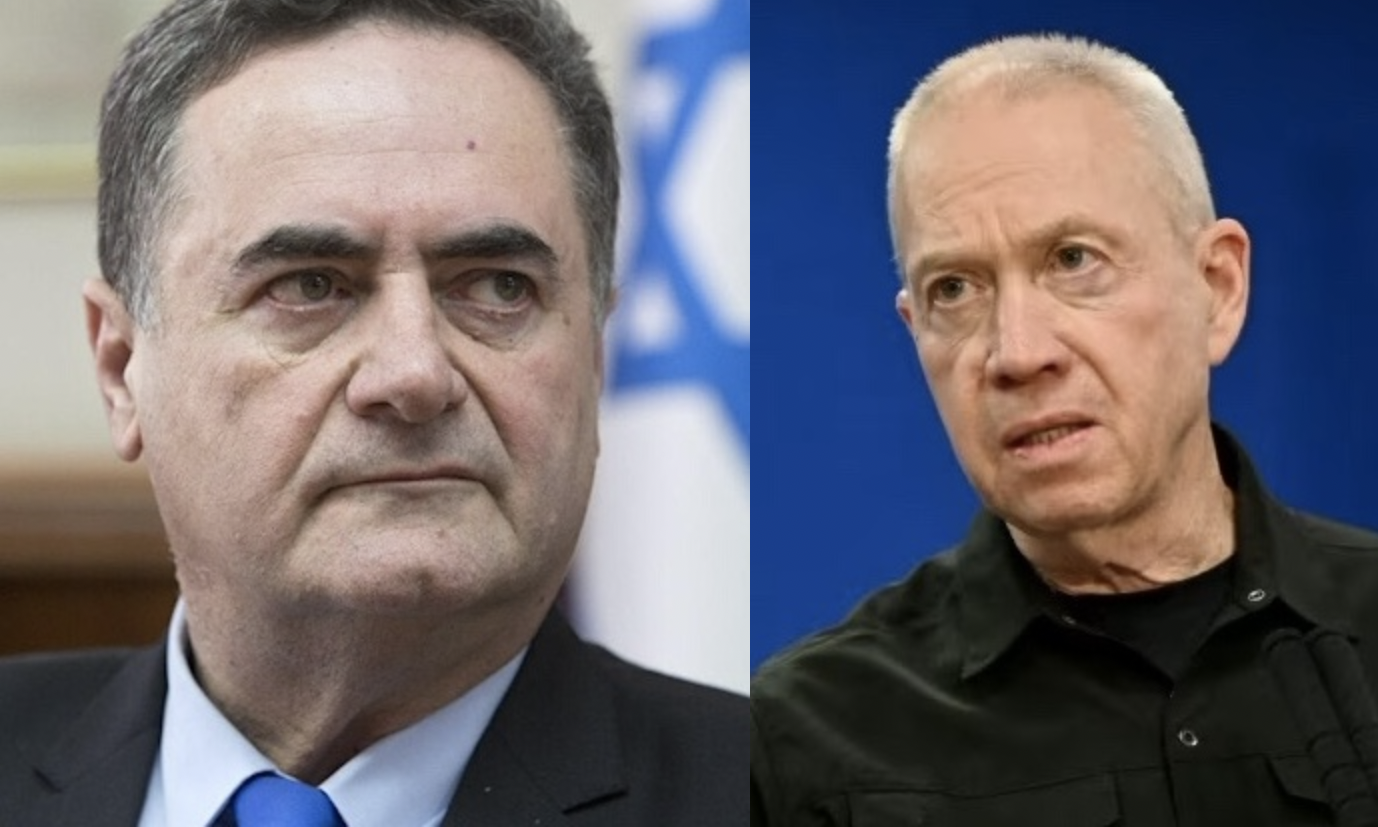
Largely overlooked amongst the grotesque collection of messianic, supremacist enthusiasts for genocide who make up the leadership of the State of Israel — in particular, of course, Prime Minister Benjamin Netanyahu and the two far-right ministers in his coalition government, Itamar Ben-Gvir and Bezalel Smotrich — is the figure of Israel Katz, a longtime “hardliner” and ally of Netanyahu who was appointed as the defense minister in November 2024 after Netanyahu sacked his predecessor Yoav Gallant.
Now 70 years of age, Katz first emerged publicly as a far-right student agitator at the Hebrew University of Jerusalem in the 1980s, opposing what he saw as “Arab students’ campus violence”, when he was suspended for a year for tying the university’s rector, the renowned chemist Raphael Mechoulam, to a chair using a rope. A former solder, whose parents were Holocaust survivors from Romania, he has been a member of the Knesset since 1998, and had held numerous ministerial positions, mostly under Netanyahu, since 2003.
Israel Katz as the epitome of relentless genocidal intent
For the last 18 months, Katz has been the epitome of relentless genocidal intent. In a statement issued after his appointment, he spoke of his intention to secure “victory over our enemies and to achieve the goals of the war: the return of all hostages as the most important moral mission, the destruction of Hamas in Gaza, the defeat of Hezbollah in Lebanon, the containment of Iranian aggression, and the safe return of the residents of the north and south [of Israel] to their homes.”
Israel Approves Lawless Show Trials and Mass Executions for Palestinians Seized on Oct. 7, 2023

Please click on either of the ‘Donate’ or ‘Buy’ buttons below (via PayPal or Stripe) to make a donation towards the $2,500 (£2,000) I’m trying to raise to support my work as a reader-funded investigative journalist, commentator and activist over the next three months. To get links to all my work in your inbox, please also consider taking out a free or paid subscription to my new Substack newsletter.
As the beleaguered International Criminal Court seeks an arrest warrant for Bezalel Smotrich, Itamar Ben-Gvir, in charge of Israel’s torture prisons, and a key driver of legislation approving the death penalty for Palestinians, and establishing a special military tribunal to prosecute and execute those seized on Oct. 7 , 2023, continues to evade accountability.
When the Nazis held the Wannsee Conference on January 1942 to co-ordinate the “Final Solution to the Jewish Question” — the extermination of all the Jews in German-controlled Europe — it was attended by 15 high-level administrators in the relevant government departments, and the SS.
When senior officials in Israel were planning the genocide of the Palestinian people of the Gaza Strip, after October 7, 2023, no single conference was convened to facilitate what it would be appropriate to call Israel’s “Final Solution to the Palestinian Question”, but key officials can be readily identified.
The first two are Prime Minister Benjamin Netanyahu and the former Minister of Defense Yoav Gallant, for whom arrest warrants were issued by the International Criminal Court on November 21, 2024, for war crimes and crimes against humanity — the war crime of starvation as a method of warfare, and the crimes against humanity of murder, persecution, and other inhumane acts.
Israel, the US, the UK and Germany Have Destroyed Human Rights

Please click on either of the ‘Donate’ or ‘Buy’ buttons below (via PayPal or Stripe) to make a donation towards the $2,500 (£2,000) I’m trying to raise to support my work as a reader-funded investigative journalist, commentator and activist over the next three months. To get links to all my work in your inbox, please also consider taking out a free or paid subscription to my new Substack newsletter.
Yesterday, December 10, was Human Rights Day, marking the anniversary of the proclamation and adoption by the United Nations, on December 10, 1948, of the Universal Declaration of Human Rights, a hugely commendable and aspirational template for a better world, in which, to quote from its Preamble, “the equal and inalienable rights of all members of the human family” were recognized as “the foundation of freedom, justice and peace in the world.”
Translated into 577 languages, from Abkhaz to Zulu, the UDHR is, as the UN explains, “the most translated document in the world”, and is “generally agreed to be the foundation of international human rights law”, having “inspired a rich body of legally binding international human rights treaties.”
These include, as I discussed in an article year ago, entitled, Is Hope Still Alive on the Anniversaries of the Genocide and Torture Conventions, and the Universal Declaration of Human Rights?, the Convention against Torture and Other Cruel, Inhuman or Degrading Treatment or Punishment (more generally known as the Torture Convention), which was adopted by the UN General Assembly on December 10, 1984, the 36th anniversary of the UDHR, expanding on Article 5 of the Declaration, which states, unequivocally, “No one shall be subjected to torture or to cruel, inhuman or degrading treatment or punishment.”
UN Report Confirms Genocide in Gaza, But the World Still Shrugs, Even As Israel Erases Gaza City
Please click on either of the ‘Donate’ buttons below (via PayPal or Stripe) to make a donation towards the $2,500 (£2,000) I’m trying to raise to support my work as a reader-funded investigative journalist, commentator and activist over the next three months. To get links to all my work in your inbox, please also consider taking out a free or paid subscription to my new Substack newsletter.
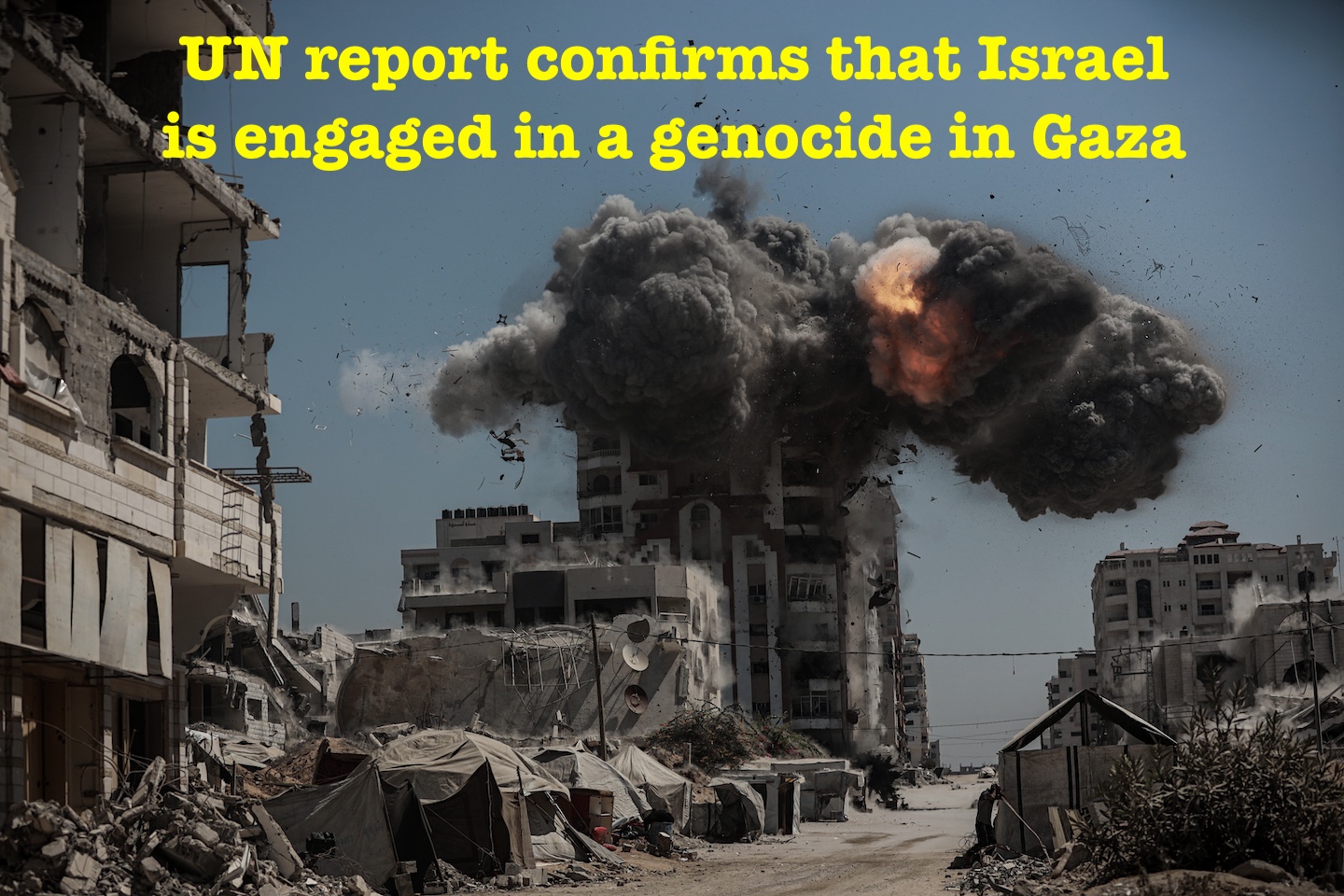
Four days ago, ripples of concern briefly surfaced in the global media, as a UN Commission of Inquiry — the Independent International Commission of Inquiry on the occupied Palestinian territory, including East Jerusalem, and Israel — issued a devastating 72-page report establishing, definitively, that the State of Israel is engaged in a genocide of the Palestinian people in the Gaza Strip, and has been throughout the whole of the last 23 months.
The Commission of Inquiry — chaired by Navi Pillay, who, over the last 30 years has served as a judge on the International Criminal Tribunal dealing with the Rwanda genocide, and at the International Criminal Court, and who was also, from 2008 to 2014, the UN High Commissioner for Human Rights — was established in May 2021 by the UN Human Rights Council to investigate violations of international humanitarian law in the territories illegally occupied by Israel since 1967, and its latest report follows on from other devastating reports over the last year.
One of these was in October last year, focusing on Israel’s exterminatory “war” on Gaza’s hospitals, and its extraordinarily brutal treatment of Palestinians in its prisons, which I wrote about in detail in two articles at the time — UN Report Confirms Israel Guilty of War Crimes and “Extermination” in Attacks on Gaza’s Hospitals and UN Report Condemns Unparalleled Violence, Including Torture, Rape and Murder, in Israel’s Unaccountable Prisons for Palestinians.
It’s Official: UN Declares Catastrophic Famine Conditions in Gaza; Israel Still Denies It

Please click on either of the ‘Donate’ buttons below (via PayPal or Stripe) to make a donation towards the $2,500 (£2,000) I’m trying to raise to support my work as a reader-funded investigative journalist, commentator and activist over the next three months. To get links to all my work in your inbox, please also consider taking out a free or paid subscription to my new Substack newsletter.
Today, in an extraordinary declaration, delivered from Geneva with articulate, controlled fury and indignation, Tom Fletcher, a British diplomat, and, since October last year, the United Nations Under-Secretary-General for Humanitarian Affairs and Emergency Relief Coordinator, confirmed to the world what has been increasingly apparent over the last six months: that the most severe famine conditions are occurring in the Gaza Strip, that this is an “entirely man-made” disaster, deliberately engineered by the State of Israel, and that it can and must be “halted and reversed”, via an immediate ceasefire “to allow humanitarian aid to reach everyone in the Gaza Strip.”
According to the devastating new report by the IPC (the Integrated Food Security Phase Classification), which Fletcher was presenting to the world, 514,000 people, roughly a quarter of Gaza’s surviving population, are experiencing famine, with the number rising to 641,000 by the end of September unless immediate action is taken.
The IPC sets stringent conditions on the evidence required for a famine to be declared. Famine (Phase 5) requires an area to have 20% of households facing an extreme food shortage, 30% of children to be acutely malnourished, and two adult non-trauma deaths or four child non-trauma deaths for every 10,000 people to be taking place every day “due to outright starvation or to the interaction of malnutrition and disease.”
No Return to Genocide As the Gaza Ceasefire Begins and the Extent of Israel’s Policy of Extermination Is Revealed

Please support my work as a reader-funded investigative journalist, commentator and activist. If you can help, please click on the button below to donate via PayPal. Please also consider taking out a free or paid subscription to my new Substack newsletter.
As the ceasefire in Gaza began on the morning of Sunday January 19 (delayed for three hours by Israel, when another 19 Palestinians were killed in last-minute bombing raids), I found myself trying to imagine what it must have felt like to be free, for the first time in 15 months — or, at least, since the six-day “pause” for the exchange of hostages at the end of November 2023 — from the constant threat of death, through the devastating Israeli bombings using weapons of maximum destruction relentlessly replenished by Israel’s ever-obliging allies (the US and Germany, in particular, but with numerous other countries involved), through cynical targeting by IDF snipers, and through the equally cynical targeting by armed quadcopters, a specialty of the Israeli “defense” industry. I also tried to imagine how sweet the silence must have been in the absence of what was, by all accounts, the truly relentless buzzing of drones, spying, monitoring, intimidating, and seeking out targets.
Throughout Sunday, the survivors of what had, until the ceasefire was announced last Wednesday, seemed to be a genocidal assault without end, were finally able to begin returning home — on what, as if by some miracle, was a bright and sunny day, in marked contrast to the freezing torrents of rain to which they had recently been subjected. As they walked from the makeshift tent cities to which most of them (an estimated 1.9 million people in total) had been exiled through expulsion orders, as Israel systematically razed Gaza to the ground, from north to south, over the first eight months of its remorseless destruction, what greeted them was a post-apocalyptic landscape of almost unimaginable annihilation.
While some were able to locate their homes, or what remained of them, others were unable even to find where they used to live, as a result of Israel’s determined efforts to erase their homeland. Almost all, however, were primarily preoccupied with finding the remains of their loved ones, buried under the rubble, or shot in the streets — just one of the many dreadful legacies of this unprecedented, and unprecedentedly long assault on a trapped civilian population in which no one — no one — has survived without losing family members, and in which hundreds of entire extended families have been erased from the civil registry (the same civil registry possessed by the Israelis, who used it to maximize their extermination).
Dare We Hope That the Gaza Ceasefire Deal Will End the Horror of Israel’s Extermination of the Palestinian People?

Please support my work as a reader-funded investigative journalist, commentator and activist. If you can help, please click on the button below to donate via PayPal. Please also consider taking out a free or paid subscription to my new Substack newsletter.
Is it really true? After 470 days of the most grotesque, publicly-celebrated, western-backed atrocities that any of us have ever seen, dare we hope that a durable ceasefire has been agreed that will bring to an end the soul-draining horrors of Israel’s relentless efforts to exterminate the Palestinian population of the Gaza Strip?
On Wednesday (January 15), the Prime Minister of Qatar, Sheikh Mohammed bin Abdulrahman bin Jassim Al Thani, announced the agreement of a ceasefire deal, agreed to by Israel and Hamas, in negotiations involving Qatar, Egypt and the US. President Biden and the President-Elect, Donald Trump, both claimed responsibility for securing the success of the deal, although it was noticeable that the terms of the deal were almost identical to those agreed to by Hamas over eight months ago, on May 6, 2024, which Israel’s Prime Minister, Benjamin Netanyahu, then refused to accept.
This suggests that, despite their protestations, neither Biden nor the US Secretary of State, Antony Blinken, who also rushed to take credit for the deal, had actually done much at all in the intervening eight months, except to be publicly humiliated by Netanyahu, while continuing to send an extraordinary amount of deadly weapons to Israel, indicating that they were prepared to accept humiliation because they continued to unconditionally support Israel’s apparently never-ending hunger for Palestinians’ blood.
Plumbing the Depths of Human Depravity: 450 Days of Extermination in Gaza

Please support my work as a reader-funded investigative journalist, commentator and activist. If you can help, please click on the button below to donate via PayPal. Please also consider taking out a free or paid subscription to my new Substack newsletter.
For 450 days, the State of Israel has been engaged in a sustained policy of vengeance and extermination against the trapped civilian population of the Gaza Strip, a “Holy War” driven by a vile supremacist settler colonial mentality masquerading as the fulfilment of an invented religious entitlement to the Palestinians’ land, involving a giddy and unfettered hatred of the Palestinians as sub-human, and specific revenge for the assault on Israel, on October 7, 2023, in which armed militants who had broken out of the “open-air prison” in which they had been confined for 16 years, went on a killing spree that left 1,068 Israelis and 71 foreign nationals dead, and also kidnapped 251 others.
At the barest minimum, over the last 450 days, hundreds of thousands of Palestinians — mostly civilians — have been killed, or will die, as a result of relentless bombing raids, in which block after block of residential housing, containing almost a quarter of a million homes, has been completely destroyed or damaged, mostly without warning, using bombs of such devastating ferocity that those killed have been torn apart, decapitated, crushed, hurled through the air like broken dolls, or buried alive.
Survivors, meanwhile, have been picked off by snipers, or by armed drones and quadcopters, or have died — and will continue to die — because of a “complete siege” imposed two days after the October 7 attacks, cutting off supplies of food and water, of fuel and of vital medical equipment and supplies. This, accompanied by the almost unimaginably cynical destruction of most of Gaza’s hospitals and health centres, has sentenced to death as yet untold numbers of the elderly, pregnant women, babies and children, those with existing medical conditions, and those with diseases created by the siege, as well as the complete destruction of Gaza’s water and sewage systems.
Is Hope Still Alive on the Anniversaries of the Genocide and Torture Conventions, and the Universal Declaration of Human Rights?

Please support my work as a reader-funded investigative journalist, commentator and activist. If you can help, please click on the button below to donate via PayPal. Please also consider taking out a free or paid subscription to my new Substack newsletter.
For anyone concerned with human rights and international humanitarian law, two dates in 1948 — December 9 and December 10 — are of crucial importance, as these are the dates when the recently-formed United Nations, via its General Assembly, idealistically and optimistically adopted, on December 9, the Convention on the Prevention and Punishment of the Crime of Genocide (the Genocide Convention), and, the day after, adopted and proclaimed the Universal Declaration of Human Rights (UDHR), which established, for the first time, fundamental human rights to be universally protected, and which, as the UN explains, “inspired, and paved the way for, the adoption of more than seventy human rights treaties.” Ever since, December 10 — today — has been known and celebrated as Human Rights Day, while December 9 is marked as the International Day of Commemoration and Dignity of the Victims of the Crime of Genocide and of the Prevention of this Crime.
One of those subsequent treaties is the Convention against Torture and Other Cruel, Inhuman or Degrading Treatment or Punishment (the Torture Convention), which, after decades of wrangling, was finally adopted by the General Assembly on December 10, 1984, the 36th anniversary of the UDHR, expanding on Article 5 of the Declaration, which states, unequivocally, “No one shall be subjected to torture or to cruel, inhuman or degrading treatment or punishment.”
The Genocide Convention, and the long quest for accountability
The Genocide Convention, drawing on the work of the Polish Jewish lawyer Raphael Lemkin, who first coined the term during the Second World War, defines genocide as “any of the following acts committed with intent to destroy, in whole or in part, a national, ethnical, racial or religious group” — “killing members of the group”, “causing serious bodily or mental harm to members of the group”, “deliberately inflicting on the group conditions of life calculated to bring about its physical destruction in whole or in part”, “imposing measures intended to prevent births within the group”, and “forcibly transferring children of the group to another group.”












 Who's still at Guantánamo?
