How Can the Genocidal State of Israel Be Brought to an End?

Please click on either of the ‘Donate’ or ‘Buy’ buttons below (via PayPal or Stripe) to make a donation towards the $2,500 (£2,000) I’m trying to raise to support my work as a reader-funded investigative journalist, commentator and activist over the next three months. To get links to all my work in your inbox, please also consider taking out a free or paid subscription to my new Substack newsletter.
It’s time for me to state something openly that has, to date, only been a sub-text of the 100 or so full-length articles that I’ve written over the last 34 months about the ongoing genocide being undertaken by the State of Israel in the Gaza Strip — that the State of Israel must, definitely, be brought to an end.
It took just over three years and three months from the Nazis’ approval of the “Final Solution to the Jewish Question” at the Wannsee Conference on January 22, 1942, which led to the establishment of extermination camps on an industrial scale, to the destruction of the Nazi regime in May 1945.
It’s now two years and ten months since the new Nazis — the Zionist Israeli regime in Tel Aviv — began its “Final Solution to the Palestinian Question” in the Gaza Strip, and if there were to be any justice in the world, the Israeli regime would be brought to an end before 2027 begins.
We’ve been repeatedly told, for the last 34 months, that we aren’t allowed to make comparisons between the Nazis and Israel, but how can we not?
Gaza As a Death Camp, After 1,000 Days of Genocide
Please click on either of the ‘Donate’ or ‘Buy’ buttons below (via PayPal or Stripe) to make a donation towards the $2,500 (£2,000) I’m trying to raise to support my work as a reader-funded investigative journalist, commentator and activist over the next three months. To get links to all my work in your inbox, please also consider taking out a free or paid subscription to my new Substack newsletter.
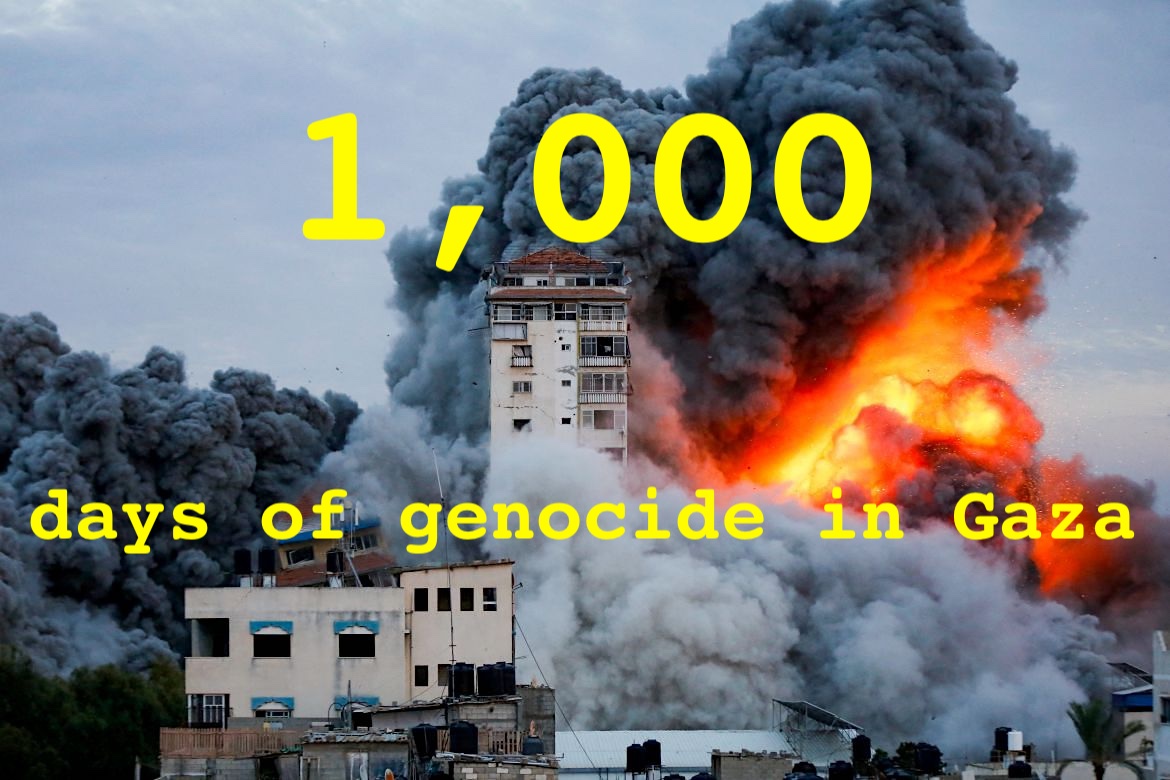
Today marks 1,000 days of Israel’s genocide in the Gaza Strip, in which, at the most conservative estimate, almost a quarter of a million people have been killed or wounded. On June 29, Gaza’s shattered Health Ministry reported that the death toll stood at 73,058, and the numbers of those injured stood at 173,488, many of them gravely so.
These figures are devastating enough, as they constitute a death toll of 73 people every single day over the last 33 months, but they are, without any doubt, a serious undercount. The real death toll is at least double that figure, and maybe more, as I establish in my notes at the end of this article.
In addition, as was revealed last August, an official Israeli military intelligence database, keeping tabs on how many suspected militants had been killed in Gaza, revealed that, according the military’s own figures, only 17% of those killed in Gaza were assessed as having been militants: in other words, 83% were civilians, a figure that, as I discussed in my analysis at the time, could actually be as high as 95%.
Humanity’s Greatest Failure: Turning Genocide in Gaza into a Spectator Sport
Please support my work as a reader-funded investigative journalist, commentator and activist. If you can help, please click on the button below to donate via PayPal.
In Gaza, the world is watching a genocide play out in real time, like a vast public spectacle, or, to provide a more current analogy, like the most gruesome reality show.
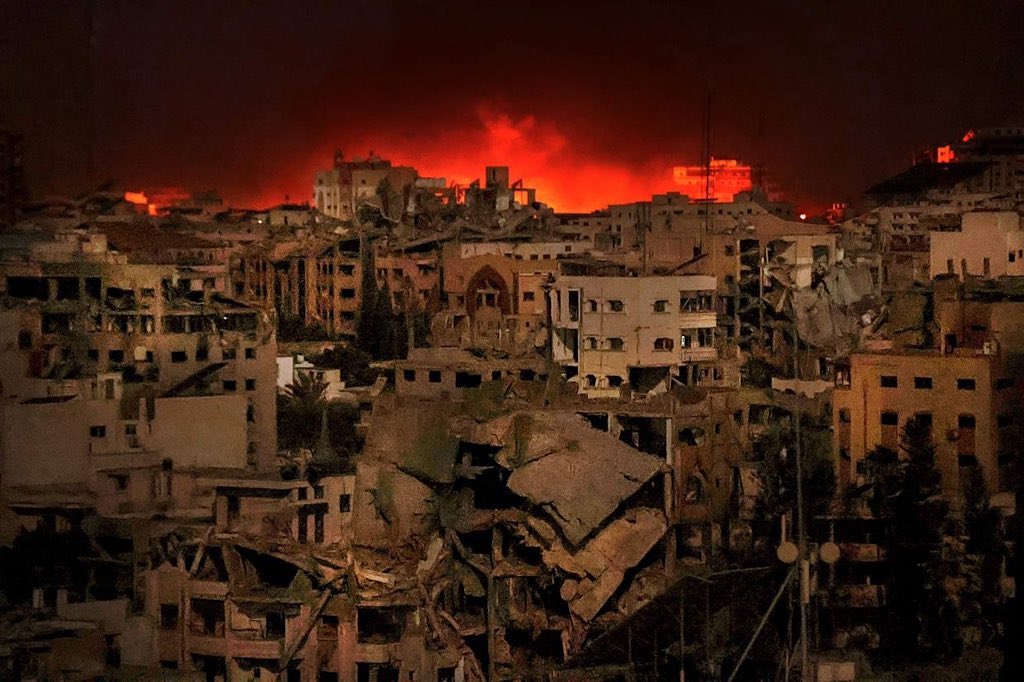
Over the last month, as the State of Israel has relentlessly bombed the 2.3 million civilians trapped in the “open air prison” of the Gaza Strip, killing over 10,000 people, including over 4,000 children, the world has watched as, via its mainstream media, neighbourhood after neighbourhood has been destroyed and the dead bodies of children and adults are dragged out of the wreckage, with barely a whisper of official dissent.
Political leaders in the west openly support it, news readers talk blandly of those who have died, as though it was some sort of unfortunate but natural occurrence, generally refusing to acknowledge that they have actually been killed, and almost always refusing to name the perpetrators, while armchair genocide supporters, in significant numbers, cheer it on via social media.
Rarely reported are the additional uncomfortable truths that, although voices from within Gaza regularly state that “nowhere in Gaza is safe”, they are unable to leave, even if they wanted to, because Israel has controlled all entry to and exit from the Gaza Strip since 2007, and they are also subjected to a “complete siege”, as promised by the defence minister Yoav Gallant on October 8, whereby supplies of water, food, fuel and medical supplies have been cut off.
Please Listen to Benjamin Ferencz, the Last Nuremberg Prosecutor, Explain His Implacable Opposition to War
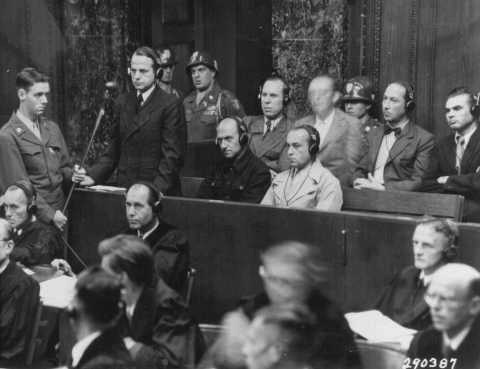 So the sabre-rattling in the West has begun yet again, cruelly and idiotically calling for more bombing in Syria, one of the most devastated countries in the world, in response to the recent terrorist attacks in Paris — even though the terrorists were European citizens, and even though the ongoing war in Syria has, to date, created a refugee crisis unprecedented in modern history. In response, I’m hoping that anyone interested in peace — and in understanding the true horrors of war — will find the time to listen to a profoundly enlightening interview I came across by chance last Friday, on the 70th anniversary of the day the Nuremberg trials began.
On BBC Radio 4, the PM programme interviewed Benjamin Ferencz, 95, the last surviving prosecutor from the trials, who was just 27 years old when, in 1947, he became the Chief Prosecutor in the ninth of the twelve Nuremberg trials, of 24 officers of the Einsatzgruppen, mobile SS death squads, who operated behind the front line in Nazi-occupied eastern Europe. and who, from 1941 to 1943 alone, murdered more than one million Jews and tens of thousands of other people, including gypsies and the disabled.
Ferencz’s testimony about what he witnessed at the liberation of the Nazis’ death camps, and his experience of the trials — and his subsequent conviction that he had to devote his life to peace — ought to be required listening for everyone, from our politicians to every single one of our fellow citizens. Read the rest of this entry »












 Who's still at Guantánamo?
